
Identities of Inverse Operations
Trigonometry · Learn by Concept
Help Questions
Trigonometry › Identities of Inverse Operations
Simplify using identities. Leave no fractions in your answer.



Explanation
The easiest first step is to simplify our inverse identities:

Cross cancelling, we end up with

Finally, eliminate the fraction:

Thus,

Simplify each expression below. Your answer should have (at most) one trigonometric function and no fractions.
1.


Explanation
Using the quotient identities for trig functions, you can rewrite,
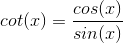
and
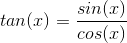
Then the fraction becomes
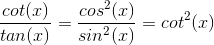
Simplify each expression below. Your answer should have (at most) one trigonometric function and no fractions.





Explanation
Use the Pythagorean Identities:

and

Thus the expression becomes,

Simplify each expression below. Your answer should have (at most) one trigonometric function and no fractions.



Explanation
Use the distributive property (FOIL method) to simplify the expression.



Using Pythagorean Identities:

Simplify each expression below. Your answer should have (at most) one trigonometric function and no fractions.



Explanation
First, simplify the first term in the expression to 1 because of the Pythagorean Identity.

Then, simplify the second term to

This reduces to

The expression is now,

Distribute the negative and get,

Solve each question over the interval


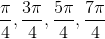


Explanation
Divide both sides by 

Take the square root of both sides to get that 

The angles for which this is true (this is taking the arctan) are every angle when 

These angles are all the multiples of 


Explanation
Let's look at these individually:


This leaves two - and we can tell which of these does not work using the fact that 
