
Trigonometric Identities - Trigonometry
Card 1 of 376

Which of the following is equivalent to the function above.
Which of the following is equivalent to the function above.
Tap to reveal answer
The cosine graph at zero has a peak at 1.
The first peak in the sine curve is at π/2, so you adjust the cosine with a -π/2 and that gives the answer 
The cosine graph at zero has a peak at 1.
The first peak in the sine curve is at π/2, so you adjust the cosine with a -π/2 and that gives the answer
← Didn't Know|Knew It →
Which of those below is equivalent to  ?
?
Which of those below is equivalent to
Tap to reveal answer
Think of a right triangle. The two non-right angles are complementary since the angles in a triangle add up to 180. As a result, when we apply the definitions of sine and cosine, we get that the sine of one of these angles is equivalent to the cosine of the other. As a result, the sine of one angle is equal to the cosine of its complement and vice versa.
Therefore, when we look at the angles of a right triangle that includes a 60 degree angle we get
 .
.
Thus the 
Think of a right triangle. The two non-right angles are complementary since the angles in a triangle add up to 180. As a result, when we apply the definitions of sine and cosine, we get that the sine of one of these angles is equivalent to the cosine of the other. As a result, the sine of one angle is equal to the cosine of its complement and vice versa.
Therefore, when we look at the angles of a right triangle that includes a 60 degree angle we get
Thus the
← Didn't Know|Knew It →
Given that  , which of the following must also be true?
Given that
Tap to reveal answer
The supplementary angle identity states that in the positive quadrants, if two angles are supplementary (add to 180 degrees), they must have the same sine. In other words,
if  , then
Using this, we can see that

Thus, if  , then
  also.
also.
The supplementary angle identity states that in the positive quadrants, if two angles are supplementary (add to 180 degrees), they must have the same sine. In other words,
if
Using this, we can see that
Thus, if
← Didn't Know|Knew It →
Which of the following is equivalent to  ?
?
Which of the following is equivalent to
Tap to reveal answer
Recall that the cosine and sine of complementary angles are equal.
Thus, we are looking for the complement of 70, which gives us 20.
When we take the cosine of this, we will get an equivalent statement.
Recall that the cosine and sine of complementary angles are equal.
Thus, we are looking for the complement of 70, which gives us 20.
When we take the cosine of this, we will get an equivalent statement.
← Didn't Know|Knew It →
Simplify the following expression:

Simplify the following expression:
Tap to reveal answer
Simplifying this expression relies on an understanding of the cofunction identities. The cofunction identities hinge on the fact that the value of a trig function of a particular angle is equal to the value of the cofunction of the the complement of that angle. In other words,






That means that returning to our initial expression, we can do some substiution.
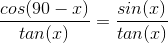
We then turn to another identity, namely the fact that tangent is just the quotient of sine and cosine.
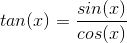
We can substitute again
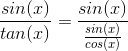
Yet dividing by a fraction is the same as multipying by the reciprocal.

With some cancellation, we have arrived at our answer.
Simplifying this expression relies on an understanding of the cofunction identities. The cofunction identities hinge on the fact that the value of a trig function of a particular angle is equal to the value of the cofunction of the the complement of that angle. In other words,
That means that returning to our initial expression, we can do some substiution.
We then turn to another identity, namely the fact that tangent is just the quotient of sine and cosine.
We can substitute again
Yet dividing by a fraction is the same as multipying by the reciprocal.
With some cancellation, we have arrived at our answer.
← Didn't Know|Knew It →
Which one is equal to 
Which one is equal to
Tap to reveal answer
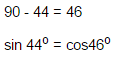
Complementary angles are equal to one's  to others
Complementary angles are equal to one's
← Didn't Know|Knew It →
Find  without using a calculator.
Find
Tap to reveal answer
To answer this question, use the sum formula for sine:


To answer this question, use the sum formula for sine:
← Didn't Know|Knew It →
Simplify the following expression using trigonometric identities:

Simplify the following expression using trigonometric identities:
Tap to reveal answer
In order to simplify the given equation we should first try to determine if the Pythagorean Theorem as applicable to trigonomety can be utilized. We do this first due to the higher degree of the functions involved. We can notice that if we group the higher order sine and the higher order cosine, that we can in fact pull out some common terms:

Now we notice that we can further group the terms:

The first term in the previous equation is in fact the Pythagorean Theorem as applied to trigonometry and the second term is the sum of two angles with respect to the sine function:

This reduced simply to the sum function for sine:

In order to simplify the given equation we should first try to determine if the Pythagorean Theorem as applicable to trigonomety can be utilized. We do this first due to the higher degree of the functions involved. We can notice that if we group the higher order sine and the higher order cosine, that we can in fact pull out some common terms:
Now we notice that we can further group the terms:
The first term in the previous equation is in fact the Pythagorean Theorem as applied to trigonometry and the second term is the sum of two angles with respect to the sine function:
This reduced simply to the sum function for sine:
← Didn't Know|Knew It →
Without the aide of a calculator, compute the exact value of 
Without the aide of a calculator, compute the exact value of
Tap to reveal answer
In order to determine an exact value we want to split up the angle into angles which we can determine the exact value; these are multiples of  ,
,  ,
,  ,
,  , and
, and  . Since the given angle has a 12 in the denominator we must have two fractions which can be found to have a common denominator of 12, the pairs are 3 and 4 or 2 and 6. We can write an algebraic equation which must hold to assist us in determining these values:

Where  and
and  are integers. If we work to get a common denominator of 12:

We can now reduce the equation to obtain a simpler form:

Using this equation it is simple to see that  and
and  and the operation is addition. Therefore rewriting the equation:

Where we have simply reduced the fractions to their lowest terms. Now that we have the sum of two known angles we can simply continue and write out the appropriate formula:

We know the values of the corresponding angles and we must note the quadrant the angle is in, here we are in the first quadrant for both angles which means that all values are positive.

This reduces to:

In order to determine an exact value we want to split up the angle into angles which we can determine the exact value; these are multiples of
Where
We can now reduce the equation to obtain a simpler form:
Using this equation it is simple to see that
Where we have simply reduced the fractions to their lowest terms. Now that we have the sum of two known angles we can simply continue and write out the appropriate formula:
We know the values of the corresponding angles and we must note the quadrant the angle is in, here we are in the first quadrant for both angles which means that all values are positive.
This reduces to:
← Didn't Know|Knew It →
Without the aide of a calculator, compute the exact value of 
Without the aide of a calculator, compute the exact value of
Tap to reveal answer
In order to determine an exact value we want to split up the angle into angles which we can determine the exact value; these are multiples of  ,
,  ,
,  ,
,  , and
, and  . Since the given angle has a 12 in the denominator we must have two fractions which can be found to have a common denominator of 12, the pairs are 3 and 4 or 2 and 6. We can write an algebraic equation which must hold to assist us in determining these values:

Where  and
and  are integers. If we work to get a common denominator of 12:

We can now reduce the equation to obtain a simpler form:

Using this equation it is simple to see that  and
and  and the operation is subtraction. Therefore rewriting the equation:

Where we have simply reduced the fractions to their lowest terms. Now that we have the sum of two known angles we can simply continue and write out the appropriate formula:

We know the values of the corresponding angles and we must note the quadrant the angle is in, here we are in the first quadrant for both angles which means that all values are positive.

This reduces to:

In order to determine an exact value we want to split up the angle into angles which we can determine the exact value; these are multiples of
Where
We can now reduce the equation to obtain a simpler form:
Using this equation it is simple to see that
Where we have simply reduced the fractions to their lowest terms. Now that we have the sum of two known angles we can simply continue and write out the appropriate formula:
We know the values of the corresponding angles and we must note the quadrant the angle is in, here we are in the first quadrant for both angles which means that all values are positive.
This reduces to:
← Didn't Know|Knew It →
Without the aide of a calculator, compute the exact value of 
Without the aide of a calculator, compute the exact value of
Tap to reveal answer
In order to determine an exact value we want to split up the angle into angles which we can determine the exact value; these are multiples of  ,
,  ,
,  ,
,  , and
, and  . Since the given angle has a 12 in the denominator we must have two fractions which can be found to have a common denominator of 12, the pairs are 3 and 4 or 2 and 6. We can write an algebraic equation which must hold to assist us in determining these values:

Where  and
and  are integers. If we work to get a common denominator of 12:

We can now reduce the equation to obtain a simpler form:

Using this equation we actually need to flip the fractions as follows:

Now we can get the right values of;  and
and  and the operation is subtraction. Therefore rewriting the equation:

Where we have simply reduced the fractions to their lowest terms. Now that we have the sum of two known angles we can simply continue and write out the appropriate formula:

We know the values of the corresponding angles and we must note the quadrant the angle is in, here we are in the first quadrant for angle A which means that all values are positive and the second angle, B, we are in the second quadrant so sine is positive and all other functions are negative.

This reduces to:

Finally, we obtain the solution:

In order to determine an exact value we want to split up the angle into angles which we can determine the exact value; these are multiples of
Where
We can now reduce the equation to obtain a simpler form:
Using this equation we actually need to flip the fractions as follows:
Now we can get the right values of;
Where we have simply reduced the fractions to their lowest terms. Now that we have the sum of two known angles we can simply continue and write out the appropriate formula:
We know the values of the corresponding angles and we must note the quadrant the angle is in, here we are in the first quadrant for angle A which means that all values are positive and the second angle, B, we are in the second quadrant so sine is positive and all other functions are negative.
This reduces to:
Finally, we obtain the solution:
← Didn't Know|Knew It →
What is the phase shift of  ?
?
What is the phase shift of
Tap to reveal answer
The key here is to use this sum/product identity:

In this case,  and
and  . Note as well that because
  subtracts, it will translate into
  . So using the identity, we can state
  as...
as...

Bear in mind that for a sine function of form

...our phase shift is equal to...

The key here is to use this sum/product identity:
In this case,
Bear in mind that for a sine function of form
...our phase shift is equal to...
← Didn't Know|Knew It →
If  , then calculate
  .
.
If
Tap to reveal answer
Because  , we can use the half-angle formula for cosines to determine
  .
.
In general,

for  .
.
For this problem,


Hence,

Because
In general,
for
For this problem,
Hence,
← Didn't Know|Knew It →
Find  if
if  and
and  .
.
Find
Tap to reveal answer
The double-angle identity for sine is written as

and we know that

Using  , we see that
  , which gives us

Since we know  is between
  and
and  , sin
, sin  is negative, so
  . Thus,
 .
.
Finally, substituting into our double-angle identity, we get

The double-angle identity for sine is written as
and we know that
Using
Since we know
Finally, substituting into our double-angle identity, we get
← Didn't Know|Knew It →
Find the exact value of  using an appropriate half-angle identity.
Find the exact value of
Tap to reveal answer
The half-angle identity for sine is:

If our half-angle is  , then our full angle is
  . Thus,

The exact value of  is expressed as
  , so we have

Simplify under the outer radical and we get

Now simplify the denominator and get

Since  is in the first quadrant, we know sin is positive. So,

The half-angle identity for sine is:
If our half-angle is
The exact value of
Simplify under the outer radical and we get
Now simplify the denominator and get
Since
← Didn't Know|Knew It →
Which of the following best represents  ?
?
Which of the following best represents
Tap to reveal answer
Write the half angle identity for cosine.

Replace theta with two theta.

Therefore:

Write the half angle identity for cosine.
Replace theta with two theta.
Therefore:
← Didn't Know|Knew It →
What is the amplitude of  ?
?
What is the amplitude of
Tap to reveal answer
The key here is to use the half-angle identity for  to convert it and make it much easier to work with.

In this case,  , so therefore...

Consequently,  has an amplitude of
  .
.
The key here is to use the half-angle identity for
In this case,
Consequently,
← Didn't Know|Knew It →
What is  ?
?
What is
Tap to reveal answer
Let  ; then
 .
.
We'll use the half-angle formula to evaluate this expression.

Now we'll substitute  for
for  .
.

 is in the first quadrant, so
  is positive. So
 .
.
Let
We'll use the half-angle formula to evaluate this expression.
Now we'll substitute
← Didn't Know|Knew It →
What is  , given that
  and
and  are well defined values?
What is
Tap to reveal answer
Using the half angle formula for tangent,
 ,
,
we plug in 30 for  .
.
We also know from the unit circle that  is
is  and
and  is
is  .
.
Plug all values into the equation, and you will get the correct answer.

Using the half angle formula for tangent,
we plug in 30 for
We also know from the unit circle that
Plug all values into the equation, and you will get the correct answer.
← Didn't Know|Knew It →
Simplify  .
.
Simplify
Tap to reveal answer
Recognize that  is a reworking on
  , meaning that
  .
.
Plug that in to our given equation:

Notice that one of the  's cancel out.
 .
.
Recognize that
Plug that in to our given equation:
Notice that one of the
← Didn't Know|Knew It →