
Solving Trigonometric Equations - Trigonometry
Card 1 of 264
Solve for  :
: 
Solve for
Tap to reveal answer
There are multiple solution paths. We could subtract 1 from both sides and use the quadratic formula with  and
and  . Or we could solve using inverse opperations:
 divide both sides by 2
 take the square root of both sides

The unit circle tells us that potential solutions for  are
are  .
.
To get our final solution set, divide each by 3, giving:
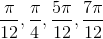 .
.
There are multiple solution paths. We could subtract 1 from both sides and use the quadratic formula with
The unit circle tells us that potential solutions for
To get our final solution set, divide each by 3, giving:
← Didn't Know|Knew It →
Solve for  :
: 
Solve for
Tap to reveal answer
This problem has multiple solution paths, including subtracting 5 from both sides and using the quadratic formula with  . We can also solve using inverse opperations:
 subtract 2 from both sides
 divide both sides by 4
 take the square root of both sides

If the sine of an angle is  , that angle must be one of
  . Since the angle is
  , we can get theta by subtracting
  :
:


This problem has multiple solution paths, including subtracting 5 from both sides and using the quadratic formula with
If the sine of an angle is
← Didn't Know|Knew It →
Solve the following equation for  .
.

Solve the following equation for
Tap to reveal answer
 ; We start by substituting a new variable. Let
  .
.
 ; Use the double angle identity for cosine
 ; the 1's cancel, so add
  to both sides
 ; factor out a
  from both terms.
 ; set each expression equal to 0.
 or
or  ; solve the second equation for sin u.
 or
or  ; take the inverse sine to solve for u (use a unit circle diagram or a calculator)
 ; multiply everything by 2 to solve for x.
 ; Notice that the last two solutions are not within our range
  . So the only solution is
  .
.
← Didn't Know|Knew It →
Solve the equation below for  greater than or equal to
  and strictly less than
  .
.

Solve the equation below for
Tap to reveal answer
Recall the values of  for which
  . If it helps, think of sine as the
  values on the unit circle. Thus, the acceptable values of
  would be 0, 180, 360, 540 etc.. However, in our scenario
  .
.
Thus we have  and
and  .
.
Any other answer would give us values greater than 90. When we divide by 4, we get our answers,
 and
and  .
.
Recall the values of
Thus we have
Any other answer would give us values greater than 90. When we divide by 4, we get our answers,
← Didn't Know|Knew It →

Find the three smallest positive roots of the above equation.
Find the three smallest positive roots of the above equation.
Tap to reveal answer
By the double angle identity, we can find


So to get the zeros, solve:

This means that any number that when doubled equals a multiple of 180 degrees is a zero. In this case that includes

But the question asks for the smallest positive roots which excludes the negative and zero roots, leaving 90, 180, 270
By the double angle identity, we can find
So to get the zeros, solve:
This means that any number that when doubled equals a multiple of 180 degrees is a zero. In this case that includes
But the question asks for the smallest positive roots which excludes the negative and zero roots, leaving 90, 180, 270
← Didn't Know|Knew It →
Which of the following is NOT a solution to the equation below such that  ?
?

Which of the following is NOT a solution to the equation below such that
Tap to reveal answer
Given the multiple choice nature of the problem, the easiest way to solve would be to simply plug in each answer and find the one that does not work.
However, we want to learn the math within the problem. We begin solving the equation by factoring

We then divide.

We then must remember that our left side is equivalent to something simpler.

We can therefore substitute.

We then must consider the angles whose cosine is  . The two angles within the first revolution of the unit circle are
  and
and  , but since our angle is
  , we need to consider the second revolution, which also gives us
  and
and  .
.
But since  is equal to each of these angles, we must divide them by 2 to find our answers. Therefore, we have

Therefore, there is only one answer choice that does not belong.
Given the multiple choice nature of the problem, the easiest way to solve would be to simply plug in each answer and find the one that does not work.
However, we want to learn the math within the problem. We begin solving the equation by factoring
We then divide.
We then must remember that our left side is equivalent to something simpler.
We can therefore substitute.
We then must consider the angles whose cosine is
But since
Therefore, there is only one answer choice that does not belong.
← Didn't Know|Knew It →
Which of the following is a solution to the following equation such that 

Which of the following is a solution to the following equation such that
Tap to reveal answer
We begin by getting the right side of the equation to equal zero.

Next we factor.

We then set each factor equal to zero and solve.
 or
or 


We then determine the angles that satisfy each solution within one revolution.
The angles  and
and  satisfy the first, and
  satisfies the second. Only
  is among our answer choices.
We begin by getting the right side of the equation to equal zero.
Next we factor.
We then set each factor equal to zero and solve.
We then determine the angles that satisfy each solution within one revolution.
The angles
← Didn't Know|Knew It →
Solve the following equation. Find all solutions such that  .
.

Solve the following equation. Find all solutions such that
Tap to reveal answer
 ; Divide both sides by 2 to get
 ; take the inverse sine on both sides
 ; the left side reduces to x, so

At this point, either use a unit circle diagram or a calculator to find the value.
Keep in mind that the problem asks for all solutions between  and
and  .
.
If you use a calculator, you will only get  as an answer.
So we need to find another angle that satisfies the equation  .
.

At this point, either use a unit circle diagram or a calculator to find the value.
Keep in mind that the problem asks for all solutions between
If you use a calculator, you will only get
So we need to find another angle that satisfies the equation
← Didn't Know|Knew It →
Solve the following equation. Find all solutions such that  .
.

Solve the following equation. Find all solutions such that
Tap to reveal answer
 ; First use the double angle identity for
  .
.
 ; divide both sides by 2
 ; subtract the
  from both sides
 ; factor out the
 ; Now we have the product of two expressions is 0. This can only happen if one (or both) expressions are equal to 0. So let each expression equal 0.
 or
or  ;
;
 or
or  ; Take the inverse of each function for each expression.
 or
or  ; The second equation is not possible so gives no solution, but the first equation gives us:

← Didn't Know|Knew It →
Solve the following equation for  .
.

Solve the following equation for
Tap to reveal answer
The fastest way to solve this problem is to substitute a new variable. Let  .
.
The equation now becomes:

So at what angles are the sine and cosine functions equal. This occurs at

You may be wondering, "Why did you include
 if they're not between
  and
and  ?"
?"
The reason is because once we substitute back the original variable, we will have to divide by 2. This dividing by 2 will bring the last two answers within our range.

Dividing each answer by 2 gives us

The fastest way to solve this problem is to substitute a new variable. Let
The equation now becomes:
So at what angles are the sine and cosine functions equal. This occurs at
You may be wondering, "Why did you include
The reason is because once we substitute back the original variable, we will have to divide by 2. This dividing by 2 will bring the last two answers within our range.
Dividing each answer by 2 gives us
← Didn't Know|Knew It →
Solve the equation for  .
.

Solve the equation for
Tap to reveal answer
We begin by substituting a new variable  .
.
 ; Use the double angle identity for
  .
.
 ; subtract the
  from both sides.
 ; This expression can be factored.
 ; set each expression equal to 0.
 or
or  ; solve each equation for
 or
or  ; Since we sustituted a new variable we can see that if
  , then we must have
  . Since
  , that means
  .
.
This is important information because it tells us that when we solve both equations for u, our answers can go all the way up to  not just
  .
.
So we get
 Divide everything by 2 to get our final solutions

We begin by substituting a new variable
This is important information because it tells us that when we solve both equations for u, our answers can go all the way up to
So we get
← Didn't Know|Knew It →
Solve the following equation for  .
.

Solve the following equation for
Tap to reveal answer
 ; First divide both sides of the equation by 4
 ; Next take the square root on both sides. Be careful. Remember that when YOU take a square root to solve an equation, the answer could be positive or negative. (If the square root was already a part of the equation, it usually only requires the positive square root. For example, the solutions to
  are 2 and -2, but if we plug in 4 into the function
  the answer is only 2.) So,
 ; we can separate this into two equations
 and
and  ; we get
 and
and 
← Didn't Know|Knew It →
Solve the equation for  .
.

Solve the equation for
Tap to reveal answer
 ; Divide both sides by 3
 ; Take the square root on both sides. Just as the previous question, when you take a square root the answer could be positive or negative.
 ; This can be written as two separate equations
 and
and  ; Take the inverse tangent
 and
and 
← Didn't Know|Knew It →
Solve the following equation for  .
.

Solve the following equation for
Tap to reveal answer
 ; The expression is similar to a quadratic expression and can be factored.
 ; set both expressions equal to 0. Since they are the same, the solutions will repeat, so I will only write it once.

 ; take the inverse tangent on both sides


← Didn't Know|Knew It →
Solve the following equation for  .
.

Solve the following equation for
Tap to reveal answer
 ; use the double angle identity for cosine
 ; distribute the 3 on the right side
 ; add the
  to both sides
 ; divide both sides by 8
 ; take the square root on both sides (Remember: it could be positive or negative)
 ; separate into two equations and take the inverse sine
 and
and  ; Use a calculator
 and
and  (calculator will give -0.659, but that is not in our range, so add
  to get 5.624)
The last two solutions are found using a unit circle. Since our x can be negative or positive this means that there is a corresponding value in all of the quadrants.

Similarly, we can get our last answer x= 3.801 as this is the x value in the third quadrant and is found by adding  .
.
The last two solutions are found using a unit circle. Since our x can be negative or positive this means that there is a corresponding value in all of the quadrants.
Similarly, we can get our last answer x= 3.801 as this is the x value in the third quadrant and is found by adding
← Didn't Know|Knew It →
The equation  represents the motion of a weight hanging on a spring after it has been pulled 6 inches below its equilibrium point and released. The variable
  represents the weight's position above or below the equilibrium point. For example,
  means the weight is 5 inches below its equilibrium point.
  means the weight is 5 inches above its equilibrium point. The variable
  represents the time, in seconds, after the weight was released.
Find the first 2 times the weight is 3 inches below its equilibrium point.
The equation
Find the first 2 times the weight is 3 inches below its equilibrium point.
Tap to reveal answer
You are asked to find the first TWO times the the weight is 3 inches below its equilibrium point. Since it is below the equilibrium, that 3 will be negative. The y variable is used to represent position so we need to have  .
.
 ; now we solve. First, divide by -6.
 ; At this point, it may help to substitute a new variable. Once you get more practice with this type of problem, you can skip the substitution.
Let  , then
 ; using a calculator or a unit circle diagram, find the first TWO angles that give us a cosing value of 1/2.
 ; bring back the variable t
 ; divide each solution by 3
 .
.
You are asked to find the first TWO times the the weight is 3 inches below its equilibrium point. Since it is below the equilibrium, that 3 will be negative. The y variable is used to represent position so we need to have
Let
← Didn't Know|Knew It →
The equation  represents the motion of a weight hanging on a spring after it has been pulled 6 inches below its equilibrium point and released. The variable
  represents the weight's position above or below the equilibrium point. For example,
  means the weight is 5 inches below its equilibrium point.
  means the weight is 5 inches above its equilibrium point. The variable
  represents the time, in seconds, after the weight was released.
Find the first three times the weight is 1.5 inches above its equilibrium point.
The equation
Find the first three times the weight is 1.5 inches above its equilibrium point.
Tap to reveal answer
Similar to the previous question, we set up the equation with 
 ; divide both sides by 3
 ; Use a substitution to make things easier
 ; take the inverse sine. Use a calculator or unit circle diagram to find the first THREE solutions (that is what the problem asked for).
 ; bring back the expression for u and separate your answers.
 ; solve each equation.
Notice that you will have to add  for each equation, but all the other fractions have a denominator of 6.
 ; add
; add  to both sides of each equation.
 ; Divide by 4 in each equation
 ; And finally simplify

Similar to the previous question, we set up the equation with
Notice that you will have to add
← Didn't Know|Knew It →
Solve for  . Give your answer in radians.

Solve for
Tap to reveal answer
We can factor the original expression as  . This gives us 2 factors that we need to individually set equal to 0.
The simpler one is:
 . The two values for x that give a cosine of 0 are
  and
and  .
.
Now set the second factor equal to 0:
 add 1 to both sides
 divide by 2
 . The two values for x that give a cosine of
  are
are  and
and  .
.
In total we have 4 answers, 
We can factor the original expression as
The simpler one is:
Now set the second factor equal to 0:
In total we have 4 answers,
← Didn't Know|Knew It →
Solve for  . Give your answer in radians.

Solve for
Tap to reveal answer
We can think of this equation as:

Then we can factor it as:
 . Now we set both factors equal to 0 and solve.
The simpler one is  . Sine is 0 when x is 0 or
  .
.  would also work, although it is just another way of saying 0.
Now we will set the second factor equal to zero:
 add
add  to both sides
 multiply both sides by

This must have no solution, because sine and cosine are never any larger than 1, and they are never 1 simultaneously. This means that our only answers are 0 and  .
.
We can think of this equation as:
Then we can factor it as:
The simpler one is
Now we will set the second factor equal to zero:
This must have no solution, because sine and cosine are never any larger than 1, and they are never 1 simultaneously. This means that our only answers are 0 and
← Didn't Know|Knew It →
Solve for  , giving an answer in radians.

Solve for
Tap to reveal answer
This expression can be factored as:
 . We can solve by setting each factor equal to 0.
 gives the answers
  since sine is 0 for those values of x.
To continue solving, set the second factor equal to 0:
 add
add  to both sides.
 divide both sides by 2.

The values of x that give a sine of  are
are  and
and  , so this equation has 4 solutions.
This expression can be factored as:
To continue solving, set the second factor equal to 0:
The values of x that give a sine of
← Didn't Know|Knew It →