
Triangles - Trigonometry
Card 1 of 644
Two angles in a triangle are  and
and  . What is the measure of the 3rd angle?
Two angles in a triangle are
Tap to reveal answer
The sum of the angles of a triangle is 180˚.
Thus, since the sum of our two angles is 100˚, our missing angle must be,
 .
.
The sum of the angles of a triangle is 180˚.
Thus, since the sum of our two angles is 100˚, our missing angle must be,
← Didn't Know|Knew It →
Which of the following is true about the right triangle below?

Which of the following is true about the right triangle below?
Tap to reveal answer
Since the pictured triangle is a right triangle, the unlabeled angle at the lower left is a right angle measuring 90 degrees. Since interior angles in a triangle sum to 180 degrees, the unlabeled angle at the upper left can be calculated by 180 - 45 - 90 = 45. The pictured triangle is therefore a 45-45-90 triangle. In a 45-45-90 triangle, the ratio between the two short side lengths is 1:1. Therefore, A = B. Triangles with two congruent side lengths are isosceles by definition.
Since the pictured triangle is a right triangle, the unlabeled angle at the lower left is a right angle measuring 90 degrees. Since interior angles in a triangle sum to 180 degrees, the unlabeled angle at the upper left can be calculated by 180 - 45 - 90 = 45. The pictured triangle is therefore a 45-45-90 triangle. In a 45-45-90 triangle, the ratio between the two short side lengths is 1:1. Therefore, A = B. Triangles with two congruent side lengths are isosceles by definition.
← Didn't Know|Knew It →
Which of the following is not a theorem to prove that triangles are similar?
Which of the following is not a theorem to prove that triangles are similar?
Tap to reveal answer
ASA (Angle Side Angle) is a theorem to prove triangle congruency.
In this case, we only need two angles to prove that two triangles are similar, so the last side in ASA is unnecessary for this question.
For this purpose, we use the theorem AA instead.
ASA (Angle Side Angle) is a theorem to prove triangle congruency.
In this case, we only need two angles to prove that two triangles are similar, so the last side in ASA is unnecessary for this question.
For this purpose, we use the theorem AA instead.
← Didn't Know|Knew It →
What does the scale factor of a dilation need to be to ensure that triangles are not only similar but also congruent?
What does the scale factor of a dilation need to be to ensure that triangles are not only similar but also congruent?
Tap to reveal answer
The scale factor of a dilation tells us what we multiply corresponding sides by to get the new side lengths. In this case, we want these lengths to be the same to get congruent triangles. Thus, we must be looking for the multiplicative identity, which is 1.
The scale factor of a dilation tells us what we multiply corresponding sides by to get the new side lengths. In this case, we want these lengths to be the same to get congruent triangles. Thus, we must be looking for the multiplicative identity, which is 1.
← Didn't Know|Knew It →
If the hypotenuse of a right triangle has a length of 6, and the length of a leg is 2, what is the angle between the hypotenuse and the leg?
If the hypotenuse of a right triangle has a length of 6, and the length of a leg is 2, what is the angle between the hypotenuse and the leg?
Tap to reveal answer
The leg must be an adjacent side to the hypotenuse.
Therefore, we can use inverse cosine to solve for the angle.
First write the equation for sine of an angle.
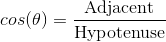
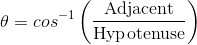
Substitute the lengths given and solve for the angle.
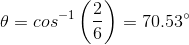
The leg must be an adjacent side to the hypotenuse.
Therefore, we can use inverse cosine to solve for the angle.
First write the equation for sine of an angle.
Substitute the lengths given and solve for the angle.
← Didn't Know|Knew It →
A skateboard ramp made so that the rider can gain sufficient speed before a jump is 15 feet high and the ramp is 17 feet long. What is the measure of the angle  between the ramp and the ground?
A skateboard ramp made so that the rider can gain sufficient speed before a jump is 15 feet high and the ramp is 17 feet long. What is the measure of the angle
Tap to reveal answer
For the angle in question we have the opposite side and the hypotenuse given to us. We can use the sine function.

Use the inverse sin to find the measure of an angle between these sides:
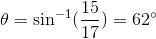
For the angle in question we have the opposite side and the hypotenuse given to us. We can use the sine function.
Use the inverse sin to find the measure of an angle between these sides:
← Didn't Know|Knew It →
Artemis wants to build a ramp to make the entrance to their home more accessible. The angle between the ramp and the ground cannot be more than  steep. Artemis has
  feet of space in their yard that the ramp can take up, and the distance between the ground and the house entrance is
  feet high. Will Artemis be able to build a ramp that complies with the
  standard?
Artemis wants to build a ramp to make the entrance to their home more accessible. The angle between the ramp and the ground cannot be more than 


Tap to reveal answer
Begin the problem by visualizing a diagram of the situation:
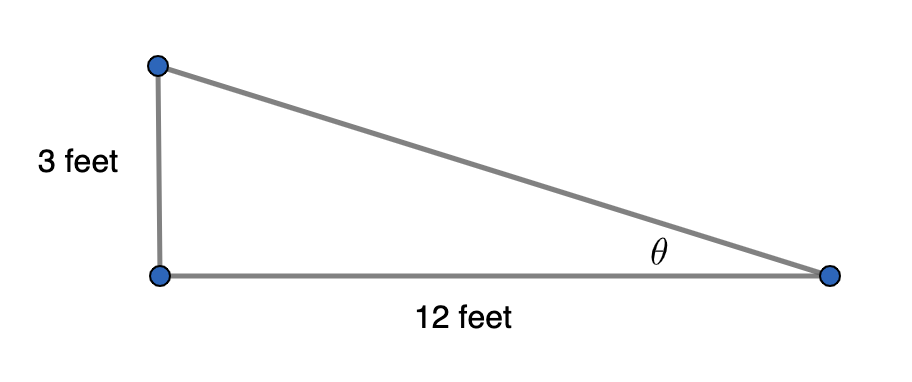
We can use inverse trig to solve for the unknown angle  .
.

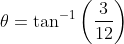

Because this angle is larger than  , this ramp would not comply with standards.
Begin the problem by visualizing a diagram of the situation:
We can use inverse trig to solve for the unknown angle 


Because this angle is larger than 
← Didn't Know|Knew It →
What is the ratio of the side opposite the  angle to the hypotenuse?
What is the ratio of the side opposite the
Tap to reveal answer
Step 1: Locate the side that is opposite the  side..
The shortest side is opposite the  angle. Let's say that this side has length
  .
.
Step 2: Recall the ratio of the sides of a  triangle:
From the shortest side, the ratio is  .
.
 is the hypotenuse, which is twice as big as the shortest side..
The ratio of the short side to the hypotenuse is 
Step 1: Locate the side that is opposite the
The shortest side is opposite the
Step 2: Recall the ratio of the sides of a
From the shortest side, the ratio is
The ratio of the short side to the hypotenuse is
← Didn't Know|Knew It →
What is the height of an equilateral triangle with side length 8?
What is the height of an equilateral triangle with side length 8?
Tap to reveal answer
The altitude of an equilateral triangle splits it into two 30-60-90 triangles. The height of the triangle is the longer leg of the 30-60-90 triangle. If the hypotenuse is 8, the longer leg is  .
.
To double check the answer use the Pythagorean Thereom:

The altitude of an equilateral triangle splits it into two 30-60-90 triangles. The height of the triangle is the longer leg of the 30-60-90 triangle. If the hypotenuse is 8, the longer leg is
To double check the answer use the Pythagorean Thereom:
← Didn't Know|Knew It →
In a  triangle, the side opposite the
  degree angle is
  . How long is the side opposite the
  degree angle?
In a
Tap to reveal answer
Based on the 30-60-90 identity, the measure of the side opposite the 30 degree angle is doubled to get the hypotenuse.
Therefore,


Based on the 30-60-90 identity, the measure of the side opposite the 30 degree angle is doubled to get the hypotenuse.
Therefore,
← Didn't Know|Knew It →
In a 30-60-90 triangle, the length of the side opposite the  angle is
  . What is the length of the hypotenuse?
In a 30-60-90 triangle, the length of the side opposite the
Tap to reveal answer
By definition, the length of the hypotenuse is twice the length of the side opposite the  angle.
Recall that the hypotenuse is the side opposite the  angle.
Thus, using the equation below, where ss represents the short side (that opposite the  angle) we get:

Plugging in our values for the short side we find the hypotenuse as follows:

By definition, the length of the hypotenuse is twice the length of the side opposite the
Recall that the hypotenuse is the side opposite the
Thus, using the equation below, where ss represents the short side (that opposite the
Plugging in our values for the short side we find the hypotenuse as follows:
← Didn't Know|Knew It →
A triangle has three angles  ,
,  and
and  such that
  and
and  . The side opposite to
  measures
  units in length. How long is the side opposite of
  ?
?
A triangle has three angles
Tap to reveal answer
A triangle with a  angle relation is a
  ,
,  ,
,  degree triangle. The side opposite the smallest angle of a triangle is the shortest side, of length
  . The side opposite the largest angle is the longest side, measuring twice the length of the shortest side for this triangle,
  units.


Therefore, to make the above statement true  .
.
A triangle with a
Therefore, to make the above statement true
← Didn't Know|Knew It →
Triangle  is equilateral with a side length of
  .
.
What is the height of the triangle?
Triangle
What is the height of the triangle?
Tap to reveal answer
An equilateral triangle has internal angles of 60°, so the sin of one of those angles is equivalent to the height of the triangle divided by the side length,

so..

An equilateral triangle has internal angles of 60°, so the sin of one of those angles is equivalent to the height of the triangle divided by the side length,
so..
← Didn't Know|Knew It →
It is known that the smallest side of a 30-60-90 triangle is 5.
Find  .
.
It is known that the smallest side of a 30-60-90 triangle is 5.
Find
Tap to reveal answer
We know that in a 30-60=90 triangle, the smallest side corresponds to the side opposite the 30 degree angle.
Additionally, we know that the hypotenuse is 2 times the value of the smallest side, so in this case, that is 10.
The formula for
 , so
, so  or
or  .
.
We know that in a 30-60=90 triangle, the smallest side corresponds to the side opposite the 30 degree angle.
Additionally, we know that the hypotenuse is 2 times the value of the smallest side, so in this case, that is 10.
The formula for
← Didn't Know|Knew It →
It is known that for a 30-60-90 triangle,
 .
.
Find the area of the triangle.
Note:

It is known that for a 30-60-90 triangle,
Find the area of the triangle.
Note:
Tap to reveal answer
First, we know that in a 30-60-90 triangle,
 .
.
Also, the base is the smallest side times  , so in our case it is
  .
.
The height is just the smallest side,  .
.
Substituting these values into the formula given for area of a triangle, we obtain the answer  .
.
First, we know that in a 30-60-90 triangle,
Also, the base is the smallest side times
The height is just the smallest side,
Substituting these values into the formula given for area of a triangle, we obtain the answer
← Didn't Know|Knew It →
In a  triangle, if one leg is
  . What is the measure of the hypotenuse?
In a
Tap to reveal answer
One option is to use the Pythagorean Theorem.
Since we have an isosceles triangle, both legs must be congruent.
Plug in to get your answer.


Or, you can remember the 45-45-90 identity, which states that the hypotenuse is  times the leg.
One option is to use the Pythagorean Theorem.
Since we have an isosceles triangle, both legs must be congruent.
Plug in to get your answer.
Or, you can remember the 45-45-90 identity, which states that the hypotenuse is
← Didn't Know|Knew It →
A triangle has three angles  ,
,  ,
,  such that
  and
and  together are as much as
  . What is the ratio of the longest side to the shortest?
A triangle has three angles
Tap to reveal answer
A triangle with the sum of two angles equaling the third is a  triangle


A triangle with the sum of two angles equaling the third is a
← Didn't Know|Knew It →
Find the value of  in the triangle below.

Find the value of
Tap to reveal answer
The first two things to recognize regarding our tirangle are 1) it is a right triangle and 2) it is an isosceles triangle. The two congruent sides tell us that the two non-right angles are also congruent, and a little quick math tells us that they each equal 45 degrees. This means our right triangle is not just any right triangle but a 45-45-90 triangle.
This is important because the sides of every 45-45-90 triangle follow the same ratio. The two legs are obviously always congruent to each other (being isosceles), but to find the hypotenuse, we simply have to multiply the length of a leg by  .
.
Given this fact we would be in good shape if we had the length of a leg and needed the hypotenuse. But we have the hypotenuse and need the leg, which we means we need to work backwards going this way, we need to divide the length of the hypotenuse by  . Therefore,

However, general practice in mathematics doesn't allow us to leave a square root in the denominator. We solve this problem by rationalizing the denominator, which is accomplished by multiplying the numerator and the denominator by  .
.

This effectively eliminates the square root in the denominator and provides our answer.

The first two things to recognize regarding our tirangle are 1) it is a right triangle and 2) it is an isosceles triangle. The two congruent sides tell us that the two non-right angles are also congruent, and a little quick math tells us that they each equal 45 degrees. This means our right triangle is not just any right triangle but a 45-45-90 triangle.
This is important because the sides of every 45-45-90 triangle follow the same ratio. The two legs are obviously always congruent to each other (being isosceles), but to find the hypotenuse, we simply have to multiply the length of a leg by
Given this fact we would be in good shape if we had the length of a leg and needed the hypotenuse. But we have the hypotenuse and need the leg, which we means we need to work backwards going this way, we need to divide the length of the hypotenuse by
However, general practice in mathematics doesn't allow us to leave a square root in the denominator. We solve this problem by rationalizing the denominator, which is accomplished by multiplying the numerator and the denominator by
This effectively eliminates the square root in the denominator and provides our answer.
← Didn't Know|Knew It →
The following figure was made by beginning with a square. The midpoints of the four sides of the square were then joined to form another square. The process was repeated to form a third square and finally once more to form the fourth and smallest square in the middle, which has a side length of  . Find the value of
  .
.

The following figure was made by beginning with a square. The midpoints of the four sides of the square were then joined to form another square. The process was repeated to form a third square and finally once more to form the fourth and smallest square in the middle, which has a side length of
Tap to reveal answer
We begin by realizing that the midpoints of the sides of our outer square divide each side in half. Furthermore, the sides of our second square connecting these midpoints form four right triangles in each corner of our largest square.

But these right triangles are special right triangles. They are 45-45-90 triangles, which means we can find the hypotenuse (and thus the side of our second square) by multiplying the length of the leg by  . Therefore the length of a side of our second square is
  .
.

We now repeat the process, beginning by forming four new 45-45-90 triangles

To find the hypotenuse of each of these triangles (and thus the side length of our third square), we simply multiply by  again.


We then repeat the process one final time, multiplying by  again.

Our final hypotenuse and thus the side of our innermost square is  .
.
We begin by realizing that the midpoints of the sides of our outer square divide each side in half. Furthermore, the sides of our second square connecting these midpoints form four right triangles in each corner of our largest square.
But these right triangles are special right triangles. They are 45-45-90 triangles, which means we can find the hypotenuse (and thus the side of our second square) by multiplying the length of the leg by
We now repeat the process, beginning by forming four new 45-45-90 triangles
To find the hypotenuse of each of these triangles (and thus the side length of our third square), we simply multiply by
We then repeat the process one final time, multiplying by
Our final hypotenuse and thus the side of our innermost square is
← Didn't Know|Knew It →
Find the value of 

Find the value of
Tap to reveal answer
Solving this problem begins with realizing that all three of our triangles are not only right triangles but isosceles and are therefore 45-45-90 triangles. That means in each triangle to get from the length of a leg to the length of the hypotenuse, we simply multiply by  . Therefore, the hypotenuse of our bottom triangle is

However, the hypotenuse of the bottom triangle is also the leg of the middle triangle. To find the hypotenuse of this triangle, we simply repeat the process.

However, again the hypotenuse of the middle triangle is also the leg of the upper triangle. To find  , the hypotenuse of the upper triangle, we simply repeat the process one last time.

Solving this problem begins with realizing that all three of our triangles are not only right triangles but isosceles and are therefore 45-45-90 triangles. That means in each triangle to get from the length of a leg to the length of the hypotenuse, we simply multiply by
However, the hypotenuse of the bottom triangle is also the leg of the middle triangle. To find the hypotenuse of this triangle, we simply repeat the process.
However, again the hypotenuse of the middle triangle is also the leg of the upper triangle. To find
← Didn't Know|Knew It →