
Angles - Trigonometry
Card 1 of 336
Which two angles are both in the same quadrant?
Which two angles are both in the same quadrant?
Tap to reveal answer
First lets identify the different quadrants.
Quadrant I:
Quadrant II: 
Quadrant III: 
Quadrant IV: 
Now looking at our possible answer choices, we will add or subtract  until we get the reduced fraction of the angle. This will tell us which quadrant the angle lies in.
 thus in quadrant III.
 thus in quadrant III.
Therefore,
 and
and  is the correct answer.
First lets identify the different quadrants.
Quadrant I:
Quadrant II:
Quadrant III:
Quadrant IV:
Now looking at our possible answer choices, we will add or subtract
Therefore,
← Didn't Know|Knew It →
What is the relationship between angles 1 and 2?
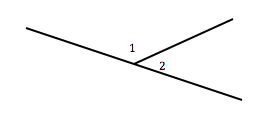
What is the relationship between angles 1 and 2?
Tap to reveal answer
These angles are supplementary, as the sum of the angles is 180o.
These angles are supplementary, as the sum of the angles is 180o.
← Didn't Know|Knew It →
Find the supplementary angle of  :
:
Find the supplementary angle of
Tap to reveal answer
Since the given angle is in radians to find the supplementary angle we need to subtract the giving angle from  .
.
Hence,

Since the given angle is in radians to find the supplementary angle we need to subtract the giving angle from
Hence,
← Didn't Know|Knew It →
Determine the quadrant that contains the terminal side of an angle measuring  .
.
Determine the quadrant that contains the terminal side of an angle measuring
Tap to reveal answer
Each quadrant represents a  change in radians. Therefore, an angle of
  radians would pass through quadrants
  ,
,  , and end in quadrant
  . The movement of the angle is in the clockwise direction because it is negative.
Each quadrant represents a
← Didn't Know|Knew It →
Determine the quadrant that contains the terminal side of an angle  .
.
Determine the quadrant that contains the terminal side of an angle
Tap to reveal answer
Each quadrant represents a  change in degrees. Therefore, an angle of
  radians would pass through quadrants
  ,
,  ,
,  ,
,  and end in quadrant
  . The movement of the angle is in the clockwise direction because it is negative.
Each quadrant represents a
← Didn't Know|Knew It →
What quadrant contains the terminal side of the angle  ?
?
What quadrant contains the terminal side of the angle
Tap to reveal answer
The coordinate plane is divided into four regions, or quadrants. An angle can be located in the first, second, third and fourth quadrant, depending on which quadrant contains its terminal side.
When the angle is more than  we can divide the angle by
  and cut off the whole number part. If we divide
  by
by  , the integer part would be
  and the remaining is
  . Now we should find the quadrant for this angle.
When the angle is between  and
and  , the angle is a second quadrant angle. Since
  is between and
  , it is a second quadrant angle.
The coordinate plane is divided into four regions, or quadrants. An angle can be located in the first, second, third and fourth quadrant, depending on which quadrant contains its terminal side.
When the angle is more than
When the angle is between
← Didn't Know|Knew It →
What quadrant contains the terminal side of the angle  ?
?
What quadrant contains the terminal side of the angle
Tap to reveal answer
First we can write:

The coordinate plane is divided into four regions, or quadrants. An angle can be located in the first, second, third and fourth quadrant, depending on which quadrant contains its terminal side. When the angle is between  and
and  , the angle is a second quadrant angle. Since
  is between
  and
and  , it is a second quadrant angle.
First we can write:
The coordinate plane is divided into four regions, or quadrants. An angle can be located in the first, second, third and fourth quadrant, depending on which quadrant contains its terminal side. When the angle is between
← Didn't Know|Knew It →
What quadrant contains the terminal side of the angle  ?
?
What quadrant contains the terminal side of the angle
Tap to reveal answer
The coordinate plane is divided into four regions, or quadrants. An angle can be located in the first, second, third and fourth quadrant, depending on which quadrant contains its terminal side. When the angle is between  and
and  , the angle is a third quadrant angle. Since
  is between
  and
and  , it is a thrid quadrant angle.
The coordinate plane is divided into four regions, or quadrants. An angle can be located in the first, second, third and fourth quadrant, depending on which quadrant contains its terminal side. When the angle is between
← Didn't Know|Knew It →
What quadrant contains the terminal side of the angle  ?
?
What quadrant contains the terminal side of the angle
Tap to reveal answer
First we can convert it to degrees:

The movement of the angle is clockwise because it is negative. So we should start passing through quadrant  . Since
  is between
  and
and  , it ends in the quadrant
  .
.
First we can convert it to degrees:
The movement of the angle is clockwise because it is negative. So we should start passing through quadrant
← Didn't Know|Knew It →
What quadrant contains the terminal side of the angle  ?
?
What quadrant contains the terminal side of the angle
Tap to reveal answer
The coordinate plane is divided into four regions, or quadrants. An angle can be located in the first, second, third and fourth quadrant, depending on which quadrant contains its terminal side.
When the angle is more than we can divide the angle by and cut off the whole number part. If we divide  by , the integer part would be
  and the remaining is
  . Now we should find the quadrant for this angle.
When the angle is between  and , the angle is a first quadrant angle. Since
  is between
  and
and  , it is a first quadrant angle.
The coordinate plane is divided into four regions, or quadrants. An angle can be located in the first, second, third and fourth quadrant, depending on which quadrant contains its terminal side.
When the angle is more than
When the angle is between
← Didn't Know|Knew It →
What quadrant contains the terminal side of the angle  ?
?
What quadrant contains the terminal side of the angle
Tap to reveal answer
First we can convert it to degrees:

When the angle is more than we can divide the angle by and cut off the whole number part. If we divide  by , the integer part would be and the remaining is
  . Now we should find the quadrant for this angle.
When the angle is between  and
and  , the angle is a third quadrant angle. Since
  is between
  and
and  , it is a third quadrant angle.
First we can convert it to degrees:
When the angle is more than
When the angle is between
← Didn't Know|Knew It →
Which of the following angles lies in the second quadrant?
Which of the following angles lies in the second quadrant?
Tap to reveal answer
The second quadrant contains angles between  and
and  , plus those with additional multiples of
  . The angle
  is, after subtracting
  , is simply
  , which puts it in the second quadrant.
The second quadrant contains angles between
← Didn't Know|Knew It →
In what quadrant does  lie?
lie?
In what quadrant does
Tap to reveal answer
When we think of angles, we go clockwise from the positive x axis.
Thus, for negative angles, we go counterclockwise. Since each quadrant is defined by 90˚, we end up in the 3rd quadrant.
When we think of angles, we go clockwise from the positive x axis.
Thus, for negative angles, we go counterclockwise. Since each quadrant is defined by 90˚, we end up in the 3rd quadrant.
← Didn't Know|Knew It →
Which of the following answers best represent  ?
?
Which of the following answers best represent
Tap to reveal answer
The angle 315 degrees is located in the fourth quadrant. The correct coordinate designating this angle is  .
.
The tangent of an angle is  .
.
Therefore,

The angle 315 degrees is located in the fourth quadrant. The correct coordinate designating this angle is
The tangent of an angle is
Therefore,
← Didn't Know|Knew It →
Which angle is not in quadrant III?
Which angle is not in quadrant III?
Tap to reveal answer
First lets identify the angles that make up the third quadrant. Quadrant three is  to
to  or in radians,
  to
to  thus, any angle that does not fall within this range is not in quadrant three.
Therefore, the correct answer,
 is not in quadrant three because it is in the first quadrant.
This is clear when we subtract
 .
.
First lets identify the angles that make up the third quadrant. Quadrant three is
Therefore, the correct answer,
This is clear when we subtract
← Didn't Know|Knew It →
Which angle is in quadrant II?
Which angle is in quadrant II?
Tap to reveal answer
First lets identify the different quadrants.
Quadrant I:
Quadrant II:
Quadrant III:
Quadrant IV:
The correct answer, , is coterminal with
  .
.
We can figure this out by adding  , or equivalently
  to get
  , or we can count thirds of pi around the unit circle clockwise. Either way, it is the only angle that ends in the second quadrant.
First lets identify the different quadrants.
Quadrant I:
Quadrant II:
Quadrant III:
Quadrant IV:
The correct answer,
We can figure this out by adding
← Didn't Know|Knew It →
The angle  divides which two quadrants?
The angle
Tap to reveal answer
 is coterminal with the angle
  , or
, or  . This splits quadrants I and II:
← Didn't Know|Knew It →
In which angle would a  angle terminate in?
In which angle would a
Tap to reveal answer
One way to uncover which quadrant this angle lies is to ask how many complete revolutions this angle makes by dividing it by 360 (and rounding down to the nearest whole number).
With a calculator we find that  makes
makes  full revolutions. Now the key lies in what the remainder the angle makes with
  revolutions:

 , therefore our angle lies in the fourth quadrant.
Alternatively, we could find evaluate  and
and  .
.
The former (sine) gives us a negative number whereas the latter (cosine) gives a positive. The only quadrant in which sine is negative and cosine is positive is the fourth quadrant.
One way to uncover which quadrant this angle lies is to ask how many complete revolutions this angle makes by dividing it by 360 (and rounding down to the nearest whole number).
With a calculator we find that
Alternatively, we could find evaluate
The former (sine) gives us a negative number whereas the latter (cosine) gives a positive. The only quadrant in which sine is negative and cosine is positive is the fourth quadrant.
← Didn't Know|Knew It →
Which quadrant does  belong?
Which quadrant does
Tap to reveal answer
Step 1: Define the quadrants and the angles that go in:
QI:

QII:

QIII:

QIV:

Step 2: Find the quadrant where  is:
is:
The angle is located in QII (Quadrant II)
Step 1: Define the quadrants and the angles that go in:
QI:
QII:
QIII:
QIV:
Step 2: Find the quadrant where
The angle is located in QII (Quadrant II)
← Didn't Know|Knew It →
The angle  is in which quadrant?
The angle
Tap to reveal answer
First, using the unit circle, we can see that the denominator has a four in it, which means it is a multiple of  .
.
We want to reduce the angle down until we can visualize which quadrant it is in. You can subtract  away from the angle each time (because that is just one revolution, and we end up at the same spot).
If you subtract away  twice, you are left with
  , which is in quadrant I.
 .
.
First, using the unit circle, we can see that the denominator has a four in it, which means it is a multiple of
We want to reduce the angle down until we can visualize which quadrant it is in. You can subtract
If you subtract away
← Didn't Know|Knew It →