
How to find the area of a parallelogram
SSAT Upper Level Quantitative · Learn by Concept
Help Questions
SSAT Upper Level Quantitative › How to find the area of a parallelogram
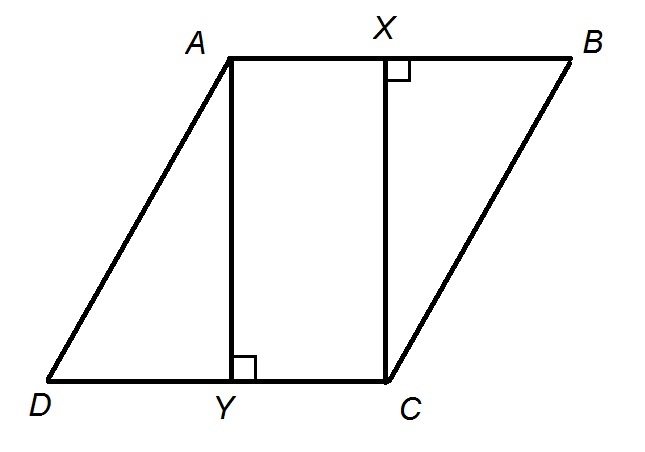
Figure NOT drawn to scale.
The above depicts Rhombus 

Give the area of Rhombus 


Explanation
The area of any parallelogram is the product of the length of its base and that of a corresponding altitude. We can take 

All four sides of a rhombus have the same length, so we can find 

Now multiply the lengths of this base and the altitude to get the area:

The length of the shorter diagonal of a rhombus is 40% that of the longer diagonal. The area of the rhombus is 


Explanation
Let 
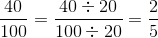


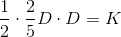
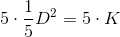
The area of a rhombus is half the product of the lengths of its diagonals, so we can set up, and solve for 



Which of the following shapes is NOT a quadrilateral?
Triangle
Square
Rectangle
Rhombus
Kite
Explanation
A quadrilateral is any two-dimensional shape with 

Which shape is NOT a quadrilateral?
Circle
Trapezoid
Kite
Rhombus
Rectangle
Explanation
A quadrilateral has to have 
Which two shapes have to have 
Square and Rectangle
Square and Rhombus
Square and Parallelogram
Rectangle and Rhombus
Rectangle and Parallelogram
Explanation
By definition, the only two quadrilaterals that have to have 
What is the difference between a trapezoid and a isosceles trapezoid?
An isosceles trapezoid has to have equal base angles
A trapezoid has to have equal base angles
An isosceles trapezoid has to have equal side lengths
A trapezoid has to have equal side lengths
There is no difference between them
Explanation
By definition, an isosceles trapezoid has to have 
A parallelogram has the base length of 


Explanation
The area of a parallelogram is given by:

Where 


A parallelogram has a base length of 


Explanation
Base length is 

The area of a parallelogram is given by:

Where:


So we can write:




The longer diagonal of a rhombus is 20% longer than the shorter diagonal; the rhombus has area 


Explanation
Let 
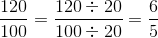
of 

The area of a rhombus is half the product of the lengths of its diagonals, so we can set up an equation and solve for
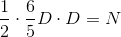

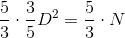


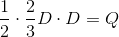
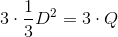
The length of the shorter diagonal of a rhombus is two-thirds that of the longer diagonal. The area of the rhombus is 


Explanation
Let 
The area of a rhombus is half the product of the lengths of its diagonals, so we can set up the following equation and solve for



To convert yards to inches, multiply by 36:
