
Rational Numbers - SSAT Upper Level Quantitative
Card 1 of 1732
What number can be filled in the blank to make the two ratios equivalent?


What number can be filled in the blank to make the two ratios equivalent?
Tap to reveal answer
Set up a proportion statement:

Rewrite:

Set up a proportion statement:
Rewrite:
← Didn't Know|Knew It →
A pie is made up of  crust,
  apples, and
  sugar, and the rest is jelly. What is the ratio of crust to jelly?
A pie is made up of
Tap to reveal answer
A pie is made up of  crust,
  apples,
  sugar, and the rest is jelly. What is the ratio of crust to jelly?
To compute this ratio, you must first ascertain how much of the pie is jelly. This is:
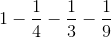
Begin by using the common denominator  :
:


So, the ratio of crust to jelly is:

This can be written as the fraction:
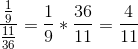 , or
, or 
A pie is made up of
To compute this ratio, you must first ascertain how much of the pie is jelly. This is:
Begin by using the common denominator
So, the ratio of crust to jelly is:
This can be written as the fraction:
← Didn't Know|Knew It →
In a solution,  of the fluid is water,
  is wine, and
  is lemon juice. What is the ratio of lemon juice to water?
In a solution,
Tap to reveal answer
This problem is really an easy fraction division. You should first divide the lemon juice amount by the water amount:
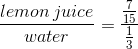
Remember, to divide fractions, you multiply by the reciprocal:
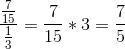
This is the same as saying:

This problem is really an easy fraction division. You should first divide the lemon juice amount by the water amount:
Remember, to divide fractions, you multiply by the reciprocal:
This is the same as saying:
← Didn't Know|Knew It →
If  and
and  , what is the ratio of
  to
to  ?
?
If
Tap to reveal answer
To find a ratio like this, you simply need to make the fraction that represents the division of the two values by each other. Therefore, we have:

Recall that division of fractions requires you to multiply by the reciprocal:
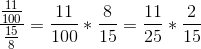 ,
,
which is the same as:

This is the same as the ratio:

To find a ratio like this, you simply need to make the fraction that represents the division of the two values by each other. Therefore, we have:
Recall that division of fractions requires you to multiply by the reciprocal:
which is the same as:
This is the same as the ratio:
← Didn't Know|Knew It →
A smoothie is made up of  pineapple juice and
  mango juice; the rest is orange juice. What is the ratio of orange juice to pineapple juice?
A smoothie is made up of
Tap to reveal answer
First, find out how much of the smoothie is orange juice.
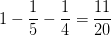
Since we want the ratio of orange juice to pineapple juice, we want to set up the fractions like this:
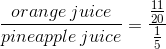
Now, divide these fractions.

First, find out how much of the smoothie is orange juice.
Since we want the ratio of orange juice to pineapple juice, we want to set up the fractions like this:
Now, divide these fractions.
← Didn't Know|Knew It →
A bakery sells three different types of cookies.  of the cookies sold are chocolate chip,
  sold are oatmeal raisin, and the rest sold are sugar cookies. What is the ratio of sugar cookies to oatmeal raisin cookies that the bakery sells?
A bakery sells three different types of cookies.
Tap to reveal answer
First, find the fraction of sugar cookies that are sold.
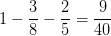
Since we want the ratio of sugar cookies to oatmeal raisin cookies:
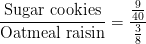
Now, multiply and simplify the resulting fraction.

First, find the fraction of sugar cookies that are sold.
Since we want the ratio of sugar cookies to oatmeal raisin cookies:
Now, multiply and simplify the resulting fraction.
← Didn't Know|Knew It →
Simplify:

Simplify:
Tap to reveal answer
Simplify into a complex fraction for the numerator and denominator.
For the numerator, we need to multiply  then the top should read
  .
.
For the bottom, we need to multiply  in order to add the components. Thus the bottom should read
  .
.
Dividing fractions is the same as multiplying the numerator by the reciprocal of the denominator.
Therefore, multiply top and bottom by  and then you should see that if you factor a
  on the bottom, the
  cancels along with the
  .
.

The answer then should be  .
.
Simplify into a complex fraction for the numerator and denominator.
For the numerator, we need to multiply
For the bottom, we need to multiply
Dividing fractions is the same as multiplying the numerator by the reciprocal of the denominator.
Therefore, multiply top and bottom by
The answer then should be
← Didn't Know|Knew It →
Convert  into a fraction.
Convert
Tap to reveal answer
The whole number  is multipled by the denominator
  . Then we add the numerator
  . This value is divided by the denominator. Final answer is
  .
.
The whole number
← Didn't Know|Knew It →
Convert  to an improper fraction.
Convert
Tap to reveal answer
To convert into an improper fraction, take the whole number  and multiply that with the denominator
  .
.

Then, we add that to the numerator which is  .
.

Then we take that sum and put it over th denominator  which gives us an answer of:
 .
.
To convert into an improper fraction, take the whole number
Then, we add that to the numerator which is
Then we take that sum and put it over th denominator
← Didn't Know|Knew It →
Simplify.

Simplify.
Tap to reveal answer
Lets focus on the left fraction. Lets try to have three fractions multipled altogether. To acheive this, we can multiply the numerator of the left fraction with the reciprocal of the denominator.
Thus, mutliple the numerator and denominator by  .
.
Now we have  . We can simplify this by crossing out the
  to a
to a  and the
  to a
to a  .
.
Then, cross out the  into a
  and the
  into a
  . It should look like this:
 .
.
Multiply it out and you will get the answer.

Lets focus on the left fraction. Lets try to have three fractions multipled altogether. To acheive this, we can multiply the numerator of the left fraction with the reciprocal of the denominator.
Thus, mutliple the numerator and denominator by
Now we have
Then, cross out the
Multiply it out and you will get the answer.
← Didn't Know|Knew It →
Solve and simplify.

Solve and simplify.
Tap to reveal answer
Convert both numerator and denominators into fractions. Convert the integers first to fractions.


Now that our numerator and denominator have a common denominator between their fractions we can subtract them.

Then multiply top and bottom by  as that is the reciprocal of the denominator and when dividing fractions, it is the same as multiplying the numerator by the reciprocal of the denominator.

Then reduce by crossing out the  into a
  and the
  into a
  .
.
Then multiply to get the answer.

Convert both numerator and denominators into fractions. Convert the integers first to fractions.
Now that our numerator and denominator have a common denominator between their fractions we can subtract them.
Then multiply top and bottom by
Then reduce by crossing out the
Then multiply to get the answer.
← Didn't Know|Knew It →
Solve and simplify.

Solve and simplify.
Tap to reveal answer
Remember PEMDAS, the order of operations for dealing with expressions which is the acronym that stands for (Parentheses, Exponents, Multiplication, Division, Addition, Subtraction).
Multiplication has priority over addition. Looking at the fractions that are multiplied together we can see the  is reduced to
  and the
  into a
  .
.
The new fraction becomes:

Then find least common denominator. In our case it will be 70.

 .
.
Then add it all up to get the final answer.

Remember PEMDAS, the order of operations for dealing with expressions which is the acronym that stands for (Parentheses, Exponents, Multiplication, Division, Addition, Subtraction).
Multiplication has priority over addition. Looking at the fractions that are multiplied together we can see the
The new fraction becomes:
Then find least common denominator. In our case it will be 70.
Then add it all up to get the final answer.
← Didn't Know|Knew It →
Simplify.

Simplify.
Tap to reveal answer
Remember PEMDAS. Take care of the parentheses first and find least common denominator of the fractions. Next distribute, then add and finally, subtract.

Working with the parentheses we get:

Reduce the  to
to  and the
  to
to  . Then reduce
  to
to  and
and  to
to  .
.

Multiply first then subtract.

If I divide the left fraction by  , I should be able to match the denominator of the right fraction and also I can subtract easily.

Remember PEMDAS. Take care of the parentheses first and find least common denominator of the fractions. Next distribute, then add and finally, subtract.
Working with the parentheses we get:
Reduce the
Multiply first then subtract.
If I divide the left fraction by
← Didn't Know|Knew It →
Which of the following fractions is closest to 0.6?
Which of the following fractions is closest to 0.6?
Tap to reveal answer
For each fraction, divide each numerator by its denominator to get its decimal representation, then subtract to find its difference from 0.6.


 is the closest to 0.6 of the five.
For each fraction, divide each numerator by its denominator to get its decimal representation, then subtract to find its difference from 0.6.
← Didn't Know|Knew It →
Express  as a decimal.
Express
Tap to reveal answer
Divide 8 by 15:
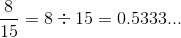
The 3 repeats, so the correct choice is  .
.
Divide 8 by 15:
The 3 repeats, so the correct choice is
← Didn't Know|Knew It →
Give the decimal equivalent of  .
.
Give the decimal equivalent of
Tap to reveal answer
Divide 11 by 18:

The 1 repeats infinitely, so this can be rewritten as  .
.
Divide 11 by 18:
The 1 repeats infinitely, so this can be rewritten as
← Didn't Know|Knew It →
Give the decimal equivalent of  .
.
Give the decimal equivalent of
Tap to reveal answer
Divide 5 by 27:

The group "185" repeats infinitely, so this can be written as  .
.
Divide 5 by 27:
The group "185" repeats infinitely, so this can be written as
← Didn't Know|Knew It →
Give the decimal equivalent of  .
.
Give the decimal equivalent of
Tap to reveal answer
Divide 7 by 36:

The 4 repeats infinitely, so this can be rewritten as  .
.
Divide 7 by 36:
The 4 repeats infinitely, so this can be rewritten as
← Didn't Know|Knew It →
Write the value of this expression as a decimal:

Write the value of this expression as a decimal:
Tap to reveal answer
Simplify the sum by taking the least common denominator, which is 12:


Divide 13 by 12:

Simplify the sum by taking the least common denominator, which is 12:
Divide 13 by 12:
← Didn't Know|Knew It →
Let  ,
,  ,
, 
Which of the following is closest to  ?
?
Let
Which of the following is closest to
Tap to reveal answer


The correct choice is 1.8.
The correct choice is 1.8.
← Didn't Know|Knew It →