
Area of Polygons - SSAT Upper Level Quantitative
Card 1 of 276
Mark wants to seed his lawn, which measures 225 feet by 245 feet. The grass seed he wants to use gets 400 square feet of coverage to the pound; a fifty-pound bag sells for $45.00, and a ten-pound bag sells for $13.00. What is the least amount of money Mark should expect to spend on grass seed?
Mark wants to seed his lawn, which measures 225 feet by 245 feet. The grass seed he wants to use gets 400 square feet of coverage to the pound; a fifty-pound bag sells for $45.00, and a ten-pound bag sells for $13.00. What is the least amount of money Mark should expect to spend on grass seed?
Tap to reveal answer
The area of Mark's lawn is  . The amount of grass seed he needs is
  pounds.
He has two options.
Option 1: he can buy three fifty-pound bags for 
Option 2: he can buy two fifty-pound bags and four ten-pound bags for 
The first option is the more economical.
The area of Mark's lawn is
He has two options.
Option 1: he can buy three fifty-pound bags for
Option 2: he can buy two fifty-pound bags and four ten-pound bags for
The first option is the more economical.
← Didn't Know|Knew It →
The base length of a parallelogram is equal to the side length of a square. The base length of the parallelogram is two times longer than its corresponding altitude. Compare the area of the parallelogram with the area of the square.
The base length of a parallelogram is equal to the side length of a square. The base length of the parallelogram is two times longer than its corresponding altitude. Compare the area of the parallelogram with the area of the square.
Tap to reveal answer
The area of a parallelogram is given by:

Where  is the base length and
  is the corresponding altitude. In this problem we have:

or

So the area of the parallelogram would be:

The area of a square is given by:

weher  is the side length of a square. In this problem we have
  , so we can write:

Then:

or:

The area of a parallelogram is given by:
Where
or
So the area of the parallelogram would be:
The area of a square is given by:
weher
Then:
or:
← Didn't Know|Knew It →
How many squares with the side length of 2 inches can be fitted in a rectangle with the width of 10 inches and height of 4 inches?
How many squares with the side length of 2 inches can be fitted in a rectangle with the width of 10 inches and height of 4 inches?
Tap to reveal answer
Solution 1:
We can divide the rectangle width and height by the square side length and multiply the results:
rectangle width  square length =
rectangle height square length =

Solution 2:
As the results of the division of rectangle width and height by the square length are integers and do not have a residual, we can say that the squares can be perfectly fitted in the rectangle. Now in order to find the number of squares we can divide the rectangle area by the square area:
Rectangle area =  square inches
Square area =  square inches
So we can get:

Solution 1:
We can divide the rectangle width and height by the square side length and multiply the results:
rectangle width
rectangle height
Solution 2:
As the results of the division of rectangle width and height by the square length are integers and do not have a residual, we can say that the squares can be perfectly fitted in the rectangle. Now in order to find the number of squares we can divide the rectangle area by the square area:
Rectangle area =
Square area =
So we can get:
← Didn't Know|Knew It →
The width and height of a rectangle are  and
and  , respectively. Give the area of the rectangle in terms of
  .
.
The width and height of a rectangle are
Tap to reveal answer
The area of a rectangle is given by multiplying the width times the height. As a formula:

Where:
 is the width and
  is the height. So we can get:

The area of a rectangle is given by multiplying the width times the height. As a formula:
Where:
← Didn't Know|Knew It →
A rectangle has the area of 80 square inches. The width of the rectangle is 2 inches longer that its height. Give the height of the rectangle.
A rectangle has the area of 80 square inches. The width of the rectangle is 2 inches longer that its height. Give the height of the rectangle.
Tap to reveal answer
The area of a rectangle is given by multiplying the width times the height. That means:

where:
 width and
  height.
We know that:  . Substitube the
  in the area formula:

Now we should solve the equation for  :
:

The equation has two answers, one positive  and one negative
  . As the length is always positive, the correct answer is
  inches.
The area of a rectangle is given by multiplying the width times the height. That means:
where:
We know that:
Now we should solve the equation for
The equation has two answers, one positive
← Didn't Know|Knew It →
A rectangle with a width of 6 inches has an area of 48 square inches. Give the sum of the lengths of the rectangle's diagonals.
A rectangle with a width of 6 inches has an area of 48 square inches. Give the sum of the lengths of the rectangle's diagonals.
Tap to reveal answer
A rectangle has two congruent diagonals. A diagonal of a rectangle divides it into two identical right triangles. The diagonal of the rectangle is the hypotenuse of these triangles. We can use the Pythagorean Theorem to find the length of the diagonal if we know the width and height of the rectangle.

where:
 is the width of the rectangle
 is the height of the rectangle
First, we find the height of the rectangle:

So we can write:
 inches
As a rectangle has two diagonals with the same length, the sum of the diagonals is  inches.
A rectangle has two congruent diagonals. A diagonal of a rectangle divides it into two identical right triangles. The diagonal of the rectangle is the hypotenuse of these triangles. We can use the Pythagorean Theorem to find the length of the diagonal if we know the width and height of the rectangle.
where:
First, we find the height of the rectangle:
So we can write:
As a rectangle has two diagonals with the same length, the sum of the diagonals is
← Didn't Know|Knew It →
A rectangle has the width of  and the diagonal length of
  . Give the area of the rectangle in terms of
  .
.
A rectangle has the width of
Tap to reveal answer
First we need to find the height of the rectangle. Since the width and the diagonal lengths are known, we can use the Pythagorean Theorem to find the height of the rectangle:


So we have:


So we can get:

First we need to find the height of the rectangle. Since the width and the diagonal lengths are known, we can use the Pythagorean Theorem to find the height of the rectangle:
So we have:
So we can get:
← Didn't Know|Knew It →
The perimeter of a rectangle is 800 inches. The width of the rectangle is 60% of its length. What is the area of the rectangle?
The perimeter of a rectangle is 800 inches. The width of the rectangle is 60% of its length. What is the area of the rectangle?
Tap to reveal answer
Let  be the length of the rectangle. Then its width is 60% of this, or
  . The perimeter is the sum of the lengths of its sides, or
 ; we set this equal to 800 inches and solve for
  :
:


The width is therefore
 .
.
The product of the length and width is the area:
 square inches.
Let
The width is therefore
The product of the length and width is the area:
← Didn't Know|Knew It →
The perimeter of a rectangle is 490 centimeters. The width of the rectangle is three-fourths of its length. What is the area of the rectangle?
The perimeter of a rectangle is 490 centimeters. The width of the rectangle is three-fourths of its length. What is the area of the rectangle?
Tap to reveal answer
Let be the length of the rectangle. Then its width is three-fourths of this, or  . The perimeter is the sum of the lengths of its sides, or
 .
.
Set this equal to 490 centimeters and solve for  :
:


The length of the rectangle is 140 centimeters; the width is three-fourths of this, or
 centimeters.
The area is the product of the length and the width:
 square centimeters.
Let
Set this equal to 490 centimeters and solve for
The length of the rectangle is 140 centimeters; the width is three-fourths of this, or
The area is the product of the length and the width:
← Didn't Know|Knew It →
The area of a rectangle is  square feet. The width of the rectangle is four-sevenths of its length. Give the length of the rectangle in inches in terms of
  .
.
The area of a rectangle is
Tap to reveal answer
Let  be the length in feet. Then the width of the rectangle in feet is four-sevenths of this, or
  . The area is equal to the product of the length and the width, so set up this equation and solve for
  :
:


Since this is the length in feet, we multiply this by 12 to get the length in inches:

Let
Since this is the length in feet, we multiply this by 12 to get the length in inches:
← Didn't Know|Knew It →
Rectangle A has length 40 inches and height 24 inches. Rectangle B has length 30 inches and height 28 inches. Rectangle C has length 72 inches, and its area is the mean of the areas of the other two rectangles. What is the height of Rectangle C?
Rectangle A has length 40 inches and height 24 inches. Rectangle B has length 30 inches and height 28 inches. Rectangle C has length 72 inches, and its area is the mean of the areas of the other two rectangles. What is the height of Rectangle C?
Tap to reveal answer
The area of a rectangle is the product of the length and its height, Rectangle A has area  square inches; Rectangle B has area
  square inches.
The area of Rectangle C is the mean of these areas, or
 square inches, so its height is this area divided by its length:
 inches.
The area of a rectangle is the product of the length and its height, Rectangle A has area
The area of Rectangle C is the mean of these areas, or
← Didn't Know|Knew It →
Rectangle A has length 40 inches and height  inches; Rectangle B has length 30 inches and height
  inches; Rectangle C has height
  inches, and its area is the sum of those of the other two rectangles. What is its length?
Rectangle A has length 40 inches and height
Tap to reveal answer
The area of a rectangle is the product of the length and its height.
Rectangle A has area  square inches, and Rectangle B has an area of
  square inches, so the sum of their areas is
  square inches. This is the area of Rectangle C; divide it by height
  inches to get a length of
 inches. This answer is not among the given choices.
The area of a rectangle is the product of the length and its height.
Rectangle A has area
← Didn't Know|Knew It →
A basketball team wants to paint a 4-foot wide border around its court to make sure fans don't get too close to the action. If the court is 94 by 50 feet, and one can of paint can cover 300 square feet, how many cans of paint does the team need to ensure that the entire border is painted?
(Assume that you cannot buy partial cans of paint.)
A basketball team wants to paint a 4-foot wide border around its court to make sure fans don't get too close to the action. If the court is 94 by 50 feet, and one can of paint can cover 300 square feet, how many cans of paint does the team need to ensure that the entire border is painted?
(Assume that you cannot buy partial cans of paint.)
Tap to reveal answer
We begin this problem by finding the difference of two areas: the larger rectangle bounded by the outer edge of the border and the smaller rectangle that is the court itself.
The larger rectangle is  square feet
  , and the court is
  square feet
  .
.
The difference,  , repesents the area of the border.
Now we divide this by  , which is just a bit over
  . But since we can't leave
  square feet unpainted, we have to round up to
  cans of paint.
We begin this problem by finding the difference of two areas: the larger rectangle bounded by the outer edge of the border and the smaller rectangle that is the court itself.
The larger rectangle is
The difference,
Now we divide this by
← Didn't Know|Knew It →
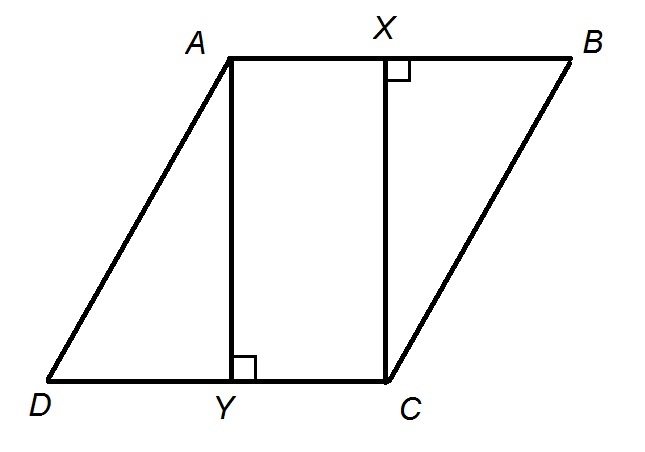
Figure NOT drawn to scale
The above figure shows Rhombus  ;
;  and
and  are midpoints of their respective sides. Rhombus
  has area 900.
Give the area of Rectangle  .
.
Figure NOT drawn to scale
The above figure shows Rhombus
Give the area of Rectangle
Tap to reveal answer
A rhombus, by definition, has four sides of equal length. Therefore,  , and, by the Multiplication Property,
  . Also, since
  and
and  are the midpoints of their respective sides,
  and
and  . Combining these statements, and letting
  :
:

Also, both  and
and  are altitudes of the rhombus; they are congruent, and we will call their common length
  (height).
The figure, with the lengths, is below.
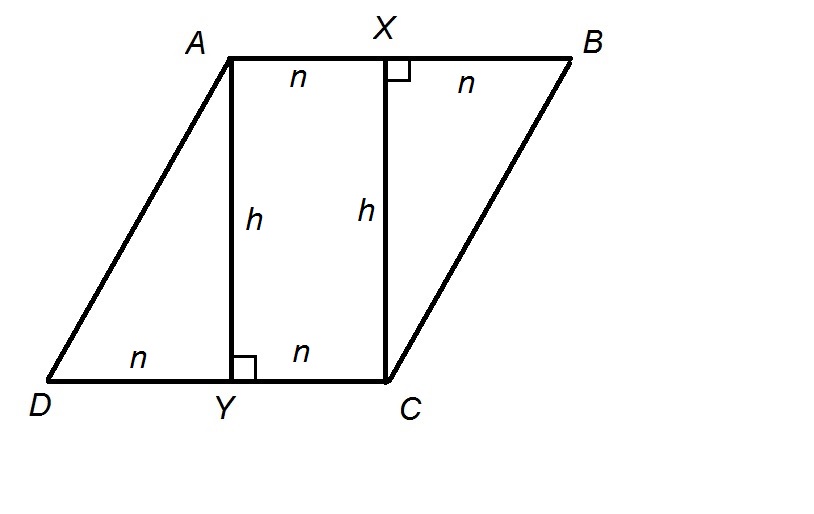
The area of the entire Rhombus  is the product of its height
  and the length of a base
  , so
, so
 .
.
Rectangle  has as its length and width
  and
and  , so its area is their product
  , Since
 ,
,
From the Division Property, it follows that
 ,
,
and
 .
.
This makes 450 the area of Rectangle .
A rhombus, by definition, has four sides of equal length. Therefore,
Also, both
The figure, with the lengths, is below.
The area of the entire Rhombus
Rectangle
From the Division Property, it follows that
and
This makes 450 the area of Rectangle
← Didn't Know|Knew It →

The above diagram shows a rectangular solid. The shaded side is a square. Give the total surface area of the solid.
The above diagram shows a rectangular solid. The shaded side is a square. Give the total surface area of the solid.
Tap to reveal answer
A square has four sides of equal length, as seen in the diagram below.

All six sides are rectangles, so their areas are equal to the products of their dimensions:
Top, bottom, front, back (four surfaces): 
Left, right (two surfaces): 
The total area: 
A square has four sides of equal length, as seen in the diagram below.
All six sides are rectangles, so their areas are equal to the products of their dimensions:
Top, bottom, front, back (four surfaces):
Left, right (two surfaces):
The total area:
← Didn't Know|Knew It →

The above diagram shows a rectangular solid. The shaded side is a square. In terms of  , give the surface area of the solid.
The above diagram shows a rectangular solid. The shaded side is a square. In terms of
Tap to reveal answer
Since a square has four sides of equal length, the solid looks like this:

The areas of each of the individual surfaces, each of which is a rectangle, are the product of their dimensions:
Front, back, top, bottom (four surfaces): 
Left, right (two surfaces): 
The total surface area is therefore

Since a square has four sides of equal length, the solid looks like this:
The areas of each of the individual surfaces, each of which is a rectangle, are the product of their dimensions:
Front, back, top, bottom (four surfaces):
Left, right (two surfaces):
The total surface area is therefore
← Didn't Know|Knew It →
A rectangle with a width of 6 inches has an area of 48 square inches. Give the sum of the lengths of the rectangle's diagonals.
A rectangle with a width of 6 inches has an area of 48 square inches. Give the sum of the lengths of the rectangle's diagonals.
Tap to reveal answer
A rectangle has two congruent diagonals. A diagonal of a rectangle divides it into two identical right triangles. The diagonal of the rectangle is the hypotenuse of these triangles. We can use the Pythagorean Theorem to find the length of the diagonal if we know the width and height of the rectangle.
where:
is the width of the rectangle
is the height of the rectangle
First, we find the height of the rectangle:
So we can write:
inches
As a rectangle has two diagonals with the same length, the sum of the diagonals is inches.
A rectangle has two congruent diagonals. A diagonal of a rectangle divides it into two identical right triangles. The diagonal of the rectangle is the hypotenuse of these triangles. We can use the Pythagorean Theorem to find the length of the diagonal if we know the width and height of the rectangle.
where:
First, we find the height of the rectangle:
So we can write:
As a rectangle has two diagonals with the same length, the sum of the diagonals is
← Didn't Know|Knew It →
Mark wants to seed his lawn, which measures 225 feet by 245 feet. The grass seed he wants to use gets 400 square feet of coverage to the pound; a fifty-pound bag sells for $45.00, and a ten-pound bag sells for $13.00. What is the least amount of money Mark should expect to spend on grass seed?
Mark wants to seed his lawn, which measures 225 feet by 245 feet. The grass seed he wants to use gets 400 square feet of coverage to the pound; a fifty-pound bag sells for $45.00, and a ten-pound bag sells for $13.00. What is the least amount of money Mark should expect to spend on grass seed?
Tap to reveal answer
The area of Mark's lawn is . The amount of grass seed he needs is pounds.
He has two options.
Option 1: he can buy three fifty-pound bags for
Option 2: he can buy two fifty-pound bags and four ten-pound bags for
The first option is the more economical.
The area of Mark's lawn is
He has two options.
Option 1: he can buy three fifty-pound bags for
Option 2: he can buy two fifty-pound bags and four ten-pound bags for
The first option is the more economical.
← Didn't Know|Knew It →
The base length of a parallelogram is equal to the side length of a square. The base length of the parallelogram is two times longer than its corresponding altitude. Compare the area of the parallelogram with the area of the square.
The base length of a parallelogram is equal to the side length of a square. The base length of the parallelogram is two times longer than its corresponding altitude. Compare the area of the parallelogram with the area of the square.
Tap to reveal answer
The area of a parallelogram is given by:
Where is the base length and is the corresponding altitude. In this problem we have:
or
So the area of the parallelogram would be:
The area of a square is given by:
weher is the side length of a square. In this problem we have , so we can write:
Then:
or:
The area of a parallelogram is given by:
Where
or
So the area of the parallelogram would be:
The area of a square is given by:
weher
Then:
or:
← Didn't Know|Knew It →
How many squares with the side length of 2 inches can be fitted in a rectangle with the width of 10 inches and height of 4 inches?
How many squares with the side length of 2 inches can be fitted in a rectangle with the width of 10 inches and height of 4 inches?
Tap to reveal answer
Solution 1:
We can divide the rectangle width and height by the square side length and multiply the results:
rectangle width square length =
rectangle heightsquare length =
Solution 2:
As the results of the division of rectangle width and height by the square length are integers and do not have a residual, we can say that the squares can be perfectly fitted in the rectangle. Now in order to find the number of squares we can divide the rectangle area by the square area:
Rectangle area = square inches
Square area = square inches
So we can get:
Solution 1:
We can divide the rectangle width and height by the square side length and multiply the results:
rectangle width
rectangle height
Solution 2:
As the results of the division of rectangle width and height by the square length are integers and do not have a residual, we can say that the squares can be perfectly fitted in the rectangle. Now in order to find the number of squares we can divide the rectangle area by the square area:
Rectangle area =
Square area =
So we can get:
← Didn't Know|Knew It →