
How to find the perimeter of a rectangle
SSAT Middle Level Quantitative · Learn by Concept
Help Questions
SSAT Middle Level Quantitative › How to find the perimeter of a rectangle

Give the perimeter of the rectangle in the above diagram.


Explanation
The perimeter of a rectangle can be calculated by multiplying two by the sum of the length and width of the rectangle.


The perimeter of the rectangle is 

Give the perimeter of the rectangle in the above diagram.


Explanation
The perimeter of a rectangle is the sum of the length and the width, multiplied by 2:

The rectangle has a perimeter of 38 centimeters.
Find the perimeter of the rectangle shown below


Explanation
The perimeter of a rectangle, or any shape, is the distance around the outside. You add up the length of each side to find this number. The coordinates of the points are 


Note: Figure NOT drawn to scale.
Refer to the above diagram. Give the ratio of the perimeter of the large rectangle to that of the smaller rectangle.


The correct answer is not given among the other choices.
Explanation
Opposite sides of a rectangle are congruent.
The large rectangle has perimeter

The smaller rectangle has perimeter

The ratio is

A rectangle has an area of 


Explanation
Since each side is a whole number, first find the whole number factors of 


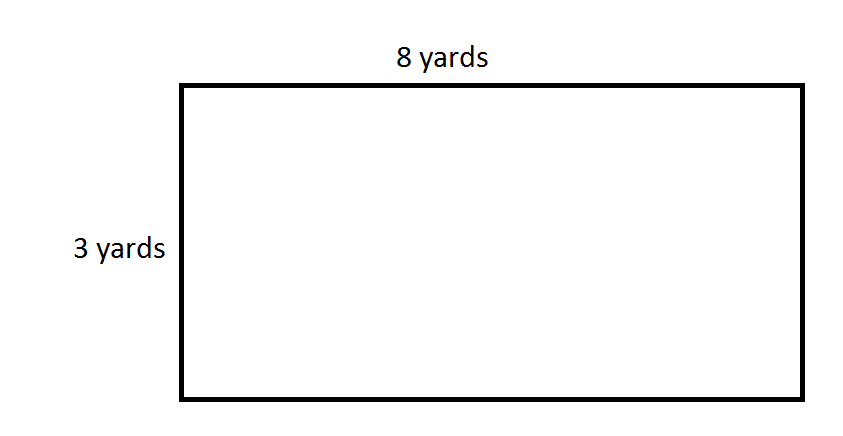
Give the perimeter of the above rectangle in centimeters, using the conversion factor 


Explanation
The perimeter of the rectangle is 

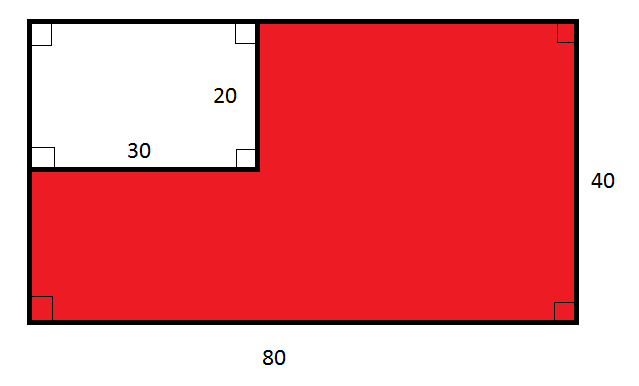
Note: Figure NOT drawn to scale.
Refer to the above diagram. Give the perimeter of the red polygon.


The perimeter cannot be determined from the information given.
Explanation
Since opposite sides of a rectangle have the same measure, the missing sidelengths can be calculated as in the diagram below:

The sidelengths of the red polygon can now be added to find the perimeter:

Rectangle ABCD has an area of 


Explanation
The area of a rectangle is found by multiplying the length times the width. The question tells you the width is 

Thus the length is 8. 
To find the perimeter you add up all of the sides.


The width of a rectangle is one-third of its length. If the width is given as 


Explanation
The perimeter of a rectangle is the sum of its sides.
The sum of the widths is 


What is the perimeter of a rectangle with a width of 3 and a length of 10?
26
13
30
12
60
Explanation
The formula for the perimeter of a rectangle is 
Plug in our given values to solve:


