How to find the missing part of a list

SSAT Middle Level Quantitative · Learn by Concept

Help Questions

SSAT Middle Level Quantitative › How to find the missing part of a list

1 - 10
1

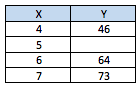
Complete the table below using the equation

Screen shot 2015 07 27 at 8.42.18 am

CORRECT

0

0

0

0

Explanation

In order to solve this question, we need to use both the equation and the table. We are looking for the corresponding value for . We can plug into the in our equation to solve for .

2

Define .

How many of the four sets listed are subsets of the set ?

(A)

(B)

(C)

(D)

Two

CORRECT

One

0

None

0

Four

0

Three

0

Explanation

For a set to be a subset of , all of its elements must also be elements of - that is, all of its elements must be multiples of 5. An integer is a multiple of 5 if and only if its last digit is 5 or 0, so all we have to do is examine the last digit of each number in all four sets.

In the sets and , every element ends in a 5 or a 0, so all elements of both sets are in ; both sets are subsets of .

However, includes one element that does not end in either 5 or 0, namely 8934, so 8934 is not an element in ; subsequently, this set is not a subset of . Similarly, is not a subset of , since it includes 7472, which ends in neither 0 nor 5.

The correct answer is therefore two.

3

Complete the table below using the equation

Screen shot 2015 07 27 at 8.14.00 am

CORRECT

0

0

0

0

Explanation

In order to solve this question, we need to use both the equation and the table. We are looking for the corresponding value for . We can plug into the in our equation to solve for .

4

What is the value of in the sequence below?

CORRECT

0

0

0

Explanation

In this sequence, every subsequent number is equal to one third of the preceding number:

Given that , that is the correct answer.

5

Find the next number that should appear in the set below:

CORRECT

0

0

0

Explanation

In this set, each subsequent fraction is half the size of the preceding fraction; (the denominator is doubled for each successive fraction, but the numerator stays the same). Given that the last fraction in the set is , it follows that the subsequent fraction will be .

6

Complete the table below using the equation

Screen shot 2015 07 27 at 9.11.28 am

CORRECT

0

0

0

0

Explanation

In order to solve this question, we need to use both the equation and the table. We are looking for the corresponding value for . We can plug into the in our equation to solve for .

7

Complete the table below using the equation

Screen shot 2015 07 27 at 8.48.14 am

CORRECT

0

0

0

0

Explanation

In order to solve this question, we need to use both the equation and the table. We are looking for the corresponding value for . We can plug into the in our equation to solve for .

8

Complete the table below using the equation

Screen shot 2015 07 27 at 8.58.03 am

CORRECT

0

0

0

0

Explanation

In order to solve this question, we need to use both the equation and the table. We are looking for the corresponding value for . We can plug into the in our equation to solve for .

9

Define two sets as follows:

Which of the following numbers is an element of ?

CORRECT

0

0

0

0

Explanation

is the intersection of and - the set of all elements appearing in both sets. Thus, an element can be eliminated from by demonstrating either that it is not an element of or that it is not an element of .

is the set of positive integers ending in "5". 513 and 657 are not in , so they are not in .

is the set of muliples of 9. We test the three remaining numbers easily by seeing if 9 divides their digit sum:

425 and 565 are not multiples of 9; neither is in , so neither is in .

and , so . This is the correct choice.

10

Define sets and as follows:

How many elements are in the set ?

The correct answer is not given among the other responses.

CORRECT

One

0

Two

0

Three

0

Four

0

Explanation

The elements of the set - that is, the intersection of and - are exactly those in both sets. We can test each of the six elements in for inclusion in set by dividing each by 7 and noting which divisions yield no remainder:

and have no elements in common, so has zero elements. This is not one of the choices.