
Fractions - SSAT Middle Level Quantitative
Card 1 of 3424
Add: 
Add:
Tap to reveal answer
Add the numerators and leave the denominators the same:

Answer:
Add the numerators and leave the denominators the same:
Answer:
← Didn't Know|Knew It →
Add:

Add:
Tap to reveal answer
Add the numerators and leave the denominators the same:
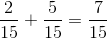
Answer: 
Add the numerators and leave the denominators the same:
Answer:
← Didn't Know|Knew It →
Add:

Add:
Tap to reveal answer
Add the numerators and leave the denominators the same:
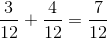
Answer: 
Add the numerators and leave the denominators the same:
Answer:
← Didn't Know|Knew It →
Solve:

Solve:
Tap to reveal answer
Add the numerators and leave the denominators the same:
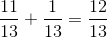
Answer: 
Add the numerators and leave the denominators the same:
Answer:
← Didn't Know|Knew It →
Solve:

Solve:
Tap to reveal answer
Add the numerators and leave the denominators the same:
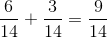
Answer: 
Add the numerators and leave the denominators the same:
Answer:
← Didn't Know|Knew It →
Solve:

Solve:
Tap to reveal answer
Add the numerators and leave the denominators the same:
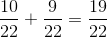
Answer: 
Add the numerators and leave the denominators the same:
Answer:
← Didn't Know|Knew It →
Solve the expression.

Solve the expression.
Tap to reveal answer
Start by solving for the term in parenthesis. We will need to find the least common denominator in order to add the fractions. Since 6 can be multiplied by 2 to get 12, 12 must be the least common denominator.
Convert the fractions so that they share a denominator of 12.


Add the fractions in parenthesis.
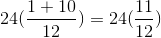
Multiply.

You can then simplify the fraction be removing 12 from both the numerator and denominator.

Start by solving for the term in parenthesis. We will need to find the least common denominator in order to add the fractions. Since 6 can be multiplied by 2 to get 12, 12 must be the least common denominator.
Convert the fractions so that they share a denominator of 12.
Add the fractions in parenthesis.
Multiply.
You can then simplify the fraction be removing 12 from both the numerator and denominator.
← Didn't Know|Knew It →
Add:

Add:
Tap to reveal answer
Add the numerators and leave the denominators alone:
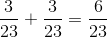
Answer: 
Add the numerators and leave the denominators alone:
Answer:
← Didn't Know|Knew It →
Subtract:

Subtract:
Tap to reveal answer
Subtract the numerators and leave the denominators alone:
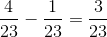
Answer: 
Subtract the numerators and leave the denominators alone:
Answer:
← Didn't Know|Knew It →
Add:

Add:
Tap to reveal answer
Because the two fractions have the same denominator, simply add the numerators and leave the denominator as is:
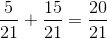
Answer: 
Because the two fractions have the same denominator, simply add the numerators and leave the denominator as is:
Answer:
← Didn't Know|Knew It →
Which of the following is the sum of seven tenths and seventeen hundredths?
Which of the following is the sum of seven tenths and seventeen hundredths?
Tap to reveal answer
Seven tenths is equal to 0.7; seventeen hundredths is equal to 0.17. Add them, rewriting 0.7 as 0.70:


Seven tenths is equal to 0.7; seventeen hundredths is equal to 0.17. Add them, rewriting 0.7 as 0.70:
← Didn't Know|Knew It →
Which of the following is the sum of five-sevenths and one-half?
Which of the following is the sum of five-sevenths and one-half?
Tap to reveal answer
Since  , express each fraction as its equivalent in fourteenths, and add the numerators, as follows:

Since
← Didn't Know|Knew It →
Which of the following is the sum of sixty-seven tenths, sixty-seven hundredths, and sixty-seven ten-thousandths?
Which of the following is the sum of sixty-seven tenths, sixty-seven hundredths, and sixty-seven ten-thousandths?
Tap to reveal answer
Sixty-seven tenths, sixty-seven hundredths, and sixty-seven ten-thousandths can be rewritten as 6.7, 0.67, and 0.0067, respectively. Add, appending zeroes at the end of each number as needed:

Sixty-seven tenths, sixty-seven hundredths, and sixty-seven ten-thousandths can be rewritten as 6.7, 0.67, and 0.0067, respectively. Add, appending zeroes at the end of each number as needed:
← Didn't Know|Knew It →

Tap to reveal answer
I think the easiest way to do this problem is to make a common denominator. 4 is the smallest common denominator.
 is equivalent to
  .
.
When you add  and
and  you get
  .
.
 reduces to
  and is equivalent to
  .
.
I think the easiest way to do this problem is to make a common denominator. 4 is the smallest common denominator.
When you add
← Didn't Know|Knew It →
Add the fractions below.

Add the fractions below.
Tap to reveal answer
First, we need to find a common denominator. In this case, we can convert both denominators to  .
.

Now we can add the numerators.
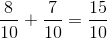
Both the numerator and denominator are divisible by  , so we can simplify.
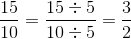
First, we need to find a common denominator. In this case, we can convert both denominators to
Now we can add the numerators.
Both the numerator and denominator are divisible by
← Didn't Know|Knew It →
Find the sum: 
Find the sum:
Tap to reveal answer
Add the fractions by writing each with the lowest common denominator, which is  .
.

Add the integers: 
Now add the two sums: 
Add the fractions by writing each with the lowest common denominator, which is
Add the integers:
Now add the two sums:
← Didn't Know|Knew It →
Evaluate:

Evaluate:
Tap to reveal answer
The sum of two numbers of unlike sign is the difference of their absolute values, with the sign of the "dominant" number (the positive number here) affixed:

Subtract vertically by aligning the decimal points, making sure you append the 3.2 with a placeholder zero:


This is the correct choice.
The sum of two numbers of unlike sign is the difference of their absolute values, with the sign of the "dominant" number (the positive number here) affixed:
Subtract vertically by aligning the decimal points, making sure you append the 3.2 with a placeholder zero:
This is the correct choice.
← Didn't Know|Knew It →

Tap to reveal answer
When adding fractions, both denominators must be the same. A quick and easy way to do this is to multiply the numerator and the denominator of each fraction by the other fraction's denominator:
 and
and 
The  is multiplied by 6 on both ends because the denominator of
  is 6. Likewise,
  is multiplied by 3 on both ends because the denominator of
  is 3. The problem should now look like this:

Remember to reduce. 15 and 18 are both divisible by 3.

Your answer is  .
.
When adding fractions, both denominators must be the same. A quick and easy way to do this is to multiply the numerator and the denominator of each fraction by the other fraction's denominator:
The
Remember to reduce. 15 and 18 are both divisible by 3.
Your answer is
← Didn't Know|Knew It →

Tap to reveal answer
Add the numerators:


Add the numerators:
← Didn't Know|Knew It →
Evaluate:

Evaluate:
Tap to reveal answer
Rewrite these numbers as improper fractions.


Now evaluate:


 , so
, so

Rewrite these numbers as improper fractions.
Now evaluate:
← Didn't Know|Knew It →