
Numbers and Operations - SSAT Middle Level Quantitative
Card 1 of 5772
Solve:

Solve:
Tap to reveal answer
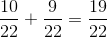
Add the numerators and leave the denominators the same:
Answer: 
Add the numerators and leave the denominators the same:
Answer:
← Didn't Know|Knew It →
What is 220% of 0.00022?
What is 220% of 0.00022?
Tap to reveal answer
220% of a number is 2.2 multiplied by that number, so 220% of 0.00022 is equal to
 .
.
220% of a number is 2.2 multiplied by that number, so 220% of 0.00022 is equal to
← Didn't Know|Knew It →
Solve the expression.

Solve the expression.
Tap to reveal answer
Start by solving for the term in parenthesis. We will need to find the least common denominator in order to add the fractions. Since 6 can be multiplied by 2 to get 12, 12 must be the least common denominator.
Convert the fractions so that they share a denominator of 12.


Add the fractions in parenthesis.
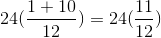
Multiply.

You can then simplify the fraction be removing 12 from both the numerator and denominator.

Start by solving for the term in parenthesis. We will need to find the least common denominator in order to add the fractions. Since 6 can be multiplied by 2 to get 12, 12 must be the least common denominator.
Convert the fractions so that they share a denominator of 12.
Add the fractions in parenthesis.
Multiply.
You can then simplify the fraction be removing 12 from both the numerator and denominator.
← Didn't Know|Knew It →
Add:

Add:
Tap to reveal answer
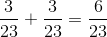
Add the numerators and leave the denominators alone:
Answer: 
Add the numerators and leave the denominators alone:
Answer:
← Didn't Know|Knew It →
Subtract:

Subtract:
Tap to reveal answer
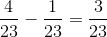
Subtract the numerators and leave the denominators alone:
Answer: 
Subtract the numerators and leave the denominators alone:
Answer:
← Didn't Know|Knew It →
Add:

Add:
Tap to reveal answer
Because the two fractions have the same denominator, simply add the numerators and leave the denominator as is:
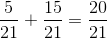
Answer: 
Because the two fractions have the same denominator, simply add the numerators and leave the denominator as is:
Answer:
← Didn't Know|Knew It →
Which of the following is the sum of seven tenths and seventeen hundredths?
Which of the following is the sum of seven tenths and seventeen hundredths?
Tap to reveal answer
Seven tenths is equal to 0.7; seventeen hundredths is equal to 0.17. Add them, rewriting 0.7 as 0.70:


Seven tenths is equal to 0.7; seventeen hundredths is equal to 0.17. Add them, rewriting 0.7 as 0.70:
← Didn't Know|Knew It →
Which of the following is the sum of five-sevenths and one-half?
Which of the following is the sum of five-sevenths and one-half?
Tap to reveal answer
Since  , express each fraction as its equivalent in fourteenths, and add the numerators, as follows:

Since
← Didn't Know|Knew It →
The ratio of tea to milk in Kelsey’s favorite drink is 5:2. The total volume of the drink is 14 ounces. How many ounces of Kelsey’s drink are tea?
The ratio of tea to milk in Kelsey’s favorite drink is 5:2. The total volume of the drink is 14 ounces. How many ounces of Kelsey’s drink are tea?
Tap to reveal answer
Determine the total parts of tea and milk in the drink by adding them  .
.
Divide the total volume of the drink by the number of parts in the drink to determine how many ounces per part 
Finally, multiply the parts of tea (5) by the number of ounces/part. Therefore,  .
.
Determine the total parts of tea and milk in the drink by adding them
Divide the total volume of the drink by the number of parts in the drink to determine how many ounces per part
Finally, multiply the parts of tea (5) by the number of ounces/part. Therefore,
← Didn't Know|Knew It →
Which of the following is the sum of sixty-seven tenths, sixty-seven hundredths, and sixty-seven ten-thousandths?
Which of the following is the sum of sixty-seven tenths, sixty-seven hundredths, and sixty-seven ten-thousandths?
Tap to reveal answer
Sixty-seven tenths, sixty-seven hundredths, and sixty-seven ten-thousandths can be rewritten as 6.7, 0.67, and 0.0067, respectively. Add, appending zeroes at the end of each number as needed:

Sixty-seven tenths, sixty-seven hundredths, and sixty-seven ten-thousandths can be rewritten as 6.7, 0.67, and 0.0067, respectively. Add, appending zeroes at the end of each number as needed:
← Didn't Know|Knew It →
Tim has  of peanuts that he wants to divide evenly into
  bags. How much will each bag of peanuts weigh?
Tim has
Tap to reveal answer
We are splitting  into
into  equal groups, so we are dividing
  by
by  .
.
To solve  we multiply by the reciprocal.


We are splitting
To solve
← Didn't Know|Knew It →
What is the value of  in the proportion?

What is the value of
Tap to reveal answer
Simplify  by dividing both the numerator and denominator by 8 so that it simplifies to
  . Now it should be obvious that
  in order for both sides of the equation to be equal.
Simplify
← Didn't Know|Knew It →
Phil earns  for each hour he works. For every hour he works, he then gives
  to his sister Lola. How much money will Lola have if Phil works
  hours?
Phil earns
Tap to reveal answer
To Solve:
Multiply the  Lola receives by the
  hours Phil worked:

Phil will give Lola  if he works
  hours.
To Solve:
Multiply the
Phil will give Lola
← Didn't Know|Knew It →
For every $3 I earn at work, I donate $1 to charity. How much money will I donate if I make $27.00/week.
For every $3 I earn at work, I donate $1 to charity. How much money will I donate if I make $27.00/week.
Tap to reveal answer
To find the amount of the donation, divide 27 by 3.

The answer is 9.
To find the amount of the donation, divide 27 by 3.
The answer is 9.
← Didn't Know|Knew It →
Give the value of  that makes this proportion statement correct:

Give the value of
Tap to reveal answer
Cross-multiply, then solve for  :
:


Cross-multiply, then solve for
← Didn't Know|Knew It →
Give the value of  that makes this proportion statement correct:

Give the value of
Tap to reveal answer
Cross-multiply, then solve for  :
:


Cross-multiply, then solve for
← Didn't Know|Knew It →
Give the value of  that makes this proportion statement correct:

Give the value of
Tap to reveal answer
Multiply both sides by 80 and solve for  :
:


Multiply both sides by 80 and solve for
← Didn't Know|Knew It →
Give the value of  that makes this proportion statement correct:

Give the value of
Tap to reveal answer
Multiply both sides by 75 and solve for  :
:


Multiply both sides by 75 and solve for
← Didn't Know|Knew It →
Read this problem, but do not solve it.
4 out of every 5 dentists surveyed recommend Triton sugarless gum to patients who chew gum. If 2,100 dentists were surveyed, how many dentists recommended Triton?
If we let  be the number of dentists who recommended Triton, what proportion statement could be used to solve this problem?
Read this problem, but do not solve it.
4 out of every 5 dentists surveyed recommend Triton sugarless gum to patients who chew gum. If 2,100 dentists were surveyed, how many dentists recommended Triton?
If we let
Tap to reveal answer
The ratios that are set equal to each other in a proportion statement must compare the same quantities in the same order.
In each ratio, we can put number of dentists who recommended Triton in the numerator, and number of dentists who were surveyed in the denominator.
One ratio is 4 dentists recommending Triton to 5 dentists surveyed (the general ratio): this is  .
.
The other ratio is  dentists recommending Triton to 2,100 dentists surveyed (the actual number); this is
  .
.
The proportion statement sets these equal:

which is the correct choice.
The ratios that are set equal to each other in a proportion statement must compare the same quantities in the same order.
In each ratio, we can put number of dentists who recommended Triton in the numerator, and number of dentists who were surveyed in the denominator.
One ratio is 4 dentists recommending Triton to 5 dentists surveyed (the general ratio): this is
The other ratio is
The proportion statement sets these equal:
which is the correct choice.
← Didn't Know|Knew It →
Read this problem, but do not solve it: Two inches on a map represent twenty-five miles of actual distance. If Pierce Springs and Buchanan Falls are eight inches apart on the map, how far apart are they in actuality?
If we let  be the actual distance between Pierce Springs and Buchanan Falls, which proportion could be used to solve this problem?
Read this problem, but do not solve it: Two inches on a map represent twenty-five miles of actual distance. If Pierce Springs and Buchanan Falls are eight inches apart on the map, how far apart are they in actuality?
If we let
Tap to reveal answer
The ratios that are set equal to each other in a proportion must compare the same quantities in the same order.
In each ratio, we can put number of map inches in the numerator and the number of actual miles in the denominator.
One ratio is two map inches to twenty-five actual miles (the map scale); this ratio is  .
.
The other ratio is eight map inches to  actual miles (the distance between Pierce Springs and Buchanan Falls); this ratio is
  .
.
The proportion statement that sets these equal to each other is  , and is therefore the correct choice.
The ratios that are set equal to each other in a proportion must compare the same quantities in the same order.
In each ratio, we can put number of map inches in the numerator and the number of actual miles in the denominator.
One ratio is two map inches to twenty-five actual miles (the map scale); this ratio is
The other ratio is eight map inches to
The proportion statement that sets these equal to each other is
← Didn't Know|Knew It →