
How to divide fractions - SSAT Middle Level Quantitative
Card 1 of 716
Tim has  of peanuts that he wants to divide evenly into
  bags. How much will each bag of peanuts weigh?
Tim has
Tap to reveal answer
We are splitting  into
into  equal groups, so we are dividing
  by
by  .
.
To solve  we multiply by the reciprocal.


We are splitting
To solve
← Didn't Know|Knew It →
Drew has  of peanuts that he wants to divide evenly into
  bags. How much will each bag of peanuts weigh?
Drew has
Tap to reveal answer
We are splitting  into
into  equal groups, so we are dividing
  by
by  .
.
To solve  we multiply by the reciprocal.


We are splitting
To solve
← Didn't Know|Knew It →
 is larger than 0. Which of the following could be equal to
  ?
?
I. 
II. 
III. 
I.
II.
III.
Tap to reveal answer
All of the answers can be divided by 3 to yield an answer larger than zero. In fact, any positive number would be a viable answer.
All of the answers can be divided by 3 to yield an answer larger than zero. In fact, any positive number would be a viable answer.
← Didn't Know|Knew It →

Tap to reveal answer
Change division to multiplication by flipping the second fraction. Then, simplify and perform the multiplication.


The answer is 1.
Change division to multiplication by flipping the second fraction. Then, simplify and perform the multiplication.
The answer is 1.
← Didn't Know|Knew It →
Express the quotient as a fraction in lowest terms:

Express the quotient as a fraction in lowest terms:
Tap to reveal answer
Rewrite the mixed fractions as improper fractions, change to a multiplication by inverting the second, cross-cancel, and multiply across:

Rewrite the mixed fractions as improper fractions, change to a multiplication by inverting the second, cross-cancel, and multiply across:
← Didn't Know|Knew It →
Express the quotient as a fraction in lowest terms:

Express the quotient as a fraction in lowest terms:
Tap to reveal answer
Rewrite the mixed fractions as improper fractions, change to a multiplication by inverting the second, cross-cancel, and multiply across:

Rewrite the mixed fractions as improper fractions, change to a multiplication by inverting the second, cross-cancel, and multiply across:
← Didn't Know|Knew It →

Tap to reveal answer
First convert each fraction into an improper fraction.

Then flip the second fraction, reduce and multiply:

The answer is  .
.
First convert each fraction into an improper fraction.
Then flip the second fraction, reduce and multiply:
The answer is
← Didn't Know|Knew It →
Evaluate:

Evaluate:
Tap to reveal answer
Multiply by the reciprocal, cross-cancel, then multiply numerators and denominators:

Multiply by the reciprocal, cross-cancel, then multiply numerators and denominators:
← Didn't Know|Knew It →
Evaluate:

Evaluate:
Tap to reveal answer
Multiply by the reciprocal, cross-cancel, then multiply numerators and denominators:

Multiply by the reciprocal, cross-cancel, then multiply numerators and denominators:
← Didn't Know|Knew It →
Evaluate:

Evaluate:
Tap to reveal answer
Multiply by the reciprocal, cross-cancel, then multiply numerators and denominators:

Multiply by the reciprocal, cross-cancel, then multiply numerators and denominators:
← Didn't Know|Knew It →
Evaluate:

Evaluate:
Tap to reveal answer
Multiply by the reciprocal, cross-cancel, then multiply numerators and denominators:

Multiply by the reciprocal, cross-cancel, then multiply numerators and denominators:
← Didn't Know|Knew It →
Evaluate:

Evaluate:
Tap to reveal answer

← Didn't Know|Knew It →
Evaluate:

Evaluate:
Tap to reveal answer

← Didn't Know|Knew It →
Evaluate:

Evaluate:
Tap to reveal answer
By order of operations, divide first. Move the decimal point right two places in both dividend and divisor to make the divisor a whole number, and divide the resulting whole numbers:

Add this quotient to 80.8:

Append a decimal point and a zero to 40, align the decimal points, and add:


By order of operations, divide first. Move the decimal point right two places in both dividend and divisor to make the divisor a whole number, and divide the resulting whole numbers:
Add this quotient to 80.8:
Append a decimal point and a zero to 40, align the decimal points, and add:
← Didn't Know|Knew It →
Evaluate:

Evaluate:
Tap to reveal answer
By order of operations, divide first. Since the divisor is a whole number, divide as is:

Add this quotient to 6.51.

Add vertically, aligning the decimal points (appending a zero to 0.3):


By order of operations, divide first. Since the divisor is a whole number, divide as is:
Add this quotient to 6.51.
Add vertically, aligning the decimal points (appending a zero to 0.3):
← Didn't Know|Knew It →
Which of the following yields the largest number?
Which of the following yields the largest number?
Tap to reveal answer
When dividing by a fraction between 0 and 1, the answer will always get larger. In this case it is larger than simply adding the two fractions together.
When dividing by a fraction between 0 and 1, the answer will always get larger. In this case it is larger than simply adding the two fractions together.
← Didn't Know|Knew It →
Evaluate:

Evaluate:
Tap to reveal answer
Rewrite this horizontally as a division expression, rewrite as a product, cross-cancel, and multply across:


Rewrite this horizontally as a division expression, rewrite as a product, cross-cancel, and multply across:
← Didn't Know|Knew It →
Evaluate:

Evaluate:
Tap to reveal answer
Rewrite this horizontally as a division expression, rewrite as a product, cross-cancel, and finally multiply across:

Since  ,
,
 ,
,
which is the correct answer.
Rewrite this horizontally as a division expression, rewrite as a product, cross-cancel, and finally multiply across:
Since
which is the correct answer.
← Didn't Know|Knew It →
Evaluate:

Evaluate:
Tap to reveal answer
Rewrite this horizontally as a division expression, rewrite as a product, cross-cancel, and multply across:

Since  ,
,

Rewrite this horizontally as a division expression, rewrite as a product, cross-cancel, and multply across:
Since
← Didn't Know|Knew It →

Tap to reveal answer
When dividing fractions, first find the reciprocal of the second fraction and change the problem to multiplication:
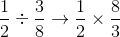
You then treat the problem like any other multiplication problem and multiply straight across.

Since the numerator is larger than the denominator, we know our answer will be greater than 1.

6 divides into 8 one time, with 2 remaining. The 2 remains on top of the 6 as the numerator. This answer can still be reduced; however, as 2 and 6 are both evenly divisible by 2.

Your final answer is 
When dividing fractions, first find the reciprocal of the second fraction and change the problem to multiplication:
You then treat the problem like any other multiplication problem and multiply straight across.
Since the numerator is larger than the denominator, we know our answer will be greater than 1.
6 divides into 8 one time, with 2 remaining. The 2 remains on top of the 6 as the numerator. This answer can still be reduced; however, as 2 and 6 are both evenly divisible by 2.
Your final answer is
← Didn't Know|Knew It →