
How to find the domain of a function
SAT Math · Learn by Concept
Help Questions
SAT Math › How to find the domain of a function
Which of the following functions has a domain that includes all real values of 
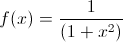
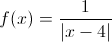
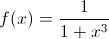

Explanation
The domain of a function includes all of the values of x for which that function is defined. In other words, the domain is all of the real values of x that will produce a real number. Let's look at the domains of each function one at a time.
First, let's examine
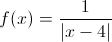
In general, when we are examining the domain of a function, we want to find places where we end up with zeros in the denominators or square-roots of negative numbers. For example, in the function 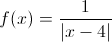
Next, let's look at 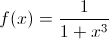

Subtract one from both sides.

Take the cube root of both sides.

Thus, if x = –1, then f(x) will be equal to 1/0, which isn't defined, because we can't divide by zero. Therefore, we can eliminate this answer choice.
Now, let's analyze 
We can never take the square root of a negative number. Thus, if 

Next, let's look at 
![a^{\frac{b}{c}}=\sqrt[c]{a^b}](https://vt-vtwa-assets.varsitytutors.com/vt-vtwa/uploads/formula_image/image/17894/gif.latex)


By process of elimination the answer must be 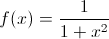
The answer is
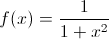
Let 
If 


Explanation
Because x and y must be negative integers greater than negative five, then x and y can only be equal to the following values:
x can equal -4, -3, -2, or -1
y can equal -4, -3, -2, or -1
Now we can try all of the combinations of x and y, and see what x # y would equal. It is helpful to note that x # y is the same as y # x because 2yx + y + x = 2xy + x + y. This means that the order of x and y doesn't matter.
-4 # -4 = 2(-4)(-4) + -4 + -4 = 24
-4 # -3 = 2(-4)(-3) + -4 + -3 = 17
-4 # -2 = 10
-4 # -1 = 3
-3 # -3 = 12
-3 # -2 = 7
-3 # -1 = 2
-2 # -2 = 4
-2 # -1 = 1
-1 # -1 = 0
We don't need to find -3 # -4, -2 # -4, etc, because x # y = y # x .
The smallest value of x # y must be 0.
What is the domain of the function f(x) = 2/(7x – 1) ?
x > (1/7)
x < (1/7)
x < (–1/7)
x > (–1/7)
x ≠ (1/7)
Explanation
The domain means what real number can you plug in that would still make the function work. For this case, we have to worry about the denominator so that it does not equal 0, so we solve the following. 7x – 1 = 0, 7x = 1, x = 1/7, so when x ≠ 1/7 the function will work.
Find the domain of the function:
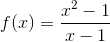
All real numbers except for 1
All real numbers
All real numbers except for –2
0
Explanation
If a value of x makes the denominator of a equation zero, that value is not part of the domain. This is true, even here where the denominator can be "cancelled" by factoring the numerator into

and then cancelling the 
This new expression, 


Thus the domain of the function is all 

What is the domain of the given function?
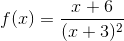
x ≠ –3
All real numbers
x ≠ 3, –3
x ≠ 3
x ≠ 0
Explanation
The domain of the function is all real numbers except x = –3. When x = –3, f(–3) is undefined.

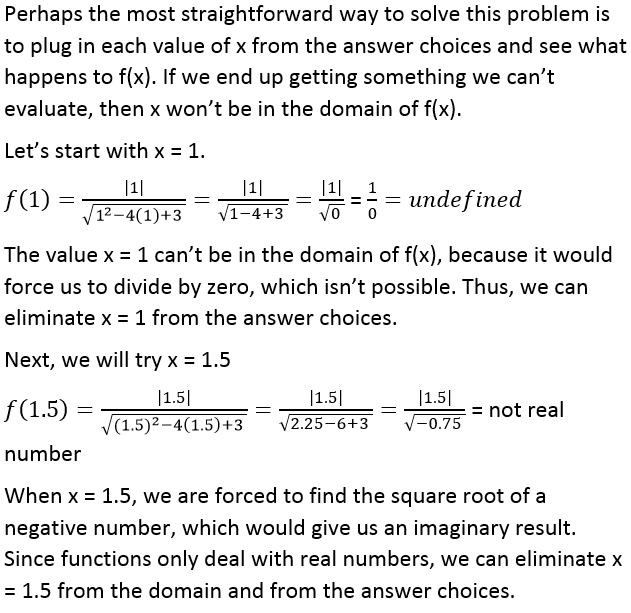
x = 0
x = 1
x = 1.5
x = 2
x = 3
Explanation
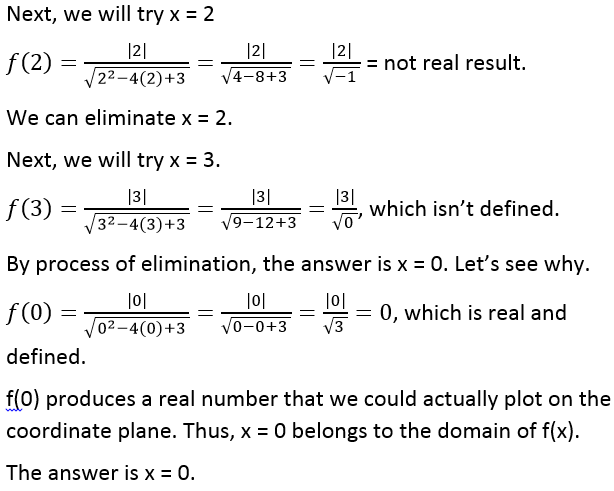
Find the domain of the following function.


Explanation
To find the domain, you must find all the values you can put in for x. Thus, you must figure out what values would "break" your function and give you something unable to be computed.
First we know that the number inside a square root must be positive. Thus, we can set the inside greater than or equal to 0 and solve.

We also know that the denominator of a fraction must never be 0. Thus, if we find out when it is 0, we can exclude that x value from our domain.

If we combine both of these for x, we can create an interval for our domain.

Define a function 
It is desired that is domain be restricted so that 


Explanation
A quadratic function has a parabola as its graph; this graph changes direction (downward to upward, or vice versa) at a given point called the vertex.


The 

is 
The 


Of the five intervals in the choices,

so 

Define a function 

Give the range of 


Explanation
A quadratic function has a parabola as its graph; this graph changes direction at a vertex.
The 

is 
The 


The minimum and maximum values of 


Define 

Determine 


Explanation
First, we must determine whether 
A quadratic function has a parabola as its graph; this graph changes direction at its vertex.


The
is
The 


The vertex of the graph of 


To determine the inverse of 


The graph of 


Therefore, 
The vertex form of

Replace 

Switch 


Solve for 


Multiply both sides by 2:


Take the square root of both sides:

Subtract 8 from both sides


Replace 


Either 

The domain of 


