
How to divide fractions
SAT Math · Learn by Concept
Help Questions
SAT Math › How to divide fractions
Simplify


Fractions with variables cannot be divided
Explanation
When you dividing fractions, multiply by the reciprocal of the denominator.

Evaluate the expression:


Explanation
When dividing fractions, you invert the second term and multiply the numbers.

You can reduce the numbers that are diagonal from each other to make the numbers smaller and easier to multiply.
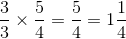
If 


Explanation
Dividing by a number (in this case 

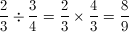
Evaluate the following:
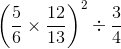


None of the available answers
Explanation
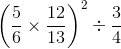
First we will evaluate the terms in the parentheses:
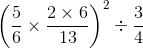
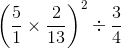

Next, we will square the first fraction:


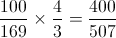
We can evaluate the division as such:
If p is a positive integer, and 4 is the remainder when p-8 is divided by 5, which of the following could be the value of p?
17
18
19
20
Explanation
Remember that if x has a remainder of 4 when divided by 5, xminus 4 must be divisible by 5. We are therefore looking for a number p such that p - 8 - 4 is divisible by 5. The only answer choice that fits this description is 17.
Simplify:

a2/c2
ad/bc
a/b/c/d
ac/bd
It is already in simplest terms
Explanation
Division is the same as multiplying by the reciprocal. Thus, a/b ÷ c/d = a/b x d/c = ad/bc