
Matrices
SAT Subject Test in Math II · Learn by Concept
Help Questions
SAT Subject Test in Math II › Matrices
If 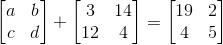



Explanation
You can treat matrices just like you treat other members of an equation. Therefore, you can subtract the matrix

from both sides of the equation. This gives you:
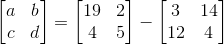
Now, matrix subtraction is simple. You merely subtract each element, matching the correlative spaces with each other:
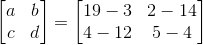
Then, you simplify:

Therefore,

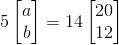
What is 


Explanation
You can begin by treating this equation just like it was:

That is, you can divide both sides by 
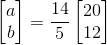
Now, for scalar multiplication of matrices, you merely need to multiply the scalar by each component:
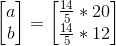
Then, simplify:

Therefore,

If 


Explanation
Begin by distributing the fraction through the matrix on the left side of the equation. This will simplify the contents, given that they are factors of 
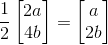
Now, this means that your equation looks like:

This simply means:

and


Therefore,

Let 

Let 
Which of the following is equal to 


Explanation
The 2 x 2 identity matrix is 


so

Subtract the elements in the corresponding positions:


Simplify:
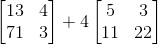


Explanation
Scalar multiplication and addition of matrices are both very easy. Just like regular scalar values, you do multiplication first:

The addition of matrices is very easy. You merely need to add them directly together, correlating the spaces directly.




Calculate:


Explanation
To add two matrices, add the elements in corresponding positions:


Let 
Give 


Explanation


For which of the following real values of 


None of these


Explanation
A matrix 


We seek the value of 


Therefore, either 


Evaluate 


Explanation

The element in row 


Multiply:

The matrices cannot be multiplied.


Explanation
Two matrices can be multiplied if and only if the number of columns in the first matrix and the number of rows in the second are equal. The first matrix has two columns; the second matrix has one row. This violates the condition, so they cannot be multiplied in this order.