
Factoring and Finding Roots
SAT Subject Test in Math II · Learn by Concept
Help Questions
SAT Subject Test in Math II › Factoring and Finding Roots
Give the set of all real solutions of the equation 


The equation has no real solution.
Explanation
Set 


Substituting 


a quadratic equation in 
This can be solved using the 


By the Zero Product Principle, one of these factors is equal to zero:
Either:


Substituting 

Taking the positive and negative square roots of both sides:

Or:


Substituting back:

Taking the positive and negative square roots of both sides, and applying the Quotient of Radicals property, then simplifying by rationalizing the denominator:

The solution set is 
A cubic polynomial 


The correct answer cannot be determined from the information given.


Explanation
A polynomial with rational coefficients has its imaginary zeroes in conjugate pairs. Two imaginary zeroes are given that are each other's complex conjugate - 

Which of the following values of 

a prime polynomial?


None of the other responses is correct.
Explanation


Therefore, for each given value of 


Which of the following choices gives a sixth root of seven hundred and twenty-nine?

None of these


Explanation
Let 

Subtracting 64 from both sides, this equation becomes

729 is a perfect square (of 27) The binomial at left can be factored first as the difference of two squares:


27 is a perfect cube (of 3), so the two binomials can be factored as the sum and difference, respectively, of two cubes:


The equation therefore becomes

By the Zero Product Principle, one of these factors must be equal to 0.
If 


If 



If 


Therefore, the set of sixth roots of 729 is

Of the choices given, 
A polynomial 


Which of the following is this polynomial?


Cannot be determined
Explanation
A fourth-degree, or quartic, polynomial has four zeroes, if a zero of multiplicity 


where the 
A polynomial with rational coefficients has its imaginary zeroes in conjugate pairs. Since 


We can rewrite this as

or

Multiply these factors using the difference of squares pattern, then the square of a binomial pattern:


Therefore,

Multiplying:


Define a function 


Explanation
Define 


By the Intermediate Value Theorem (IVT), if 


Evaluate 


Only in the case of 


Define functions 


Explanation
Define


Then if 
it follows that

or, equivalently,

By the Intermediate Value Theorem (IVT), if
Since polynomial 


Evaluate 


Only in the case of 


Which of the following could be a solution for the equation 


There are no solutions for the equation.
Explanation
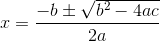
From the discriminant, 

Next, factor the equation 

Finally, solve for 

What is a possible root to 


Explanation
Factor the trinomial.
The multiples of the first term is 
The multiples of the third term is 
We can then factor using these terms.

Set the equation to zero.

This means that each product will equal zero.

The roots are either

The answer is:

Which of the following values of

a prime polynomial?
None of the other responses is correct.


Explanation


