
Absolute Value
SAT Subject Test in Math II · Learn by Concept
Help Questions
SAT Subject Test in Math II › Absolute Value
Solve:


Explanation
The lines on the outside of this problem indicate it is an absolute value problem. When solving with absolute value, remember that it is a measure of displacement from 0, meaning the answer will always be positive.

For this problem, that gives us a final answer of 10.
Solve:



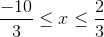


Explanation
Here, we have to split the problem up into two parts:


Let's start with the first equation:

First, we can add 

Now we divide by -6. Remember, when you divide by a negative, you flip the sign of the inequality:

Which we can reduce:

Now let's do the other part of the problem the same way:


Give the solution set of the inequality:

All real numbers


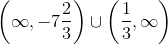
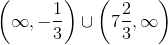
Explanation
To solve an absolute value inequality, first isolate the absolute value expression, which can be done here by subtracting 35 from both sides:



There is no need to go further. The absolute value of any number is always greater than or equal to 0, so, regardless of the value of 

Therefore, the solution set is the set of all real numbers.
Solve:


Explanation
The lines on the outside of this problem indicate it is an absolute value problem. When solving with absolute value, remember that it is a measure of displacement from 0, meaning the answer will always be positive.

For this problem, that gives us a final answer of 25.
Define 
Evaluate 


Explanation


Solve:


Explanation
The lines on the outside of this problem indicate it is an absolute value problem. When solving with absolute value, remember that it is a measure of displacement from 0, meaning the answer will always be positive.

For this problem, that gives us a final answer of 12.
Solve:


Explanation
The lines on the outside of this problem indicate it is an absolute value problem. When solving with absolute value, remember that it is a measure of displacement from 0, meaning the answer will always be positive.

For this problem, that gives us a final answer of 7.
Solve:


Explanation
The lines on the outside of this problem indicate it is an absolute value problem. When solving with absolute value, remember that it is a measure of displacement from 0, meaning the answer will always be positive.

For this problem, that gives us a final answer of 129.
Solve:


Explanation
The lines on the outside of this problem indicate it is an absolute value problem. When solving with absolute value, remember that it is a measure of displacement from 0, meaning the answer will always be positive.

For this problem, that gives us a final answer of 14.
Solve:


Explanation
The lines on the outside of this problem indicate it is an absolute value problem. When solving with absolute value, remember that it is a measure of displacement from 0, meaning the answer will always be positive.

For this problem, that gives us a final answer of 10.