
Slope
SAT Subject Test in Math I · Learn by Concept
Help Questions
SAT Subject Test in Math I › Slope
What is the slope of the line depicted by this equation?


Explanation
This equation is written in standard form, that is, 


In this instance 

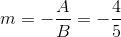
This question can also be solved by converting the slope-intercept form: 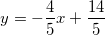
Find the slope of the line



Explanation
To find the slope of any line, we must get the equation into the form

where m is the slope and b is the y-intercept.
To manipulate our equation into this form, we must solve for y. First, we must move the x term to the right side of our equation by subtracting it from both sides.


To isolate y, we now must divide each side by 3.
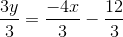
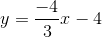
Now our equation is in the desired form. The coefficient of our x term is our slope, 

Find the slope of the following equation:


Explanation
In order to find the slope, we will need to rearrange the equation so that it is in slope-intercept form 
Subtract 


Divide by three on both sides.
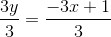

This equation is now in the form of 

The slope is 

What is the slope of the function above?


Explanation
First you must get the formula into slope-intercept form which means having 


You must multiple both sides by 

The slope is the value being multiplied by the 

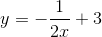
What is the slope of the given equation?



Explanation
The slope in a linear equation is defined as 
The x-variable exists in the denominator, which refers to the parent function of:

This function is not linear, and will have changing slope along its domain.
The answer is:

What is the slope of the following equation?


Explanation
The given equation will need to be rewritten in slope intercept format.

Divide by two on both sides.

Rearrange the right side by order of powers.
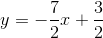
The slope can be seen as

The answer is:
