
Area
SAT Subject Test in Math I · Learn by Concept
Help Questions
SAT Subject Test in Math I › Area
Find the area of a kite with diagonal lengths of 


Explanation
Write the formula for the area of a kite.

Plug in the given diagonals.
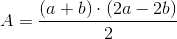
Pull out a common factor of two in 
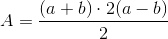

Use the FOIL method to simplify.


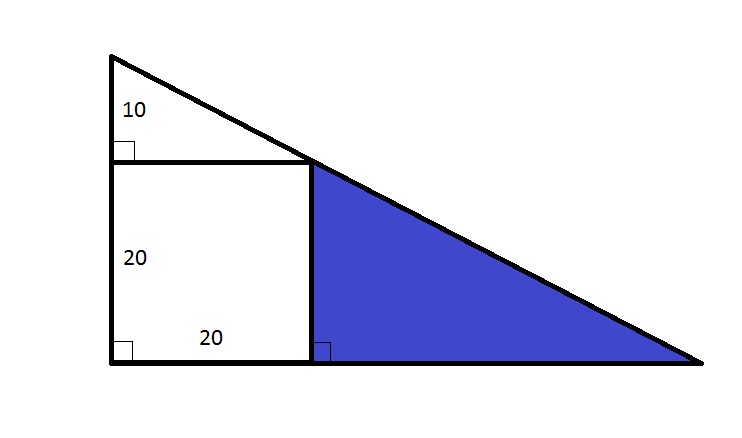
Note: Figure NOT drawn to scale.
Refer to the figure above, which shows a square inscribed inside a large triangle. What percent of the entire triangle has been shaded blue?


Insufficient information is given to answer the question.
Explanation
The shaded portion of the entire triangle is similar to the entire large triangle by the Angle-Angle postulate, so sides are in proportion. The short leg of the blue triangle has length 20; that of the large triangle, 30. Therefore, the similarity ratio is 


The blue triangle is therefore 

Find the area of a circle with a diameter of 


Explanation
Write the formula for the area of a circle.

Substitute the diameter and solve.

On the XY plane, line segment AB has endpoints (0, a) and (b, 0). If a square is drawn with segment AB as a side, in terms of a and b what is the area of the square?


Cannot be determined
Explanation
Since the question is asking for area of the square with side length AB, recall the formula for the area of a square.

Now, use the distance formula to calculate the length of AB.

let

Now substitute the values into the distance formula.

From here substitute the side length value into the area formula.

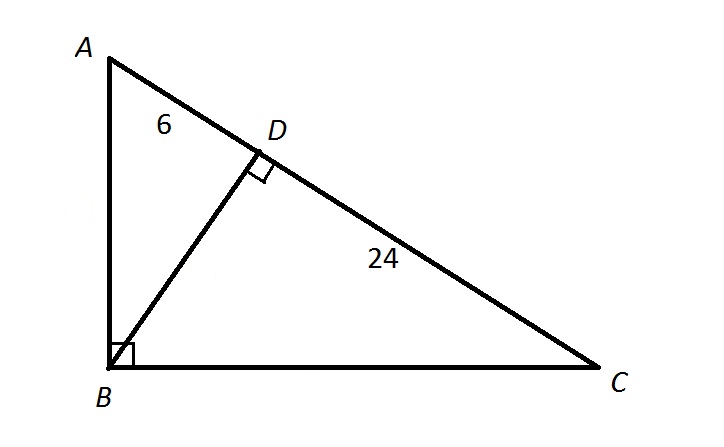
Note: Figure NOT drawn to scale.
Refer to the above diagram. Give the ratio of the area of 


Insufficient information is given to answer the question.
Explanation


The areas of 

The area of 

The area of 

The ratio of the areas is 
Give the area of 


Cannot be determined

Explanation
The area of a triangle, given its three sidelengths, can be calculated using Heron's formula:

where 


Setting, 


and, substituting in Heron's formula:


Give the area of 


Explanation
The area of a triangle with two sides of lengths 


Setting 


Find the area of a kite if the diagonal dimensions are 


Explanation
The area of the kite is given below. The FOIL method will need to be used to simplify the binomial.


The diagonals of a kite are 


Explanation
The formula for the area for a kite is


Figure not drawn to scale.
Find the area of the rectangle above when the perimeter is 36 in.
72 in2
70 in2
144 in2
36 in2
84 in2
Explanation
Because we know the perimeter is 36 inches, we can determine the length of side w based on the equation of the perimeter of a rectangle:


Side w is 6 in long.
Now that we know that side w is 6 inches long, we have everythinng we need to calculate the area of the rectangle.

