
Analyzing Figures
SAT Subject Test in Math I · Learn by Concept
Help Questions
SAT Subject Test in Math I › Analyzing Figures
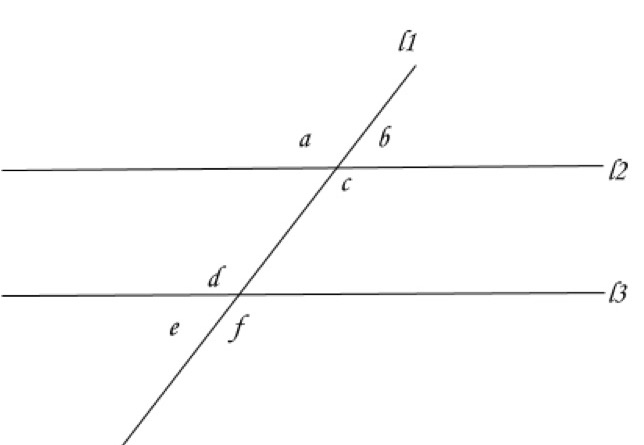
If line 2 and line 3 eventually intersect when extended to the left which of the following could be true?
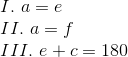
I only
Cannot be determined
I and II
I and III
I, II, and III
Explanation
Read the question carefully and notice that the image is deceptive: these lines are not parallel. So we cannot apply any of our rules about parallel lines. So we cannot infer II or III, those are only trueif the lines are parallel. If we sketch line 2 and line 3 meeting we will form a triangle and it is possible to make a = e. One such solution is to make a and e 60 degrees.
What is the maximum number of distinct regions that can be created with 4 intersecting circles on a plane?


Explanation
Try sketching it out.
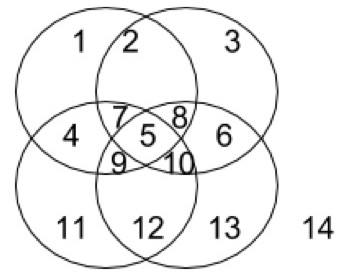
Start with one circle and then keep adding circles like a venn diagram and start counting. A region is any portion of the figure that can be defined and has a boundary with another portion. Don't forget that the exterior (labeled 14) is a region that does not have exterior boundaries.
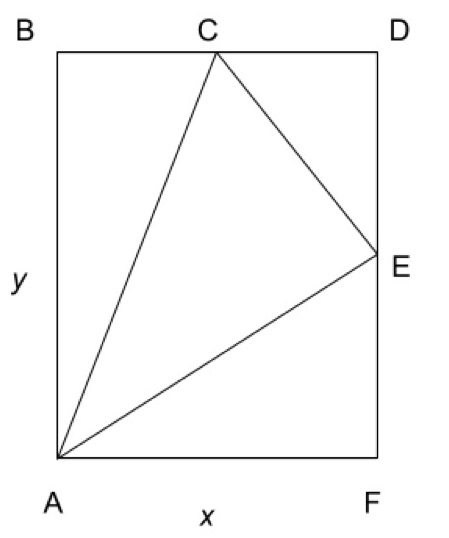
Note: Figure may not be drawn to scale
In rectangle 


cannot be determined
Explanation
Notice that the figure may not be to scale, and points 

Next, recall the formula for the area of a triangle:

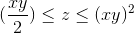
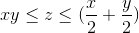
To find the minimum area we need the smallest possible values for 

To make 


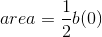


To find the maximum value we need the largest possible values for 


which is the maximum possible area of triangle
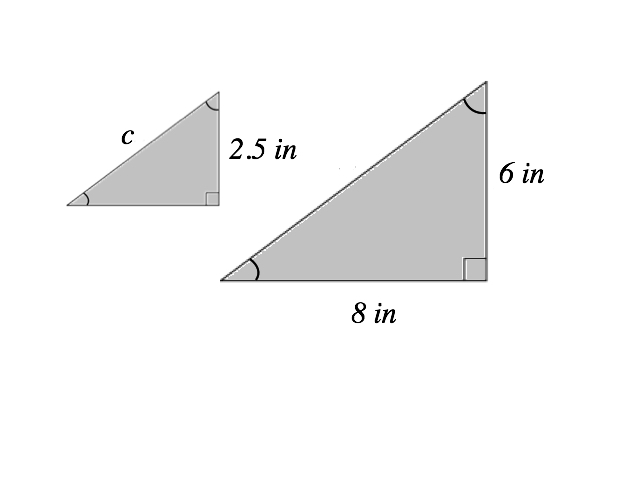
Figures not drawn to scale
The triangles above are similar. Given the measurements above, what is the length of side c?


Explanation
You can find the length of c by first finding the length of the hypotenuse of the larger similar triangle and then setting up a ratio to find the hypotenuse of the smaller similar triangle.


You also could have found 10 by recognizing this triangle is a form of a 3-4-5 triangle.
The hypotenuse of the bigger triangle is 10 inches.
Now that we know the length of the hypotenuse for the larger triangle, we can set up a ratio equation to find the hypotenuse of the smaller triangle.


The sides of a triangle have lengths 6 yards, 18 feet, and 216 inches. Which of the following is true about this triangle?
The triangle is acute and equilateral.
This triangle is acute and scalene.
This triangle is right and scalene.
This triangle is right and isosceles, but not equilateral.
This triangle is acute and isosceles, but not equilateral.
Explanation
One yard is equal to 3 feet; it is also equal to 36 inches. Therefore:
18 feet is equal to 
and
216 feet is equal to 
The three sides are congruent, making the triangle equilateral - and all equilateral triangles are acute.