
Solid Geometry - PSAT Math
Card 1 of 1015
How many smaller boxes with a dimensions of 1 by 5 by 5 can fit into cube shaped box with a surface area of 150?
How many smaller boxes with a dimensions of 1 by 5 by 5 can fit into cube shaped box with a surface area of 150?
Tap to reveal answer
There surface are of a cube is 6 times the area of one face of the cube , therefore 


a is equal to an edge of the cube
the volume of the cube is 
The problem states that the dimensions of the smaller boxes are 1 x 5 x 5, the volume of one of the smaller boxes is 25.
Therefore, 125/25 = 5 small boxes
There surface are of a cube is 6 times the area of one face of the cube , therefore
a is equal to an edge of the cube
the volume of the cube is
The problem states that the dimensions of the smaller boxes are 1 x 5 x 5, the volume of one of the smaller boxes is 25.
Therefore, 125/25 = 5 small boxes
← Didn't Know|Knew It →
A cube weighs 5 pounds. How much will a different cube of the same material weigh if the sides are 3 times as long?
A cube weighs 5 pounds. How much will a different cube of the same material weigh if the sides are 3 times as long?
Tap to reveal answer
A cube that has three times as long sides is 3x3x3=27 times bigger than the original. Therefore, the answer is 5x27= 135.
A cube that has three times as long sides is 3x3x3=27 times bigger than the original. Therefore, the answer is 5x27= 135.
← Didn't Know|Knew It →
If the volume of a cube is 50 cubic feet, what is the volume when the sides double in length?
If the volume of a cube is 50 cubic feet, what is the volume when the sides double in length?
Tap to reveal answer
Using S as the side length in the original cube, the original is s*s*s. Doubling one side and tripling the other gives 2s*2s*2s for a new volume formula for 8s*s*s, showing that the new volume is 8x greater than the original.
Using S as the side length in the original cube, the original is s*s*s. Doubling one side and tripling the other gives 2s*2s*2s for a new volume formula for 8s*s*s, showing that the new volume is 8x greater than the original.
← Didn't Know|Knew It →
A right rectangular prism has a volume of 64 cubic units. Its dimensions are such that the second dimension is twice the length of the first, and the third is one-fourth the dimension of the second. What are its exact dimensions?
A right rectangular prism has a volume of 64 cubic units. Its dimensions are such that the second dimension is twice the length of the first, and the third is one-fourth the dimension of the second. What are its exact dimensions?
Tap to reveal answer
Based on our prompt, we can say that the prism has dimensions that can be represented as:
Dim1: x
Dim2: 2 * Dim1 = 2x
Dim3: (1/4) * Dim2 = (1/4) * 2x = (1/2) * x
More directly stated, therefore, our dimensions are: x, 2x, and 0.5x. Therefore, the volume is x * 2x * 0.5x = 64, which simplifies to x3 = 64. Solving for x, we find x = 4. Therefore, our dimensions are:
x = 4
2x = 8
0.5x = 2
Or: 2 x 4 x 8
Based on our prompt, we can say that the prism has dimensions that can be represented as:
Dim1: x
Dim2: 2 * Dim1 = 2x
Dim3: (1/4) * Dim2 = (1/4) * 2x = (1/2) * x
More directly stated, therefore, our dimensions are: x, 2x, and 0.5x. Therefore, the volume is x * 2x * 0.5x = 64, which simplifies to x3 = 64. Solving for x, we find x = 4. Therefore, our dimensions are:
x = 4
2x = 8
0.5x = 2
Or: 2 x 4 x 8
← Didn't Know|Knew It →
A right rectangular prism has a volume of 120 cubic units. Its dimensions are such that the second dimension is three times the length of the first, and the third dimension is five times the dimension of the first. What are its exact dimensions?
A right rectangular prism has a volume of 120 cubic units. Its dimensions are such that the second dimension is three times the length of the first, and the third dimension is five times the dimension of the first. What are its exact dimensions?
Tap to reveal answer
Based on our prompt, we can say that the prism has dimensions that can be represented as:
Dim1: x
Dim2: 3 * Dim1 = 3x
Dim3: 5 * Dim1 = 5x
More directly stated, therefore, our dimensions are: x, 3x, and 5x. Therefore, the volume is x * 3x * 5x = 120, which simplifies to 15x3 = 120 or x3 = 8. Solving for x, we find x = 2. Therefore, our dimensions are:
x = 2
3x = 6
5x = 10
Or: 2 x 6 x 10
Based on our prompt, we can say that the prism has dimensions that can be represented as:
Dim1: x
Dim2: 3 * Dim1 = 3x
Dim3: 5 * Dim1 = 5x
More directly stated, therefore, our dimensions are: x, 3x, and 5x. Therefore, the volume is x * 3x * 5x = 120, which simplifies to 15x3 = 120 or x3 = 8. Solving for x, we find x = 2. Therefore, our dimensions are:
x = 2
3x = 6
5x = 10
Or: 2 x 6 x 10
← Didn't Know|Knew It →
An upright cylinder with a height of 30 and a radius of 5 is in a big tub being filled with oil. If only the top 10% of the cylinder is visible, what is the surface area of the submerged cylinder?
An upright cylinder with a height of 30 and a radius of 5 is in a big tub being filled with oil. If only the top 10% of the cylinder is visible, what is the surface area of the submerged cylinder?
Tap to reveal answer
The height of the submerged part of the cylinder is 27cm. 2πrh + πr2 is equal to 270π + 25π = 295π
The height of the submerged part of the cylinder is 27cm. 2πrh + πr2 is equal to 270π + 25π = 295π
← Didn't Know|Knew It →
A cylinder has a volume of 20. If the radius doubles, what is the new volume?
A cylinder has a volume of 20. If the radius doubles, what is the new volume?
Tap to reveal answer
The equation for the volume of the cylinder is πr2h. When the radius doubles (r becomes 2r) you get π(2r)2h = 4πr2h. So when the radius doubles, the volume quadruples, giving a new volume of 80.
The equation for the volume of the cylinder is πr2h. When the radius doubles (r becomes 2r) you get π(2r)2h = 4πr2h. So when the radius doubles, the volume quadruples, giving a new volume of 80.
← Didn't Know|Knew It →
A cone has a base circumference of 77_π_ in and a height of 2 ft. What is its approximate volume?
A cone has a base circumference of 77_π_ in and a height of 2 ft. What is its approximate volume?
Tap to reveal answer
There are two things to be careful with here. First, we must solve for the radius of the base. Secondly, note that the height is given in feet, not inches. Notice that all the answers are in cubic inches. Therefore, it will be easiest to convert all of our units to inches.
First, solve for the radius, recalling that C = 2_πr_, or, for our values 77_π_ = 2_πr_. Solving for r, we get r = 77/2 or r = 38.5.
The height, in inches, is 24.
The basic form for the volume of a cone is: V = (1 / 3)πr_2_h
For our values this would be:
V = (1/3)π * 38.52 * 24 = 8 * 1482.25_π_ = 11,858π in3
There are two things to be careful with here. First, we must solve for the radius of the base. Secondly, note that the height is given in feet, not inches. Notice that all the answers are in cubic inches. Therefore, it will be easiest to convert all of our units to inches.
First, solve for the radius, recalling that C = 2_πr_, or, for our values 77_π_ = 2_πr_. Solving for r, we get r = 77/2 or r = 38.5.
The height, in inches, is 24.
The basic form for the volume of a cone is: V = (1 / 3)πr_2_h
For our values this would be:
V = (1/3)π * 38.52 * 24 = 8 * 1482.25_π_ = 11,858π in3
← Didn't Know|Knew It →
A cube is inscribed in a sphere of radius 1 such that all 8 vertices of the cube are on the surface of the sphere. What is the length of the diagonal of the cube?
A cube is inscribed in a sphere of radius 1 such that all 8 vertices of the cube are on the surface of the sphere. What is the length of the diagonal of the cube?
Tap to reveal answer
Since the diagonal of the cube is a line segment that goes through the center of the cube (and also the circumscribed sphere), it is clear that the diagonal of the cube is also the diameter of the sphere. Since the radius = 1, the diameter = 2.
Since the diagonal of the cube is a line segment that goes through the center of the cube (and also the circumscribed sphere), it is clear that the diagonal of the cube is also the diameter of the sphere. Since the radius = 1, the diameter = 2.
← Didn't Know|Knew It →
If a sphere has an approximate volume of  , then what is the approximate diameter of this sphere?
If a sphere has an approximate volume of
Tap to reveal answer
The formula for the volume of a sphere is
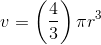
Therefore,
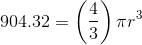
Dividing both sides by  , leaves us with
  . Taking the cube root, we find
  , meaning our diameter
  .
.
The formula for the volume of a sphere is
Therefore,
Dividing both sides by
← Didn't Know|Knew It →
A cube with volume 27 cubic inches is inscribed inside a sphere such that each vertex of the cube touches the sphere. What is the radius, in inches, of the sphere?
A cube with volume 27 cubic inches is inscribed inside a sphere such that each vertex of the cube touches the sphere. What is the radius, in inches, of the sphere?
Tap to reveal answer
We know that the cube has a volume of 27 cubic inches, so each side of the cube must be ∛27=3 inches. Since the cube is inscribed inside the sphere, the diameter of the sphere is the diagonal length of the cube, so the radius of the sphere is half of the diagonal length of the cube. To find the diagonal length of the cube, we use the distance formula d=√(32+32+32 )=√(3*32 )=3√3, and then divide the result by 2 to find the radius of the sphere, (3√3)/2.
We know that the cube has a volume of 27 cubic inches, so each side of the cube must be ∛27=3 inches. Since the cube is inscribed inside the sphere, the diameter of the sphere is the diagonal length of the cube, so the radius of the sphere is half of the diagonal length of the cube. To find the diagonal length of the cube, we use the distance formula d=√(32+32+32 )=√(3*32 )=3√3, and then divide the result by 2 to find the radius of the sphere, (3√3)/2.
← Didn't Know|Knew It →
The surface area of a sphere is 100π square feet. What is the radius in feet?
The surface area of a sphere is 100π square feet. What is the radius in feet?
Tap to reveal answer
S = 4π(r2)
100π = 4π(r2)
100 = 4r2
25 = r2
5 = r
S = 4π(r2)
100π = 4π(r2)
100 = 4r2
25 = r2
5 = r
← Didn't Know|Knew It →
Find the radius of a sphere whose volume is 
 .
.
Find the radius of a sphere whose volume is
Tap to reveal answer
Use the equation for the volume of a sphere to find the radius.


So, the radius of the sphere is 3
Use the equation for the volume of a sphere to find the radius.
So, the radius of the sphere is 3
← Didn't Know|Knew It →
A spherical water tank has a surface area of 400 square meters. To the nearest tenth of a meter, give the radius of the tank.
A spherical water tank has a surface area of 400 square meters. To the nearest tenth of a meter, give the radius of the tank.
Tap to reveal answer
Given radius  , the surface area of a sphere
  is given by the formula

Set  and solve for
  :
:


 meters.
Given radius
Set
← Didn't Know|Knew It →
The city of Washington wants to build a spherical water tank for the town hall. The tank is to have capacity 120 cubic meters of water.
To the nearest tenth, what will the radius of the tank be?
The city of Washington wants to build a spherical water tank for the town hall. The tank is to have capacity 120 cubic meters of water.
To the nearest tenth, what will the radius of the tank be?
Tap to reveal answer
Given the radius  , the volume
  of a sphere is given by the formula

We find the inner radius  by setting
  :
:


 meters.
Given the radius
We find the inner radius
← Didn't Know|Knew It →
A spherical tank is to hold 50,000 liters of water. Given that one cubic meter is equal to 1,000 liters, give the radius of this tank to the nearest tenth of a meter.
A spherical tank is to hold 50,000 liters of water. Given that one cubic meter is equal to 1,000 liters, give the radius of this tank to the nearest tenth of a meter.
Tap to reveal answer
Given radius  , the volume
  of a sphere is given by the formula

Since 1,000 liters = 1 cubic meter, 50,000 liters = 50 cubic meters, and we find  by setting
  :
:


 meters.
Given radius
Since 1,000 liters = 1 cubic meter, 50,000 liters = 50 cubic meters, and we find
← Didn't Know|Knew It →
The Kelvin temperature scale is basically the same as the Celsius scale except with a different zero point; to convert degrees Celsius to Kelvins, add 273. Also, by Charles's law, the volume of a given mass of gas varies directly as its temperature, expressed in Kelvins.
A spherical balloon is filled with 10,000 cubic meters of gas in the morning when the temperature is  . The temperature increases to
  by noon, with no other conditions changing. What is the radius of the balloon at noon, to the nearest tenth of a meter?
The Kelvin temperature scale is basically the same as the Celsius scale except with a different zero point; to convert degrees Celsius to Kelvins, add 273. Also, by Charles's law, the volume of a given mass of gas varies directly as its temperature, expressed in Kelvins.
A spherical balloon is filled with 10,000 cubic meters of gas in the morning when the temperature is
Tap to reveal answer
First, we use the variation equation to figure out the volume of the balloon at noon. First, we add 273 to each of the temperatures.
The initial temperature is 
The final (noon) temperature is 
Since volume varies directly as temperature, we can set up the equation


The volume of a sphere is given by the formula

so set  and solve for
  :
:


 meters.
First, we use the variation equation to figure out the volume of the balloon at noon. First, we add 273 to each of the temperatures.
The initial temperature is
The final (noon) temperature is
Since volume varies directly as temperature, we can set up the equation
The volume of a sphere is given by the formula
so set
← Didn't Know|Knew It →
The Kelvin temperature scale is basically the same as the Celsius scale except with a different zero point; to convert degrees Celsius to Kelvins, add 273. Also, by Charles's law, the volume of a given mass of gas varies directly as its temperature, expressed in Kelvins.
In the early morning, when the temperature is  , a spherical balloon is filled with helium until its radius is 100 meters. At 2:00 PM, the temperature is
  . To the nearest tenth of a meter, what is the radius of the balloon at this time?
The Kelvin temperature scale is basically the same as the Celsius scale except with a different zero point; to convert degrees Celsius to Kelvins, add 273. Also, by Charles's law, the volume of a given mass of gas varies directly as its temperature, expressed in Kelvins.
In the early morning, when the temperature is
Tap to reveal answer
The volume of the balloon is given by the formula
 .
.
Also, by the variation relationship,

We do not need to calculate the original volume of the balloon; we can simply replace the volume with the formula:

Dividing both sides by  yields a new equation:

The initial radius is 
The initial temperature is 
The final (noon) temperature is 
Substitute to find the final radius:


 meters.
The volume of the balloon is given by the formula
Also, by the variation relationship,
We do not need to calculate the original volume of the balloon; we can simply replace the volume with the formula:
Dividing both sides by
The initial radius is
The initial temperature is
The final (noon) temperature is
Substitute to find the final radius:
← Didn't Know|Knew It →
If a sphere has a volume of  , then what is the radius of the sphere?
If a sphere has a volume of
Tap to reveal answer
The volume of a sphere is equal to

Therefore,

The volume of a sphere is equal to
Therefore,
← Didn't Know|Knew It →
A spherical orange fits snugly inside a small cubical box such that each of the six walls of the box just barely touches the surface of the orange. If the volume of the box is 64 cubic inches, what is the surface area of the orange in square inches?
A spherical orange fits snugly inside a small cubical box such that each of the six walls of the box just barely touches the surface of the orange. If the volume of the box is 64 cubic inches, what is the surface area of the orange in square inches?
Tap to reveal answer
The volume of a cube is found by V = s3. Since V = 64, s = 4. The side of the cube is the same as the diameter of the sphere. Since d = 4, r = 2. The surface area of a sphere is found by SA = 4π(r2) = 4π(22) = 16π.
The volume of a cube is found by V = s3. Since V = 64, s = 4. The side of the cube is the same as the diameter of the sphere. Since d = 4, r = 2. The surface area of a sphere is found by SA = 4π(r2) = 4π(22) = 16π.
← Didn't Know|Knew It →