
Geometry - PSAT Math
Card 1 of 4697
A gardener wants to build a fence around their garden shown below. How many feet of fencing will they need, if the length of the rectangular side is 12 and the width is 8?
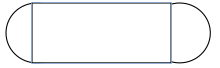
A gardener wants to build a fence around their garden shown below. How many feet of fencing will they need, if the length of the rectangular side is 12 and the width is 8?
Tap to reveal answer
The shape of the garden consists of a rectangle and two semi-circles. Since they are building a fence we need to find the perimeter. The perimeter of the length of the rectangle is 24. The perimeter or circumference of the circle can be found using the equation C=2π(r), where r= the radius of the circle. Since we have two semi-circles we can find the circumference of one whole circle with a radius of 4, which would be 8π.
The shape of the garden consists of a rectangle and two semi-circles. Since they are building a fence we need to find the perimeter. The perimeter of the length of the rectangle is 24. The perimeter or circumference of the circle can be found using the equation C=2π(r), where r= the radius of the circle. Since we have two semi-circles we can find the circumference of one whole circle with a radius of 4, which would be 8π.
← Didn't Know|Knew It →
A circle with diameter of length  is inscribed in a square. Which of the following is equivalent to the area inside of the square, but outside of the circle?
A circle with diameter of length
Tap to reveal answer
In order to find the area that is inside the square but outside the circle, we will need to subtract the area of the circle from the area of the square. The area of a circle is equal to  . However, since we are given the length of the diameter, we will need to solve for the radius in terms of the diameter. Because the diameter of a circle is twice the length of its radius, we can write the following equation and solve for
  :
:

Divide both sides by 2.

We will now substitute this into the formula for the area of the circle.
area of circle = 
We next will need to find the area of the square. Because the circle is inscribed in the square, the diameter of the circle is equal to the length of the circle's side. In other words, the square has side lengths equal to d. The area of any square is equal to the square of its side length. Therefore, the area of the square is  .
.
area of square = 
Lastly, we will subtract the area of the circle from the area of the square.
difference in areas = 
We will rewrite  so that its denominator is 4.
difference in areas = 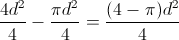
The answer is  .
.
In order to find the area that is inside the square but outside the circle, we will need to subtract the area of the circle from the area of the square. The area of a circle is equal to
Divide both sides by 2.
We will now substitute this into the formula for the area of the circle.
area of circle =
We next will need to find the area of the square. Because the circle is inscribed in the square, the diameter of the circle is equal to the length of the circle's side. In other words, the square has side lengths equal to d. The area of any square is equal to the square of its side length. Therefore, the area of the square is
area of square =
Lastly, we will subtract the area of the circle from the area of the square.
difference in areas =
We will rewrite
difference in areas =
The answer is
← Didn't Know|Knew It →
If a circle has an area of  , what is the circumference of the circle?
If a circle has an area of
Tap to reveal answer
The formula for the area of a circle is πr2. For this particular circle, the area is 81π, so 81π = πr2. Divide both sides by π and we are left with r2=81. Take the square root of both sides to find r=9. The formula for the circumference of the circle is 2πr = 2π(9) = 18π. The correct answer is 18π.
The formula for the area of a circle is πr2. For this particular circle, the area is 81π, so 81π = πr2. Divide both sides by π and we are left with r2=81. Take the square root of both sides to find r=9. The formula for the circumference of the circle is 2πr = 2π(9) = 18π. The correct answer is 18π.
← Didn't Know|Knew It →
A car tire has a radius of 18 inches. When the tire has made 200 revolutions, how far has the car gone in feet?
A car tire has a radius of 18 inches. When the tire has made 200 revolutions, how far has the car gone in feet?
Tap to reveal answer
If the radius is 18 inches, the diameter is 3 feet. The circumference of the tire is therefore 3π by C=d(π). After 200 revolutions, the tire and car have gone 3π x 200 = 600π feet.
If the radius is 18 inches, the diameter is 3 feet. The circumference of the tire is therefore 3π by C=d(π). After 200 revolutions, the tire and car have gone 3π x 200 = 600π feet.
← Didn't Know|Knew It →
A circle has the equation below. What is the circumference of the circle?
(x – 2)2 + (y + 3)2 = 9
A circle has the equation below. What is the circumference of the circle?
(x – 2)2 + (y + 3)2 = 9
Tap to reveal answer
The radius is 3. Yielding a circumference of  .
.
The radius is 3. Yielding a circumference of
← Didn't Know|Knew It →
The diameter of a circle is defined by the two points (2,5) and (4,6). What is the circumference of this circle?
The diameter of a circle is defined by the two points (2,5) and (4,6). What is the circumference of this circle?
Tap to reveal answer
We first must calculate the distance between these two points. Recall that the distance formula is:√((x2 - x1)2 + (y2 - y1)2)
For us, it is therefore: √((4 - 2)2 + (6 - 5)2) = √((2)2 + (1)2) = √(4 + 1) = √5
If d = √5, the circumference of our circle is πd, or π√5.
We first must calculate the distance between these two points. Recall that the distance formula is:√((x2 - x1)2 + (y2 - y1)2)
For us, it is therefore: √((4 - 2)2 + (6 - 5)2) = √((2)2 + (1)2) = √(4 + 1) = √5
If d = √5, the circumference of our circle is πd, or π√5.
← Didn't Know|Knew It →
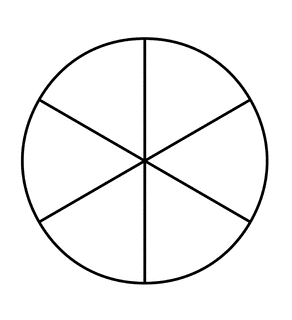
If a circle (shown above) with area  is divided into 6 equal slices, what is the arc length of one of the slices?
Note: The above figure is not necessarily drawn to scale.
If a circle (shown above) with area
Note: The above figure is not necessarily drawn to scale.
Tap to reveal answer
Begin by solving for the circumference of the circle. Use the area of the circle, which is given, and the equation for the area of a circle to determine the radius of the circle:
 =
= 
Divide both sides by  .
.
 =
= 

Solve for  :
:


The radius of the circle is 6. Now find the circumference.
Circumference is equal to 2 times the radius multiplied by  .
.


Now that we have the circumference, divide by 6 to find the length of one of the slices of the circle:

The arc length of one of the slices of the circle is  .
.
Begin by solving for the circumference of the circle. Use the area of the circle, which is given, and the equation for the area of a circle to determine the radius of the circle:
Divide both sides by
Solve for
The radius of the circle is 6. Now find the circumference.
Circumference is equal to 2 times the radius multiplied by
Now that we have the circumference, divide by 6 to find the length of one of the slices of the circle:
The arc length of one of the slices of the circle is
← Didn't Know|Knew It →
A square with a side length of 4 inches is inscribed in a circle, as shown below. What is the area of the unshaded region inside of the circle, in square inches?
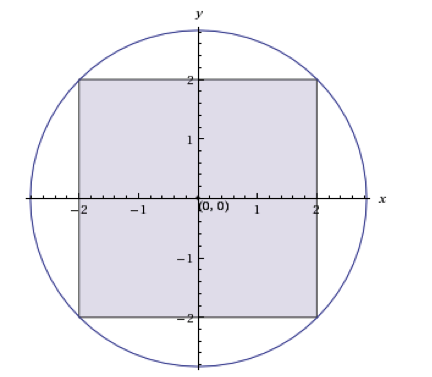
A square with a side length of 4 inches is inscribed in a circle, as shown below. What is the area of the unshaded region inside of the circle, in square inches?
Tap to reveal answer
Using the Pythagorean Theorem, the diameter of the circle (also the diagonal of the square) can be found to be 4√2. Thus, the radius of the circle is half of the diameter, or 2√2. The area of the circle is then π(2√2)2, which equals 8π. Next, the area of the square must be subtracted from the entire circle, yielding an area of 8π-16 square inches.
Using the Pythagorean Theorem, the diameter of the circle (also the diagonal of the square) can be found to be 4√2. Thus, the radius of the circle is half of the diameter, or 2√2. The area of the circle is then π(2√2)2, which equals 8π. Next, the area of the square must be subtracted from the entire circle, yielding an area of 8π-16 square inches.
← Didn't Know|Knew It →
If a circle has a circumference of 16π, what would its area be if its radius were halved?
If a circle has a circumference of 16π, what would its area be if its radius were halved?
Tap to reveal answer
The circumference of a circle = πd where d = diameter. Therefore, this circle’s diameter must equal 16. Knowing that diameter = 2 times the radius, we can determine that the radius of this circle = 8. Halving the radius would give us a new radius of 4. To find the area of this new circle, use the formula A=πr² where r = radius. Plug in 4 for r. Area will equal 16π.
The circumference of a circle = πd where d = diameter. Therefore, this circle’s diameter must equal 16. Knowing that diameter = 2 times the radius, we can determine that the radius of this circle = 8. Halving the radius would give us a new radius of 4. To find the area of this new circle, use the formula A=πr² where r = radius. Plug in 4 for r. Area will equal 16π.
← Didn't Know|Knew It →
An original circle has an area of  . If the radius is increased by a factor of 3, what is the ratio of the new area to the old area?
An original circle has an area of
Tap to reveal answer
The formula for the area of a circle is  . If we increase
  by a factor of 3, we will increase the area by a factor of 9.
The formula for the area of a circle is
← Didn't Know|Knew It →
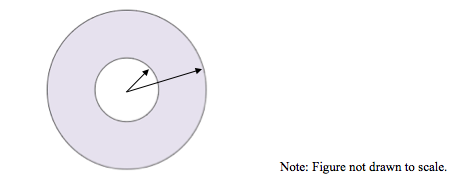
Kate has a ring-shaped lawn which has an inner radius of 10 feet and an outer radius 25 feet. What is the area of her lawn?
Kate has a ring-shaped lawn which has an inner radius of 10 feet and an outer radius 25 feet. What is the area of her lawn?
Tap to reveal answer
The area of an annulus is

where  is the radius of the larger circle, and
  is the radius of the smaller circle.



The area of an annulus is
where
← Didn't Know|Knew It →
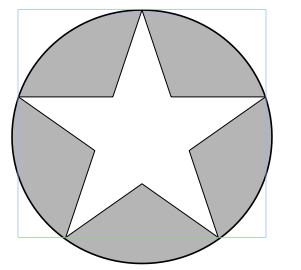
A star is inscribed in a circle with a diameter of 30, given the area of the star is 345, find the area of the shaded region, rounded to one decimal.
A star is inscribed in a circle with a diameter of 30, given the area of the star is 345, find the area of the shaded region, rounded to one decimal.
Tap to reveal answer
The area of the circle is (30/2)2*3.14 (π) = 706.5, since the shaded region is simply the area difference between the circle and the star, it’s 706.5-345 = 361.5
The area of the circle is (30/2)2*3.14 (π) = 706.5, since the shaded region is simply the area difference between the circle and the star, it’s 706.5-345 = 361.5
← Didn't Know|Knew It →
If a circle has circumference  , what is its area?
If a circle has circumference 
Tap to reveal answer
If the circumference is  , then since
  we know
  . We further know that
  , so
, so 
If the circumference is 


← Didn't Know|Knew It →
The diameter of a circle increases by 100 percent. If the original area is 16π, what is the new area of the circle?
The diameter of a circle increases by 100 percent. If the original area is 16π, what is the new area of the circle?
Tap to reveal answer
The original radius would be 4, making the new radius 8 and by the area of a circle (A=π(r)2) the new area would be 64π.
The original radius would be 4, making the new radius 8 and by the area of a circle (A=π(r)2) the new area would be 64π.
← Didn't Know|Knew It →
Two equal circles are cut out of a rectangular sheet of paper with the dimensions 10 by 20. The circles were made to have the greatest possible diameter. What is the approximate area of the paper after the two circles have been cut out?
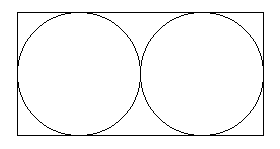
Two equal circles are cut out of a rectangular sheet of paper with the dimensions 10 by 20. The circles were made to have the greatest possible diameter. What is the approximate area of the paper after the two circles have been cut out?
Tap to reveal answer
The length of 20 represents the diameters of both circles. Each circle has a diameter of 10 and since radius is half of the diameter, each circle has a radius of 5. The area of a circle is A = πr2 . The area of one circle is 25π. The area of both circles is 50π. The area of the rectangle is (10)(20) = 200. 200 - 50π gives you the area of the paper after the two circles have been cut out. π is about 3.14, so 200 – 50(3.14) = 43.
The length of 20 represents the diameters of both circles. Each circle has a diameter of 10 and since radius is half of the diameter, each circle has a radius of 5. The area of a circle is A = πr2 . The area of one circle is 25π. The area of both circles is 50π. The area of the rectangle is (10)(20) = 200. 200 - 50π gives you the area of the paper after the two circles have been cut out. π is about 3.14, so 200 – 50(3.14) = 43.
← Didn't Know|Knew It →
A 6 by 8 rectangle is inscribed in a circle. What is the area of the circle?
A 6 by 8 rectangle is inscribed in a circle. What is the area of the circle?
Tap to reveal answer
The image below shows the rectangle inscribed in the circle. Dividing the rectangle into two triangles allows us to find the diameter of the circle, which is equal to the length of the line we drew. Using a2+b2= c2 we get 62 + 82 = c2. c2 = 100, so c = 10. The area of a circle is  . Radius is half of the diameter of the circle (which we know is 10), so r = 5.

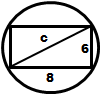
The image below shows the rectangle inscribed in the circle. Dividing the rectangle into two triangles allows us to find the diameter of the circle, which is equal to the length of the line we drew. Using a2+b2= c2 we get 62 + 82 = c2. c2 = 100, so c = 10. The area of a circle is
← Didn't Know|Knew It →
A circle with a diameter of 6” sits inside a circle with a radius of 8”. What is the area of the interstitial space between the two circles?
A circle with a diameter of 6” sits inside a circle with a radius of 8”. What is the area of the interstitial space between the two circles?
Tap to reveal answer
The area of a circle is πr2.
The diameter of the first circle = 6” so radius of the first circle = 3” so the area = π * 32 = 9π in2
The radius of the second circle = 8” so the area = π * 82 = 64π in2
The area of the interstitial space = area of the first circle – area of the second circle.
Area = 64π in2 - 9π in2 = 55π in2
The area of a circle is πr2.
The diameter of the first circle = 6” so radius of the first circle = 3” so the area = π * 32 = 9π in2
The radius of the second circle = 8” so the area = π * 82 = 64π in2
The area of the interstitial space = area of the first circle – area of the second circle.
Area = 64π in2 - 9π in2 = 55π in2
← Didn't Know|Knew It →
A 12x16 rectangle is inscribed in a circle. What is the area of the circle?
A 12x16 rectangle is inscribed in a circle. What is the area of the circle?
Tap to reveal answer
Explanation: Visualizing the rectangle inside the circle (corners touching the circumference of the circle and the center of the rectangle is the center of the circle) you will see that the rectangle can be divided into 8 congruent right triangles, with the hypotenuse as the radius of the circle. Calculating the radius you divide each side of the rectangle by two for the sides of each right triangle (giving 6 and 8). The hypotenuse (by pythagorean theorem or just knowing right triangle sets) the hypotenuse is give as 10. Area of a circle is given by πr2. 102 is 100, so 100π is the area.
Explanation: Visualizing the rectangle inside the circle (corners touching the circumference of the circle and the center of the rectangle is the center of the circle) you will see that the rectangle can be divided into 8 congruent right triangles, with the hypotenuse as the radius of the circle. Calculating the radius you divide each side of the rectangle by two for the sides of each right triangle (giving 6 and 8). The hypotenuse (by pythagorean theorem or just knowing right triangle sets) the hypotenuse is give as 10. Area of a circle is given by πr2. 102 is 100, so 100π is the area.
← Didn't Know|Knew It →
If the radius of a circle is tripled, and the new area is 144π what was the diameter of the original circle?
If the radius of a circle is tripled, and the new area is 144π what was the diameter of the original circle?
Tap to reveal answer
The area of a circle is A=πr2. Since the radius was tripled 144π =π(3r)2. Divide by π and then take the square root of both sides of the equal sign to get 12=3r, and then r=4. The diameter (d) is equal to twice the radius so d= 2(4) = 8.
The area of a circle is A=πr2. Since the radius was tripled 144π =π(3r)2. Divide by π and then take the square root of both sides of the equal sign to get 12=3r, and then r=4. The diameter (d) is equal to twice the radius so d= 2(4) = 8.
← Didn't Know|Knew It →
If the equation of a circle is (x – 7)2 + (y + 1)2 = 81, what is the area of the circle?
If the equation of a circle is (x – 7)2 + (y + 1)2 = 81, what is the area of the circle?
Tap to reveal answer
The equation is already in a circle equation, and the right side of the equation stands for r2 → r2 = 81 and r = 9
The area of a circle is πr2, so the area of this circle is 81π.
The equation is already in a circle equation, and the right side of the equation stands for r2 → r2 = 81 and r = 9
The area of a circle is πr2, so the area of this circle is 81π.
← Didn't Know|Knew It →