
Quadratic Equations - PSAT Math
Card 1 of 399
Find the zeros of the following function.

Find the zeros of the following function.
Tap to reveal answer
To find the zeros of the function use factoring.
Set up the expression in factored form, leaving blanks for the numbers that are not yet known.

At this point, you need to find two numbers - one for each blank. By looking at the original expression, a few clues can be gathered that will help find the two numbers. The product of these two numbers will be equal to the last term of the original expression (6, or c in the standard quadratic formula), and their sum will be equal to the coefficient of the second term of the original expression (5, or b in the standard quadratic formula). Because their product is positive (6) and the sum is positive, that must mean that they both have positive signs.
Now, at this point, test a few different possibilities using the clues gathered from the original expression. In the end, it's found that the only numbers that work are 2 and 3, as the product of 2 and 3 is 6, and sum of 2 and 3 is 5. So, this results in the expression's factored form looking like...

From here, set each binomial equal to zero and solve for  .
.

and

To verify the zeros, graph the original function and identify where the graph touches or crosses the x-axis.

Therefore the zeros of the function are,

To find the zeros of the function use factoring.
Set up the expression in factored form, leaving blanks for the numbers that are not yet known.
At this point, you need to find two numbers - one for each blank. By looking at the original expression, a few clues can be gathered that will help find the two numbers. The product of these two numbers will be equal to the last term of the original expression (6, or c in the standard quadratic formula), and their sum will be equal to the coefficient of the second term of the original expression (5, or b in the standard quadratic formula). Because their product is positive (6) and the sum is positive, that must mean that they both have positive signs.
Now, at this point, test a few different possibilities using the clues gathered from the original expression. In the end, it's found that the only numbers that work are 2 and 3, as the product of 2 and 3 is 6, and sum of 2 and 3 is 5. So, this results in the expression's factored form looking like...
From here, set each binomial equal to zero and solve for
and
To verify the zeros, graph the original function and identify where the graph touches or crosses the x-axis.
Therefore the zeros of the function are,
← Didn't Know|Knew It →
Find the zeros of the following function.

Find the zeros of the following function.
Tap to reveal answer
To find the zeros of the function use factoring.
Set up the expression in factored form, leaving blanks for the numbers that are not yet known.
At this point, you need to find two numbers - one for each blank. By looking at the original expression, a few clues can be gathered that will help find the two numbers. The product of these two numbers will be equal to the last term of the original expression (2, or c in the standard quadratic formula), and their sum will be equal to the coefficient of the second term of the original expression (-3, or b in the standard quadratic formula). Because their product is positive (2) and the sum is negative, that must mean that they both have negative signs.
Now, at this point, test a few different possibilities using the clues gathered from the original expression. In the end, it's found that the only numbers that work are 1 and 2, as the product of 1 and 2 is 2, and sum of 1 and 2 is 3. So, this results in the expression's factored form looking like...

From here, set each binomial equal to zero and solve for .

and

To verify the zeros, graph the original function and identify where the graph touches or crosses the x-axis.

Therefore the zeros of the function are,

To find the zeros of the function use factoring.
Set up the expression in factored form, leaving blanks for the numbers that are not yet known.
At this point, you need to find two numbers - one for each blank. By looking at the original expression, a few clues can be gathered that will help find the two numbers. The product of these two numbers will be equal to the last term of the original expression (2, or c in the standard quadratic formula), and their sum will be equal to the coefficient of the second term of the original expression (-3, or b in the standard quadratic formula). Because their product is positive (2) and the sum is negative, that must mean that they both have negative signs.
Now, at this point, test a few different possibilities using the clues gathered from the original expression. In the end, it's found that the only numbers that work are 1 and 2, as the product of 1 and 2 is 2, and sum of 1 and 2 is 3. So, this results in the expression's factored form looking like...
From here, set each binomial equal to zero and solve for
and
To verify the zeros, graph the original function and identify where the graph touches or crosses the x-axis.
Therefore the zeros of the function are,
← Didn't Know|Knew It →
Find all possible zeros of the following function.

Find all possible zeros of the following function.
Tap to reveal answer
To find the zeros of the function use factoring.
Set up the expression in factored form, leaving blanks for the numbers that are not yet known.
At this point, you need to find two numbers - one for each blank. By looking at the original expression, a few clues can be gathered that will help find the two numbers. The product of these two numbers will be equal to the last term of the original expression (1, or c in the standard quadratic formula), and their sum will be equal to the coefficient of the second term of the original expression (2, or b in the standard quadratic formula). Because their product is positive (1) and the sum is positive, that must mean that they both have positive signs.
Now, at this point, test a few different possibilities using the clues gathered from the original expression. In the end, it's found that the only numbers that work are 1 and 1, as the product of 1 and 1 is 1, and sum of 1 and 1 is 2. So, this results in the expression's factored form looking like...

From here, set the binomial equal to zero and solve for .

To verify the zeros, graph the original function and identify where the graph touches or crosses the x-axis.

Therefore the zero of the function is,

To find the zeros of the function use factoring.
Set up the expression in factored form, leaving blanks for the numbers that are not yet known.
At this point, you need to find two numbers - one for each blank. By looking at the original expression, a few clues can be gathered that will help find the two numbers. The product of these two numbers will be equal to the last term of the original expression (1, or c in the standard quadratic formula), and their sum will be equal to the coefficient of the second term of the original expression (2, or b in the standard quadratic formula). Because their product is positive (1) and the sum is positive, that must mean that they both have positive signs.
Now, at this point, test a few different possibilities using the clues gathered from the original expression. In the end, it's found that the only numbers that work are 1 and 1, as the product of 1 and 1 is 1, and sum of 1 and 1 is 2. So, this results in the expression's factored form looking like...
From here, set the binomial equal to zero and solve for
To verify the zeros, graph the original function and identify where the graph touches or crosses the x-axis.
Therefore the zero of the function is,
← Didn't Know|Knew It →
Find all possible zeros for the following function.

Find all possible zeros for the following function.
Tap to reveal answer
To find the zeros of the function using factoring.

Set up the expression in factored form, leaving blanks for the numbers that are not yet known.
At this point, you need to find two numbers - one for each blank. By looking at the original expression, a few clues can be gathered that will help find the two numbers. The product of these two numbers will be equal to the last term of the original expression (4, or c in the standard quadratic formula), and their sum will be equal to the coefficient of the second term of the original expression (-4, or b in the standard quadratic formula). Because their product is positive (4) and the sum is negative, that must mean that they both have negative signs.
Now, at this point, test a few different possibilities using the clues gathered from the original expression. In the end, it's found that the only numbers that work are -2 and -2, as the product of -2 and -2 is 4, and sum of -2 and -2 is -4. So, this results in the expression's factored form looking like...

From here, set each binomial equal to zero and solve for . Since the binomials are the same, there will only be one zero.

To verify the zeros, graph the original function and identify where the graph touches or crosses the x-axis.

Therefore the zero of the function is,

To find the zeros of the function using factoring.
Set up the expression in factored form, leaving blanks for the numbers that are not yet known.
At this point, you need to find two numbers - one for each blank. By looking at the original expression, a few clues can be gathered that will help find the two numbers. The product of these two numbers will be equal to the last term of the original expression (4, or c in the standard quadratic formula), and their sum will be equal to the coefficient of the second term of the original expression (-4, or b in the standard quadratic formula). Because their product is positive (4) and the sum is negative, that must mean that they both have negative signs.
Now, at this point, test a few different possibilities using the clues gathered from the original expression. In the end, it's found that the only numbers that work are -2 and -2, as the product of -2 and -2 is 4, and sum of -2 and -2 is -4. So, this results in the expression's factored form looking like...
From here, set each binomial equal to zero and solve for
To verify the zeros, graph the original function and identify where the graph touches or crosses the x-axis.
Therefore the zero of the function is,
← Didn't Know|Knew It →
Find all possible zeros for the following function.

Find all possible zeros for the following function.

Tap to reveal answer
To find the zeros of the function, use factoring.

Set up the expression in factored form, leaving blanks for the numbers that are not yet known.
At this point, you need to find two numbers - one for each blank. By looking at the original expression, a few clues can be gathered that will help find the two numbers. The product of these two numbers will be equal to the last term of the original expression (-1, or c in the standard quadratic formula), and their sum will be equal to the coefficient of the second term of the original expression (0, or b in the standard quadratic formula). Because their product is negative (-1) and the sum is zero, that must mean that they have different signs but the same absolute value.
Now, at this point, test a few different possibilities using the clues gathered from the original expression. In the end, it's found that the only numbers that work are 1 and -1, as the product of 1 and -1 is -1, and sum of 1 and -1 is 0. So, this results in the expression's factored form looking like...

This is known as a difference of squares.
From here, set each binomial equal to zero and solve for  .
.

and

To verify the zeros, graph the original function and identify where the graph touches or crosses the x-axis.

Therefore the zeros of the function are,

To find the zeros of the function, use factoring.

Set up the expression in factored form, leaving blanks for the numbers that are not yet known.
At this point, you need to find two numbers - one for each blank. By looking at the original expression, a few clues can be gathered that will help find the two numbers. The product of these two numbers will be equal to the last term of the original expression (-1, or c in the standard quadratic formula), and their sum will be equal to the coefficient of the second term of the original expression (0, or b in the standard quadratic formula). Because their product is negative (-1) and the sum is zero, that must mean that they have different signs but the same absolute value.
Now, at this point, test a few different possibilities using the clues gathered from the original expression. In the end, it's found that the only numbers that work are 1 and -1, as the product of 1 and -1 is -1, and sum of 1 and -1 is 0. So, this results in the expression's factored form looking like...
This is known as a difference of squares.
From here, set each binomial equal to zero and solve for
and
To verify the zeros, graph the original function and identify where the graph touches or crosses the x-axis.
Therefore the zeros of the function are,
← Didn't Know|Knew It →
Find all possible zeros for the following function.

Find all possible zeros for the following function.
Tap to reveal answer
To find the zeros of the function use factoring.
Set up the expression in factored form, leaving blanks for the numbers that are not yet known.
At this point, you need to find two numbers - one for each blank. By looking at the original expression, a few clues can be gathered that will help find the two numbers. The product of these two numbers will be equal to the last term of the original expression (3, or c in the standard quadratic formula), and their sum will be equal to the coefficient of the second term of the original expression (4, or b in the standard quadratic formula). Because their product is positive (3) and the sum is positive, that must mean that they both have positive signs.
Now, at this point, test a few different possibilities using the clues gathered from the original expression. In the end, it's found that the only numbers that work are 1 and 3, as the product of 1 and 3 is 3, and sum of 1 and 3 is 4. So, this results in the expression's factored form looking like...

From here, set each binomial equal to zero and solve for .

and
To verify the zeros, graph the original function and identify where the graph touches or crosses the x-axis.

Therefore, the zeros are,

To find the zeros of the function use factoring.
Set up the expression in factored form, leaving blanks for the numbers that are not yet known.
At this point, you need to find two numbers - one for each blank. By looking at the original expression, a few clues can be gathered that will help find the two numbers. The product of these two numbers will be equal to the last term of the original expression (3, or c in the standard quadratic formula), and their sum will be equal to the coefficient of the second term of the original expression (4, or b in the standard quadratic formula). Because their product is positive (3) and the sum is positive, that must mean that they both have positive signs.
Now, at this point, test a few different possibilities using the clues gathered from the original expression. In the end, it's found that the only numbers that work are 1 and 3, as the product of 1 and 3 is 3, and sum of 1 and 3 is 4. So, this results in the expression's factored form looking like...
From here, set each binomial equal to zero and solve for
and
To verify the zeros, graph the original function and identify where the graph touches or crosses the x-axis.
Therefore, the zeros are,
← Didn't Know|Knew It →
Find all possible zeros for the following function.

Find all possible zeros for the following function.
Tap to reveal answer
To find the zeros of the function use factoring.
Set up the expression in factored form, leaving blanks for the numbers that are not yet known.
At this point, you need to find two numbers - one for each blank. By looking at the original expression, a few clues can be gathered that will help find the two numbers. The product of these two numbers will be equal to the last term of the original expression (20, or c in the standard quadratic formula), and their sum will be equal to the coefficient of the second term of the original expression (9, or b in the standard quadratic formula). Because their product is positive (20) and the sum is positive, that must mean that they both have positive signs.
Now, at this point, test a few different possibilities using the clues gathered from the original expression. In the end, it's found that the only numbers that work are 4 and 5, as the product of 4 and 5 is 20, and sum of 4 and 5 is 9. So, this results in the expression's factored form looking like...

From here, set each binomial equal to zero and solve for .

and

To verify the zeros, graph the original function and identify where the graph touches or crosses the x-axis.

Therefore the zeros are,

To find the zeros of the function use factoring.
Set up the expression in factored form, leaving blanks for the numbers that are not yet known.
At this point, you need to find two numbers - one for each blank. By looking at the original expression, a few clues can be gathered that will help find the two numbers. The product of these two numbers will be equal to the last term of the original expression (20, or c in the standard quadratic formula), and their sum will be equal to the coefficient of the second term of the original expression (9, or b in the standard quadratic formula). Because their product is positive (20) and the sum is positive, that must mean that they both have positive signs.
Now, at this point, test a few different possibilities using the clues gathered from the original expression. In the end, it's found that the only numbers that work are 4 and 5, as the product of 4 and 5 is 20, and sum of 4 and 5 is 9. So, this results in the expression's factored form looking like...
From here, set each binomial equal to zero and solve for
and
To verify the zeros, graph the original function and identify where the graph touches or crosses the x-axis.
Therefore the zeros are,
← Didn't Know|Knew It →
Find all possible zeros for the following function.

Find all possible zeros for the following function.
Tap to reveal answer
To find the zeros of the function use factoring.
Set up the expression in factored form, leaving blanks for the numbers that are not yet known.
At this point, you need to find two numbers - one for each blank. By looking at the original expression, a few clues can be gathered that will help find the two numbers. The product of these two numbers will be equal to the last term of the original expression (-4, or c in the standard quadratic formula), and their sum will be equal to the coefficient of the second term of the original expression (3, or b in the standard quadratic formula). Because their product is negative (-4) and the sum is positive, that must mean that they have opposite signs.
Now, at this point, test a few different possibilities using the clues gathered from the original expression. In the end, it's found that the only numbers that work are 4 and -1, as the product of 4 and -1 is -4, and sum of 4 and -1 is 3. So, this results in the expression's factored form looking like...

From here, set each binomial equal to zero and solve for .
and

To verify the zeros, graph the original function and identify where the graph touches or crosses the x-axis.

Therefore the zeros of the function are,

To find the zeros of the function use factoring.
Set up the expression in factored form, leaving blanks for the numbers that are not yet known.
At this point, you need to find two numbers - one for each blank. By looking at the original expression, a few clues can be gathered that will help find the two numbers. The product of these two numbers will be equal to the last term of the original expression (-4, or c in the standard quadratic formula), and their sum will be equal to the coefficient of the second term of the original expression (3, or b in the standard quadratic formula). Because their product is negative (-4) and the sum is positive, that must mean that they have opposite signs.
Now, at this point, test a few different possibilities using the clues gathered from the original expression. In the end, it's found that the only numbers that work are 4 and -1, as the product of 4 and -1 is -4, and sum of 4 and -1 is 3. So, this results in the expression's factored form looking like...
From here, set each binomial equal to zero and solve for
and
To verify the zeros, graph the original function and identify where the graph touches or crosses the x-axis.
Therefore the zeros of the function are,
← Didn't Know|Knew It →
Find all the possible zeros for the following function.

Find all the possible zeros for the following function.
Tap to reveal answer
To find the zeros of the function use factoring.
Set up the expression in factored form, leaving blanks for the numbers that are not yet known.
At this point, you need to find two numbers - one for each blank. By looking at the original expression, a few clues can be gathered that will help find the two numbers. The product of these two numbers will be equal to the last term of the original expression (-2, or c in the standard quadratic formula), and their sum will be equal to the coefficient of the second term of the original expression (-1, or b in the standard quadratic formula). Because their product is negative (-2) and the sum is negative, that must mean that they have opposite signs.
Now, at this point, test a few different possibilities using the clues gathered from the original expression. In the end, it's found that the only numbers that work are 1 and -2, as the product of 1 and -1 is -2, and sum of -2 and 1 is -1. So, this results in the expression's factored form looking like...

From here, set each binomial equal to zero and solve for .

and

To verify the zeros, graph the original function and identify where the graph touches or crosses the x-axis.

Therefore, the zeros of the function are

To find the zeros of the function use factoring.
Set up the expression in factored form, leaving blanks for the numbers that are not yet known.
At this point, you need to find two numbers - one for each blank. By looking at the original expression, a few clues can be gathered that will help find the two numbers. The product of these two numbers will be equal to the last term of the original expression (-2, or c in the standard quadratic formula), and their sum will be equal to the coefficient of the second term of the original expression (-1, or b in the standard quadratic formula). Because their product is negative (-2) and the sum is negative, that must mean that they have opposite signs.
Now, at this point, test a few different possibilities using the clues gathered from the original expression. In the end, it's found that the only numbers that work are 1 and -2, as the product of 1 and -1 is -2, and sum of -2 and 1 is -1. So, this results in the expression's factored form looking like...
From here, set each binomial equal to zero and solve for
and
To verify the zeros, graph the original function and identify where the graph touches or crosses the x-axis.
Therefore, the zeros of the function are
← Didn't Know|Knew It →
Find all possible zeros for the following function.

Find all possible zeros for the following function.
Tap to reveal answer
To find the zeros of the function, use factoring.

Set up the expression in factored form, leaving blanks for the numbers that are not yet known.
At this point, you need to find two numbers - one for each blank. By looking at the original expression, a few clues can be gathered that will help find the two numbers. The product of these two numbers will be equal to the last term of the original expression (-9, or c in the standard quadratic formula), and their sum will be equal to the coefficient of the second term of the original expression (0, or b in the standard quadratic formula). Because their product is negative (-9) and the sum is zero, that must mean that they have different signs but the same absolute value.
Now, at this point, test a few different possibilities using the clues gathered from the original expression. In the end, it's found that the only numbers that work are 3 and -3, as the product of 3 and -3 is -9, and sum of 3 and -3 is 0. So, this results in the expression's factored form looking like...

This is known as a difference of squares.
From here, set each binomial equal to zero and solve for .

and

To verify the zeros, graph the original function and identify where the graph touches or crosses the x-axis.

Therefore the zeros of the function are,

To find the zeros of the function, use factoring.
Set up the expression in factored form, leaving blanks for the numbers that are not yet known.
At this point, you need to find two numbers - one for each blank. By looking at the original expression, a few clues can be gathered that will help find the two numbers. The product of these two numbers will be equal to the last term of the original expression (-9, or c in the standard quadratic formula), and their sum will be equal to the coefficient of the second term of the original expression (0, or b in the standard quadratic formula). Because their product is negative (-9) and the sum is zero, that must mean that they have different signs but the same absolute value.
Now, at this point, test a few different possibilities using the clues gathered from the original expression. In the end, it's found that the only numbers that work are 3 and -3, as the product of 3 and -3 is -9, and sum of 3 and -3 is 0. So, this results in the expression's factored form looking like...
This is known as a difference of squares.
From here, set each binomial equal to zero and solve for
and
To verify the zeros, graph the original function and identify where the graph touches or crosses the x-axis.
Therefore the zeros of the function are,
← Didn't Know|Knew It →
Find all possible zeros for the following function.

Find all possible zeros for the following function.
Tap to reveal answer
To find the zeros of the function use factoring.
Set up the expression in factored form, leaving blanks for the numbers that are not yet known.
At this point, you need to find two numbers - one for each blank. By looking at the original expression, a few clues can be gathered that will help find the two numbers. The product of these two numbers will be equal to the last term of the original expression (16, or c in the standard quadratic formula), and their sum will be equal to the coefficient of the second term of the original expression (8, or b in the standard quadratic formula). Because their product is positive (16) and the sum is positive, that must mean that they both have positive signs.
Now, at this point, test a few different possibilities using the clues gathered from the original expression. In the end, it's found that the only numbers that work are 4 and 4, as the product of 4 and 4 is 16, and sum of 4 and 4 is 8. So, this results in the expression's factored form looking like...

From here, set the binomial equal to zero and solve for .

To verify the zeros, graph the original function and identify where the graph touches or crosses the x-axis.

Therefore the zero of the function is,

To find the zeros of the function use factoring.
Set up the expression in factored form, leaving blanks for the numbers that are not yet known.
At this point, you need to find two numbers - one for each blank. By looking at the original expression, a few clues can be gathered that will help find the two numbers. The product of these two numbers will be equal to the last term of the original expression (16, or c in the standard quadratic formula), and their sum will be equal to the coefficient of the second term of the original expression (8, or b in the standard quadratic formula). Because their product is positive (16) and the sum is positive, that must mean that they both have positive signs.
Now, at this point, test a few different possibilities using the clues gathered from the original expression. In the end, it's found that the only numbers that work are 4 and 4, as the product of 4 and 4 is 16, and sum of 4 and 4 is 8. So, this results in the expression's factored form looking like...
From here, set the binomial equal to zero and solve for
To verify the zeros, graph the original function and identify where the graph touches or crosses the x-axis.
Therefore the zero of the function is,
← Didn't Know|Knew It →
Find all possible zeros for the following function.

Find all possible zeros for the following function.
Tap to reveal answer
To find the zeros of this function first identify and factor of the GCF.
In this particular case,the GCF is  as it appears in both terms. Factoring out the GCF results in the following.

From here, set each term equal to zero and solve for  .
.

and


Therefore the zeros are,

To find the zeros of this function first identify and factor of the GCF.
In this particular case,the GCF is
From here, set each term equal to zero and solve for
and
Therefore the zeros are,
← Didn't Know|Knew It →
Complete the square to calculate the maximum or minimum point of the given function.

Complete the square to calculate the maximum or minimum point of the given function.
Tap to reveal answer
Completing the square method uses the concept of perfect squares. Recall that a perfect square is in the form,

where when multiplied out,

the middle term coefficient, when divided by two and squared, results in the coefficient of the last term.
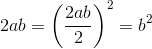
Complete the square for this particular function is as follows.

First identify the middle term coefficient.

Now divide the middle term coefficient by two.

From here write the function with the perfect square. Remember when adding the new squared term, add it to both sides to keep the equation balanced.

When simplified the new function is,

Since the  term is positive, the parabola will be opening up. This means that the function has a minimum value at the vertex. To find the
  value of the vertex set the inside portion of the binomial equal to zero and solve.

From here, substitute the the  value into the original function.


Therefore the minimum value occurs at the point  .
.
Completing the square method uses the concept of perfect squares. Recall that a perfect square is in the form,
where when multiplied out,
the middle term coefficient, when divided by two and squared, results in the coefficient of the last term.
Complete the square for this particular function is as follows.
First identify the middle term coefficient.
Now divide the middle term coefficient by two.
From here write the function with the perfect square. Remember when adding the new squared term, add it to both sides to keep the equation balanced.
When simplified the new function is,
Since the
From here, substitute the the
Therefore the minimum value occurs at the point
← Didn't Know|Knew It →
Complete the square to calculate the maximum or minimum point of the given function.

Complete the square to calculate the maximum or minimum point of the given function.
Tap to reveal answer
Completing the square method uses the concept of perfect squares. Recall that a perfect square is in the form,
where when multiplied out,
the middle term coefficient, when divided by two and squared, results in the coefficient of the last term.
Complete the square for this particular function is as follows.

First identify the middle term coefficient.

Now divide the middle term coefficient by two.

From here write the function with the perfect square. Remember when adding the new squared term, add it to both sides to keep the equation balanced.

When simplified the new function is,

Since the term is positive, the parabola will be opening up. This means that the function has a minimum value at the vertex. To find the value of the vertex set the inside portion of the binomial equal to zero and solve.

From here, substitute the the value into the original function.


Therefore the minimum value occurs at the point  .
.
Completing the square method uses the concept of perfect squares. Recall that a perfect square is in the form,
where when multiplied out,
the middle term coefficient, when divided by two and squared, results in the coefficient of the last term.
Complete the square for this particular function is as follows.
First identify the middle term coefficient.
Now divide the middle term coefficient by two.
From here write the function with the perfect square. Remember when adding the new squared term, add it to both sides to keep the equation balanced.
When simplified the new function is,
Since the
From here, substitute the the
Therefore the minimum value occurs at the point
← Didn't Know|Knew It →
Complete the square to calculate the maximum or minimum point of the given function.

Complete the square to calculate the maximum or minimum point of the given function.
Tap to reveal answer
Completing the square method uses the concept of perfect squares. Recall that a perfect square is in the form,
where when multiplied out,
the middle term coefficient, when divided by two and squared, results in the coefficient of the last term.
Complete the square for this particular function is as follows.

First identify the middle term coefficient.

Now divide the middle term coefficient by two.

From here write the function with the perfect square.

When simplified the new function is,

Since the term is positive, the parabola will be opening up. This means that the function has a minimum value at the vertex. To find the value of the vertex set the inside portion of the binomial equal to zero and solve.

From here, substitute the the value into the original function.


Therefore the minimum value occurs at the point  .
.
Completing the square method uses the concept of perfect squares. Recall that a perfect square is in the form,
where when multiplied out,
the middle term coefficient, when divided by two and squared, results in the coefficient of the last term.
Complete the square for this particular function is as follows.
First identify the middle term coefficient.
Now divide the middle term coefficient by two.
From here write the function with the perfect square.
When simplified the new function is,
Since the
From here, substitute the the
Therefore the minimum value occurs at the point
← Didn't Know|Knew It →
Complete the square to calculate the maximum or minimum point of the given function.

Complete the square to calculate the maximum or minimum point of the given function.
Tap to reveal answer
Completing the square method uses the concept of perfect squares. Recall that a perfect square is in the form,
where when multiplied out,
the middle term coefficient, when divided by two and squared, results in the coefficient of the last term.
Complete the square for this particular function is as follows.

First identify the middle term coefficient.

Now divide the middle term coefficient by two.

From here write the function with the perfect square.

When simplified the new function is,

Since the term is positive, the parabola will be opening up. This means that the function has a minimum value at the vertex. To find the value of the vertex set the inside portion of the binomial equal to zero and solve.

From here, substitute the the value into the original function.


Therefore the minimum value occurs at the point  .
.
Completing the square method uses the concept of perfect squares. Recall that a perfect square is in the form,
where when multiplied out,
the middle term coefficient, when divided by two and squared, results in the coefficient of the last term.
Complete the square for this particular function is as follows.
First identify the middle term coefficient.
Now divide the middle term coefficient by two.
From here write the function with the perfect square.
When simplified the new function is,
Since the
From here, substitute the the
Therefore the minimum value occurs at the point
← Didn't Know|Knew It →
Complete the square to calculate the maximum or minimum point of the given function.

Complete the square to calculate the maximum or minimum point of the given function.
Tap to reveal answer
Completing the square method uses the concept of perfect squares. Recall that a perfect square is in the form,
where when multiplied out,
the middle term coefficient, when divided by two and squared, results in the coefficient of the last term.
Complete the square for this particular function is as follows.

First identify the middle term coefficient.

Now divide the middle term coefficient by two.

From here write the function with the perfect square.

When simplified the new function is,

Since the term is positive, the parabola will be opening up. This means that the function has a minimum value at the vertex. To find the value of the vertex set the inside portion of the binomial equal to zero and solve.

From here, substitute the the value into the original function.


Therefore the minimum value occurs at the point  .
.
Completing the square method uses the concept of perfect squares. Recall that a perfect square is in the form,
where when multiplied out,
the middle term coefficient, when divided by two and squared, results in the coefficient of the last term.
Complete the square for this particular function is as follows.
First identify the middle term coefficient.
Now divide the middle term coefficient by two.
From here write the function with the perfect square.
When simplified the new function is,
Since the
From here, substitute the the
Therefore the minimum value occurs at the point
← Didn't Know|Knew It →
Complete the square to calculate the maximum or minimum point of the given function.

Complete the square to calculate the maximum or minimum point of the given function.
Tap to reveal answer
Completing the square method uses the concept of perfect squares. Recall that a perfect square is in the form,
where when multiplied out,
the middle term coefficient, when divided by two and squared, results in the coefficient of the last term.
Complete the square for this particular function is as follows.

First identify the middle term coefficient.

Now divide the middle term coefficient by two.

From here write the function with the perfect square.

When simplified the new function is,

Since the term is positive, the parabola will be opening up. This means that the function has a minimum value at the vertex. To find the value of the vertex set the inside portion of the binomial equal to zero and solve.

From here, substitute the the value into the original function.


Therefore the minimum value occurs at the point  .
.
Completing the square method uses the concept of perfect squares. Recall that a perfect square is in the form,
where when multiplied out,
the middle term coefficient, when divided by two and squared, results in the coefficient of the last term.
Complete the square for this particular function is as follows.
First identify the middle term coefficient.
Now divide the middle term coefficient by two.
From here write the function with the perfect square.
When simplified the new function is,
Since the
From here, substitute the the
Therefore the minimum value occurs at the point
← Didn't Know|Knew It →
Complete the square to calculate the maximum or minimum point of the given function.

Complete the square to calculate the maximum or minimum point of the given function.
Tap to reveal answer
Completing the square method uses the concept of perfect squares. Recall that a perfect square is in the form,
where when multiplied out,
the middle term coefficient, when divided by two and squared, results in the coefficient of the last term.
Complete the square for this particular function is as follows.

First factor out a negative one.

Now identify the middle term coefficient.

Now divide the middle term coefficient by two.

From here write the function with the perfect square.

When simplified the new function is,

Since the term is negative, the parabola will be opening down. This means that the function has a maximum value at the vertex. To find the value of the vertex set the inside portion of the binomial equal to zero and solve.

From here, substitute the the value into the original function.


Therefore the maximum value occurs at the point  .
.
Completing the square method uses the concept of perfect squares. Recall that a perfect square is in the form,
where when multiplied out,
the middle term coefficient, when divided by two and squared, results in the coefficient of the last term.
Complete the square for this particular function is as follows.
First factor out a negative one.
Now identify the middle term coefficient.
Now divide the middle term coefficient by two.
From here write the function with the perfect square.
When simplified the new function is,
Since the
From here, substitute the the
Therefore the maximum value occurs at the point
← Didn't Know|Knew It →
Complete the square to calculate the maximum or minimum point of the given function.

Complete the square to calculate the maximum or minimum point of the given function.
Tap to reveal answer
Completing the square method uses the concept of perfect squares. Recall that a perfect square is in the form,
where when multiplied out,
the middle term coefficient, when divided by two and squared, results in the coefficient of the last term.
Complete the square for this particular function is as follows.

First factor out a negative one.

Now identify the middle term coefficient.

Now divide the middle term coefficient by two.

From here write the function with the perfect square.

When simplified the new function is,

Since the term is negative, the parabola will be opening down. This means that the function has a maximum value at the vertex. To find the value of the vertex set the inside portion of the binomial equal to zero and solve.

From here, substitute the the value into the original function.


Therefore the maximum value occurs at the point  .
.
Completing the square method uses the concept of perfect squares. Recall that a perfect square is in the form,
where when multiplied out,
the middle term coefficient, when divided by two and squared, results in the coefficient of the last term.
Complete the square for this particular function is as follows.
First factor out a negative one.
Now identify the middle term coefficient.
Now divide the middle term coefficient by two.
From here write the function with the perfect square.
When simplified the new function is,
Since the
From here, substitute the the
Therefore the maximum value occurs at the point
← Didn't Know|Knew It →