
Data Analysis - PSAT Math
Card 1 of 1757
A number between 1 and 15 is selected at random. What are the odds the number selected is a multiple of 6?
A number between 1 and 15 is selected at random. What are the odds the number selected is a multiple of 6?
Tap to reveal answer
In the set of 1 to 15, two numbers, 6 and 12, are multiples of 6. That means there are two chances out of 15 to select a multiple of 6.
2/15
In the set of 1 to 15, two numbers, 6 and 12, are multiples of 6. That means there are two chances out of 15 to select a multiple of 6.
2/15
← Didn't Know|Knew It →
A big box of crayons contains a total of 120 crayons.
The box is composed of 3 colors; red, blue, and orange. 30 of the crayons are red, 40 of the crayons are blue and the rest are orange. If one picks a crayon randomly from the box, what is the probability that it will be orange?
A big box of crayons contains a total of 120 crayons.
The box is composed of 3 colors; red, blue, and orange. 30 of the crayons are red, 40 of the crayons are blue and the rest are orange. If one picks a crayon randomly from the box, what is the probability that it will be orange?
Tap to reveal answer
To solve the problem one must calculate that there are 50 orange crayons in the box. So 50/120 are orange. If we simplify that fraction by 10 we get 5/12.
To solve the problem one must calculate that there are 50 orange crayons in the box. So 50/120 are orange. If we simplify that fraction by 10 we get 5/12.
← Didn't Know|Knew It →
The average for 24 students on a test is 81%. Two more students take the test, averaging 74% between the two of them. What is the total class average (to the closest hundreth) if these two students are added to the 24?
The average for 24 students on a test is 81%. Two more students take the test, averaging 74% between the two of them. What is the total class average (to the closest hundreth) if these two students are added to the 24?
Tap to reveal answer
The easiest way to solve this is to consider the total scores as follows:
Group 1: 81 * 24 = 1944
Group 2: 74 * 2 = 148
Therefore, the total percentage points earned for the class is 148 + 1944 = 2092. The new class average will be 2092/26 or 80.46. (For our purposes, this is 80.46%.)
The easiest way to solve this is to consider the total scores as follows:
Group 1: 81 * 24 = 1944
Group 2: 74 * 2 = 148
Therefore, the total percentage points earned for the class is 148 + 1944 = 2092. The new class average will be 2092/26 or 80.46. (For our purposes, this is 80.46%.)
← Didn't Know|Knew It →
The average of 5, 10, 12, 15, and x is 11. What is the median?
The average of 5, 10, 12, 15, and x is 11. What is the median?
Tap to reveal answer
You must first find what x is in order to find the median.
To find x, set up the following equation:
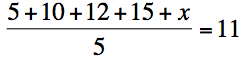
To solve the equation, first multiply both sides by 5:
5 + 10 + 12 + 15 + x = 55
Then, add up 5 + 10 + 12 + 15 to get 42:
42 + x = 55
x = 13
Now that you know what x is, you are ready to find the median. To find the median, order the numbers from lowest to highest. The median is the number in the middle.
5, 10, 12, 13, 15
You must first find what x is in order to find the median.
To find x, set up the following equation:
To solve the equation, first multiply both sides by 5:
5 + 10 + 12 + 15 + x = 55
Then, add up 5 + 10 + 12 + 15 to get 42:
42 + x = 55
x = 13
Now that you know what x is, you are ready to find the median. To find the median, order the numbers from lowest to highest. The median is the number in the middle.
5, 10, 12, 13, 15
← Didn't Know|Knew It →

Looking at the table, what is the difference of the mean minus the mode.
Looking at the table, what is the difference of the mean minus the mode.
Tap to reveal answer
The mode is 3 and subtracting 3 from 2.5 gives -0.5.
The mode is 3 and subtracting 3 from 2.5 gives -0.5.
← Didn't Know|Knew It →
Find the mode of the following set of numbers:
1, 6, 3, 6, 5, 9
Find the mode of the following set of numbers:
1, 6, 3, 6, 5, 9
Tap to reveal answer
Mode is the most frequently occuring number in a set. 6 appears most frequently since there are 2 sixes but the rest of the numbers only appear once. The mode is 6
Mode is the most frequently occuring number in a set. 6 appears most frequently since there are 2 sixes but the rest of the numbers only appear once. The mode is 6
← Didn't Know|Knew It →
Find the mode in this set of numbers:
2, 100, 52, 97, 1, 7, 22, 19, 100
Find the mode in this set of numbers:
2, 100, 52, 97, 1, 7, 22, 19, 100
Tap to reveal answer
The mode is the number that appears the most
The mode is the number that appears the most
← Didn't Know|Knew It →
Find the mode from the following set of numbers
1, 4, 8, 17, 8, 8, 15, 21, 32, 17
Find the mode from the following set of numbers
1, 4, 8, 17, 8, 8, 15, 21, 32, 17
Tap to reveal answer
The mode is the number that appears the most in a given set of numbers
The mode is the number that appears the most in a given set of numbers
← Didn't Know|Knew It →
What is the mode of the following set of numbers?
24, 38, 26, 27, 7, 27, 34, 12, 13
What is the mode of the following set of numbers?
24, 38, 26, 27, 7, 27, 34, 12, 13
Tap to reveal answer
The mode is the number that appears the most in a given set of numbers.
The mode is the number that appears the most in a given set of numbers.
← Didn't Know|Knew It →
Find the range of the data set:
25, 83 , 51, 13, 37, 21, 52, 58
Find the range of the data set:
25, 83 , 51, 13, 37, 21, 52, 58
Tap to reveal answer
44 is the median of the data. 42.5 is the arithmetic mean. 13 is the minimum value. 83 is the maximum value.
To find the range, subtract the minimum value from the maximum value:
83 - 13 = 70
44 is the median of the data. 42.5 is the arithmetic mean. 13 is the minimum value. 83 is the maximum value.
To find the range, subtract the minimum value from the maximum value:
83 - 13 = 70
← Didn't Know|Knew It →
F, G, H are the only three numbers in a sequence in which each number is twice the number before it. The three number have an arithmetic mean of 21. What is the value of H?
F, G, H are the only three numbers in a sequence in which each number is twice the number before it. The three number have an arithmetic mean of 21. What is the value of H?
Tap to reveal answer
We know that H = 2G = 4F, and G = 2F and that (F + G + H)/3=21. If we substitute each term with its F equivalent we get:
(F + 2F + 4F)/3 = 21
7F/3 = 21
7F = 63
F = 9
If we substitute F = 9 into H = 4F, we get H = 36.
The correct answer is 36.
We know that H = 2G = 4F, and G = 2F and that (F + G + H)/3=21. If we substitute each term with its F equivalent we get:
(F + 2F + 4F)/3 = 21
7F/3 = 21
7F = 63
F = 9
If we substitute F = 9 into H = 4F, we get H = 36.
The correct answer is 36.
← Didn't Know|Knew It →
A bag of marbles has 7 yellow marbles, 5 red marbles, 3 blue marbles, and 6 white marbles. What is the probability of choosing a yellow marble, putting it back and choosing a blue marble, and then NOT putting the blue marble back and picking a white marble?
A bag of marbles has 7 yellow marbles, 5 red marbles, 3 blue marbles, and 6 white marbles. What is the probability of choosing a yellow marble, putting it back and choosing a blue marble, and then NOT putting the blue marble back and picking a white marble?
Tap to reveal answer
There are a total of 7 + 5 + 3 + 6 = 21 marbles. The probability of picking a yellow marble is 7/21 = 1/3. Then we put it back and choose a blue marble with probability 3/21 = 1/7. We do NOT put this blue marble back, but then we grab for a white. The probability of picking a white is now 6/20 = 3/10, because now we are choosing from 20 marbles instead of 21. So putting it together, the probability of choosing a yellow marble, replacing it and then choosing a blue and a white, is 1/3 * 1/7 * 3/10 = 1/70.
There are a total of 7 + 5 + 3 + 6 = 21 marbles. The probability of picking a yellow marble is 7/21 = 1/3. Then we put it back and choose a blue marble with probability 3/21 = 1/7. We do NOT put this blue marble back, but then we grab for a white. The probability of picking a white is now 6/20 = 3/10, because now we are choosing from 20 marbles instead of 21. So putting it together, the probability of choosing a yellow marble, replacing it and then choosing a blue and a white, is 1/3 * 1/7 * 3/10 = 1/70.
← Didn't Know|Knew It →
In a regular 52-card deck, what is the probability of drawing three aces in a row, with replacement?
In a regular 52-card deck, what is the probability of drawing three aces in a row, with replacement?
Tap to reveal answer
There are 4 aces in the 52 card deck, so the probability of drawing an ace is 4/52. Then we put this ace back in the deck and draw again. The probability of drawing an ace is again 4/52. Similarly, on the third draw, the probability of getting an ace is 4/52. So the probability of drawing an ace on the 1st draw AND the 2nd draw AND the 3rd draw is 4/52 * 4/52 * 4/52.
There are 4 aces in the 52 card deck, so the probability of drawing an ace is 4/52. Then we put this ace back in the deck and draw again. The probability of drawing an ace is again 4/52. Similarly, on the third draw, the probability of getting an ace is 4/52. So the probability of drawing an ace on the 1st draw AND the 2nd draw AND the 3rd draw is 4/52 * 4/52 * 4/52.
← Didn't Know|Knew It →
A bag contains four blue marbles, eight red marbles, and six orange marbles. If a marble is randomly selected from the bag, what is the probability that the marble will be either red or orange?
A bag contains four blue marbles, eight red marbles, and six orange marbles. If a marble is randomly selected from the bag, what is the probability that the marble will be either red or orange?
Tap to reveal answer
The probability of an event is the ratio of the number of desired outcomes to the total number of possible outcomes. In this problem, the total number of outcomes is equal to the total number of marbles in the bag. There are four blue, eight red, and six orange marbles, so the total number of marbles is the sum of four, eight, and six, or eighteen.
We are asked to find the probability of choosing a marble that is either red or orange. This means we have to consider the number of marbles that are either red or orange. Because there are eight red and six orange, there are fourteen marbles that are either red or orange.
The probability is thus fourteen out of eighteen, because there are fourteen red or orange marbles, out of a total of eighteen marbles. We will need to simplify the fraction 14/18.
Probability = 14/18 = 7/9
The answer is 7/9.
The probability of an event is the ratio of the number of desired outcomes to the total number of possible outcomes. In this problem, the total number of outcomes is equal to the total number of marbles in the bag. There are four blue, eight red, and six orange marbles, so the total number of marbles is the sum of four, eight, and six, or eighteen.
We are asked to find the probability of choosing a marble that is either red or orange. This means we have to consider the number of marbles that are either red or orange. Because there are eight red and six orange, there are fourteen marbles that are either red or orange.
The probability is thus fourteen out of eighteen, because there are fourteen red or orange marbles, out of a total of eighteen marbles. We will need to simplify the fraction 14/18.
Probability = 14/18 = 7/9
The answer is 7/9.
← Didn't Know|Knew It →
What is the probability that you will pull out 3 diamonds in a standard deck without replacement.
What is the probability that you will pull out 3 diamonds in a standard deck without replacement.
Tap to reveal answer
There are 13 diamonds in a standard deck of 52 cards. So, you have a 13/52 (1/4) chance of getting a diamond; then a 12/51 (4/17) chance of pulling the next diamond; last, there is a 11/50 chance of getting the third diamond. When you combine probabilities, you multiply the individual probabilities together
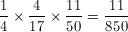
There are 13 diamonds in a standard deck of 52 cards. So, you have a 13/52 (1/4) chance of getting a diamond; then a 12/51 (4/17) chance of pulling the next diamond; last, there is a 11/50 chance of getting the third diamond. When you combine probabilities, you multiply the individual probabilities together
← Didn't Know|Knew It →
On Halloween there is a bowl of candy. 33 pieces are gum drops, 24 are candy corn, 15 are suckers and 28 are hard candies. Without looking in the bowl, what are the chances that you pull a gum drop?
On Halloween there is a bowl of candy. 33 pieces are gum drops, 24 are candy corn, 15 are suckers and 28 are hard candies. Without looking in the bowl, what are the chances that you pull a gum drop?
Tap to reveal answer
Probability = # Gum Drops / # Total Number of Candies

Probability = # Gum Drops / # Total Number of Candies
← Didn't Know|Knew It →
There is a special contest held at a high school where the winner will receive a prize of $100. 300 seniors, 200 juniors, 200 sophomores, and 100 freshmen enter the contest. Each senior places their name in the hat 5 times, juniors 3 times, and sophmores and freshmen each only once. What is the probability that a junior's name will be chosen?
There is a special contest held at a high school where the winner will receive a prize of $100. 300 seniors, 200 juniors, 200 sophomores, and 100 freshmen enter the contest. Each senior places their name in the hat 5 times, juniors 3 times, and sophmores and freshmen each only once. What is the probability that a junior's name will be chosen?
Tap to reveal answer
The first thing to do here is find the total number of students in the contest. Seniors = 300 * 5 = 1500, Juniors = 200 * 3 = 600, Sophomores = 200, and Freshmen = 100. So adding all these up you get a total of 2400 names in the hat. Out of these 2400 names, 600 of them are Juniors. So the probability of choosing a Junior's name is 600/2400 = 1/4.
The first thing to do here is find the total number of students in the contest. Seniors = 300 * 5 = 1500, Juniors = 200 * 3 = 600, Sophomores = 200, and Freshmen = 100. So adding all these up you get a total of 2400 names in the hat. Out of these 2400 names, 600 of them are Juniors. So the probability of choosing a Junior's name is 600/2400 = 1/4.
← Didn't Know|Knew It →
Michelle is randomly drawing cards from a deck of of 52 cards. What is the chance she will draw a black queen followed by a 5 of any color, without replacing the cards?
Michelle is randomly drawing cards from a deck of of 52 cards. What is the chance she will draw a black queen followed by a 5 of any color, without replacing the cards?
Tap to reveal answer
There are 2 black queens in the deck, one of spades and one of clubs, so there is a 2/52 chance a black Queen will be drawn and 4/51 chance of drawing a 5 of any color, since the queen has already been removed from the deck. Thus: 2/52 * 4/51 = 8/2652 → 2/663.
1
There are 2 black queens in the deck, one of spades and one of clubs, so there is a 2/52 chance a black Queen will be drawn and 4/51 chance of drawing a 5 of any color, since the queen has already been removed from the deck. Thus: 2/52 * 4/51 = 8/2652 → 2/663.
1
← Didn't Know|Knew It →
Zack has 10 green, 14 red, 2 blue, and 6 black marbles in a bag. What is the probability that Zack will not randomly pick a red or blue marble from the bag?
Zack has 10 green, 14 red, 2 blue, and 6 black marbles in a bag. What is the probability that Zack will not randomly pick a red or blue marble from the bag?
Tap to reveal answer
To NOT choose a red or blue, leaves 6 black and 10 green to choose from. That leaves 16 marbles out of a total of 32 marbles, or a 1/2 chance.
To NOT choose a red or blue, leaves 6 black and 10 green to choose from. That leaves 16 marbles out of a total of 32 marbles, or a 1/2 chance.
← Didn't Know|Knew It →
What is the probability of choosing three hearts in three draws from a standard deck of playing cards, if replacement of cards is not allowed?
What is the probability of choosing three hearts in three draws from a standard deck of playing cards, if replacement of cards is not allowed?
Tap to reveal answer
The standard deck of cards has 52 cards: 13 cards in 4 suits.
Ways to choose three hearts: 13 * 12 * 11 = 1716
Ways to choose three cards: 52 * 51 * 50 = 132600
Probability is a number between 0 and 1 that is defines as the total ways of what you want ÷ by the total ways
The resulting simplified fraction is 11/850
The standard deck of cards has 52 cards: 13 cards in 4 suits.
Ways to choose three hearts: 13 * 12 * 11 = 1716
Ways to choose three cards: 52 * 51 * 50 = 132600
Probability is a number between 0 and 1 that is defines as the total ways of what you want ÷ by the total ways
The resulting simplified fraction is 11/850
← Didn't Know|Knew It →