
Fractions - PSAT Math
Card 1 of 1526
Sally bought five computers for her office that cost $300, $405, $485, $520, and $555 respectively. She made a down payment of 2/5 the total cost and paid the rest in nine equal payments over the next nine months. Assuming no tax and no interest, what is the value of each of the nine payments?
Sally bought five computers for her office that cost $300, $405, $485, $520, and $555 respectively. She made a down payment of 2/5 the total cost and paid the rest in nine equal payments over the next nine months. Assuming no tax and no interest, what is the value of each of the nine payments?
Tap to reveal answer
The total cost of the 5 computers is 2265.
2/5 of 2265 = 906, which is what Sally pays up front.
2265 – 906 = 1359, which is what Sally still owes.
1359/9 = 151, which is the value of each of the 9 equal payments.
The total cost of the 5 computers is 2265.
2/5 of 2265 = 906, which is what Sally pays up front.
2265 – 906 = 1359, which is what Sally still owes.
1359/9 = 151, which is the value of each of the 9 equal payments.
← Didn't Know|Knew It →
The price of a computer is reduced by 1/8. The new price is then reduced by 1/6. What fraction of the original price is the current price?
The price of a computer is reduced by 1/8. The new price is then reduced by 1/6. What fraction of the original price is the current price?
Tap to reveal answer
Let the original price = p.
After the first reduction, the price is (7/8)p
After the second reduction, the price is (5/6)(7/8)p = (35/48)p
Let the original price = p.
After the first reduction, the price is (7/8)p
After the second reduction, the price is (5/6)(7/8)p = (35/48)p
← Didn't Know|Knew It →
If a car travels at 30 mph, how many feet per second does travel?
If a car travels at 30 mph, how many feet per second does travel?
Tap to reveal answer
30 miles / 1 hour * 5280 ft / 1 mile * 3600 seconds / 1 hour = 44 ft/sec
30 miles / 1 hour * 5280 ft / 1 mile * 3600 seconds / 1 hour = 44 ft/sec
← Didn't Know|Knew It →
Simplify the expression
 .
.
Simplify the expression
Tap to reveal answer
The expression must first be factored in order to be solvable. Both the numerator and the denominator can be factored, which would give
 .
.
 can be divided from both the numerator and the denominator to give

The expression must first be factored in order to be solvable. Both the numerator and the denominator can be factored, which would give
← Didn't Know|Knew It →
Simplify the expression
 .
.
Simplify the expression
Tap to reveal answer
The expression can be rewritten as

The expression can be rewritten as
← Didn't Know|Knew It →
A particular ball always bounces back to 2/5 of the height of its previous bounce after being dropped. After the first bounce it reaches a height of 175 inches. Approximately how high (in inches) will it reach after its fifth bounce?
A particular ball always bounces back to 2/5 of the height of its previous bounce after being dropped. After the first bounce it reaches a height of 175 inches. Approximately how high (in inches) will it reach after its fifth bounce?
Tap to reveal answer
The first bounce reaches a height of 175. The second bounce will equal 175 multiplied by 2/5 or 70. Repeat this process. You will get the data below. 4.48 is rounded to 4.5.
The first bounce reaches a height of 175. The second bounce will equal 175 multiplied by 2/5 or 70. Repeat this process. You will get the data below. 4.48 is rounded to 4.5.
← Didn't Know|Knew It →

Tap to reveal answer
Remember, when you multiply fractions, you can directly multiply their denominators and their numerators; therefore, you can begin this problem by making it into one large fraction:
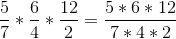
Now, you could multiply all of this out and then divide. However, you can cancel things immediately. The  goes into the
  and the
  into the
  . Thus, you have:

Remember, when you multiply fractions, you can directly multiply their denominators and their numerators; therefore, you can begin this problem by making it into one large fraction:
Now, you could multiply all of this out and then divide. However, you can cancel things immediately. The
← Didn't Know|Knew It →
Alan is twice as old as Betty. He will be twice as old as Charlie in 10 years. If Charlie is 2 years old, how old is Betty?
Alan is twice as old as Betty. He will be twice as old as Charlie in 10 years. If Charlie is 2 years old, how old is Betty?
Tap to reveal answer
If Charlie is 2 years old now; in 10 years he will be 12 years old. At that point, Alan will be twice as old as Charlie. Twice 12 is 24. This means that Alan is currently 10 years younger than 24, or 14. Since Alan is currently twice as old as Betty, she must be half of 14, or 7.
If Charlie is 2 years old now; in 10 years he will be 12 years old. At that point, Alan will be twice as old as Charlie. Twice 12 is 24. This means that Alan is currently 10 years younger than 24, or 14. Since Alan is currently twice as old as Betty, she must be half of 14, or 7.
← Didn't Know|Knew It →
The ratio of 10 to 14 is closest to what value?
The ratio of 10 to 14 is closest to what value?
Tap to reveal answer
Another way to express ratios is through division. 10 divided by 14 is approximate 0.71.
Another way to express ratios is through division. 10 divided by 14 is approximate 0.71.
← Didn't Know|Knew It →
Simplify:
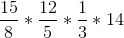
Simplify:
Tap to reveal answer
First, begin by remembering that  is the same as
  :
:
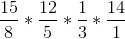
Next, recall that you multiply fractions by multiplying the numerators and denominators by each other. It is very simple. This would give you:

Now, you can cancel the  and the
  :
:

Next, you can reduce the  and the
  :
:

You can also reduce the resulting  and the
  :
:

First, begin by remembering that
Next, recall that you multiply fractions by multiplying the numerators and denominators by each other. It is very simple. This would give you:
Now, you can cancel the
Next, you can reduce the
You can also reduce the resulting
← Didn't Know|Knew It →
In 7 years Bill will be twice Amy’s age. Amy was 1.5 times Molly’s age 2 years ago. If Bill is 29 how old is Molly?
In 7 years Bill will be twice Amy’s age. Amy was 1.5 times Molly’s age 2 years ago. If Bill is 29 how old is Molly?
Tap to reveal answer
Consider
(Bill + 7) = 2 x (Amy + 7)
(Amy – 2) = 1.5 x (Molly – 2)
Solve for Molly using the two equations by finding Amy’s age in terms of Molly’s age.
Amy = 2 + 1.5 Molly – 3 = 1.5 x Molly – 1
Substitute this into the first equation:
(Bill + 7) = 2 x (Amy + 7) = 2 x (1.5 x Molly – 1 + 7) = 2 x (1.5 x Molly + 6) = 3 x Molly + 12
Solve for Molly:
Bill + 7 – 12 = 3 x Molly
Molly = (Bill – 5) ¸ 3
Substitute Bill = 29
Molly = (Bill – 5) ¸ 3 = 8
Consider
(Bill + 7) = 2 x (Amy + 7)
(Amy – 2) = 1.5 x (Molly – 2)
Solve for Molly using the two equations by finding Amy’s age in terms of Molly’s age.
Amy = 2 + 1.5 Molly – 3 = 1.5 x Molly – 1
Substitute this into the first equation:
(Bill + 7) = 2 x (Amy + 7) = 2 x (1.5 x Molly – 1 + 7) = 2 x (1.5 x Molly + 6) = 3 x Molly + 12
Solve for Molly:
Bill + 7 – 12 = 3 x Molly
Molly = (Bill – 5) ¸ 3
Substitute Bill = 29
Molly = (Bill – 5) ¸ 3 = 8
← Didn't Know|Knew It →
In a mixture of flour and sugar, the ratio of flour to sugar is 5 to 1. How many kilograms of flour will there be in 12 kilograms of this mixture?
In a mixture of flour and sugar, the ratio of flour to sugar is 5 to 1. How many kilograms of flour will there be in 12 kilograms of this mixture?
Tap to reveal answer
The question says that the mixture has 5 units of flour for every 1 unit of sugar, which adds up to a total of 5 + 1 = 6 units of the mixture; therefore in 6 kilograms of the mixture, 1 kilogram will be sugar.
To find how much sugar will be in 12 kilograms of the mixture, we multiply the amount of sugar in 6 kilograms of the mixture by 2, giving us 1 kilogram of sugar * 2 = 2 kilograms of sugar.
The question says that the mixture has 5 units of flour for every 1 unit of sugar, which adds up to a total of 5 + 1 = 6 units of the mixture; therefore in 6 kilograms of the mixture, 1 kilogram will be sugar.
To find how much sugar will be in 12 kilograms of the mixture, we multiply the amount of sugar in 6 kilograms of the mixture by 2, giving us 1 kilogram of sugar * 2 = 2 kilograms of sugar.
← Didn't Know|Knew It →
A water tank holds 500 gallons of water. There is a hole in the tank that leaks out the water at rate of 100 mL/min. In how many days will the water tank contain only half of the water it holds originally? Note: 1 gallon = 3.785 L
A water tank holds 500 gallons of water. There is a hole in the tank that leaks out the water at rate of 100 mL/min. In how many days will the water tank contain only half of the water it holds originally? Note: 1 gallon = 3.785 L
Tap to reveal answer
1 gallon = 3.785L = 3785mL, half of the tank = 250*3785 = 946,250mL. To find the minutes, 946250mL/(100mL/min) = 9462.5min. Since 1 day=24hr*60min=1440min, the number of days =94625min/(1440min/day)=6.5 days
1 gallon = 3.785L = 3785mL, half of the tank = 250*3785 = 946,250mL. To find the minutes, 946250mL/(100mL/min) = 9462.5min. Since 1 day=24hr*60min=1440min, the number of days =94625min/(1440min/day)=6.5 days
← Didn't Know|Knew It →
Alex runs around his school race track one time in 15 minutes and takes another 25 minutes to run around a second time. If the course is 4 miles long, what is his approximate average speed in miles per hour for the entire run?
Alex runs around his school race track one time in 15 minutes and takes another 25 minutes to run around a second time. If the course is 4 miles long, what is his approximate average speed in miles per hour for the entire run?
Tap to reveal answer
15 + 25 = 40 minutes. 40 minutes is 2/3 of an hour. Distance = rate x time. Using this formula, we have 4 = (2/3) r. To solve for r we multiply both sides by (2/3). r = 6
15 + 25 = 40 minutes. 40 minutes is 2/3 of an hour. Distance = rate x time. Using this formula, we have 4 = (2/3) r. To solve for r we multiply both sides by (2/3). r = 6
← Didn't Know|Knew It →
If a car travels 60 mph for 2 hours, 55 mph for 1.5 hours and 30 mph for 45 minutes, how far has the car traveled?
If a car travels 60 mph for 2 hours, 55 mph for 1.5 hours and 30 mph for 45 minutes, how far has the car traveled?
Tap to reveal answer
Distance traveled = mph x hour
60mph x 2hours + 55mph x 1.5 hours + 30 mph x 45 minutes (or .75 hours) =
120 miles + 82.5 miles + 22.5 miles = 225 miles
Distance traveled = mph x hour
60mph x 2hours + 55mph x 1.5 hours + 30 mph x 45 minutes (or .75 hours) =
120 miles + 82.5 miles + 22.5 miles = 225 miles
← Didn't Know|Knew It →
If an object travels at 1200 ft per hour, how many minutes does it take to travel 180 ft?
If an object travels at 1200 ft per hour, how many minutes does it take to travel 180 ft?
Tap to reveal answer
1200 ft per hour becomes 20 ft per second (divide 1200 by 60 because there are 60 minutes in an hour). 180/20 is 9, giving 9 minutes to travel 180 ft.
1200 ft per hour becomes 20 ft per second (divide 1200 by 60 because there are 60 minutes in an hour). 180/20 is 9, giving 9 minutes to travel 180 ft.
← Didn't Know|Knew It →
If you live 3 miles from your school. What average speed do you have to ride your bike get to your school from your house in 15 minutes?
If you live 3 miles from your school. What average speed do you have to ride your bike get to your school from your house in 15 minutes?
Tap to reveal answer
The best way to find speed is to divide the distance by time. Since time is given in minutes we must convert minutes to hours so that our units match those in the answer choices. (3miles/15min)(60min/1hr)=12miles/hr; Remember when multipliying fractions to multiply straight across the top and bottom.
The best way to find speed is to divide the distance by time. Since time is given in minutes we must convert minutes to hours so that our units match those in the answer choices. (3miles/15min)(60min/1hr)=12miles/hr; Remember when multipliying fractions to multiply straight across the top and bottom.
← Didn't Know|Knew It →
If an airplane is flying 225mph about how long will it take the plane to go 600 miles?
If an airplane is flying 225mph about how long will it take the plane to go 600 miles?
Tap to reveal answer
Speed = distance /time; So by solving for time we get time = distance /speed. So the equation for the answer is (600 miles)/ (225 miles/hr)= 2.67 hours; Remember to round up when the last digit of concern is 5 or more.
Speed = distance /time; So by solving for time we get time = distance /speed. So the equation for the answer is (600 miles)/ (225 miles/hr)= 2.67 hours; Remember to round up when the last digit of concern is 5 or more.
← Didn't Know|Knew It →
Vikki is able to complete 4 SAT reading questions in 6 minutes. At this rate, how many questions can she answer in 3 1/2 hours?
Vikki is able to complete 4 SAT reading questions in 6 minutes. At this rate, how many questions can she answer in 3 1/2 hours?
Tap to reveal answer
First, find how many minutes are in 3 1/2 hours: 3 * 60 + 30 = 210 minutes. Then divide 210 by 6 to find how many six-minute intervals are in 210 minutes: 210/6 = 35. Since Vikki can complete 4 questions every 6 minutes, and there are 35 six-minute intervals we can multiply 4 by 35 to determine the total number of questions that she can complete.
4 * 35 = 140 problems.
First, find how many minutes are in 3 1/2 hours: 3 * 60 + 30 = 210 minutes. Then divide 210 by 6 to find how many six-minute intervals are in 210 minutes: 210/6 = 35. Since Vikki can complete 4 questions every 6 minutes, and there are 35 six-minute intervals we can multiply 4 by 35 to determine the total number of questions that she can complete.
4 * 35 = 140 problems.
← Didn't Know|Knew It →
The price of k kilograms of quartz is 50 dollars, and each kilogram makes s clocks. In terms of s and k, what is the price, in dollars, of the quartz required to make 1 clock?
The price of k kilograms of quartz is 50 dollars, and each kilogram makes s clocks. In terms of s and k, what is the price, in dollars, of the quartz required to make 1 clock?
Tap to reveal answer
We want our result to have units of "dollars" in the numerator and units of "clocks" in the denominator. To do so, put the given information into conversion ratios that cause the units of "kilogram" to cancel out, as follows: (50 dollar/k kilogram)* (1 kilogram / s clock) = 50/(ks) dollar/clock.
Since the ratio has dollars in the numerator and clocks in the denominator, it represents the dollar price per clock.
We want our result to have units of "dollars" in the numerator and units of "clocks" in the denominator. To do so, put the given information into conversion ratios that cause the units of "kilogram" to cancel out, as follows: (50 dollar/k kilogram)* (1 kilogram / s clock) = 50/(ks) dollar/clock.
Since the ratio has dollars in the numerator and clocks in the denominator, it represents the dollar price per clock.
← Didn't Know|Knew It →