
Arithmetic - PSAT Math
Card 1 of 4032
Sally bought five computers for her office that cost $300, $405, $485, $520, and $555 respectively. She made a down payment of 2/5 the total cost and paid the rest in nine equal payments over the next nine months. Assuming no tax and no interest, what is the value of each of the nine payments?
Sally bought five computers for her office that cost $300, $405, $485, $520, and $555 respectively. She made a down payment of 2/5 the total cost and paid the rest in nine equal payments over the next nine months. Assuming no tax and no interest, what is the value of each of the nine payments?
Tap to reveal answer
The total cost of the 5 computers is 2265.
2/5 of 2265 = 906, which is what Sally pays up front.
2265 – 906 = 1359, which is what Sally still owes.
1359/9 = 151, which is the value of each of the 9 equal payments.
The total cost of the 5 computers is 2265.
2/5 of 2265 = 906, which is what Sally pays up front.
2265 – 906 = 1359, which is what Sally still owes.
1359/9 = 151, which is the value of each of the 9 equal payments.
← Didn't Know|Knew It →
The price of a computer is reduced by 1/8. The new price is then reduced by 1/6. What fraction of the original price is the current price?
The price of a computer is reduced by 1/8. The new price is then reduced by 1/6. What fraction of the original price is the current price?
Tap to reveal answer
Let the original price = p.
After the first reduction, the price is (7/8)p
After the second reduction, the price is (5/6)(7/8)p = (35/48)p
Let the original price = p.
After the first reduction, the price is (7/8)p
After the second reduction, the price is (5/6)(7/8)p = (35/48)p
← Didn't Know|Knew It →
If a car travels at 30 mph, how many feet per second does travel?
If a car travels at 30 mph, how many feet per second does travel?
Tap to reveal answer
30 miles / 1 hour * 5280 ft / 1 mile * 3600 seconds / 1 hour = 44 ft/sec
30 miles / 1 hour * 5280 ft / 1 mile * 3600 seconds / 1 hour = 44 ft/sec
← Didn't Know|Knew It →
Simplify the expression
 .
.
Simplify the expression
Tap to reveal answer
The expression must first be factored in order to be solvable. Both the numerator and the denominator can be factored, which would give
 .
.
 can be divided from both the numerator and the denominator to give

The expression must first be factored in order to be solvable. Both the numerator and the denominator can be factored, which would give
← Didn't Know|Knew It →
Simplify the expression
 .
.
Simplify the expression
Tap to reveal answer
The expression can be rewritten as

The expression can be rewritten as
← Didn't Know|Knew It →
A particular ball always bounces back to 2/5 of the height of its previous bounce after being dropped. After the first bounce it reaches a height of 175 inches. Approximately how high (in inches) will it reach after its fifth bounce?
A particular ball always bounces back to 2/5 of the height of its previous bounce after being dropped. After the first bounce it reaches a height of 175 inches. Approximately how high (in inches) will it reach after its fifth bounce?
Tap to reveal answer
The first bounce reaches a height of 175. The second bounce will equal 175 multiplied by 2/5 or 70. Repeat this process. You will get the data below. 4.48 is rounded to 4.5.
The first bounce reaches a height of 175. The second bounce will equal 175 multiplied by 2/5 or 70. Repeat this process. You will get the data below. 4.48 is rounded to 4.5.
← Didn't Know|Knew It →
The price of a purse is reduced by 20%. It is then put on final sale with an additional 30% off. What is the total discount on the purse?
The price of a purse is reduced by 20%. It is then put on final sale with an additional 30% off. What is the total discount on the purse?
Tap to reveal answer
Let us assume that the original purse is $100. The price after the first reduction is $80. After the second reduction the price is now $56. The difference between 100 and 56 is 44, giving 44% off.
Let us assume that the original purse is $100. The price after the first reduction is $80. After the second reduction the price is now $56. The difference between 100 and 56 is 44, giving 44% off.
← Didn't Know|Knew It →
Julie goes shopping at Gap. There is a storewide sale of 30% off. She buys a sweater on clearance that gets an additional 50% off. If the sweater was originally $50, how much did she pay?
Julie goes shopping at Gap. There is a storewide sale of 30% off. She buys a sweater on clearance that gets an additional 50% off. If the sweater was originally $50, how much did she pay?
Tap to reveal answer
The original price was $50. First you take 30% off (50 * (100 - 30)/100 = $35). Then you take an additional 50% off the new price (35 * 50/100 = 17.50)
The original price was $50. First you take 30% off (50 * (100 - 30)/100 = $35). Then you take an additional 50% off the new price (35 * 50/100 = 17.50)
← Didn't Know|Knew It →

Tap to reveal answer
Remember, when you multiply fractions, you can directly multiply their denominators and their numerators; therefore, you can begin this problem by making it into one large fraction:
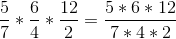
Now, you could multiply all of this out and then divide. However, you can cancel things immediately. The  goes into the
  and the
  into the
  . Thus, you have:

Remember, when you multiply fractions, you can directly multiply their denominators and their numerators; therefore, you can begin this problem by making it into one large fraction:
Now, you could multiply all of this out and then divide. However, you can cancel things immediately. The
← Didn't Know|Knew It →
Alan is twice as old as Betty. He will be twice as old as Charlie in 10 years. If Charlie is 2 years old, how old is Betty?
Alan is twice as old as Betty. He will be twice as old as Charlie in 10 years. If Charlie is 2 years old, how old is Betty?
Tap to reveal answer
If Charlie is 2 years old now; in 10 years he will be 12 years old. At that point, Alan will be twice as old as Charlie. Twice 12 is 24. This means that Alan is currently 10 years younger than 24, or 14. Since Alan is currently twice as old as Betty, she must be half of 14, or 7.
If Charlie is 2 years old now; in 10 years he will be 12 years old. At that point, Alan will be twice as old as Charlie. Twice 12 is 24. This means that Alan is currently 10 years younger than 24, or 14. Since Alan is currently twice as old as Betty, she must be half of 14, or 7.
← Didn't Know|Knew It →
The ratio of 10 to 14 is closest to what value?
The ratio of 10 to 14 is closest to what value?
Tap to reveal answer
Another way to express ratios is through division. 10 divided by 14 is approximate 0.71.
Another way to express ratios is through division. 10 divided by 14 is approximate 0.71.
← Didn't Know|Knew It →
A baker has four different types of frosting, three different kinds of sprinkles, and 8 different cookie cutters. How many different cookie combinations can the baker create if each cookie has one type of frosting and one type of sprinkle?
A baker has four different types of frosting, three different kinds of sprinkles, and 8 different cookie cutters. How many different cookie combinations can the baker create if each cookie has one type of frosting and one type of sprinkle?
Tap to reveal answer
Since this a combination problem and we want to know how many different ways the cookies can be created we can solve this using the Fundamental counting principle. 4 x 3 x 8 = 96
Multiplying each of the possible choices together.
Since this a combination problem and we want to know how many different ways the cookies can be created we can solve this using the Fundamental counting principle. 4 x 3 x 8 = 96
Multiplying each of the possible choices together.
← Didn't Know|Knew It →
If x and y are integers and at least one of them is even, which of the following MUST be true?
If x and y are integers and at least one of them is even, which of the following MUST be true?
Tap to reveal answer
Since we are only told that "at least" one of the numbers is even, we could have one even and one odd integer OR we could have two even integers.
Even plus odd is odd, but even plus even is even, so x + y could be either even or odd.
Even times odd is even, and even times even is even, so xy must be even.
Since we are only told that "at least" one of the numbers is even, we could have one even and one odd integer OR we could have two even integers.
Even plus odd is odd, but even plus even is even, so x + y could be either even or odd.
Even times odd is even, and even times even is even, so xy must be even.
← Didn't Know|Knew It →
If xy = 100 and x and y are distinct positive integers, what is the smallest possible value of x + y?
If xy = 100 and x and y are distinct positive integers, what is the smallest possible value of x + y?
Tap to reveal answer
Consider the possible values for (x, y):
(1, 100)
(2, 50)
(4, 25)
(5, 20)
Note that (10, 10) is not possible since the two variables are to be distinct. The sums of the above pairs, respectively, are:
1 + 100 = 101
2 + 50 = 52
4 + 25 = 29
5 + 20 = 25, the smallest possible value.
Consider the possible values for (x, y):
(1, 100)
(2, 50)
(4, 25)
(5, 20)
Note that (10, 10) is not possible since the two variables are to be distinct. The sums of the above pairs, respectively, are:
1 + 100 = 101
2 + 50 = 52
4 + 25 = 29
5 + 20 = 25, the smallest possible value.
← Didn't Know|Knew It →
Which of the following is not a rational number?
Which of the following is not a rational number?
Tap to reveal answer
A rational number is a number that can be written in the form of a/b, where a and b are integers, aka a real number that can be written as a simple fraction or ratio. 4 of the 5 answer choices can be written as fractions and are thus rational.
5 = 5/1, 1.75 = 7/4, .001 = 1/1000, 0.111... = 1/9
√2 cannot be written as a fraction because it is irrational. The two most famous irrational numbers are √2 and pi.
A rational number is a number that can be written in the form of a/b, where a and b are integers, aka a real number that can be written as a simple fraction or ratio. 4 of the 5 answer choices can be written as fractions and are thus rational.
5 = 5/1, 1.75 = 7/4, .001 = 1/1000, 0.111... = 1/9
√2 cannot be written as a fraction because it is irrational. The two most famous irrational numbers are √2 and pi.
← Didn't Know|Knew It →
Four consecutive integers have a mean of 9.5. What is the largest of these integers?
Four consecutive integers have a mean of 9.5. What is the largest of these integers?
Tap to reveal answer
Four consecutive integers could be represented as n, n+1, n+2, n+3
Therefore, by saying that they have a mean of 9.5, we mean to say:
(n + n+1 + n+2 + n+ 3)/4 = 9.5
(4n + 6)/4 = 9.5 → 4n + 6 = 38 → 4n = 32 → n = 8
Therefore, the largest value is n + 3, or 11.
Four consecutive integers could be represented as n, n+1, n+2, n+3
Therefore, by saying that they have a mean of 9.5, we mean to say:
(n + n+1 + n+2 + n+ 3)/4 = 9.5
(4n + 6)/4 = 9.5 → 4n + 6 = 38 → 4n = 32 → n = 8
Therefore, the largest value is n + 3, or 11.
← Didn't Know|Knew It →
Simplify:
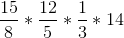
Simplify:
Tap to reveal answer
First, begin by remembering that  is the same as
  :
:
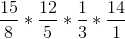
Next, recall that you multiply fractions by multiplying the numerators and denominators by each other. It is very simple. This would give you:

Now, you can cancel the  and the
  :
:

Next, you can reduce the  and the
  :
:

You can also reduce the resulting  and the
  :
:

First, begin by remembering that
Next, recall that you multiply fractions by multiplying the numerators and denominators by each other. It is very simple. This would give you:
Now, you can cancel the
Next, you can reduce the
You can also reduce the resulting
← Didn't Know|Knew It →
-27, -24, -21, -18…
In the sequence above, each term after the first is 3 greater than the preceding term. Which of the following could not be a value in the sequence?
-27, -24, -21, -18…
In the sequence above, each term after the first is 3 greater than the preceding term. Which of the following could not be a value in the sequence?
Tap to reveal answer
All of the values in the sequence must be a multiple of 3. All answers are multiples of 3 except 461 so 461 cannot be part of the sequence.
All of the values in the sequence must be a multiple of 3. All answers are multiples of 3 except 461 so 461 cannot be part of the sequence.
← Didn't Know|Knew It →
The Widget Company has annual revenues of $150,000. Their expenses over the same time frame was $75,000. What was the percent profit?
The Widget Company has annual revenues of $150,000. Their expenses over the same time frame was $75,000. What was the percent profit?
Tap to reveal answer
Profit = Revenue – Expense
% Profit = $ Profit ÷ $ Total Revenue
% Profit = ($150,000 – $75,000) ÷ $150,000 = 50%
Profit = Revenue – Expense
% Profit = $ Profit ÷ $ Total Revenue
% Profit = ($150,000 – $75,000) ÷ $150,000 = 50%
← Didn't Know|Knew It →
Nicki sold 20 albums at $5 each. How many albums should Minaj sell at $4.50 to earn more than Nicki?
Nicki sold 20 albums at $5 each. How many albums should Minaj sell at $4.50 to earn more than Nicki?
Tap to reveal answer
The answer is 23. 23*$4.50 = $103.50, which is more than what Nicki earned.
The answer is 23. 23*$4.50 = $103.50, which is more than what Nicki earned.
← Didn't Know|Knew It →