
Equations / Inequalities - PSAT Math
Card 1 of 1561
Complete the square to calculate the maximum or minimum point of the given function.

Complete the square to calculate the maximum or minimum point of the given function.
Tap to reveal answer
Completing the square method uses the concept of perfect squares. Recall that a perfect square is in the form,

where when multiplied out,

the middle term coefficient, when divided by two and squared, results in the coefficient of the last term.
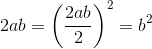
Complete the square for this particular function is as follows.

First identify the middle term coefficient.

Now divide the middle term coefficient by two.

From here write the function with the perfect square. Remember when adding the new squared term, add it to both sides to keep the equation balanced.

When simplified the new function is,

Since the  term is positive, the parabola will be opening up. This means that the function has a minimum value at the vertex. To find the
  value of the vertex set the inside portion of the binomial equal to zero and solve.

From here, substitute the the  value into the original function.


Therefore the minimum value occurs at the point  .
.
Completing the square method uses the concept of perfect squares. Recall that a perfect square is in the form,
where when multiplied out,
the middle term coefficient, when divided by two and squared, results in the coefficient of the last term.
Complete the square for this particular function is as follows.
First identify the middle term coefficient.
Now divide the middle term coefficient by two.
From here write the function with the perfect square. Remember when adding the new squared term, add it to both sides to keep the equation balanced.
When simplified the new function is,
Since the
From here, substitute the the
Therefore the minimum value occurs at the point
← Didn't Know|Knew It →
Complete the square to calculate the maximum or minimum point of the given function.

Complete the square to calculate the maximum or minimum point of the given function.
Tap to reveal answer
Completing the square method uses the concept of perfect squares. Recall that a perfect square is in the form,
where when multiplied out,
the middle term coefficient, when divided by two and squared, results in the coefficient of the last term.
Complete the square for this particular function is as follows.

First identify the middle term coefficient.

Now divide the middle term coefficient by two.

From here write the function with the perfect square. Remember when adding the new squared term, add it to both sides to keep the equation balanced.

When simplified the new function is,

Since the term is positive, the parabola will be opening up. This means that the function has a minimum value at the vertex. To find the value of the vertex set the inside portion of the binomial equal to zero and solve.

From here, substitute the the value into the original function.


Therefore the minimum value occurs at the point  .
.
Completing the square method uses the concept of perfect squares. Recall that a perfect square is in the form,
where when multiplied out,
the middle term coefficient, when divided by two and squared, results in the coefficient of the last term.
Complete the square for this particular function is as follows.
First identify the middle term coefficient.
Now divide the middle term coefficient by two.
From here write the function with the perfect square. Remember when adding the new squared term, add it to both sides to keep the equation balanced.
When simplified the new function is,
Since the
From here, substitute the the
Therefore the minimum value occurs at the point
← Didn't Know|Knew It →
Complete the square to calculate the maximum or minimum point of the given function.

Complete the square to calculate the maximum or minimum point of the given function.
Tap to reveal answer
Completing the square method uses the concept of perfect squares. Recall that a perfect square is in the form,
where when multiplied out,
the middle term coefficient, when divided by two and squared, results in the coefficient of the last term.
Complete the square for this particular function is as follows.

First identify the middle term coefficient.

Now divide the middle term coefficient by two.

From here write the function with the perfect square.

When simplified the new function is,

Since the term is positive, the parabola will be opening up. This means that the function has a minimum value at the vertex. To find the value of the vertex set the inside portion of the binomial equal to zero and solve.

From here, substitute the the value into the original function.


Therefore the minimum value occurs at the point  .
.
Completing the square method uses the concept of perfect squares. Recall that a perfect square is in the form,
where when multiplied out,
the middle term coefficient, when divided by two and squared, results in the coefficient of the last term.
Complete the square for this particular function is as follows.
First identify the middle term coefficient.
Now divide the middle term coefficient by two.
From here write the function with the perfect square.
When simplified the new function is,
Since the
From here, substitute the the
Therefore the minimum value occurs at the point
← Didn't Know|Knew It →
Complete the square to calculate the maximum or minimum point of the given function.

Complete the square to calculate the maximum or minimum point of the given function.
Tap to reveal answer
Completing the square method uses the concept of perfect squares. Recall that a perfect square is in the form,
where when multiplied out,
the middle term coefficient, when divided by two and squared, results in the coefficient of the last term.
Complete the square for this particular function is as follows.

First identify the middle term coefficient.

Now divide the middle term coefficient by two.

From here write the function with the perfect square.

When simplified the new function is,

Since the term is positive, the parabola will be opening up. This means that the function has a minimum value at the vertex. To find the value of the vertex set the inside portion of the binomial equal to zero and solve.

From here, substitute the the value into the original function.


Therefore the minimum value occurs at the point  .
.
Completing the square method uses the concept of perfect squares. Recall that a perfect square is in the form,
where when multiplied out,
the middle term coefficient, when divided by two and squared, results in the coefficient of the last term.
Complete the square for this particular function is as follows.
First identify the middle term coefficient.
Now divide the middle term coefficient by two.
From here write the function with the perfect square.
When simplified the new function is,
Since the
From here, substitute the the
Therefore the minimum value occurs at the point
← Didn't Know|Knew It →
Complete the square to calculate the maximum or minimum point of the given function.

Complete the square to calculate the maximum or minimum point of the given function.
Tap to reveal answer
Completing the square method uses the concept of perfect squares. Recall that a perfect square is in the form,
where when multiplied out,
the middle term coefficient, when divided by two and squared, results in the coefficient of the last term.
Complete the square for this particular function is as follows.

First identify the middle term coefficient.

Now divide the middle term coefficient by two.

From here write the function with the perfect square.

When simplified the new function is,

Since the term is positive, the parabola will be opening up. This means that the function has a minimum value at the vertex. To find the value of the vertex set the inside portion of the binomial equal to zero and solve.

From here, substitute the the value into the original function.


Therefore the minimum value occurs at the point  .
.
Completing the square method uses the concept of perfect squares. Recall that a perfect square is in the form,
where when multiplied out,
the middle term coefficient, when divided by two and squared, results in the coefficient of the last term.
Complete the square for this particular function is as follows.
First identify the middle term coefficient.
Now divide the middle term coefficient by two.
From here write the function with the perfect square.
When simplified the new function is,
Since the
From here, substitute the the
Therefore the minimum value occurs at the point
← Didn't Know|Knew It →
Complete the square to calculate the maximum or minimum point of the given function.

Complete the square to calculate the maximum or minimum point of the given function.
Tap to reveal answer
Completing the square method uses the concept of perfect squares. Recall that a perfect square is in the form,
where when multiplied out,
the middle term coefficient, when divided by two and squared, results in the coefficient of the last term.
Complete the square for this particular function is as follows.

First identify the middle term coefficient.

Now divide the middle term coefficient by two.

From here write the function with the perfect square.

When simplified the new function is,

Since the term is positive, the parabola will be opening up. This means that the function has a minimum value at the vertex. To find the value of the vertex set the inside portion of the binomial equal to zero and solve.

From here, substitute the the value into the original function.


Therefore the minimum value occurs at the point  .
.
Completing the square method uses the concept of perfect squares. Recall that a perfect square is in the form,
where when multiplied out,
the middle term coefficient, when divided by two and squared, results in the coefficient of the last term.
Complete the square for this particular function is as follows.
First identify the middle term coefficient.
Now divide the middle term coefficient by two.
From here write the function with the perfect square.
When simplified the new function is,
Since the
From here, substitute the the
Therefore the minimum value occurs at the point
← Didn't Know|Knew It →
Complete the square to calculate the maximum or minimum point of the given function.

Complete the square to calculate the maximum or minimum point of the given function.
Tap to reveal answer
Completing the square method uses the concept of perfect squares. Recall that a perfect square is in the form,
where when multiplied out,
the middle term coefficient, when divided by two and squared, results in the coefficient of the last term.
Complete the square for this particular function is as follows.

First factor out a negative one.

Now identify the middle term coefficient.

Now divide the middle term coefficient by two.

From here write the function with the perfect square.

When simplified the new function is,

Since the term is negative, the parabola will be opening down. This means that the function has a maximum value at the vertex. To find the value of the vertex set the inside portion of the binomial equal to zero and solve.

From here, substitute the the value into the original function.


Therefore the maximum value occurs at the point  .
.
Completing the square method uses the concept of perfect squares. Recall that a perfect square is in the form,
where when multiplied out,
the middle term coefficient, when divided by two and squared, results in the coefficient of the last term.
Complete the square for this particular function is as follows.
First factor out a negative one.
Now identify the middle term coefficient.
Now divide the middle term coefficient by two.
From here write the function with the perfect square.
When simplified the new function is,
Since the
From here, substitute the the
Therefore the maximum value occurs at the point
← Didn't Know|Knew It →
Complete the square to calculate the maximum or minimum point of the given function.

Complete the square to calculate the maximum or minimum point of the given function.
Tap to reveal answer
Completing the square method uses the concept of perfect squares. Recall that a perfect square is in the form,
where when multiplied out,
the middle term coefficient, when divided by two and squared, results in the coefficient of the last term.
Complete the square for this particular function is as follows.

First factor out a negative one.

Now identify the middle term coefficient.

Now divide the middle term coefficient by two.

From here write the function with the perfect square.

When simplified the new function is,

Since the term is negative, the parabola will be opening down. This means that the function has a maximum value at the vertex. To find the value of the vertex set the inside portion of the binomial equal to zero and solve.

From here, substitute the the value into the original function.


Therefore the maximum value occurs at the point  .
.
Completing the square method uses the concept of perfect squares. Recall that a perfect square is in the form,
where when multiplied out,
the middle term coefficient, when divided by two and squared, results in the coefficient of the last term.
Complete the square for this particular function is as follows.
First factor out a negative one.
Now identify the middle term coefficient.
Now divide the middle term coefficient by two.
From here write the function with the perfect square.
When simplified the new function is,
Since the
From here, substitute the the
Therefore the maximum value occurs at the point
← Didn't Know|Knew It →
Complete the square to calculate the maximum or minimum point of the given function.

Complete the square to calculate the maximum or minimum point of the given function.
Tap to reveal answer
Completing the square method uses the concept of perfect squares. Recall that a perfect square is in the form,
where when multiplied out,
the middle term coefficient, when divided by two and squared, results in the coefficient of the last term.
Complete the square for this particular function is as follows.

First factor out a negative one.

Now identify the middle term coefficient.

Now divide the middle term coefficient by two.

From here write the function with the perfect square.

When simplified the new function is,

Since the term is negative, the parabola will be opening down. This means that the function has a maximum value at the vertex. To find the value of the vertex set the inside portion of the binomial equal to zero and solve.
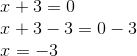
From here, substitute the the value into the original function.


Therefore the maximum value occurs at the point  .
.
Completing the square method uses the concept of perfect squares. Recall that a perfect square is in the form,
where when multiplied out,
the middle term coefficient, when divided by two and squared, results in the coefficient of the last term.
Complete the square for this particular function is as follows.
First factor out a negative one.
Now identify the middle term coefficient.
Now divide the middle term coefficient by two.
From here write the function with the perfect square.
When simplified the new function is,
Since the
From here, substitute the the
Therefore the maximum value occurs at the point
← Didn't Know|Knew It →
Complete the square to calculate the maximum or minimum point of the given function.

Complete the square to calculate the maximum or minimum point of the given function.

Tap to reveal answer
Completing the square method uses the concept of perfect squares. Recall that a perfect square is in the form,
where when multiplied out,
the middle term coefficient, when divided by two and squared, results in the coefficient of the last term.
Complete the square for this particular function is as follows.

First factor out a negative one.

Now identify the middle term coefficient.

Now divide the middle term coefficient by two.

From here write the function with the perfect square.

When simplified the new function is,

Since the term is negative, the parabola will be opening down. This means that the function has a maximum value at the vertex. To find the value of the vertex set the inside portion of the binomial equal to zero and solve.

From here, substitute the the value into the original function.


Therefore the maximum value occurs at the point  .
.
Completing the square method uses the concept of perfect squares. Recall that a perfect square is in the form,
where when multiplied out,
the middle term coefficient, when divided by two and squared, results in the coefficient of the last term.
Complete the square for this particular function is as follows.
First factor out a negative one.
Now identify the middle term coefficient.
Now divide the middle term coefficient by two.
From here write the function with the perfect square.
When simplified the new function is,
Since the
From here, substitute the the
Therefore the maximum value occurs at the point
← Didn't Know|Knew It →
Complete the square to calculate the maximum or minimum point of the given function.

Complete the square to calculate the maximum or minimum point of the given function.
Tap to reveal answer
Completing the square method uses the concept of perfect squares. Recall that a perfect square is in the form,
where when multiplied out,
the middle term coefficient, when divided by two and squared, results in the coefficient of the last term.
Complete the square for this particular function is as follows.

First factor out a negative one.

Now identify the middle term coefficient.

Now divide the middle term coefficient by two.

From here write the function with the perfect square.

When simplified the new function is,

Since the term is negative, the parabola will be opening down. This means that the function has a maximum value at the vertex. To find the value of the vertex set the inside portion of the binomial equal to zero and solve.
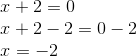
From here, substitute the the value into the original function.

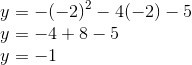
Therefore the maximum value occurs at the point  .
.
Completing the square method uses the concept of perfect squares. Recall that a perfect square is in the form,
where when multiplied out,
the middle term coefficient, when divided by two and squared, results in the coefficient of the last term.
Complete the square for this particular function is as follows.
First factor out a negative one.
Now identify the middle term coefficient.
Now divide the middle term coefficient by two.
From here write the function with the perfect square.
When simplified the new function is,
Since the
From here, substitute the the
Therefore the maximum value occurs at the point
← Didn't Know|Knew It →
Complete the square to calculate the maximum or minimum point of the given function.

Complete the square to calculate the maximum or minimum point of the given function.
Tap to reveal answer
Completing the square method uses the concept of perfect squares. Recall that a perfect square is in the form,
where when multiplied out,
the middle term coefficient, when divided by two and squared, results in the coefficient of the last term.
Complete the square for this particular function is as follows.

First factor out a negative one.

Now identify the middle term coefficient.
Now divide the middle term coefficient by two.
From here write the function with the perfect square.

When simplified the new function is,

Since the term is negative, the parabola will be opening down. This means that the function has a maximum value at the vertex. To find the value of the vertex set the inside portion of the binomial equal to zero and solve.
From here, substitute the the value into the original function.
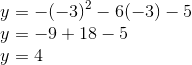
Therefore the maximum value occurs at the point  .
.
Completing the square method uses the concept of perfect squares. Recall that a perfect square is in the form,
where when multiplied out,
the middle term coefficient, when divided by two and squared, results in the coefficient of the last term.
Complete the square for this particular function is as follows.
First factor out a negative one.
Now identify the middle term coefficient.
Now divide the middle term coefficient by two.
From here write the function with the perfect square.
When simplified the new function is,
Since the
From here, substitute the the
Therefore the maximum value occurs at the point
← Didn't Know|Knew It →
Each of the following is equivalent to
xy/z * (5(x + y)) EXCEPT:
Each of the following is equivalent to
xy/z * (5(x + y)) EXCEPT:
Tap to reveal answer
Choice a is equivalent because we can say that technically we are multiplying two fractions together: (xy)/z and (5(x + y))/1. We multiply the numerators together and the denominators together and end up with xy (5x + 5y)/z. xy (5y + 5x)/z is also equivalent because it is only simplifying what is inside the parentheses and switching the order- the commutative property tells us this is still the same expression. 5x²y + 5xy²/z is equivalent as it is just a simplified version when the numerators are multiplied out. Choice 5x² + y²/z is not equivalent because it does not account for all the variables that were in the given expression and it does not use FOIL correctly.
Choice a is equivalent because we can say that technically we are multiplying two fractions together: (xy)/z and (5(x + y))/1. We multiply the numerators together and the denominators together and end up with xy (5x + 5y)/z. xy (5y + 5x)/z is also equivalent because it is only simplifying what is inside the parentheses and switching the order- the commutative property tells us this is still the same expression. 5x²y + 5xy²/z is equivalent as it is just a simplified version when the numerators are multiplied out. Choice 5x² + y²/z is not equivalent because it does not account for all the variables that were in the given expression and it does not use FOIL correctly.
← Didn't Know|Knew It →
Let S be the set of numbers that contains all of values of x such that 2x + 4 < 8. Let T contain all of the values of x such that -2x +3 < 8. What is the sum of all of the integer values that belong to the intersection of S and T?
Let S be the set of numbers that contains all of values of x such that 2x + 4 < 8. Let T contain all of the values of x such that -2x +3 < 8. What is the sum of all of the integer values that belong to the intersection of S and T?
Tap to reveal answer
First, we need to find all of the values that are in the set S, and then we need to find the values in T. Once we do this, we must find the numbers in the intersection of S and T, which means we must find the values contained in BOTH sets S and T.
S contains all of the values of x such that 2x + 4 < 8. We need to solve this inequality.
2x + 4 < 8
Subtract 4 from both sides.
2x < 4
Divide by 2.
x < 2
Thus, S contains all of the values of x that are less than (but not equal to) 2.
Now, we need to do the same thing to find the values contained in T.
-2x + 3 < 8
Subtract 3 from both sides.
-2x < 5
Divide both sides by -2. Remember, when multiplying or dividing an inequality by a negative number, we must switch the sign.
x > -5/2
Therefore, T contains all of the values of x that are greater than -5/2, or -2.5.
Next, we must find the values that are contained in both S and T. In order to be in both sets, these numbers must be less than 2, but also greater than -2.5. Thus, the intersection of S and T consists of all numbers between -2.5 and 2.
The question asks us to find the sum of the integers in the intersection of S and T. This means we must find all of the integers between -2.5 and 2.
The integers between -2.5 and 2 are the following: -2, -1, 0, and 1. We cannot include 2, because the values in S are LESS than but not equal to 2.
Lastly, we add up the values -2, -1, 0, and 1. The sum of these is -2.
The answer is -2.
First, we need to find all of the values that are in the set S, and then we need to find the values in T. Once we do this, we must find the numbers in the intersection of S and T, which means we must find the values contained in BOTH sets S and T.
S contains all of the values of x such that 2x + 4 < 8. We need to solve this inequality.
2x + 4 < 8
Subtract 4 from both sides.
2x < 4
Divide by 2.
x < 2
Thus, S contains all of the values of x that are less than (but not equal to) 2.
Now, we need to do the same thing to find the values contained in T.
-2x + 3 < 8
Subtract 3 from both sides.
-2x < 5
Divide both sides by -2. Remember, when multiplying or dividing an inequality by a negative number, we must switch the sign.
x > -5/2
Therefore, T contains all of the values of x that are greater than -5/2, or -2.5.
Next, we must find the values that are contained in both S and T. In order to be in both sets, these numbers must be less than 2, but also greater than -2.5. Thus, the intersection of S and T consists of all numbers between -2.5 and 2.
The question asks us to find the sum of the integers in the intersection of S and T. This means we must find all of the integers between -2.5 and 2.
The integers between -2.5 and 2 are the following: -2, -1, 0, and 1. We cannot include 2, because the values in S are LESS than but not equal to 2.
Lastly, we add up the values -2, -1, 0, and 1. The sum of these is -2.
The answer is -2.
← Didn't Know|Knew It →
What is the solution set of the inequality  ?
?
What is the solution set of the inequality
Tap to reveal answer
We simplify this inequality similarly to how we would simplify an equation


Thus 
We simplify this inequality similarly to how we would simplify an equation
Thus
← Didn't Know|Knew It →
The Spanish club wants to make and sell some pizzas for a fundraiser. It will cost $300 to rent the equipment to make the pizzas and $2 worth of ingredients to make each pizza. The pizzas will be sold for $5.50 apiece.
How many pizzas must be made and sold for the Spanish club to make a profit of at least $600?
The Spanish club wants to make and sell some pizzas for a fundraiser. It will cost $300 to rent the equipment to make the pizzas and $2 worth of ingredients to make each pizza. The pizzas will be sold for $5.50 apiece.
How many pizzas must be made and sold for the Spanish club to make a profit of at least $600?
Tap to reveal answer
Let  be the number of pizzas made and sold. Each pizza will require $2 worth of ingredients, so the ingredients in total will cost
  . Add this to the cost to rent the equipment and the cost will be
  .
.
The pizzas will cost $5.50 each, so the money raised will be  .
.
The profit will be the difference between the revenue and the cost -

The Spanish club wants a profit of at least $600, so we set up and solve the inequality:


The Spanish club must sell at least 258 pizzas to earn a profit.
Let
The pizzas will cost $5.50 each, so the money raised will be
The profit will be the difference between the revenue and the cost -
The Spanish club wants a profit of at least $600, so we set up and solve the inequality:
The Spanish club must sell at least 258 pizzas to earn a profit.
← Didn't Know|Knew It →
Solve the inequality.

Solve the inequality.
Tap to reveal answer


* Notice that when we multiply or divide both sides by a negative number the ineqaulity sign changes orientation.

* Notice that when we multiply or divide both sides by a negative number the ineqaulity sign changes orientation.
← Didn't Know|Knew It →
Solve the inequality

Solve the inequality
Tap to reveal answer
First, multiplying each side of the equality by  gives
gives  . Next, dividing each side of the inequality by
  will solve for
  ;
;  .
.
First, multiplying each side of the equality by
← Didn't Know|Knew It →
What is a solution set of the inequality  ?
?
What is a solution set of the inequality
Tap to reveal answer
In order to find the solution set, we solve  as we would an equation:



Therefore, the solution set is any value of  .
.
In order to find the solution set, we solve
Therefore, the solution set is any value of
← Didn't Know|Knew It →
Solve for  :
:

Solve for
Tap to reveal answer
Begin by moving all of the  values to the left side of the inequality:

becomes

Next, move the  to the right side:

Finally, divide both sides by  :
:

Begin by moving all of the
becomes
Next, move the
Finally, divide both sides by
← Didn't Know|Knew It →