
Algebraic Functions - PSAT Math
Card 1 of 826
What is the domain of the function?

What is the domain of the function?
Tap to reveal answer
The domain of f(x) is all the values of x for which f(x) is defined.
f(x) has no square roots or denominators, so it will always be defined; there are no restrictions on x because any and all values will lead to a real result.
Therefore, the domain is the set of all real numbers.
The domain of f(x) is all the values of x for which f(x) is defined.
f(x) has no square roots or denominators, so it will always be defined; there are no restrictions on x because any and all values will lead to a real result.
Therefore, the domain is the set of all real numbers.
← Didn't Know|Knew It →
Let  .
.
If  and
and  are both negative integers larger than negative five, what is the smallest value possible for
  ?
?
Let
If
Tap to reveal answer
Because x and y must be negative integers greater than negative five, then x and y can only be equal to the following values:
x can equal -4, -3, -2, or -1
y can equal -4, -3, -2, or -1
Now we can try all of the combinations of x and y, and see what x # y would equal. It is helpful to note that x # y is the same as y # x because 2yx + y + x = 2xy + x + y. This means that the order of x and y doesn't matter.
-4 # -4 = 2(-4)(-4) + -4 + -4 = 24
-4 # -3 = 2(-4)(-3) + -4 + -3 = 17
-4 # -2 = 10
-4 # -1 = 3
-3 # -3 = 12
-3 # -2 = 7
-3 # -1 = 2
-2 # -2 = 4
-2 # -1 = 1
-1 # -1 = 0
We don't need to find -3 # -4, -2 # -4, etc, because x # y = y # x .
The smallest value of x # y must be 0.
Because x and y must be negative integers greater than negative five, then x and y can only be equal to the following values:
x can equal -4, -3, -2, or -1
y can equal -4, -3, -2, or -1
Now we can try all of the combinations of x and y, and see what x # y would equal. It is helpful to note that x # y is the same as y # x because 2yx + y + x = 2xy + x + y. This means that the order of x and y doesn't matter.
-4 # -4 = 2(-4)(-4) + -4 + -4 = 24
-4 # -3 = 2(-4)(-3) + -4 + -3 = 17
-4 # -2 = 10
-4 # -1 = 3
-3 # -3 = 12
-3 # -2 = 7
-3 # -1 = 2
-2 # -2 = 4
-2 # -1 = 1
-1 # -1 = 0
We don't need to find -3 # -4, -2 # -4, etc, because x # y = y # x .
The smallest value of x # y must be 0.
← Didn't Know|Knew It →
Which of the following represents the domain of  where:

Which of the following represents the domain of
Tap to reveal answer
Using our properties of exponents, we could rewrite  as
as 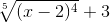
This means that when we input  , we first subtract 2, then take this to the fourth power, then take the fifth root, and then add three. We want to look at these steps individually and see whether there are any values that wouldn’t work at each step. In other words, we want to know which
  values we can put into our function at each step without encountering any problems.
The first step is to subtract 2 from  . The second step is to take that result and raise it to the fourth power. We can subtract two from any number, and we can take any number to the fourth power, which means that these steps don't put any restrictions on
  .
.
Then we must take the fifth root of a value. The trick to this problem is recognizing that we can take the fifth root of any number, positive or negative, because the function  is defined for any value of
  ; thus the fact that
  has a fifth root in it doesn't put any restrictions on
  , because we can add three to any number; therefore, the domain for
  is all real values of
  .
.
Using our properties of exponents, we could rewrite
This means that when we input
The first step is to subtract 2 from
Then we must take the fifth root of a value. The trick to this problem is recognizing that we can take the fifth root of any number, positive or negative, because the function
← Didn't Know|Knew It →
Find the domain of the function:
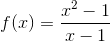
Find the domain of the function:
Tap to reveal answer
If a value of x makes the denominator of a equation zero, that value is not part of the domain. This is true, even here where the denominator can be "cancelled" by factoring the numerator into

and then cancelling the  from the numerator and the denominator.
This new expression,  is the equation of the function, but it will have a hole at the point where the denominator originally would have been zero. Thus, this graph will look like the line
  with a hole where
  , which is
 .
.
Thus the domain of the function is all  values such that
If a value of x makes the denominator of a equation zero, that value is not part of the domain. This is true, even here where the denominator can be "cancelled" by factoring the numerator into
and then cancelling the
This new expression,
Thus the domain of the function is all
← Didn't Know|Knew It →
What is the domain of the function f(x) = 2/(7x – 1) ?
What is the domain of the function f(x) = 2/(7x – 1) ?
Tap to reveal answer
The domain means what real number can you plug in that would still make the function work. For this case, we have to worry about the denominator so that it does not equal 0, so we solve the following. 7x – 1 = 0, 7x = 1, x = 1/7, so when x ≠ 1/7 the function will work.
The domain means what real number can you plug in that would still make the function work. For this case, we have to worry about the denominator so that it does not equal 0, so we solve the following. 7x – 1 = 0, 7x = 1, x = 1/7, so when x ≠ 1/7 the function will work.
← Didn't Know|Knew It →
Let  . The domain of
  includes which of the following?
I. 1
II. 2
III. –1
Let
I. 1
II. 2
III. –1
Tap to reveal answer
The domain of f(x) is defined as all of the values of x for which f(x) is defined.
The first value we have to consider is 1. Let's find f(1):
f(1) = (13 – 3(1)2 +2(1))–1
= (1 – 3(1) + 2)–1
= (1 – 3 + 2)–1
= (0)–1.
Remember that, in general, a–1 = 1/a. Thus, 0–1 = 1/0. However, it is impossible to have 0 in the denominator of a fraction, because it is impossible to divide anything by zero. Thus, 0–1 is undefined. Since f(1) is undefined, 1 cannot belong to the domain of f(x).
Now let's find f(2):
f(2) = (23 – 3(2)2 +2(2))–1
= (8 – 3(4) + 4)–1
=(8 – 12 + 4)–1
= 0–1
Because f(2) is undefined, 2 is not in the domain of f(x).
Finally, we can look at f(–1):
f(–1) = ((–1)3 – 3(–1)2 +2(–1))–1
= (–1 – 3(1) – 2)–1
= (–1 – 3 – 2)–1 = (–6)–1 = –1/6.
f(–1) is defined, so –1 belongs to the domain of f(x).
Therefore only III is in the domain of f(x).
The domain of f(x) is defined as all of the values of x for which f(x) is defined.
The first value we have to consider is 1. Let's find f(1):
f(1) = (13 – 3(1)2 +2(1))–1
= (1 – 3(1) + 2)–1
= (1 – 3 + 2)–1
= (0)–1.
Remember that, in general, a–1 = 1/a. Thus, 0–1 = 1/0. However, it is impossible to have 0 in the denominator of a fraction, because it is impossible to divide anything by zero. Thus, 0–1 is undefined. Since f(1) is undefined, 1 cannot belong to the domain of f(x).
Now let's find f(2):
f(2) = (23 – 3(2)2 +2(2))–1
= (8 – 3(4) + 4)–1
=(8 – 12 + 4)–1
= 0–1
Because f(2) is undefined, 2 is not in the domain of f(x).
Finally, we can look at f(–1):
f(–1) = ((–1)3 – 3(–1)2 +2(–1))–1
= (–1 – 3(1) – 2)–1
= (–1 – 3 – 2)–1 = (–6)–1 = –1/6.
f(–1) is defined, so –1 belongs to the domain of f(x).
Therefore only III is in the domain of f(x).
← Didn't Know|Knew It →
What is the domain of the given function?
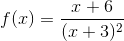
What is the domain of the given function?
Tap to reveal answer
The domain of the function is all real numbers except x = –3. When x = –3, f(–3) is undefined.
The domain of the function is all real numbers except x = –3. When x = –3, f(–3) is undefined.
← Didn't Know|Knew It →
Find the domain of the given function:
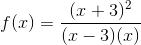
Find the domain of the given function:
Tap to reveal answer
When x = 0 or x = 3, the function is undefined due to its denominator.
Thus the domain is all real numbers x, such that x is not equal to 0 or 3.
When x = 0 or x = 3, the function is undefined due to its denominator.
Thus the domain is all real numbers x, such that x is not equal to 0 or 3.
← Didn't Know|Knew It →

Tap to reveal answer
← Didn't Know|Knew It →
What is the domain of the set of ordered pairs {(2, –3), (4, 6), (–3, 5), (–2, 5)}?
What is the domain of the set of ordered pairs {(2, –3), (4, 6), (–3, 5), (–2, 5)}?
Tap to reveal answer
The domain of a function or relation is the set of all possible x-values. Here that is simply a list of the x-coordinates of all of the coordinate pairs. So the domain is {–2, –3, 2, 4}.
The domain of a function or relation is the set of all possible x-values. Here that is simply a list of the x-coordinates of all of the coordinate pairs. So the domain is {–2, –3, 2, 4}.
← Didn't Know|Knew It →
Which of the following functions has a domain that includes all real values of  ?
?
Which of the following functions has a domain that includes all real values of
Tap to reveal answer
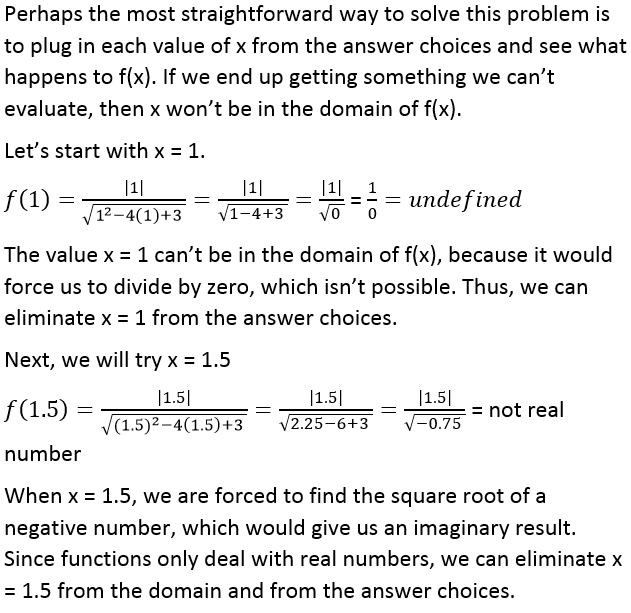
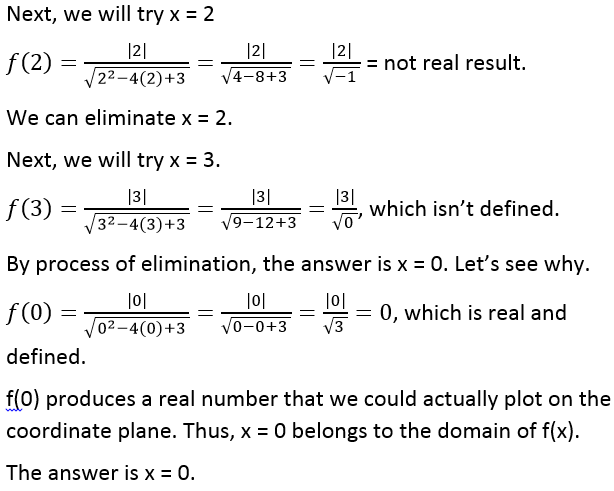
The domain of a function includes all of the values of x for which that function is defined. In other words, the domain is all of the real values of x that will produce a real number. Let's look at the domains of each function one at a time.
First, let's examine 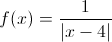
In general, when we are examining the domain of a function, we want to find places where we end up with zeros in the denominators or square-roots of negative numbers. For example, in the function 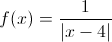 , if we let x = 4, then we would be forced to evaluate 1/0, which isn't possible. We can never divide by zero. Thus, this function is not defined over all real values of x. We can eliminate it from the answer choices.
Next, let's look at 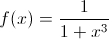 . Let's set the denominator equal to zero to see if there are any values of x which might give us a zero in the denominator.

Subtract one from both sides.

Take the cube root of both sides.

Thus, if x = –1, then f(x) will be equal to 1/0, which isn't defined, because we can't divide by zero. Therefore, we can eliminate this answer choice.
Now, let's analyze  .
.
We can never take the square root of a negative number. Thus, if  , then f(x) won't be defined. For example, if x = 4, then
  , which would produce an imaginary number. Therefore, this function can't be the correct answer.
Next, let's look at  . It will help us to rewrite f(x) in a form using square roots. In general,
 ![a^{\frac{b}{c}}=\sqrt[c]{a^b}](https://vt-vtwa-assets.varsitytutors.com/vt-vtwa/uploads/formula_image/image/17894/gif.latex) . As a result, we can rewrite f(x) as follows:
. As a result, we can rewrite f(x) as follows:
 . In this form, we can see that if
  is negative, then f(x) won't be defined. Thus, if x = –2, for example, we would be forced to find the square root of –8, which produces an imaginary result. So, this function isn't the correct answer either.
By process of elimination the answer must be 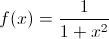 . The reasons that this function is defined for all values of x is because the denominator can never be zero. Thus, we can pick any value of x from negative to positive infinity, and we will get a real value for f(x).
The answer is 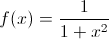
The domain of a function includes all of the values of x for which that function is defined. In other words, the domain is all of the real values of x that will produce a real number. Let's look at the domains of each function one at a time.
First, let's examine
In general, when we are examining the domain of a function, we want to find places where we end up with zeros in the denominators or square-roots of negative numbers. For example, in the function
Next, let's look at
Subtract one from both sides.
Take the cube root of both sides.
Thus, if x = –1, then f(x) will be equal to 1/0, which isn't defined, because we can't divide by zero. Therefore, we can eliminate this answer choice.
Now, let's analyze
We can never take the square root of a negative number. Thus, if
Next, let's look at
By process of elimination the answer must be
The answer is
← Didn't Know|Knew It →
If x2 + 2x - 1 = 7, which answers for x are correct?
If x2 + 2x - 1 = 7, which answers for x are correct?
Tap to reveal answer
x2 + 2x - 1 = 7
x2 + 2x - 8 = 0
(x + 4) (x - 2) = 0
x = -4, x = 2
x2 + 2x - 1 = 7
x2 + 2x - 8 = 0
(x + 4) (x - 2) = 0
x = -4, x = 2
← Didn't Know|Knew It →
Which of the following quadratic equations has a vertex located at  ?
?
Which of the following quadratic equations has a vertex located at
Tap to reveal answer
The vertex form of a parabola is given by the equation:
 , where the point
  is the vertex, and
  is a constant.
We are told that the vertex must occur at  , so let's plug this information into the vertex form of the equation.
  will be 3, and
  will be 4.

Let's now expand  by using the FOIL method, which requires us to multiply the first, inner, outer, and last terms together before adding them all together.

We can replace  with
with  .
.

Next, distribute the  .
.

Notice that in all of our answer choices, the first term is  . If we let
  , then we would have
  in our equation. Let's see what happens when we substitute
  for
for  .
.


The vertex form of a parabola is given by the equation:
We are told that the vertex must occur at
Let's now expand
We can replace
Next, distribute the
Notice that in all of our answer choices, the first term is
← Didn't Know|Knew It →
Use the quadratic equation to solve for  .
.

Use the quadratic equation to solve for
Tap to reveal answer
We take a polynomial in the form 
and enter the corresponding coefficients into the quadratic equation.
 . We normally expect to have two answers given by the sign
  .
.
So,


We take a polynomial in the form
and enter the corresponding coefficients into the quadratic equation.
So,
← Didn't Know|Knew It →
Define function  as follows:

Given that  and
and  , evaluate
  .
.
Define function
Given that
Tap to reveal answer


We solve for  in the equation


This is the only solution. Since it is established that  is not equal to 5, the correct response is that no such value exists.
We solve for
This is the only solution. Since it is established that
← Didn't Know|Knew It →
A pitcher standing on top on a 600-foot-high building throws a baseball upward at an initial speed of 90 feet per second. The height  of the ball at a given time
  can be modeled by the function

How long does it take for the ball to hit the ground? (Nearest tenth of a second)
A pitcher standing on top on a 600-foot-high building throws a baseball upward at an initial speed of 90 feet per second. The height
How long does it take for the ball to hit the ground? (Nearest tenth of a second)
Tap to reveal answer
Set the height function equal to 0:


Set  in the quadratic formula


Evaluate separately, and select the positive value.

which is thrown out.

which is positive and is the result we keep.
The correct response is 9.6 seconds.
Set the height function equal to 0:
Set
Evaluate separately, and select the positive value.
which is thrown out.
which is positive and is the result we keep.
The correct response is 9.6 seconds.
← Didn't Know|Knew It →
A pitcher standing on top on a 600-foot building throws a baseball upward at an initial speed of 90 feet per second. The height  of the ball at a given time
  can be modeled by the function

How long does it take for the ball to reach its peak? (Nearest tenth of a second)
A pitcher standing on top on a 600-foot building throws a baseball upward at an initial speed of 90 feet per second. The height
How long does it take for the ball to reach its peak? (Nearest tenth of a second)
Tap to reveal answer
The time at which the ball reaches its peak can be found by finding the  -coordinate of the vertex of the parabola representing the function.
The  -coordinate of the vertex is
  , where
  ;
;

The correct response is 2.8 seconds.
The time at which the ball reaches its peak can be found by finding the
The
The correct response is 2.8 seconds.
← Didn't Know|Knew It →
A pitcher standing on top on a 600-foot building throws a baseball upward at an initial speed of 90 feet per second. The height  of the ball at a given time
  can be modeled by the function

How high does the ball get? (Nearest foot)
A pitcher standing on top on a 600-foot building throws a baseball upward at an initial speed of 90 feet per second. The height
How high does the ball get? (Nearest foot)
Tap to reveal answer
This can be solved by first finding the first coordinate ( value) of the vertex of the parabola representing the function.
The  -coordinate of the vertex is
  , where
  ;
;

The ball takes 2.8 seconds to reach its peak. The height at that time is  , which is evaluated using substitution:


making the correct response 727 feet.
This can be solved by first finding the first coordinate (
The
The ball takes 2.8 seconds to reach its peak. The height at that time is
making the correct response 727 feet.
← Didn't Know|Knew It →
Define function  as follows:

Given that  and
and  , evaluate
  .
.
Define function
Given that
Tap to reveal answer


Solve for  in the equation


Either  , in which case
  , which is already established to be untrue, or
  , in which case
  . This is the correct response.
Solve for
Either
← Didn't Know|Knew It →
A pitcher standing on top on a 600-foot building throws a baseball upward at an initial speed of 90 feet per second. The height of the ball at a given time can be modeled by the function
How long does it take for the ball to return to the level at which it started? (Nearest tenth of a second)
A pitcher standing on top on a 600-foot building throws a baseball upward at an initial speed of 90 feet per second. The height
How long does it take for the ball to return to the level at which it started? (Nearest tenth of a second)
Tap to reveal answer
The question is essentially asking for the positive value of time  when
when
 .
.


Either  - but this simply reflects that the initial height was 600 feet - or:


 .
.
The ball returns to a height of 600 feet after 5.6 seconds.
The question is essentially asking for the positive value of time
Either
The ball returns to a height of 600 feet after 5.6 seconds.
← Didn't Know|Knew It →