
Algebraic Fractions - PSAT Math
Card 1 of 644
If the average (arithmetic mean) of  ,
,  , and
, and  is
is  , what is the average of
  ,
,  , and
, and  ?
?
If the average (arithmetic mean) of
Tap to reveal answer
If we can find the sum of  ,
,  , and 10, we can determine their average. There is not enough information to solve for
  or
or  individually, but we can find their sum,
  .
.
Write out the average formula for the original three quantities. Remember, adding together and dividing by the number of quantities gives the average: 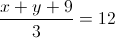
Isolate  :
:


Write out the average formula for the new three quantities:
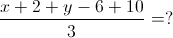
Combine the integers in the numerator:
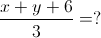
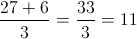
Replace  with 27:
If we can find the sum of
Write out the average formula for the original three quantities. Remember, adding together and dividing by the number of quantities gives the average:
Isolate
Write out the average formula for the new three quantities:
Combine the integers in the numerator:
Replace
← Didn't Know|Knew It →
Which of the following provides the complete solution set for  ?
?
Which of the following provides the complete solution set for
Tap to reveal answer
The absolute value will always be positive or 0, therefore all values of z will create a true statement as long as  . Thus all values except for 2 will work.
The absolute value will always be positive or 0, therefore all values of z will create a true statement as long as
← Didn't Know|Knew It →
Define the function  as follows:

Give the domain of  .
.
Define the function
Give the domain of
Tap to reveal answer
The domain of  is restricted by two different denominators, neither of which can be equal to 0, so the excluded values are:


The correct response is therefore  .
.
The domain of
The correct response is therefore
← Didn't Know|Knew It →
Given the expression,  , which value CANNOT be equal to
  ?
?
Given the expression,
Tap to reveal answer
 cannot equal a value which would make the denominator equal to 0. In order to figure out what that value is, we must first simplify this fraction, then set each factor of the denominator equal to 0. As follows:

First, simplify by finding the original binomial multiples:

Now, set each factor of the denominator equal to 0


If  OR
OR  , the denominator will equal 0.
  is the only choice provided by the answers.
Note: Even though you can cancel out  from the numerator and denominator,
  still cannot be equal to two. The graph would have a hole at
  and an aymptote at
  .
.
First, simplify by finding the original binomial multiples:
Now, set each factor of the denominator equal to 0
If
Note: Even though you can cancel out
← Didn't Know|Knew It →
Define the function  on the set of real numbers as follows:

Give the domain of  .
.
Define the function
Give the domain of
Tap to reveal answer
The domain of  is restricted by two things.
First, the expression within the radical in the numerator must be nonnegative. We therefore solve for  in the inequality

 ,
,
or, in interval notation, 
Second, the expression in the denominator must be nonzero. Therefore, we set the denominator equal to zero to determine the excluded value(s):


We exclude 4 from  , so the correct response is

The domain of
First, the expression within the radical in the numerator must be nonnegative. We therefore solve for
or, in interval notation,
Second, the expression in the denominator must be nonzero. Therefore, we set the denominator equal to zero to determine the excluded value(s):
We exclude 4 from
← Didn't Know|Knew It →
Define the function  as follows:

Give the domain of  .
.
Define the function
Give the domain of
Tap to reveal answer
The numerator, being a polynomial, is not restricting our domain. The domain is, however, restricted by the polynomial in the denominator, which must be nonzero. Therefore, we set the denominator equal to zero to determine the excluded values:


Therefore, the domain of  is the set of all real numbers except
  - that is,

The numerator, being a polynomial, is not restricting our domain. The domain is, however, restricted by the polynomial in the denominator, which must be nonzero. Therefore, we set the denominator equal to zero to determine the excluded values:
Therefore, the domain of
← Didn't Know|Knew It →
Define the function  on the set of real numbers as follows:

Give the domain of  .
.
Define the function
Give the domain of
Tap to reveal answer
There are two things restricting the domain of  .
.
One is the radical symbol in the numerator. The expression inside the radical must be nonnegative, so solve the inequality:

 ,
,
or, in interval notation, 
The other is the denominator, which must be equal to 0, so set, and solve for  in, the equation:


 is already excluded from the domain; we exclude 4, so the domain is
 .
.
There are two things restricting the domain of
One is the radical symbol in the numerator. The expression inside the radical must be nonnegative, so solve the inequality:
or, in interval notation,
The other is the denominator, which must be equal to 0, so set, and solve for
← Didn't Know|Knew It →
Define the function  on the real numbers as follows:

Give the domain of  .
.
Define the function
Give the domain of
Tap to reveal answer
The numerator, being a polynomial, is not restricting our domain. The domain is, however, restricted by the expression in the denominator, which must be nonzero. Furthermore, the radicand must be nonnegative. Combined, these facts mean that the radicand must be positive, and that the following inequality be solved:

 or, equivalently,
  .
.
In interval form, this is 
The numerator, being a polynomial, is not restricting our domain. The domain is, however, restricted by the expression in the denominator, which must be nonzero. Furthermore, the radicand must be nonnegative. Combined, these facts mean that the radicand must be positive, and that the following inequality be solved:
In interval form, this is
← Didn't Know|Knew It →
Define the function  as follows:

Give the domain of  .
.
Define the function
Give the domain of
Tap to reveal answer
The numerator, being a polynomial, does not restrict our domain. The denominator, however, does restrict it to the values for which it is not equal to 0. We set the denominator equal to 0 to find the excluded values:


The domain, in interval notation, is therefore
 .
.
The numerator, being a polynomial, does not restrict our domain. The denominator, however, does restrict it to the values for which it is not equal to 0. We set the denominator equal to 0 to find the excluded values:
The domain, in interval notation, is therefore
← Didn't Know|Knew It →
Define the functions  and
and  as follows:
 and
and 
Give the domain of the function  .
.
Define the functions
Give the domain of the function
Tap to reveal answer
The domain of the product of two functions is the intersection of the domains of the individual functions.
The domain of  is restricted to all values of
  that yield a nonzero denominator. Since this means that
 ,
,
then, subsequently,
 ,
,
so the domain is the set of all real numbers except 4.
Similarly, the domain of  is restricted to all values of
  that yield a nonzero denominator. This set is found to be the set of all real numbers except 7.
The intersection of these sets is the set of all real numbers except 4 and 7, or
 .
.
The domain of the product of two functions is the intersection of the domains of the individual functions.
The domain of
then, subsequently,
so the domain is the set of all real numbers except 4.
Similarly, the domain of
The intersection of these sets is the set of all real numbers except 4 and 7, or
← Didn't Know|Knew It →
Define the function  as follows:

Give the domain of  .
.
Define the function
Give the domain of
Tap to reveal answer
The definition of  has two denominators of two fractions (one within the other), so we must exclude the values of
  that make either denominator equal to zero.
One denominator is  . Since it cannot be zero, we have
 ,
,
and, subsequently,
 .
.
The value 2 is excluded from the domain.
The other denominator is  . If it is equal to zero, then


Therefore, this value is also excluded from the domain.
The correct domain is the set  .
.
The definition of
One denominator is
and, subsequently,
The value 2 is excluded from the domain.
The other denominator is
Therefore, this value is also excluded from the domain.
The correct domain is the set
← Didn't Know|Knew It →
Define the function  as follows:

Give the domain of  .
.
Define the function
Give the domain of
Tap to reveal answer
The numerator  , being a polynomial, does not restrict the domain.
 appears as a radicand of a square root in the definition of
  , so
, so  must be restricted to nonnegative numbers. Also,
  is a denominator, which means 0 must also be excluded. Therefore, we are restricted so far to positive numbers.
There is one more denominator, which is  ; it must be nonzero. We set this equal to zero to determine any additional value(s) that must be excluded:


Therefore, the domain is the set of all positive numbers except 9 - or
 .
.
The numerator
There is one more denominator, which is
Therefore, the domain is the set of all positive numbers except 9 - or
← Didn't Know|Knew It →
Which of the following are answers to the equation below?
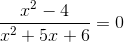
I. -3
II. -2
III. 2
Which of the following are answers to the equation below?
I. -3
II. -2
III. 2
Tap to reveal answer
Given a fractional algebraic equation with variables in the numerator and denominator of one side and the other side equal to zero, we rely on a simple concept. Zero divided by anything equals zero. That means we can focus in on what values make the numerator (the top part of the fraction) zero, or in other words,

The expression  is a difference of squares that can be factored as

Solving this for  gives either
  or
or  . That means either of these values will make our numerator equal zero. We might be tempted to conclude that both are valid answers. However, our statement earlier that zero divided by anything is zero has one caveat. We can never divide by zero itself. That means that any values that make our denominator zero must be rejected. Therefore we must also look at the denominator.

The left side factors as follows

This means that if  is
is  or
or  , we end up dividing by zero. That means that
  cannot be a valid solution, leaving
  as the only valid answer. Therefore only #3 is correct.
Given a fractional algebraic equation with variables in the numerator and denominator of one side and the other side equal to zero, we rely on a simple concept. Zero divided by anything equals zero. That means we can focus in on what values make the numerator (the top part of the fraction) zero, or in other words,
The expression
Solving this for
The left side factors as follows
This means that if
← Didn't Know|Knew It →
Find the excluded values of the following algebraic fraction
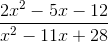
Find the excluded values of the following algebraic fraction
Tap to reveal answer
To find the excluded values of a algebraic fraction you need to find when the denominator is zero. To find when the denominator is zero you need to factor it. This denominator factors into

so this is zero when x=4,7 so our answer is

To find the excluded values of a algebraic fraction you need to find when the denominator is zero. To find when the denominator is zero you need to factor it. This denominator factors into
so this is zero when x=4,7 so our answer is
← Didn't Know|Knew It →
Simplify x/2 – x/5
Simplify x/2 – x/5
Tap to reveal answer
Simplifying this expression is similar to 1/2 – 1/5. The denominators are relatively prime (have no common factors) so the least common denominator (LCD) is 2 * 5 = 10. So the problem becomes 1/2 – 1/5 = 5/10 – 2/10 = 3/10.
Simplifying this expression is similar to 1/2 – 1/5. The denominators are relatively prime (have no common factors) so the least common denominator (LCD) is 2 * 5 = 10. So the problem becomes 1/2 – 1/5 = 5/10 – 2/10 = 3/10.
← Didn't Know|Knew It →
If  is an integer, which of the following is a possible value of
  ?
?
If
Tap to reveal answer
 , which is an integer (a number with no fraction or decimal part). All the other choices reduce to non-integers.
← Didn't Know|Knew It →
Simplify: 
Simplify:
Tap to reveal answer
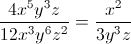
First, let's simplify  . The greatest common factor of 4 and 12 is 4. 4 divided by 4 is 1 and 12 divided by 4 is 3. Therefore
  .
.
To simply fractions with exponents, subtract the exponent in the numerator from the exponent in the denominator. That leaves us with  or
or 
First, let's simplify
To simply fractions with exponents, subtract the exponent in the numerator from the exponent in the denominator. That leaves us with
← Didn't Know|Knew It →
Which of the following fractions is not equivalent to  ?
?
Which of the following fractions is not equivalent to
Tap to reveal answer
Let us simplify  :
:
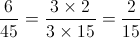
We can get alternate forms of the same fraction by multiplying the denominator and the numerator by the same number:

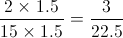
Now let's look at  :
:
 , but
, but  .
.
Therefore, is the correct answer, as it is not equivalent to .
Let us simplify
We can get alternate forms of the same fraction by multiplying the denominator and the numerator by the same number:
Now let's look at


Therefore,
← Didn't Know|Knew It →
Which of the following is not equal to 32/24?
Which of the following is not equal to 32/24?
Tap to reveal answer
24/32 = 1.33
16/12 =1.33
224/168 =1.33
4/3 = 1.33
96/72 = 1.33
160/96 = 1.67
24/32 = 1.33
16/12 =1.33
224/168 =1.33
4/3 = 1.33
96/72 = 1.33
160/96 = 1.67
← Didn't Know|Knew It →
Find the root of

Find the root of
Tap to reveal answer

The root occurs where  . So we substitute 0 for
  .
.


This means that the root is at  .
.
The root occurs where
This means that the root is at
← Didn't Know|Knew It →