
Understand features of hyperbolas and ellipses - Pre-Calculus
Card 1 of 508
Find the equations of the asymptotes for the hyperbola with the following equation:

Find the equations of the asymptotes for the hyperbola with the following equation:
Tap to reveal answer
For a hyperbola with its foci on the  -axis, like the one given in the equation, recall the standard form of the equation:
 , where
  is the center of the hyperbola.
Start by putting the given equation into the standard form of the equation of a hyperbola.
Group the  terms together and
  terms together.


Factor out  from the
  terms and
  from the
  terms.

Complete the squares. Remember to add the amount amount to both sides of the equation!

Add  to both sides of the equation:

Divide both sides by  .
.

Factor the two terms to get the standard form of the equation of a hyperbola.

The slopes of this hyperbola are given by the following:

For the hyperbola in question,  and
and  .
.
Thus, the slopes for its asymptotes are  .
.
Now, plug in the center of the hyperbola into the point-slope form of the equation of alien to get the equations for the asymptotes.
The center of the hyperbola is  .
.
The equations for the asymptotes are then:


For a hyperbola with its foci on the
Start by putting the given equation into the standard form of the equation of a hyperbola.
Group the
Factor out
Complete the squares. Remember to add the amount amount to both sides of the equation!
Add
Divide both sides by
Factor the two terms to get the standard form of the equation of a hyperbola.
The slopes of this hyperbola are given by the following:
For the hyperbola in question,
Thus, the slopes for its asymptotes are
Now, plug in the center of the hyperbola into the point-slope form of the equation of alien to get the equations for the asymptotes.
The center of the hyperbola is
The equations for the asymptotes are then:
← Didn't Know|Knew It →
Find the foci of the hyperbola with the following equation:

Find the foci of the hyperbola with the following equation:
Tap to reveal answer
Recall that the standard formula of a hyperbola can come in two forms:
 and
and
 , where the centers of both hyperbolas are
  .
.
First, put the given equation in the standard form of the equation of a hyperbola.
Group the  terms together and the
  terms together.


Next, factor out  from the
  terms and
  from the
  terms.

Complete the squares. Remember to add the same amount to both sides of the equation!

Add  to both sides.

Divide both sides by  .
.

Factor both terms to get the standard form of the equation of a hyperbola.

When the term with  is first, that means the foci will lie on a horizontal transverse axis.
When the term with  is first, that means the foci will lie on a vertical transverse axis.
To find the foci, we use the following:

For a hyperbola with a horizontal transverse access, the foci will be located at  and
and  .
.
For a hyperbola with a vertical transverse access, the foci will be located at  and
and  .
.
For the given hypebola in the question, the transverse axis is vertical and its center is located at  .
.
Next, find  .
.

The foci are then located at  and
and  .
.
Recall that the standard formula of a hyperbola can come in two forms:
First, put the given equation in the standard form of the equation of a hyperbola.
Group the
Next, factor out
Complete the squares. Remember to add the same amount to both sides of the equation!
Add
Divide both sides by
Factor both terms to get the standard form of the equation of a hyperbola.
When the term with
When the term with
To find the foci, we use the following:
For a hyperbola with a horizontal transverse access, the foci will be located at
For a hyperbola with a vertical transverse access, the foci will be located at
For the given hypebola in the question, the transverse axis is vertical and its center is located at
Next, find
The foci are then located at
← Didn't Know|Knew It →
Find the foci of the hyperbola with the following equation:

Find the foci of the hyperbola with the following equation:
Tap to reveal answer
Recall that the standard formula of a hyperbola can come in two forms:
 and
and
 , where the centers of both hyperbolas are
  .
.
First, put the given equation in the standard form of the equation of a hyperbola.
Group the  terms together and the
  terms together.


Next, factor out  from the
  terms and
  from the
  terms.

Now we can complete the squares. Remember to add the same amount to both sides of the equation!

Add  to both sides.

Divide both sides by  .
.

Factor both terms to get the standard form of the equation of a hyperbola.

When the term with  is first, that means the foci will lie on a horizontal transverse axis.
When the term with  is first, that means the foci will lie on a vertical transverse axis.
To find the foci, we use the following:

For a hyperbola with a horizontal transverse access, the foci will be located at  and
and  .
.
For a hyperbola with a vertical transverse access, the foci will be located at  and
and  .
.
For the given hypebola in the question, the transverse axis is vertical and its center is located at  .
.
Next, find  .
.

The foci are then located at  and
and  .
.
Recall that the standard formula of a hyperbola can come in two forms:
First, put the given equation in the standard form of the equation of a hyperbola.
Group the
Next, factor out
Now we can complete the squares. Remember to add the same amount to both sides of the equation!
Add
Divide both sides by
Factor both terms to get the standard form of the equation of a hyperbola.
When the term with
When the term with
To find the foci, we use the following:
For a hyperbola with a horizontal transverse access, the foci will be located at
For a hyperbola with a vertical transverse access, the foci will be located at
For the given hypebola in the question, the transverse axis is vertical and its center is located at
Next, find
The foci are then located at
← Didn't Know|Knew It →
Find the foci of the hyperbola with the following equation:

Find the foci of the hyperbola with the following equation:
Tap to reveal answer
Recall that the standard formula of a hyperbola can come in two forms:
 and
and
 , where the centers of both hyperbolas are
  .
.
When the term with  is first, that means the foci will lie on a horizontal transverse axis.
When the term with  is first, that means the foci will lie on a vertical transverse axis.
To find the foci, we use the following:

For a hyperbola with a horizontal transverse access, the foci will be located at  and
and  .
.
For a hyperbola with a vertical transverse access, the foci will be located at  and
and  .
.
For the given hypebola in the question, the transverse axis is horizontal and its center is located at  .
.
Next, find  .
.

The foci are then located at  and
and  .
.
Recall that the standard formula of a hyperbola can come in two forms:
When the term with
When the term with
To find the foci, we use the following:
For a hyperbola with a horizontal transverse access, the foci will be located at
For a hyperbola with a vertical transverse access, the foci will be located at
For the given hypebola in the question, the transverse axis is horizontal and its center is located at
Next, find
The foci are then located at
← Didn't Know|Knew It →
Find the foci of a hyperbola with the following equation:

Find the foci of a hyperbola with the following equation:
Tap to reveal answer
Recall that the standard formula of a hyperbola can come in two forms:
 and
and
 , where the centers of both hyperbolas are
  .
.
When the term with  is first, that means the foci will lie on a horizontal transverse axis.
When the term with  is first, that means the foci will lie on a vertical transverse axis.
To find the foci, we use the following:

For a hyperbola with a horizontal transverse access, the foci will be located at  and
and  .
.
For a hyperbola with a vertical transverse access, the foci will be located at  and
and  .
.
For the given hypebola in the question, the transverse axis is horizontal and its center is located at  .
.
Next, find  .
.

The foci are then located at  and
and  .
.
Recall that the standard formula of a hyperbola can come in two forms:
When the term with
When the term with
To find the foci, we use the following:
For a hyperbola with a horizontal transverse access, the foci will be located at
For a hyperbola with a vertical transverse access, the foci will be located at
For the given hypebola in the question, the transverse axis is horizontal and its center is located at
Next, find
The foci are then located at
← Didn't Know|Knew It →
Find the foci of the hyperbola with the following equation:

Find the foci of the hyperbola with the following equation:
Tap to reveal answer
Recall that the standard formula of a hyperbola can come in two forms:
 and
and
 , where the centers of both hyperbolas are
  .
.
When the term with  is first, that means the foci will lie on a horizontal transverse axis.
When the term with  is first, that means the foci will lie on a vertical transverse axis.
To find the foci, we use the following:

For a hyperbola with a horizontal transverse access, the foci will be located at  and
and  .
.
For a hyperbola with a vertical transverse access, the foci will be located at  and
and  .
.
For the given hypebola in the question, the transverse axis is horizontal and its center is located at  .
.
Next, find  .
.

The foci are then located at  and
and  .
.
Recall that the standard formula of a hyperbola can come in two forms:
When the term with
When the term with
To find the foci, we use the following:
For a hyperbola with a horizontal transverse access, the foci will be located at
For a hyperbola with a vertical transverse access, the foci will be located at
For the given hypebola in the question, the transverse axis is horizontal and its center is located at
Next, find
The foci are then located at
← Didn't Know|Knew It →
Find the foci of the hyperbola with the following equation:

Find the foci of the hyperbola with the following equation:
Tap to reveal answer
Recall that the standard formula of a hyperbola can come in two forms:
 and
and
 , where the centers of both hyperbolas are
  .
.
When the term with  is first, that means the foci will lie on a horizontal transverse axis.
When the term with  is first, that means the foci will lie on a vertical transverse axis.
To find the foci, we use the following:

For a hyperbola with a horizontal transverse access, the foci will be located at  and
and  .
.
For a hyperbola with a vertical transverse access, the foci will be located at  and
and  .
.
For the given hypebola in the question, the transverse axis is horizontal and its center is located at  .
.
Next, find  .
.

The foci are then located at  and
and  .
.
Recall that the standard formula of a hyperbola can come in two forms:
When the term with
When the term with
To find the foci, we use the following:
For a hyperbola with a horizontal transverse access, the foci will be located at
For a hyperbola with a vertical transverse access, the foci will be located at
For the given hypebola in the question, the transverse axis is horizontal and its center is located at
Next, find
The foci are then located at
← Didn't Know|Knew It →
Find the eccentricity of the following hyperbola:

Find the eccentricity of the following hyperbola:
Tap to reveal answer
Recall the standard form of the equation of a horizontal hyperbola:
 , where
  is the center
For a horizontal hyperbola, use the following equation to find the eccentricity:
 , where
For the given hyperbola,
 and
and 

Thus,

Recall the standard form of the equation of a horizontal hyperbola:
For a horizontal hyperbola, use the following equation to find the eccentricity:
For the given hyperbola,
Thus,
← Didn't Know|Knew It →
What is the equation of an ellipse in standard form with the point  as its center, an
  -axis length of
  , and a
  -axis length of
  .
.
What is the equation of an ellipse in standard form with the point
Tap to reveal answer
The equation of an ellipse in standard form is
 ,
,
where  is the center point,
  is half the length of its axis in the
  direction, and
  is half the length of the axis in the
  direction.
In this instance, the center point 
 ,
,  , and
, and  . Therefore:


The equation of an ellipse in standard form is
where
In this instance, the center point
← Didn't Know|Knew It →
Consider the following equation:

Classify the equation by its form when graphed.
Consider the following equation:
Classify the equation by its form when graphed.
Tap to reveal answer
Start with the equation

It would be helpful if we "complete the square" for both the x and y polynomials.


So by adding 9 and 900 we transform the equation into


And then by dividing 900, we see that the outcome is:

The standard equation for an ellipse is

With a center at 
Therefore this is the equation of an ellipse, with center 
Start with the equation
It would be helpful if we "complete the square" for both the x and y polynomials.
So by adding 9 and 900 we transform the equation into
And then by dividing 900, we see that the outcome is:
The standard equation for an ellipse is
With a center at
Therefore this is the equation of an ellipse, with center
← Didn't Know|Knew It →
The equation of an ellipse,  , is
, is  . Which of the following is the correct eccentricity of this ellipse?
The equation of an ellipse,
Tap to reveal answer
The equation for the eccentricity of an ellipse is  , where
  is eccentricity,
  is the distance from the foci to the center, and
  is the square root of the larger of our two denominators.
Our denominators are  and
and  , so
, so  .
.
To find  , we must use the equation
  , where
  is the square root of the smaller of our two denominators.
This gives us  , so
, so  .
.
Therefore, we can see that
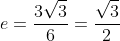 .
.
The equation for the eccentricity of an ellipse is
Our denominators are
To find
This gives us , so
.
Therefore, we can see that
.
← Didn't Know|Knew It →
Express the following equation for an ellipse in standard form:

Express the following equation for an ellipse in standard form:
Tap to reveal answer
Remember that the equation for an ellipse in standard form looks like the following:

Where the point (h,k) gives the center of the ellipse, a is half the length of its axis in the x direction, and b is half the length of its axis in the y direction. We can see that this form has a 1 on the right side of the equation, so let's start by dividing both sides of our equation by 36 to get a 1 on the right side:


Now we can simplify the fractions on the right side of the equation, which gives us the equation for our ellipse in standard form:

This ellipse would have its center at (4,7), would be 6 units wide in the x direction, and 4 units wide in the y direction, because  so
so  , and
, and  so
so  .
.
Remember that the equation for an ellipse in standard form looks like the following:
Where the point (h,k) gives the center of the ellipse, a is half the length of its axis in the x direction, and b is half the length of its axis in the y direction. We can see that this form has a 1 on the right side of the equation, so let's start by dividing both sides of our equation by 36 to get a 1 on the right side:
Now we can simplify the fractions on the right side of the equation, which gives us the equation for our ellipse in standard form:
This ellipse would have its center at (4,7), would be 6 units wide in the x direction, and 4 units wide in the y direction, because
← Didn't Know|Knew It →
Find the endpoints of the major and minor axes of the ellipse described by the following equation:

Find the endpoints of the major and minor axes of the ellipse described by the following equation:
Tap to reveal answer
In order to find the endpoints of the major and minor axes of our ellipse, we must first remember what each part of the equation in standard form means:

The point given by (h,k) is the center of our ellipse, so we know the center of the ellipse in the problem is (8,-2), and we know that the end points of our major and minor axes will line up with the center either in the x or y direction, depending on the axis. The parts of the equation that will tell us the distance from the center to the endpoints of each axis are  and
and  . If we take the square root of each, a will give us the distance from the center to the endpoints in the positive and negative x direction, and b will give us the distance from the center to the endpoints in the positive and negative y direction:


Now it is important to consider the definition of major and minor axes. The major axis of an ellipse is the longer one, will the minor axis is the shorter one. We can see that b=5, which means the axis is longer in the y direction, so this is the major axis. To find the endpoints of the major axis, we'll go 5 units from the center in the positive and negative y direction, respectively, giving us:

Similarly, to find the endpoints of the minor axis, we'll go 2 units from the center in the positive and negative x direction, respectively, giving us:

In order to find the endpoints of the major and minor axes of our ellipse, we must first remember what each part of the equation in standard form means:
The point given by (h,k) is the center of our ellipse, so we know the center of the ellipse in the problem is (8,-2), and we know that the end points of our major and minor axes will line up with the center either in the x or y direction, depending on the axis. The parts of the equation that will tell us the distance from the center to the endpoints of each axis are
Now it is important to consider the definition of major and minor axes. The major axis of an ellipse is the longer one, will the minor axis is the shorter one. We can see that b=5, which means the axis is longer in the y direction, so this is the major axis. To find the endpoints of the major axis, we'll go 5 units from the center in the positive and negative y direction, respectively, giving us:
Similarly, to find the endpoints of the minor axis, we'll go 2 units from the center in the positive and negative x direction, respectively, giving us:
← Didn't Know|Knew It →
Express the following equation for a hyperbola in standard form:

Express the following equation for a hyperbola in standard form:
Tap to reveal answer
Remember that in order for the equation of a hyperbola to be in standard form, it must be written in one of the following two ways:


Where the point (h,k) gives the center of the hyperbola. In the first option, where the x term is in front of the y term, the hyperbola opens left and right. In the second option, where the y term is in front of the x term, the hyperbola opens up and down. In either case, the distance  tells how far above and below or to the left and right of the center the vertices of the hyperbola are. We can see that our equation is of the form given in the second option, as the y term appears first. All we must do to put it in standard form is obtain a 1 on the right side, so we'll divide both sides by 144:


Now we just simplify the fractions on the left side, and the equation of the hyperbola is in standard form:

Remember that in order for the equation of a hyperbola to be in standard form, it must be written in one of the following two ways:
Where the point (h,k) gives the center of the hyperbola. In the first option, where the x term is in front of the y term, the hyperbola opens left and right. In the second option, where the y term is in front of the x term, the hyperbola opens up and down. In either case, the distance
Now we just simplify the fractions on the left side, and the equation of the hyperbola is in standard form:
← Didn't Know|Knew It →
The equation of an ellipse,  , is
, is  . Which of the following is the correct center and foci of this ellipse?
The equation of an ellipse,
Tap to reveal answer
Because our equation is already in the format
 ,
,
we do not have to manipulate the equation. The center of any ellipse in this form will always be  . So in this case, our center will be
  . To find the foci of the ellipse, we must use the equation
  , where
  is the greater of the two denominators in our equation (
 and
and  ),
),  is the lesser and
  is the distance from the center to the foci.
We know that  and
and  .
.
By using  , we see that
  , so
, so  .
.
We now know that the two foci are going to be  units in either direction of the center along the greater axis.
Because the greater denominator is under our term containing  , our ellipse will have its greater axis going vertically, rather than horizontally. Therefore, our foci will be
  units above and below our center, at
  and
and  .
.
Because our equation is already in the format
we do not have to manipulate the equation. The center of any ellipse in this form will always be
We know that
By using
We now know that the two foci are going to be
Because the greater denominator is under our term containing
← Didn't Know|Knew It →
The equation of an ellipse,  , is
, is  . Which of the following are the correct end points of the MAJOR axis of this ellipse?
The equation of an ellipse,
Tap to reveal answer
First, we must determine if the major axis is a vertical axis or a horizontal axis. We look at our denominators,  and
and  , and see that the larger one is under the
  -term. Therefore, we know that the greater axis will be a vertical one.
To find out how far the end point are from the center, we simply take  . So we know the end points will be
  units above and below our center. To find the center, we must remember that for
  ,
,
the center will be  .
.
So for our equation, the center will be  .
.  units above and below the center give us
  and
and  .
.
First, we must determine if the major axis is a vertical axis or a horizontal axis. We look at our denominators,
To find out how far the end point are from the center, we simply take
the center will be
So for our equation, the center will be
← Didn't Know|Knew It →
Determine the equations for the asymptotes of the following hyperbola:

Determine the equations for the asymptotes of the following hyperbola:
Tap to reveal answer
Let us first remember what each part of the equation for a hyperbola in standard form means:
The point (h,k) gives the center of the hyperbola. In the first option, where the x term is in front of the y term, the hyperbola opens left and right. In the second option, where the y term is in front of the x term, the hyperbola opens up and down. In either case, the distance tells how far above and below or to the left and right of the center the vertices of the hyperbola are. For each of these standard form expressions, respectively, the equations for the asymptotes are:


So we can see that the equations are essentially the same, except that the slope  is used when the hyperbola opens left and right, and its reciprocal,
  is used when the hyperbola opens up and down. We can see in the hyperbola for our problem that the x term appears first, so it opens left and right, which means we use the first option above for the equations of the asymptotes. Comparing the standard form equation with that given in the problem, we can determine h, k, a, and b:


Now we now all of the values required for the asymptote formula, so we plug them in and get:

So our asymptotes are described by the following two equations:


Let us first remember what each part of the equation for a hyperbola in standard form means:
The point (h,k) gives the center of the hyperbola. In the first option, where the x term is in front of the y term, the hyperbola opens left and right. In the second option, where the y term is in front of the x term, the hyperbola opens up and down. In either case, the distance
So we can see that the equations are essentially the same, except that the slope
Now we now all of the values required for the asymptote formula, so we plug them in and get:
So our asymptotes are described by the following two equations:
← Didn't Know|Knew It →
Find the center and the vertices of the following hyperbola:

Find the center and the vertices of the following hyperbola:
Tap to reveal answer
In order to find the center and the vertices of the hyperbola given in the problem, we must examine the standard form of a hyperbola:
The point (h,k) gives the center of the hyperbola. We can see that the equation in this problem resembles the second option for standard form above, so right away we can see the center is at:

In the first option, where the x term is in front of the y term, the hyperbola opens left and right. In the second option, where the y term is in front of the x term, the hyperbola opens up and down. In either case, the distance tells how far above and below or to the left and right of the center the vertices of the hyperbola are. Our equation is in the first form, where the x term is first, so the hyperbola opens left and right, which means the vertices are a distance  to the left and right of the center. We can now calculate
  by identifying it in our equation, and then go 3 units to the left and right of our center to find the following vertices:


In order to find the center and the vertices of the hyperbola given in the problem, we must examine the standard form of a hyperbola:
The point (h,k) gives the center of the hyperbola. We can see that the equation in this problem resembles the second option for standard form above, so right away we can see the center is at:
In the first option, where the x term is in front of the y term, the hyperbola opens left and right. In the second option, where the y term is in front of the x term, the hyperbola opens up and down. In either case, the distance
← Didn't Know|Knew It →
Which of the following is an equation for an ellipse written in standard form?
Which of the following is an equation for an ellipse written in standard form?
Tap to reveal answer
Remember that in order for the equation of an ellipse to be written in standard form, it must be written in one of the following two ways:


Where the point (h,k) gives the center of the ellipse, a is half the length of the axis for which it is the denominator, and b is half the length of the axis for which it is the denominator. Looking at our answer choices, we need one that involves addition, has different denominators under the x and y terms, and is equal to 1 on the right side of the equation. We can see that out of all the answer choices, the following is the only one that satisfies those requirements of standard form:

Remember that in order for the equation of an ellipse to be written in standard form, it must be written in one of the following two ways:
Where the point (h,k) gives the center of the ellipse, a is half the length of the axis for which it is the denominator, and b is half the length of the axis for which it is the denominator. Looking at our answer choices, we need one that involves addition, has different denominators under the x and y terms, and is equal to 1 on the right side of the equation. We can see that out of all the answer choices, the following is the only one that satisfies those requirements of standard form:
← Didn't Know|Knew It →
Which of the following is an equation for a hyperbola written in standard form?
Which of the following is an equation for a hyperbola written in standard form?
Tap to reveal answer
In order for the equation of a hyperbola to be in standard form, it must be written in one of the following two ways:


Where the point (h,k) gives the center of the hyperbola, a is half the length of the axis for which it is the denominator, and b is half the length of the axis for which it is the denominator. The easiest requirements of standard form to identify are that the right side of the equation must be 1, there must be subtraction of the terms on the left side and not addition, and the denominators must be different for the x and y terms. Looking at our answer choices, we can see that the following equation is the only one which satisfies these requirements for the standard form of a hyperbola:

In order for the equation of a hyperbola to be in standard form, it must be written in one of the following two ways:
Where the point (h,k) gives the center of the hyperbola, a is half the length of the axis for which it is the denominator, and b is half the length of the axis for which it is the denominator. The easiest requirements of standard form to identify are that the right side of the equation must be 1, there must be subtraction of the terms on the left side and not addition, and the denominators must be different for the x and y terms. Looking at our answer choices, we can see that the following equation is the only one which satisfies these requirements for the standard form of a hyperbola:
← Didn't Know|Knew It →