
Solve Logarithmic Equations - Pre-Calculus
Card 1 of 156
Solve the logarithmic equation: 
Solve the logarithmic equation:
Tap to reveal answer

Exponentiate each side to cancel the natural log:


Square both sides:


Isolate x:

Exponentiate each side to cancel the natural log:
Square both sides:
Isolate x:
← Didn't Know|Knew It →
Evaluate a logarithm.
What is  ?
?
Evaluate a logarithm.
What is
Tap to reveal answer
The derifintion of logarithm is:

In this problem,


Therefore, 
The derifintion of logarithm is:
In this problem,
Therefore,
← Didn't Know|Knew It →
Given the equation  , what is the value of
  ? Use the inverse property to aid in solving.
Given the equation 
Tap to reveal answer
The natural logarithm and natural exponent are inverses of each other. Taking the  of
of  will simply result in the argument of the exponent.
That is 
Now,  , so
, so 
The natural logarithm and natural exponent are inverses of each other. Taking the
That is
Now,
← Didn't Know|Knew It →
What is  equivalent to?
What is
Tap to reveal answer
Using the properties of logarithms,

the expression can be rewritten as

which simplifies to  .
.
Using the properties of logarithms,
the expression can be rewritten as
which simplifies to
← Didn't Know|Knew It →
Solve for  in the following logarithmic equation:

Solve for
Tap to reveal answer
Using the rules of logarithms,
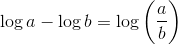
Hence,

So exponentiate both sides with a base 10:

The exponent and the logarithm cancel out, leaving:


This answer does not match any of the answer choices, therefore the answer is 'None of the other choices'.
Using the rules of logarithms,
Hence,
So exponentiate both sides with a base 10:
The exponent and the logarithm cancel out, leaving:
This answer does not match any of the answer choices, therefore the answer is 'None of the other choices'.
← Didn't Know|Knew It →
Express the log in its expanded form:

Express the log in its expanded form:
Tap to reveal answer
You need to know the Laws of Logarithms in order to solve this problem. The ones specifically used in this problem are the following:


Let's take this one variable at a time starting with expanding z:

Now y:

And finally expand x:

You need to know the Laws of Logarithms in order to solve this problem. The ones specifically used in this problem are the following:
Let's take this one variable at a time starting with expanding z:
Now y:
And finally expand x:
← Didn't Know|Knew It →
Find the value of the sum of logarithms by condensing the expression.

Find the value of the sum of logarithms by condensing the expression.
Tap to reveal answer
By the property of the sum of logarithms,
 .
.
By the property of the sum of logarithms,
← Didn't Know|Knew It →
Solve the following logarithmic equation:

Solve the following logarithmic equation:
Tap to reveal answer
In order to solve this equation, we must apply several properties of logarithms. First we notice the term on the left side of the equation, which we can rewrite using the following property:

Where a is the coefficient of the logarithm and b is some arbitrary base. Next we look at the right side of the equation, which we can rewrite using the following property for the addition of logarithms:

Using both of these properties, we can rewrite the logarithmic equation as follows:


We have the same value for the base of the logarithm on each side, so the equation then simplifies to the following:

Which we can then factor to solve for  :
:

In order to solve this equation, we must apply several properties of logarithms. First we notice the term on the left side of the equation, which we can rewrite using the following property:
Where a is the coefficient of the logarithm and b is some arbitrary base. Next we look at the right side of the equation, which we can rewrite using the following property for the addition of logarithms:
Using both of these properties, we can rewrite the logarithmic equation as follows:
We have the same value for the base of the logarithm on each side, so the equation then simplifies to the following:
Which we can then factor to solve for
← Didn't Know|Knew It →
Expand the following logarithmic expression:

Expand the following logarithmic expression:
Tap to reveal answer
We start expanding our logarithm by using the following property:


Now we have two terms, and we can further expand the first term with the following property:



Now we only have two logarithms left with nonlinear terms, which we can expand using one final property:

Using this property on our two terms with exponents, we obtain the final expanded expression:

We start expanding our logarithm by using the following property:
Now we have two terms, and we can further expand the first term with the following property:
Now we only have two logarithms left with nonlinear terms, which we can expand using one final property:
Using this property on our two terms with exponents, we obtain the final expanded expression:
← Didn't Know|Knew It →
Condense the following logarithmic equation:

Condense the following logarithmic equation:
Tap to reveal answer
We start condensing our expression using the following property, which allows us to express the coefficients of two of our terms as exponents:


Our next step is to use the following property to combine our first three terms:


Finally, we can use the following property regarding subtraction of logarithms to obtain the condensed expression:


We start condensing our expression using the following property, which allows us to express the coefficients of two of our terms as exponents:
Our next step is to use the following property to combine our first three terms:
Finally, we can use the following property regarding subtraction of logarithms to obtain the condensed expression:
← Didn't Know|Knew It →
What is another way of writing
 ?
?
What is another way of writing
Tap to reveal answer
The correct answer is

Properties of logarithms allow us to rewrite  and
and  as
as  and
and  , respectively. So we have

Again, we use the logarithm property

to get

The correct answer is
Properties of logarithms allow us to rewrite
Again, we use the logarithm property
to get
← Didn't Know|Knew It →
Solve the equation for  .
.

Solve the equation for
Tap to reveal answer
We solve the equation as follows:
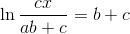
Exponentiate both sides.
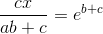
Apply the power rule on the right hand side.
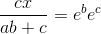
Multiply by  .
.

Divide by  .
.

We solve the equation as follows:
Exponentiate both sides.
Apply the power rule on the right hand side.
Multiply by
Divide by
← Didn't Know|Knew It →
Expand
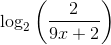 .
.
Expand
Tap to reveal answer
To expand
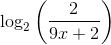 , use the quotient property of logs.
The quotient property states:

Substituting in our given information we get:

To expand
The quotient property states:
Substituting in our given information we get:
← Didn't Know|Knew It →
Express  in its expanded, simplified form.
Express
Tap to reveal answer
Using the properties of logarithms, expand the logrithm one step at a time:
When expanding logarithms, division becomes subtration, multiplication becomes division, and exponents become coefficients.
 .
.


Using the properties of logarithms, expand the logrithm one step at a time:
When expanding logarithms, division becomes subtration, multiplication becomes division, and exponents become coefficients.
← Didn't Know|Knew It →
Which of the following correctly expresses the following logarithm in expanded form?

Which of the following correctly expresses the following logarithm in expanded form?
Tap to reveal answer
Begin by recalling a few logarithm rules:
-
When adding logarithms of like base, multiply the inside.
-
When subtracting logarithms of like base, subtract the inside.
-
When multiplying a logarithm by some number, raise the inside to that power.
Keep these rules in mind as we work backward to solve this problem:

Using rule 2), we can get the following:

Next, use rule 1) on the first part to get:

Finally, use rule 3) on the second and third parts to get our final answer:

Begin by recalling a few logarithm rules:
-
When adding logarithms of like base, multiply the inside.
-
When subtracting logarithms of like base, subtract the inside.
-
When multiplying a logarithm by some number, raise the inside to that power.
Keep these rules in mind as we work backward to solve this problem:
Using rule 2), we can get the following:
Next, use rule 1) on the first part to get:
Finally, use rule 3) on the second and third parts to get our final answer:
← Didn't Know|Knew It →
Solve for  :
:

Solve for
Tap to reveal answer
First, simplify the logarithmic expressions on the left side of the equation:
 can be re-written as
  .
.
Now we have:
 .
.
The left can be consolidated into one log expression using the subtraction rule:
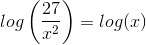 .
.
We now have log on both sides, so we can be confident that whatever is inside these functions is equal:
 to continue solving, multiply by
  on both sides:
 take the cube root:

First, simplify the logarithmic expressions on the left side of the equation:
Now we have:
The left can be consolidated into one log expression using the subtraction rule:
We now have log on both sides, so we can be confident that whatever is inside these functions is equal:
← Didn't Know|Knew It →
 .
.
Solve for  .
.
Solve for
Tap to reveal answer
First bring the inside exponent in front of the natural log.
 .
.
Next simplify the first term and bring all the terms on one side of the equation.
 .
.
Next, let set
 , so
, so  .
.
Now use the quadratic formula to solve for  .
.

and thus,  and
and  .
.
Now substitute  with
with  .
.
So,  since
since  and
and  .
.
Thus,  .
.
First bring the inside exponent in front of the natural log.
Next simplify the first term and bring all the terms on one side of the equation.
Next, let set
Now use the quadratic formula to solve for
and thus,
Now substitute
So,
Thus,
← Didn't Know|Knew It →
Write the expression in the most condensed form:
Write the expression in the most condensed form:
Tap to reveal answer

Use the Power property of Logarithms:

Rewrite the fractional exponent:

Condense into a fraction using the Quotient property of Logarithms:

Use the Power property of Logarithms:
Rewrite the fractional exponent:
Condense into a fraction using the Quotient property of Logarithms:
← Didn't Know|Knew It →
Expand this logarithm: 
Expand this logarithm:
Tap to reveal answer

Use the Quotient property of Logarithms to express on a single line:

Use the Product property of Logarithms to expand the two terms further:

Finally use the Power property of Logarithms to remove all exponents:

The expression is now fully expanded.
Use the Quotient property of Logarithms to express on a single line:
Use the Product property of Logarithms to expand the two terms further:
Finally use the Power property of Logarithms to remove all exponents:
The expression is now fully expanded.
← Didn't Know|Knew It →
Simplify: 
Simplify:
Tap to reveal answer
When logs of the same bases are subtracted, the contents of both logs will be divided with each other. When logs of the same bases are added, then the contents inside the log will be multiplied together.


When logs of the same bases are subtracted, the contents of both logs will be divided with each other. When logs of the same bases are added, then the contents inside the log will be multiplied together.
← Didn't Know|Knew It →