
Algebraic Vectors and Parametric Equations - Pre-Calculus
Card 1 of 188
Express the following vector in component form:
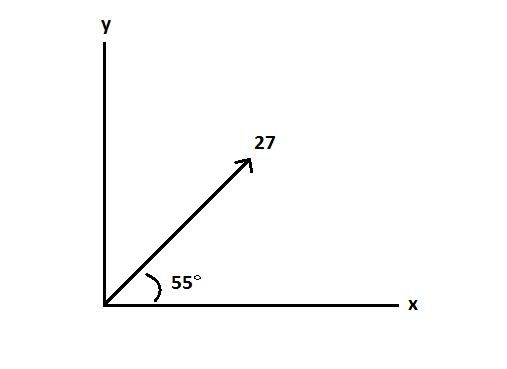
Express the following vector in component form:
Tap to reveal answer
When separating a vector into its component form, we are essentially creating a right triangle with the vector being the hypotenuse.
Therefore, we can find each component using the cos (for the x component) and sin (for the y component) functions:


We can now represent these two components together using the denotations i (for the x component) and j (for the y component).
When separating a vector into its component form, we are essentially creating a right triangle with the vector being the hypotenuse.
Therefore, we can find each component using the cos (for the x component) and sin (for the y component) functions:
We can now represent these two components together using the denotations i (for the x component) and j (for the y component).
← Didn't Know|Knew It →
Find  , then find its magnitude.
  and
and  are both vectors.


Find
Tap to reveal answer
In vector addition, you simply add each component of the vectors to each other.
x component:  .
.
y component:  .
.
z component:  .
.
The new vector is
 .
.
To find the magnitude we use the formula,



Thus its magnitude is 5.
In vector addition, you simply add each component of the vectors to each other.
x component:
y component:
z component:
The new vector is
To find the magnitude we use the formula,
Thus its magnitude is 5.
← Didn't Know|Knew It →
Find the component form of the vector with
initial point 
and
terminal point  .
.
Find the component form of the vector with
initial point
and
terminal point
Tap to reveal answer
To find the vector in component form given the initial and terminal points, simply subtract the initial point from the terminal point.

To find the vector in component form given the initial and terminal points, simply subtract the initial point from the terminal point.
← Didn't Know|Knew It →
Find the component form of the vector with
initial point 
and
terminal point 
Find the component form of the vector with
initial point
and
terminal point
Tap to reveal answer
To find the vector in component form given the initial and terminal points, simply subtract the initial point from the terminal point.


To find the vector in component form given the initial and terminal points, simply subtract the initial point from the terminal point.
← Didn't Know|Knew It →
A bird flies 15 mph up at an angle of 45 degrees to the horizontal. What is the bird's velocity in component form?
A bird flies 15 mph up at an angle of 45 degrees to the horizontal. What is the bird's velocity in component form?
Tap to reveal answer
Write the formula to find both the x and y-components of a vector.


Substitute the value of velocity and theta into the equations.
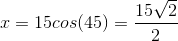
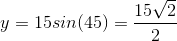
The vector is: 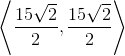
Write the formula to find both the x and y-components of a vector.
Substitute the value of velocity and theta into the equations.
The vector is:
← Didn't Know|Knew It →
Write this vector in component form: 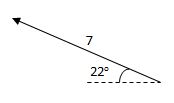
Write this vector in component form:
Tap to reveal answer
In order to find the horizontal component, set up an equation involving cosine with 7 as the hypotenuse, since the side in the implied triangle that represents the horizontal component is adjacent to the 22-degree angle:
 First, find the cosine of 22, then multiply by 7

To find the vertical component, set up an equation involving sine, since the side in the implied triangle that represents the vertical component is opposite the 22-degree angle:
 First, find the sine of 22, then multiply by 7

We are almost done, but we need to make a small adjustment. The picture indicates that the vector points up and to the left, so the horizontal component, 6.49, should be negative:

In order to find the horizontal component, set up an equation involving cosine with 7 as the hypotenuse, since the side in the implied triangle that represents the horizontal component is adjacent to the 22-degree angle:
To find the vertical component, set up an equation involving sine, since the side in the implied triangle that represents the vertical component is opposite the 22-degree angle:
We are almost done, but we need to make a small adjustment. The picture indicates that the vector points up and to the left, so the horizontal component, 6.49, should be negative:
← Didn't Know|Knew It →
Rewrite the vector  from Cartesian coordinates to polar coordinates
  .
.
Rewrite the vector
Tap to reveal answer
To convert to polar form, we need to find the magnitude of the vector,  , and the angle it forms with the positive
  -axis going counterclockwise, or
  . This is shown in the figure below.

We find the angle using trigonometric identities:

Using a calculator,

To find the magnitude of a vector, we add up the squares of each component and take the square root:
 .
.
So, our vector written in polar form is

To convert to polar form, we need to find the magnitude of the vector,
We find the angle using trigonometric identities:
Using a calculator,
To find the magnitude of a vector, we add up the squares of each component and take the square root:
So, our vector written in polar form is
← Didn't Know|Knew It →
Express the vector  in polar form.
Express the vector
Tap to reveal answer
To convert a point or a vector to its polar form, use the following equations to determine the magnitude and the direction.


Substitute the vector  to the equations to find the magnitude and the direction.


The polar form is: 
To convert a point or a vector to its polar form, use the following equations to determine the magnitude and the direction.
Substitute the vector
The polar form is:
← Didn't Know|Knew It →
Express  in polar form in degrees.
Express
Tap to reveal answer
The polar form of the vector is: 
Find  .
.

Find the angle.


The polar form of the vector is:
Find
Find the angle.
← Didn't Know|Knew It →
Express the vector in polar form.

Express the vector in polar form.
Tap to reveal answer
We know that converting into polar form requires using the formulas : and
and  .
.
Solving for r will give us the equation:

We can then solve this equation for theta thusly:

We substitute the values of x and y found in the vector equation to get the angle measure:

Since we have already solved for the radius in terms of x and y and the angle, we substitute the proper values into the equation to get the radius.

Therefore, the vector expressed in polar form is:

We know that converting into polar form requires using the formulas :
Solving for r will give us the equation:
We can then solve this equation for theta thusly:
We substitute the values of x and y found in the vector equation to get the angle measure:
Since we have already solved for the radius in terms of x and y and the angle, we substitute the proper values into the equation to get the radius.
Therefore, the vector expressed in polar form is:
← Didn't Know|Knew It →
Write the following vector in polar form: 
Write the following vector in polar form:
Tap to reveal answer
To find the polar form of  , two formula will be needed since the polar form of a vector is defined as
  .
.


However, the direction of  is not in the first quadrant, but lies in the third quadrant. It is mandatory to add 180 degrees so that the angle corresponds to the correct quadrant.

Therefore, the answer is:

To find the polar form of
However, the direction of
Therefore, the answer is:
← Didn't Know|Knew It →
Write this vector in component form:

Write this vector in component form:
Tap to reveal answer
To figure out the horizontal component, set up an equation involving cosine, since that side of the implied triangle is adjacent to the 48-degree angle:
 To solve for x, first find the cosine of 48, then multiply by 11:

To figure out the vertical component, set up an equation involving sine, since that side of the implied triangle is opposite the 48-degree angle:
 to solve for y, just like x, first find the sine of 48, then multiply by 11:

Putting this in component form results in the vector 
To figure out the horizontal component, set up an equation involving cosine, since that side of the implied triangle is adjacent to the 48-degree angle:
To figure out the vertical component, set up an equation involving sine, since that side of the implied triangle is opposite the 48-degree angle:
Putting this in component form results in the vector
← Didn't Know|Knew It →
Write the vector  in polar form
  .
.
Write the vector
Tap to reveal answer
First, it could be helpful to draw the vector so that we can get a sense of what it looks like. The component form  means from the start to the end, it moves forward 2 and down 7:

We can now use the Pythagorean Theorem to solve for the magnitude:
 note that if you had used -7 that would be perfect as well, since that would give you the exact same answer.

 take the square root of both sides
 The magnitude is
  .
.
Now to find the angle we should use trigonometric ratios. We can consider the angle being formed by the vector and the component 2, then we can place it in the right quadrant later on. We know that the tangent of that angle is  :
:
 now we can take
  of both sides to determine theta:

We can see that the angle for this particular vector is pointing down and to the right, so the angle we want is in the 4th quadrant. This angle would be 
First, it could be helpful to draw the vector so that we can get a sense of what it looks like. The component form
We can now use the Pythagorean Theorem to solve for the magnitude:
Now to find the angle we should use trigonometric ratios. We can consider the angle being formed by the vector and the component 2, then we can place it in the right quadrant later on. We know that the tangent of that angle is
We can see that the angle for this particular vector is pointing down and to the right, so the angle we want is in the 4th quadrant. This angle would be
← Didn't Know|Knew It →
Write the vector  in polar form,
  .
.
Write the vector
Tap to reveal answer
It will be helpful to first draw the vector so we can see what quadrant the angle is in:

Since the vector is pointing up and to the right, it is in the first quadrant. To determine the angle, set up a trig equation with tangent, since the component 5 is opposite and the component 4 is adjacent to the angle we are looking for:
 to solve for theta, take the inverse tangent of both sides:

Now we have the direction, and we can solve for the magnitude using Pythagorean Theorem:


 take the square root of both sides

The vector in polar form is 
It will be helpful to first draw the vector so we can see what quadrant the angle is in:
Since the vector is pointing up and to the right, it is in the first quadrant. To determine the angle, set up a trig equation with tangent, since the component 5 is opposite and the component 4 is adjacent to the angle we are looking for:
Now we have the direction, and we can solve for the magnitude using Pythagorean Theorem:
The vector in polar form is
← Didn't Know|Knew It →
Find the directional vector of  if points A and B are
  and
and  , respectively.
Find the directional vector of
Tap to reveal answer
To find vector  , the point A is the terminal point and point B is the starting point.
The directional vector can be determined by subtracting the start from the terminal point.

To find vector
The directional vector can be determined by subtracting the start from the terminal point.
← Didn't Know|Knew It →
Find the vector through the points
 and
and  .
.
Find the vector through the points
Tap to reveal answer
The correct vector is given by the subtraction of the two points:  .
.
Since the subtraction here is component-wise, it is given by the formula:  .
.
This results in the vector  .
.
The vector  is also correct as it is a scalar multiple of the vector marked as correct, it is found by reversing the order of the subtraction of the two points.
The correct vector is given by the subtraction of the two points:
Since the subtraction here is component-wise, it is given by the formula:
This results in the vector
The vector
← Didn't Know|Knew It →
Find  if
if  and
and  .
.
Find
Tap to reveal answer
To find the direction vector going from  to
to  , subtract the x and y-coordinates of
  from
from  .
.

To find the direction vector going from
← Didn't Know|Knew It →
Find  if
if  and
and  .
.
Find
Tap to reveal answer
To find the direction vector from  to
to  , subtract the x- and y-coordinates of
  from
from  .
.

To find the direction vector from
← Didn't Know|Knew It →
Find the vector that has the initial point  and the terminal point
  .
.
Find the vector that has the initial point
Tap to reveal answer
To find the directional vector, subtract the coordinates of the initial point from the coordinates of the terminal point.

To find the directional vector, subtract the coordinates of the initial point from the coordinates of the terminal point.
← Didn't Know|Knew It →
Find the direction vector that has an initial point at  and a terminal point of
  .
.
Find the direction vector that has an initial point at
Tap to reveal answer
To find the directional vector, subtract the coordinates of the initial point from the coordinates of the terminal point.

To find the directional vector, subtract the coordinates of the initial point from the coordinates of the terminal point.
← Didn't Know|Knew It →