
Matrices and Vectors - Pre-Calculus
Card 1 of 744
Find the unit vector that is in the same direction as the vector 
Find the unit vector that is in the same direction as the vector
Tap to reveal answer
To find the unit vector in the same direction as a vector, we divide it by its magnitude.
The magnitude of  is
is  .
.
We divide vector  by its magnitude to get the unit vector
  :
:
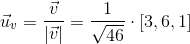
or
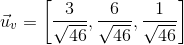
All unit vectors have a magnitude of  , so to verify we are correct:

To find the unit vector in the same direction as a vector, we divide it by its magnitude.
The magnitude of
We divide vector
or
All unit vectors have a magnitude of
← Didn't Know|Knew It →
A unit vector has length  .
.
Given the vector

find the unit vector in the same direction.
A unit vector has length
Given the vector
find the unit vector in the same direction.
Tap to reveal answer
First, you must find the length of the vector. This is given by the equation:

Then, dividing the vector by its length gives the unit vector in the same direction.
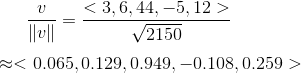
First, you must find the length of the vector. This is given by the equation:
Then, dividing the vector by its length gives the unit vector in the same direction.
← Didn't Know|Knew It →
Put the vector  in unit vector form.
Put the vector
Tap to reveal answer
To get the unit vector that is in the same direction as the original vector  , we divide the vector by the magnitude of the vector.
For  , the magnitude is:

 .
.
This means the unit vector in the same direction of  is,
is,
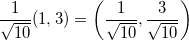 .
.
To get the unit vector that is in the same direction as the original vector
For
This means the unit vector in the same direction of
← Didn't Know|Knew It →
Find the unit vector of
 .
.
Find the unit vector of
Tap to reveal answer
In order to find the unit vector u of a given vector v, we follow the formula

Let

The magnitude of v follows the formula
 .
.
For this vector in the problem



 .
.
Following the unit vector formula and substituting for the vector and magnitude
 .
.
As such,
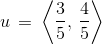 .
.
In order to find the unit vector u of a given vector v, we follow the formula
Let
The magnitude of v follows the formula
For this vector in the problem
Following the unit vector formula and substituting for the vector and magnitude
As such,
← Didn't Know|Knew It →
Find the unit vector of

Find the unit vector of
Tap to reveal answer
In order to find the unit vector u of a given vector v, we follow the formula
Let

The magnitude of v follows the formula
For this vector in the problem




Following the unit vector formula and substituting for the vector and magnitude

As such,
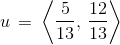
In order to find the unit vector u of a given vector v, we follow the formula
Let
The magnitude of v follows the formula
For this vector in the problem
Following the unit vector formula and substituting for the vector and magnitude
As such,
← Didn't Know|Knew It →
Write a vector equation describing the line passing through P1 (1, 4) and parallel to the vector  = (3, 4).
Write a vector equation describing the line passing through P1 (1, 4) and parallel to the vector 
Tap to reveal answer
First, draw the vector  = (3, 4); this is represented in red below. Then, plot the point P1 (1, 4), and draw a line
  (represented in blue) through it that is parallel to the vector
  .
.

We must find the equation of line  . For any point P2 (x, y) on
  ,
,  . Since
  is on line
  and is parallel to
  ,
,  for some value of t. By substitution, we have
  . Therefore, the equation
  is a vector equation describing all of the points (x, y) on line
  parallel to
  through P1 (1, 4).
First, draw the vector 


We must find the equation of line 


← Didn't Know|Knew It →
True or false: A line through P1 (x1, y1) that is parallel to the vector  is defined by the set of points
  such that
  for some real number t. Therefore,
  .
.
True or false: A line through P1 (x1, y1) that is parallel to the vector 


Tap to reveal answer
This is true. The independent variable  in this equation is called a parameter.
This is true. The independent variable 
← Didn't Know|Knew It →
Find the parametric equations for a line parallel to  and passing through the point (0, 5).
Find the parametric equations for a line parallel to 
Tap to reveal answer
A line through a point (x1,y1) that is parallel to the vector  = (a1, a2) has the following parametric equations, where t is any real number.


Using the given vector and point, we get the following:
x = 3t
y = 5 + 2t
Each value of t creates a distinct (x, y) ordered pair. You can think of these points as representing positions of an object, and of t as representing time in seconds. Evaluating the parametric equations for a value of t gives us the coordinates of the position of the object after t seconds have passed.
A line through a point (x1,y1) that is parallel to the vector 


Using the given vector and point, we get the following:
x = 3t
y = 5 + 2t
Each value of t creates a distinct (x, y) ordered pair. You can think of these points as representing positions of an object, and of t as representing time in seconds. Evaluating the parametric equations for a value of t gives us the coordinates of the position of the object after t seconds have passed.
← Didn't Know|Knew It →
Find the angle between the following two vectors in 3D space.


Find the angle between the following two vectors in 3D space.
Tap to reveal answer
We can relate the dot product, length of two vectors, and angle between them by the following formula:

So the dot product of 
 and
and
 is the addition of each product of components:

now the length of the vectors of a and b can be found using the formula for vector magnitude:


So:

 hence
hence 
We can relate the dot product, length of two vectors, and angle between them by the following formula:
So the dot product of
now the length of the vectors of a and b can be found using the formula for vector magnitude:
So:
← Didn't Know|Knew It →
Find the dot product of the two vectors

and
 .
.
Find the dot product of the two vectors
and
Tap to reveal answer
To find the dot product of two vectors,
find the product of the x-components,
find the product of the y-components,
and then find the sum.

To find the dot product of two vectors,
find the product of the x-components,
find the product of the y-components,
and then find the sum.
← Didn't Know|Knew It →
Find the dot product of the two vectors

and
 .
.
Find the dot product of the two vectors
and
Tap to reveal answer
To find the dot product of two vectors,
find the product of the x-components,
find the product of the y-components,
and then find the sum.

To find the dot product of two vectors,
find the product of the x-components,
find the product of the y-components,
and then find the sum.
← Didn't Know|Knew It →
Find the dot product of the two vectors

and
 .
.
Find the dot product of the two vectors
and
Tap to reveal answer
To find the dot product of two vectors,
find the product of the x-components,
find the product of the y-components,
and then find the sum.

To find the dot product of two vectors,
find the product of the x-components,
find the product of the y-components,
and then find the sum.
← Didn't Know|Knew It →
Let


Find the dot product of the two vectors
 .
.
Let
Find the dot product of the two vectors
Tap to reveal answer
Let

The dot product  is equal to
 .
.
Let
The dot product
← Didn't Know|Knew It →
Let


Find the dot product of the two vectors
.
Let
Find the dot product of the two vectors
Tap to reveal answer
Let

The dot product  is equal to
 .
.
Let
The dot product
← Didn't Know|Knew It →
Evaluate the dot product of the following two vectors:

Evaluate the dot product of the following two vectors:
Tap to reveal answer
To find the dot product of two vectors, we multiply the corresponding terms of each vector and then add the results together, as expressed by the following formula:


To find the dot product of two vectors, we multiply the corresponding terms of each vector and then add the results together, as expressed by the following formula:
← Didn't Know|Knew It →
Determine the dot product of  and
and  .
.
Determine the dot product of
Tap to reveal answer
The value of the dot product will return a number. The formula for a dot product is:

Use the formula to find the dot product for the given vectors.

The value of the dot product will return a number. The formula for a dot product is:
Use the formula to find the dot product for the given vectors.
← Didn't Know|Knew It →
The dot product may be used to determine the angle between two vectors.
Use the dot product to determine if the angle between the two vectors.
 ,
,
The dot product may be used to determine the angle between two vectors.
Use the dot product to determine if the angle between the two vectors.
Tap to reveal answer
First, we note that the dot product of two vectors is defined to be;
 .
.
First, we find the left side of the dot product:
 .
.
Then we compute the lengths of the vectors:
 .
.
We can then solve the dot product formula for theta to get:

Substituting the values for the dot product and the lengths will give the correct answer.

First, we note that the dot product of two vectors is defined to be;
First, we find the left side of the dot product:
Then we compute the lengths of the vectors:
We can then solve the dot product formula for theta to get:
Substituting the values for the dot product and the lengths will give the correct answer.
← Didn't Know|Knew It →
Find the angle between the two vectors: 
Find the angle between the two vectors:
Tap to reveal answer
Solving the dot product formula for the angle between the two vectors results in the equation  .
.
If we call the vectors a and b, finding the dot product and the lengths of the vectors, then substituting them into the formula will give the correct angle.


Substituting the values correctly will give the correct answer.

Solving the dot product formula for the angle between the two vectors results in the equation
If we call the vectors a and b, finding the dot product and the lengths of the vectors, then substituting them into the formula will give the correct angle.
Substituting the values correctly will give the correct answer.
← Didn't Know|Knew It →
Find the measure of the angle between the following vectors:


Find the measure of the angle between the following vectors:
Tap to reveal answer
To find the angle between two vectors, use the following formula:

 is known as the dot product of two vectors. It is found via the following formula:

The denominator of the fraction involves multiplying the magnitude of each vector. To find the magnitude of a vector, use the following formula:

Now we have everything we need to find our answer. Use our given vectors:


So the angle between these two vectors is 102.09 degrees
To find the angle between two vectors, use the following formula:
The denominator of the fraction involves multiplying the magnitude of each vector. To find the magnitude of a vector, use the following formula:
Now we have everything we need to find our answer. Use our given vectors:
So the angle between these two vectors is 102.09 degrees
← Didn't Know|Knew It →


Which of the following best explains whether the two vectors above are perpendicular or parallel?
Which of the following best explains whether the two vectors above are perpendicular or parallel?
Tap to reveal answer
Two vectors are perpendicular if their dot product is zero, and parallel if their dot product is 1.
Take the dot product of our two vectors to find the answer:

Using our given vectors:



Thus our two vectors are perpendicular.
Two vectors are perpendicular if their dot product is zero, and parallel if their dot product is 1.
Take the dot product of our two vectors to find the answer:
Using our given vectors:
Thus our two vectors are perpendicular.
← Didn't Know|Knew It →