
Electric Circuits - Physics
Card 0 of 344
Conceptual
When resistors are connected in series
Conceptual
When resistors are connected in series
In series, there are no branches for the current to travel down. Therefore it is like a one lane highway so the current is the same throughout the entire circuit.
In series, there are no branches for the current to travel down. Therefore it is like a one lane highway so the current is the same throughout the entire circuit.
Compare your answer with the correct one above
When resistors are connected in parallel, we can be certain that
When resistors are connected in parallel, we can be certain that
Consider a set of parallel resistors that are connected to the battery. Each resistor is on its own loop to the battery. Therefore each resistor has its own potential difference that is equal to the battery. That is why if one bulb goes out in a parallel circuit, the other stays lit. Each resistor has its own connection independent of the others in the circuit.
Consider a set of parallel resistors that are connected to the battery. Each resistor is on its own loop to the battery. Therefore each resistor has its own potential difference that is equal to the battery. That is why if one bulb goes out in a parallel circuit, the other stays lit. Each resistor has its own connection independent of the others in the circuit.
Compare your answer with the correct one above
An electric circuit is set up in series with five resistors. If the resistors remain the same, but the circuit is now set up with the resistors in parallel, how would this affect the total resistance?
An electric circuit is set up in series with five resistors. If the resistors remain the same, but the circuit is now set up with the resistors in parallel, how would this affect the total resistance?
Think of resistors as doors, preventing the flow of people (electrons). Imagine the following scenarios: a large group of people are in a room and all try to leave at once. If the five resistors are in series, that's like having all of these people trying to go through all five doors before they can leave. In a circuit, all the electrons in the current must pass through every resistor.
If the resistors are in parallel, it's like having five separate doors from the room. All of a sudden, the group can leave MUCH faster, encountering less resistance to their flow out of the room. The path of the electrons can split, allowing each particle to pass through only one resistor.
From a formula perspective, the resistors in series are simply summed together to find the equivalent resistance.

In parallel, however, the reciprocals are summed to find the reciprocal equivalent resistance.
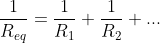
Adding whole numbers will always give you a much greater result than adding fractions. For the exact same set of resistors, arrangement in series will have a greater total resistance than arrangement in parallel.
Think of resistors as doors, preventing the flow of people (electrons). Imagine the following scenarios: a large group of people are in a room and all try to leave at once. If the five resistors are in series, that's like having all of these people trying to go through all five doors before they can leave. In a circuit, all the electrons in the current must pass through every resistor.
If the resistors are in parallel, it's like having five separate doors from the room. All of a sudden, the group can leave MUCH faster, encountering less resistance to their flow out of the room. The path of the electrons can split, allowing each particle to pass through only one resistor.
From a formula perspective, the resistors in series are simply summed together to find the equivalent resistance.
In parallel, however, the reciprocals are summed to find the reciprocal equivalent resistance.
Adding whole numbers will always give you a much greater result than adding fractions. For the exact same set of resistors, arrangement in series will have a greater total resistance than arrangement in parallel.
Compare your answer with the correct one above
What is the resistance in a circuit with a voltage of  and a current of
  ?
?
What is the resistance in a circuit with a voltage of
For this problem, use Ohm's law:  . In this equation
  is the voltage,
  is the current, and
  is the resistance.
We can re-arrange the equation to solve specifically for  .
.

Plug in the given values for voltage and current and solve for resistance.


For this problem, use Ohm's law:
We can re-arrange the equation to solve specifically for
Plug in the given values for voltage and current and solve for resistance.
Compare your answer with the correct one above
Calculate the voltage drop across the 4 ohm resistor.
Calculate the voltage drop across the 4 ohm resistor.
To begin we need to simplify the circuit to get the equivalent resistance. Let’s start with the 3 and 6 Ohm resistors in parallel.


Now we can add this resistor to the 4 Ohm resistor as they are in series.


We can now determine the current coming out of the battery using Ohm’s Law.

Rearrange to solve for current.


The current coming out of the battery will be the same current that moves through the 4 Ohm resistor. So we can determine the voltage drop across the 4 ohm resistor.


To begin we need to simplify the circuit to get the equivalent resistance. Let’s start with the 3 and 6 Ohm resistors in parallel.


Now we can add this resistor to the 4 Ohm resistor as they are in series.


We can now determine the current coming out of the battery using Ohm’s Law.

Rearrange to solve for current.


The current coming out of the battery will be the same current that moves through the 4 Ohm resistor. So we can determine the voltage drop across the 4 ohm resistor.


Compare your answer with the correct one above
Kirchoff’s loop rule is an example of
Kirchoff’s loop rule is an example of
Kirchoff’s loop law states that the sum of the voltage around a loop must equal zero. In other words, the voltage that is being provided by the batteries in the circuit must equal the voltage being used by the objects in the circuit. Voltage is a measure of the potential difference, or energy within the circuit. In other words, the battery does a certain amount of work and provides energy to the circuit which is then used by all the parts of the circuit. Therefore this is an example of conservation of energy.
Kirchoff’s loop law states that the sum of the voltage around a loop must equal zero. In other words, the voltage that is being provided by the batteries in the circuit must equal the voltage being used by the objects in the circuit. Voltage is a measure of the potential difference, or energy within the circuit. In other words, the battery does a certain amount of work and provides energy to the circuit which is then used by all the parts of the circuit. Therefore this is an example of conservation of energy.
Compare your answer with the correct one above
Kirchoff’s junction rule is an example of
Kirchoff’s junction rule is an example of
Kirchoff’s loop rules states the sum of the current going into and out of the junction must equal 0. In other words, the current going in must equal the current going on. Current is a measure of the flow of charge. Therefore, this law is conservation of charge as the number of electrons going into a junction must equal the number of electrons flowing out.
Kirchoff’s loop rules states the sum of the current going into and out of the junction must equal 0. In other words, the current going in must equal the current going on. Current is a measure of the flow of charge. Therefore, this law is conservation of charge as the number of electrons going into a junction must equal the number of electrons flowing out.
Compare your answer with the correct one above
The total amount of charge that passes through a wire’s full cross section at any point per unit of time is referred to as
The total amount of charge that passes through a wire’s full cross section at any point per unit of time is referred to as
Current is defined as the amount of charge that passes through a specific area of a wire in a specific interval of time. It is measured in Amps which are Coulombs per second.
Current is defined as the amount of charge that passes through a specific area of a wire in a specific interval of time. It is measured in Amps which are Coulombs per second.
Compare your answer with the correct one above
Each component of a series circuit carries an equal .
Each component of a series circuit carries an equal .
A series circuit has the same current running through each component, though the voltage across each component may vary. In contrast, a parallel circuit will carry a constant voltage in each branch and the current may be split in inequal amounts between branches.
Resistance and capacitance are dependent on the elements present in a given circuit, so no claims can be made. Power is similarly dependent on the elements present in a specific circuit.
A series circuit has the same current running through each component, though the voltage across each component may vary. In contrast, a parallel circuit will carry a constant voltage in each branch and the current may be split in inequal amounts between branches.
Resistance and capacitance are dependent on the elements present in a given circuit, so no claims can be made. Power is similarly dependent on the elements present in a specific circuit.
Compare your answer with the correct one above
When current in a circuit crosses a resistor, energy is lost. What form does this lost energy most commonly take?
When current in a circuit crosses a resistor, energy is lost. What form does this lost energy most commonly take?
In basic resistors, energy lost due to resistance is converted into heat. In some cases, other conversions also take place (such as generation of light in a lightbulb), but heat is still dissipated along with any alternative conversations. Lightbulbs, batteries, and other types of resistors will become hot as current passes through them.
In basic resistors, energy lost due to resistance is converted into heat. In some cases, other conversions also take place (such as generation of light in a lightbulb), but heat is still dissipated along with any alternative conversations. Lightbulbs, batteries, and other types of resistors will become hot as current passes through them.
Compare your answer with the correct one above
A closed electric circuit is set up so that there is a current of  and a resistance of
  . What is the voltage in the circuit?
A closed electric circuit is set up so that there is a current of
For this problem, use Ohm's law:  .
.
We are given the current and the resistance. Using these terms, we can solve for the voltage.



For this problem, use Ohm's law:
We are given the current and the resistance. Using these terms, we can solve for the voltage.
Compare your answer with the correct one above
What is the voltage of a circuit with  of current and
  of resistance?
What is the voltage of a circuit with
For this problem, use Ohm's law:  . In this equation
  is the voltage,
  is the current, and
  is the resistance.
Plug in the given values and solve for the voltage.


For this problem, use Ohm's law:
Plug in the given values and solve for the voltage.
Compare your answer with the correct one above
What is the current of a circuit with a voltage of  and a total resistance of
  ?
?
What is the current of a circuit with a voltage of
For this problem, use Ohm's law:  . In this equation
  is the voltage,
  is the current, and
  is the resistance.
We can re-arrange the equation to solve specifically for  .
.

Plug in the given values for voltage and resistance to solve for the current.


For this problem, use Ohm's law:
We can re-arrange the equation to solve specifically for
Plug in the given values for voltage and resistance to solve for the current.
Compare your answer with the correct one above
What is the power of a circuit with a current of  and a resistance of
  ?
?
What is the power of a circuit with a current of
The standard equation for power is:

We are given only current and reistance, meaning we must manipulate this equation so that only those variables are present. To do this, we can substitute Ohm's law for voltage.


Now we have an equation for power that uses only current and resistance. Plug in the values given in the question to find the final answer.

The standard equation for power is:
We are given only current and reistance, meaning we must manipulate this equation so that only those variables are present. To do this, we can substitute Ohm's law for voltage.
Now we have an equation for power that uses only current and resistance. Plug in the values given in the question to find the final answer.
Compare your answer with the correct one above
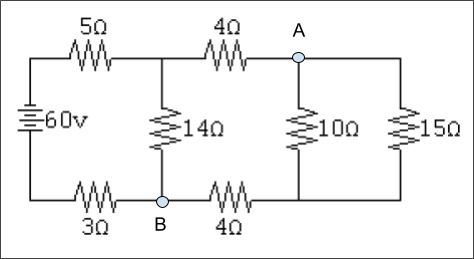
Calculate the voltage drop across the 14 ohm resistor.
Calculate the voltage drop across the 14 ohm resistor.
To begin, let us start with the  resistor and the
  resistor that are in parallel. In parallel we can add resistors through the equation


This new resistor is now in series with the two 4Ω resistors. In series we can just add these resistors up.


This new resistor is now in parallel with the  resistor. In parallel we can add resistors through the equation


This new resistor is now in series with the  and
and  resistor. In series we can just add these resistors up.


Now that we have the equivalent resistance of the circuit. We can now determine the current flowing out of the battery.

Rearrange to solve for current.


One of the best ways to work through a problem like this is to create a V= IR chart for all the components of the circuit.

We know that the current that is flowing out of the battery is the current that is flowing through both by 5 and 3 Ohm resistors since all of these are in series. So we can put this information into our chart.

Using Ohm’s Law we can determine the voltage for each of these two resistors.


We can now use Kirchoff’s loop law through the loop of the 5, 3, and 14 Ohm resistor to determine the voltage that is traveling through the 14 Ohm resistor.


To begin, let us start with the 


This new resistor is now in series with the two 4Ω resistors. In series we can just add these resistors up.


This new resistor is now in parallel with the 


This new resistor is now in series with the 


Now that we have the equivalent resistance of the circuit. We can now determine the current flowing out of the battery.

Rearrange to solve for current.


One of the best ways to work through a problem like this is to create a V= IR chart for all the components of the circuit.
We know that the current that is flowing out of the battery is the current that is flowing through both by 5 and 3 Ohm resistors since all of these are in series. So we can put this information into our chart.
Using Ohm’s Law we can determine the voltage for each of these two resistors.


We can now use Kirchoff’s loop law through the loop of the 5, 3, and 14 Ohm resistor to determine the voltage that is traveling through the 14 Ohm resistor.


Compare your answer with the correct one above
Calculate the current through the 10 ohm resistor.
Calculate the current through the 10 ohm resistor.
To begin, let us start with the  resistor and the
  resistor that are in parallel. In parallel we can add resistors through the equation


This new resistor is now in series with the two  resistors. In series we can just add these resistors up.


This new resistor is now in parallel with the  resistor. In parallel we can add resistors through the equation


This new resistor is now in series with the  and
and  resistor. In series we can just add these resistors up.


Now that we have the equivalent resistance of the circuit. We can now determine the current flowing out of the battery.

Rearrange to solve for current.


One of the best ways to work through a problem like this is to create a V= IR chart for all the components of the circuit.
We know that the current that is flowing out of the battery is the current that is flowing through both by 5 and 3 Ohm resistors since all of these are in series. So we can put this information into our chart.
Using Ohm’s Law we can determine the voltage for each of these two resistors.

We can now use Ohm’s law and our voltage to determine the current going through the 14 Ohm resistor.


Next we can analyze the current in the Junction between the 5, 14 and 4 Ohm resistors. Kirchoff’s laws state that the sum of the current flowing in and out of junction must equal 0.
We have  flowing in from the
  resistor and
  flowing out to go through the
  resistor.


So the current going through the 4 Ohm resistor is 3 amps. This will be the same for both 4 ohm resistors as both have the same current going into and out of the junctions near them. We can then use this to determine the voltage drop across each of the resistors.


Now let’s add this to our chart.

We can now use Kirchoff’s loop law to determine the voltage across the 10 Ohm resistor. Let’s analyze the loop that goes from the 5, to the 4 to the 10 back through the 4 and then through 3 Ohm resistor.


We can now use Ohm’s Law to determine the current through the 10 Ohm resistor.


To begin, let us start with the 


This new resistor is now in series with the two 


This new resistor is now in parallel with the 


This new resistor is now in series with the 


Now that we have the equivalent resistance of the circuit. We can now determine the current flowing out of the battery.

Rearrange to solve for current.


One of the best ways to work through a problem like this is to create a V= IR chart for all the components of the circuit.
We know that the current that is flowing out of the battery is the current that is flowing through both by 5 and 3 Ohm resistors since all of these are in series. So we can put this information into our chart.
Using Ohm’s Law we can determine the voltage for each of these two resistors.

We can now use Ohm’s law and our voltage to determine the current going through the 14 Ohm resistor.


Next we can analyze the current in the Junction between the 5, 14 and 4 Ohm resistors. Kirchoff’s laws state that the sum of the current flowing in and out of junction must equal 0.
We have 


So the current going through the 4 Ohm resistor is 3 amps. This will be the same for both 4 ohm resistors as both have the same current going into and out of the junctions near them. We can then use this to determine the voltage drop across each of the resistors.


Now let’s add this to our chart.
We can now use Kirchoff’s loop law to determine the voltage across the 10 Ohm resistor. Let’s analyze the loop that goes from the 5, to the 4 to the 10 back through the 4 and then through 3 Ohm resistor.


We can now use Ohm’s Law to determine the current through the 10 Ohm resistor.


Compare your answer with the correct one above
Calculate the current in the 15 Ohm Resistor.
Calculate the current in the 15 Ohm Resistor.
To begin, let us start with the  resistor and the
  resistor that are in parallel. In parallel we can add resistors through the equation


This new resistor is now in series with the two  resistors. In series we can just add these resistors up.


This new resistor is now in parallel with the  resistor. In parallel we can add resistors through the equation


This new resistor is now in series with the  and
and  resistor. In series we can just add these resistors up.


Now that we have the equivalent resistance of the circuit. We can now determine the current flowing out of the battery.

Rearrange to solve for current.


One of the best ways to work through a problem like this is to create a V= IR chart for all the components of the circuit.
We know that the current that is flowing out of the battery is the current that is flowing through both by 5 and 3 Ohm resistors since all of these are in series. So we can put this information into our chart.
Using Ohm’s Law we can determine the voltage for each of these two resistors.


We can now use Kirchoff’s loop law through the loop of the 5, 3, and 14 Ohm resistor to determine the voltage that is traveling through the 14 Ohm resistor.


We can now use Ohm’s law and our voltage to determine the current going through the 14 Ohm resistor.


We can now add this information to our chart.
Next we can analyze the current in the Junction between the 5, 14 and 4 Ohm resistors. Kirchoff’s laws state that the sum of the current flowing in and out of the junction must equal 0.
We have 4A flowing in from the 5 Ohm resistor and 1A flowing out to go through the 14 Ohm resistor.


So the current going through the 4 Ohm resistor is 3 amps. This will be the same for both 4 ohm resistors as both have the same current going into and out of the junctions near them. We can then use this to determine the voltage drop across each of the resistors.


Now let’s add this to our chart.
We can now use Kirchoff’s loop law to determine the voltage across the 10 Ohm resistor. Let’s analyze the loop that goes from the 5, to the 4 to the 10 back through the 4 and then through 3 Ohm resistor.


We can now use Ohm’s Law to determine the current through the 10 Ohm resistor.


We can now add this information to our chart.

We can now analyze the junction between the 4, 10 and 15 Ohm resistor.
Kirchoff’s laws state that the sum of the current flowing in and out of the junction must equal 0.
We have 2A flowing in from the 4 Ohm resistor and 1.2A flowing out to go through the 10 Ohm resistor.


To begin, let us start with the 


This new resistor is now in series with the two 


This new resistor is now in parallel with the 


This new resistor is now in series with the 


Now that we have the equivalent resistance of the circuit. We can now determine the current flowing out of the battery.

Rearrange to solve for current.


One of the best ways to work through a problem like this is to create a V= IR chart for all the components of the circuit.
We know that the current that is flowing out of the battery is the current that is flowing through both by 5 and 3 Ohm resistors since all of these are in series. So we can put this information into our chart.
Using Ohm’s Law we can determine the voltage for each of these two resistors.


We can now use Kirchoff’s loop law through the loop of the 5, 3, and 14 Ohm resistor to determine the voltage that is traveling through the 14 Ohm resistor.


We can now use Ohm’s law and our voltage to determine the current going through the 14 Ohm resistor.


We can now add this information to our chart.
Next we can analyze the current in the Junction between the 5, 14 and 4 Ohm resistors. Kirchoff’s laws state that the sum of the current flowing in and out of the junction must equal 0.
We have 4A flowing in from the 5 Ohm resistor and 1A flowing out to go through the 14 Ohm resistor.


So the current going through the 4 Ohm resistor is 3 amps. This will be the same for both 4 ohm resistors as both have the same current going into and out of the junctions near them. We can then use this to determine the voltage drop across each of the resistors.


Now let’s add this to our chart.
We can now use Kirchoff’s loop law to determine the voltage across the 10 Ohm resistor. Let’s analyze the loop that goes from the 5, to the 4 to the 10 back through the 4 and then through 3 Ohm resistor.


We can now use Ohm’s Law to determine the current through the 10 Ohm resistor.


We can now add this information to our chart.
We can now analyze the junction between the 4, 10 and 15 Ohm resistor.
Kirchoff’s laws state that the sum of the current flowing in and out of the junction must equal 0.
We have 2A flowing in from the 4 Ohm resistor and 1.2A flowing out to go through the 10 Ohm resistor.


Compare your answer with the correct one above

Calculate the voltage drop from point  to point
  .
.
Calculate the voltage drop from point 

To begin we need to simplify the circuit to get the equivalent resistance. Let’s start with the 3 and 6 Ohm resistors in parallel.


Now we can add this resistor to the 4 Ohm resistor as they are in series.


We can now determine the current coming out of the battery using Ohm’s Law.

Rearrange to solve for current.


The current coming out of the battery will be the same current that moves through the 4 Ohm resistor. So we can determine the voltage drop across the 4 ohm resistor.


We can then use Kirchoff’s loop law to determine the voltage drop from point  to point
  .
.
Let’s analyze the loop that goes from the battery to the 4 ohm resistor and through the 3 ohm resistor.


To begin we need to simplify the circuit to get the equivalent resistance. Let’s start with the 3 and 6 Ohm resistors in parallel.


Now we can add this resistor to the 4 Ohm resistor as they are in series.


We can now determine the current coming out of the battery using Ohm’s Law.

Rearrange to solve for current.


The current coming out of the battery will be the same current that moves through the 4 Ohm resistor. So we can determine the voltage drop across the 4 ohm resistor.


We can then use Kirchoff’s loop law to determine the voltage drop from point 

Let’s analyze the loop that goes from the battery to the 4 ohm resistor and through the 3 ohm resistor.


Compare your answer with the correct one above
Calculate the current through the 6 ohm resistor.
Calculate the current through the 6 ohm resistor.
To begin we need to simplify the circuit to get the equivalent resistance. Let’s start with the 3 and 6 Ohm resistors in parallel.


Now we can add this resistor to the 4 Ohm resistor as they are in series.


We can now determine the current coming out of the battery using Ohm’s Law.

Rearrange to solve for current.


The current coming out of the battery will be the same current that moves through the 4 Ohm resistor. So we can determine the voltage drop across the 4 ohm resistor.


We can then use Kirchoff’s loop law to determine the voltage drop across the 6 Ohm resistor. Let’s analyze the loop that goes from the battery to the 4 ohm resistor and through the 6 ohm resistor.


To begin we need to simplify the circuit to get the equivalent resistance. Let’s start with the 3 and 6 Ohm resistors in parallel.


Now we can add this resistor to the 4 Ohm resistor as they are in series.


We can now determine the current coming out of the battery using Ohm’s Law.

Rearrange to solve for current.


The current coming out of the battery will be the same current that moves through the 4 Ohm resistor. So we can determine the voltage drop across the 4 ohm resistor.


We can then use Kirchoff’s loop law to determine the voltage drop across the 6 Ohm resistor. Let’s analyze the loop that goes from the battery to the 4 ohm resistor and through the 6 ohm resistor.


Compare your answer with the correct one above

Which of the equations here is valid for the circuit shown?
Which of the equations here is valid for the circuit shown?
To answer this question we must consider Kirchoff’s Loop Law. This law states that the voltage around any loop must equal 0. In this case there are two different loops at play. To begin, let’s start on the left with the 2 Volt battery.
As we start with the 2 Volt battery, we then move into the 1 Ohm resistor with  going through it. Ohm’s law states that the voltage is equal to the current times the resistance. Therefore the voltage through this circuit is
  Since this resistor is using the voltage this will be a negative voltage when we sum around the loop.
We will continue our loop through the middle of the circuit into the 4 Volt battery. This battery is facing the opposite direction from our 2 Volt battery and therefore will be a negative when it comes to our equation.
Next is the 2 Ohm resistor with  going through it. According to Ohm’s law the voltage being used by this resistor is equal to
When summarizing all of these parts we get an equation that looks like  which simplifies down to
  This is one of the equations available to us and therefore there is no need to analyze any other loops.
To answer this question we must consider Kirchoff’s Loop Law. This law states that the voltage around any loop must equal 0. In this case there are two different loops at play. To begin, let’s start on the left with the 2 Volt battery.
As we start with the 2 Volt battery, we then move into the 1 Ohm resistor with 

We will continue our loop through the middle of the circuit into the 4 Volt battery. This battery is facing the opposite direction from our 2 Volt battery and therefore will be a negative when it comes to our equation.
Next is the 2 Ohm resistor with 

When summarizing all of these parts we get an equation that looks like 

Compare your answer with the correct one above