
Intermolecular Forces and Stability - Organic Chemistry
Card 1 of 236
Which of the following has the lowest boiling point?
Which of the following has the lowest boiling point?
Tap to reveal answer
In general, increased intermolecular interraction and higher magnitude of intermolecular forces lead to an increase in a molecule's boiling point. Inversely, decreased intermolecular interraction and lower magnitude of intermolecular forces lead to a decrease in a molecule's boiling point.
In this case, the only intermolecular force exhibited by any of these molecules are London dispersion forces. The magnitude of London dispersion forces decreases with a decrease in molecule size (carbon chain length and molecular surface area). Therefore, the shortest, most branched molecule in this problem will have the lowest boiling point. The correct answer is isobutane, a four membered, branched hydrocarbon.
In general, increased intermolecular interraction and higher magnitude of intermolecular forces lead to an increase in a molecule's boiling point. Inversely, decreased intermolecular interraction and lower magnitude of intermolecular forces lead to a decrease in a molecule's boiling point.
In this case, the only intermolecular force exhibited by any of these molecules are London dispersion forces. The magnitude of London dispersion forces decreases with a decrease in molecule size (carbon chain length and molecular surface area). Therefore, the shortest, most branched molecule in this problem will have the lowest boiling point. The correct answer is isobutane, a four membered, branched hydrocarbon.
← Didn't Know|Knew It →
Which of the following molecules has the lowest boiling point?
Which of the following molecules has the lowest boiling point?
Tap to reveal answer
When discussing boiling points of hydrocarbons, it is important to remember that branching decreases a molecule's boiling point. We can first eliminate hexane and pentane as our answers, as neither are branched. From here, we can come upon 2,3-dimethylbutane as our answer because it is more branched than 2-methylpentane. Also important when ranking hydrocarbons in terms of boiling point is the number of carbons - more carbons means a higher boiling point.
When discussing boiling points of hydrocarbons, it is important to remember that branching decreases a molecule's boiling point. We can first eliminate hexane and pentane as our answers, as neither are branched. From here, we can come upon 2,3-dimethylbutane as our answer because it is more branched than 2-methylpentane. Also important when ranking hydrocarbons in terms of boiling point is the number of carbons - more carbons means a higher boiling point.
← Didn't Know|Knew It →
Rank the given molecules in order of increasing boiling point.
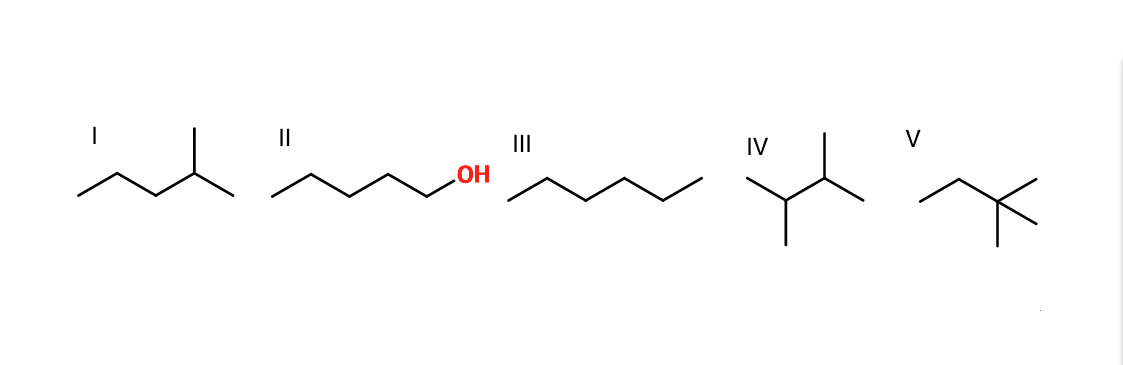
Rank the given molecules in order of increasing boiling point.
Tap to reveal answer
Most polar (II) has highest boiling point due to hydrogen bonds. The other molecules: increasing boiling point with decreased branching of the molecule (the more branched, the less surface area, and the lower the boiling point due to molecular stacking).
Most polar (II) has highest boiling point due to hydrogen bonds. The other molecules: increasing boiling point with decreased branching of the molecule (the more branched, the less surface area, and the lower the boiling point due to molecular stacking).
← Didn't Know|Knew It →
Which of the following intermolecular forces is the strongest?
Which of the following intermolecular forces is the strongest?
Tap to reveal answer
The strongest of those listed s hydrogen bonding. This type of intermolecular force is the attraction that occurs between hydrogen atoms and the lone pairs on atoms of oxygen, nitrogen and/or fluorine. Hydrogen bonds are the strongest while dispersion forces are the weakest. The strength of hydrogen bonds is responsible for properties of water such as high specific heat capacity, high surface tension, cohesion, high boiling point, and other.
The strongest of those listed s hydrogen bonding. This type of intermolecular force is the attraction that occurs between hydrogen atoms and the lone pairs on atoms of oxygen, nitrogen and/or fluorine. Hydrogen bonds are the strongest while dispersion forces are the weakest. The strength of hydrogen bonds is responsible for properties of water such as high specific heat capacity, high surface tension, cohesion, high boiling point, and other.
← Didn't Know|Knew It →
Which of the following element(s) is/are not involved in hydrogen bonds?
I. Nitrogen
II. Oxygen
III. Chlorine
Which of the following element(s) is/are not involved in hydrogen bonds?
I. Nitrogen
II. Oxygen
III. Chlorine
Tap to reveal answer
Hydrogen bonds are strong intermolecular bonds between hydrogen and one of three atoms: nitrogen, oxygen and fluorine. A typical hydrogen bond occurs between a hydrogen atom on one molecule and one of the three atoms listed on another molecule. These bonds are reversible; however, they serve as strong interactions that stabilize a mixture of molecules.
Hydrogen bonds are strong intermolecular bonds between hydrogen and one of three atoms: nitrogen, oxygen and fluorine. A typical hydrogen bond occurs between a hydrogen atom on one molecule and one of the three atoms listed on another molecule. These bonds are reversible; however, they serve as strong interactions that stabilize a mixture of molecules.
← Didn't Know|Knew It →
A researcher is trying to identify a molecule. He observes that there is a weak hydrophobic bond between adjacent molecules. He also notices a weak polar interaction between the molecules. Which of the following could be the identity of the molecule?
A researcher is trying to identify a molecule. He observes that there is a weak hydrophobic bond between adjacent molecules. He also notices a weak polar interaction between the molecules. Which of the following could be the identity of the molecule?
Tap to reveal answer
Intermolecular bonds occur between adjacent molecules (recall that ‘inter’ means ‘between’). There are several types of intermolecular bonds. Hydrophobic bonds, or van der Waals forces, are the weakest intermolecular forces and occur between every molecule; therefore, all of the listed molecules in the question have hydrophobic bonds. Polar interactions between molecules occur between charged species or polar molecules. Recall that polar molecules are molecules that contain two or more atoms with very different electronegativities. The more electronegative atom pulls the electrons closer to itself, causing polarity in the molecule. The more electronegative atom will have a partial negative charge (due to the proximity to electrons) and the less electronegative atom will have a partial positive charge. This polarity in molecule allows for dipole-dipole interactions, a type of intermolecular force.
To solve this question, we need to determine which molecules are polar. Hexane, or  , has only carbon and hydrogen atoms. Carbon and hydrogen electronegativities are very similar; therefore, this molecule is nonpolar. Hydrofluoric acid (
 ) have two atoms with very different electronegativities; therefore, this molecule is polar and will have polar interactions. Similarly, hydrobromic acid (
 ) will also be polar and will have polar interactions.
Intermolecular bonds occur between adjacent molecules (recall that ‘inter’ means ‘between’). There are several types of intermolecular bonds. Hydrophobic bonds, or van der Waals forces, are the weakest intermolecular forces and occur between every molecule; therefore, all of the listed molecules in the question have hydrophobic bonds. Polar interactions between molecules occur between charged species or polar molecules. Recall that polar molecules are molecules that contain two or more atoms with very different electronegativities. The more electronegative atom pulls the electrons closer to itself, causing polarity in the molecule. The more electronegative atom will have a partial negative charge (due to the proximity to electrons) and the less electronegative atom will have a partial positive charge. This polarity in molecule allows for dipole-dipole interactions, a type of intermolecular force.
To solve this question, we need to determine which molecules are polar. Hexane, or
← Didn't Know|Knew It →
Which of the following is considered the strongest intermolecular bond?
Which of the following is considered the strongest intermolecular bond?
Tap to reveal answer
Intermolecular bonds occur between adjacent molecules whereas intramolecular bonds occur within molecules. Examples of intermolecular bonds include hydrogen bonds, van der Waals interactions, and dipole-dipole interactions. The strongest intermolecular bond is hydrogen bond whereas the weakest is the van der Waals interactions. Covalent bonds and ionic bonds occur within molecules and are termed intramolecular bonds. Covalent bond is the strongest intramolecular bond.
Intermolecular bonds occur between adjacent molecules whereas intramolecular bonds occur within molecules. Examples of intermolecular bonds include hydrogen bonds, van der Waals interactions, and dipole-dipole interactions. The strongest intermolecular bond is hydrogen bond whereas the weakest is the van der Waals interactions. Covalent bonds and ionic bonds occur within molecules and are termed intramolecular bonds. Covalent bond is the strongest intramolecular bond.
← Didn't Know|Knew It →
It is observed that molecule A has a higher boiling point than molecule B. Which of the following could be the possible identities of molecule A and molecule B?
I. Molecule A: Hydrochloric acid, Molecule B: Hydrofluoric acid
II. Molecule A: Hydrogen peroxide, Molecule B: Diamond
III. Molecule A: Diamond, Molecule B: Nitric oxide
It is observed that molecule A has a higher boiling point than molecule B. Which of the following could be the possible identities of molecule A and molecule B?
I. Molecule A: Hydrochloric acid, Molecule B: Hydrofluoric acid
II. Molecule A: Hydrogen peroxide, Molecule B: Diamond
III. Molecule A: Diamond, Molecule B: Nitric oxide
Tap to reveal answer
Recall that boiling is the process of converting a liquid to a gas. This process involves the separation of molecules, which requires breaking the intermolecular bonds; therefore, boiling points depend on the strength of the intermolecular bonds. A stronger intermolecular bond will require more energy to break and, therefore, will have a higher boiling point. The question states that molecule A has the higher boiling point; therefore, molecule A must have stronger intermolecular interactions than molecule B. The strongest intermolecular bond is hydrogen bond, followed by dipole-dipole interactions and van der Waals interactions (weakest).
If we look at scenario I, molecule A is polar and has dipole-dipole interactions and van der Waals interactions (every molecule has van der Waals). It does not have hydrogen bonds because it does not contain nitrogen, oxygen, or fluorine (in addition the the hydrogen atom). Molecule B, on the other hand, has hydrogen bonds in addition to other intermolecular forces; therefore, molecule B has stronger intermolecular forces and a higher boiling point.
In scenario II, hydrogen peroxide has hydrogen bonds whereas diamond only has weak van der Waals interactions; therefore, molecule A has higher boiling point. In scenario III, diamond only has weak van der Waals interactions whereas nitric oxide can participate in dipole-dipole interactions as well (note that nitric oxide doesn’t have hydrogen atom and, therefore, cannot participate in hydrogen bonds). This means that molecule B has the higher boiling point in scenario III.
Recall that boiling is the process of converting a liquid to a gas. This process involves the separation of molecules, which requires breaking the intermolecular bonds; therefore, boiling points depend on the strength of the intermolecular bonds. A stronger intermolecular bond will require more energy to break and, therefore, will have a higher boiling point. The question states that molecule A has the higher boiling point; therefore, molecule A must have stronger intermolecular interactions than molecule B. The strongest intermolecular bond is hydrogen bond, followed by dipole-dipole interactions and van der Waals interactions (weakest).
If we look at scenario I, molecule A is polar and has dipole-dipole interactions and van der Waals interactions (every molecule has van der Waals). It does not have hydrogen bonds because it does not contain nitrogen, oxygen, or fluorine (in addition the the hydrogen atom). Molecule B, on the other hand, has hydrogen bonds in addition to other intermolecular forces; therefore, molecule B has stronger intermolecular forces and a higher boiling point.
In scenario II, hydrogen peroxide has hydrogen bonds whereas diamond only has weak van der Waals interactions; therefore, molecule A has higher boiling point. In scenario III, diamond only has weak van der Waals interactions whereas nitric oxide can participate in dipole-dipole interactions as well (note that nitric oxide doesn’t have hydrogen atom and, therefore, cannot participate in hydrogen bonds). This means that molecule B has the higher boiling point in scenario III.
← Didn't Know|Knew It →
Which type of intermolecular force explains why butanal has a lower boiling point than octanal?
Which type of intermolecular force explains why butanal has a lower boiling point than octanal?
Tap to reveal answer
As a molecule's mass increases, van der Waal forces also increases due to an increased area for fleeting charged interactions. Thus, the longer carbon chain length in octanal causes a higher boiling point. Because both octanal and butanal can participate in dipole-dipole interactions, this does not differentiate their boiling points, as it would if butane and butanal were compared. Both compounds participate in hydrogen bonding, which will account for their relatively high boiling points, but both molecules share the increased boiling point due to this type of intermolecular force.
As a molecule's mass increases, van der Waal forces also increases due to an increased area for fleeting charged interactions. Thus, the longer carbon chain length in octanal causes a higher boiling point. Because both octanal and butanal can participate in dipole-dipole interactions, this does not differentiate their boiling points, as it would if butane and butanal were compared. Both compounds participate in hydrogen bonding, which will account for their relatively high boiling points, but both molecules share the increased boiling point due to this type of intermolecular force.
← Didn't Know|Knew It →
Which of the following compounds are not able to form hydrogen bonds with water?
Which of the following compounds are not able to form hydrogen bonds with water?
Tap to reveal answer
This question is rather straightforward, asking us which class of compounds will not form hydrogen bonds with water.
In order to form a hydrogen bond, whether it is intermolecular or intramolecular, there needs to be a partial positively charged hydrogen atom in between two other partial negative charged atoms. These atoms tend to be highly electronegative, and are usually either nitrogen, oxygen, or flourine.
Carboxylic acids will certainly engage in hydrogen bonds. The oxygen that is double bonded to the carbon has a partial negative charge, while the carbon has a partial positive charge, just as in aldehydes and ketones. Furthermore, the hydroxyl group attached to the carbon atom can also take part in hydrogen bonds.
Ethers are compounds in which an oxygen atom is situated between two carbon atoms via single bonds. Because there is a sufficient difference in the electronegativity of oxygen and carbon, ethers are also capable of hydrogen bonding.
Alkanes are hydrocarbons. This means that the only atoms found in these molecules are carbon and hydrogen. Because there is little difference in electronegativity between carbon and hydrogen, alkanes are incapable of hydrogen bonding with water.
This question is rather straightforward, asking us which class of compounds will not form hydrogen bonds with water.
In order to form a hydrogen bond, whether it is intermolecular or intramolecular, there needs to be a partial positively charged hydrogen atom in between two other partial negative charged atoms. These atoms tend to be highly electronegative, and are usually either nitrogen, oxygen, or flourine.
Carboxylic acids will certainly engage in hydrogen bonds. The oxygen that is double bonded to the carbon has a partial negative charge, while the carbon has a partial positive charge, just as in aldehydes and ketones. Furthermore, the hydroxyl group attached to the carbon atom can also take part in hydrogen bonds.
Ethers are compounds in which an oxygen atom is situated between two carbon atoms via single bonds. Because there is a sufficient difference in the electronegativity of oxygen and carbon, ethers are also capable of hydrogen bonding.
Alkanes are hydrocarbons. This means that the only atoms found in these molecules are carbon and hydrogen. Because there is little difference in electronegativity between carbon and hydrogen, alkanes are incapable of hydrogen bonding with water.
← Didn't Know|Knew It →
Which of these accurately describes hydrogen bonds?
Which of these accurately describes hydrogen bonds?
Tap to reveal answer
A hydrogen bond forms when a hydrogen attached to an electronegative atom of one molecule becomes attracted to an electronegative atom of another molecule (the electronegative atoms that may form hydrogen bonds are oxygen, nitrogen, and fluorine). Hydrogen bonds are extremely important in water molecules. The hydrogen atoms attached to the electronegative oxygen atom in water can form hydrogen bonds with the oxygen atoms of other water molecules, giving water many of its properties as a solvent.
Hydrogen bonds are also important in protein secondary structure, which is defined by the pattern of hydrogen bonds that form between the carbonyl oxygen and amine hydrogen atoms in the peptide backbone of proteins. Lastly, hydrogen bonds increase boiling point because they increase the strength of different substances.
A hydrogen bond forms when a hydrogen attached to an electronegative atom of one molecule becomes attracted to an electronegative atom of another molecule (the electronegative atoms that may form hydrogen bonds are oxygen, nitrogen, and fluorine). Hydrogen bonds are extremely important in water molecules. The hydrogen atoms attached to the electronegative oxygen atom in water can form hydrogen bonds with the oxygen atoms of other water molecules, giving water many of its properties as a solvent.
Hydrogen bonds are also important in protein secondary structure, which is defined by the pattern of hydrogen bonds that form between the carbonyl oxygen and amine hydrogen atoms in the peptide backbone of proteins. Lastly, hydrogen bonds increase boiling point because they increase the strength of different substances.
← Didn't Know|Knew It →
Which of the following molecules would have the highest boiling point?
Which of the following molecules would have the highest boiling point?
Tap to reveal answer
Boiling point increases as the strength of intermolecular forces of a substance increases. The strength of intermolecular forces of a substance increases with a longer carbon chain, branching of elements off of the carbon chain, and the addition of  groups (because these allow hydrogen bonding). Of the choices, we know that
  only has four carbons, while the other choices have five. This gives it a lower boiling point than the others. Next, we see that
  has a
has a  branching off of its carbon chain. This gives it a higher boiling point than
  . However,
  contains two
  groups; these can contribute to hydrogen bonding, giving this substance the highest boiling point of all the choices.
Boiling point increases as the strength of intermolecular forces of a substance increases. The strength of intermolecular forces of a substance increases with a longer carbon chain, branching of elements off of the carbon chain, and the addition of
← Didn't Know|Knew It →
Rank the following compounds in terms by increasing boiling point, starting with the lowest boiling point first.
I. 1-pentanol
II. n-pentane
III. 2,2-dimethylpropane
IV. (R)-4-hydroxypentanoic acid.
Rank the following compounds in terms by increasing boiling point, starting with the lowest boiling point first.
I. 1-pentanol
II. n-pentane
III. 2,2-dimethylpropane
IV. (R)-4-hydroxypentanoic acid.
Tap to reveal answer
Boiling point is highly dependent on the intermolecular forces of a compound. Compounds with stronger intermolecular forces, larger masses, and less branching will have higher boiling points.
Compounds II and III only exhibit intermolecular London dispersion forces, so they would be the two lowest boiling compounds (weakest intermolecular forces). Because compound III has more branching, these London dispersion forces would be weaker, resulting in a lower boiling point than compound II.
III < II
Compounds I and IV would be higher boiling point compounds because of additional hydrogen bonding (strong intermolecular forces). Compound IV would be the highest boiling because the hydroxy group and carboxylic acid group could BOTH participate in intermolecular hydrogen bonding. In addition, compound IV is more polar (more polarized carbon-oxygen bonds), resulting in greater dipole-dipole attraction as well.
III < II < I < IV
Boiling point is highly dependent on the intermolecular forces of a compound. Compounds with stronger intermolecular forces, larger masses, and less branching will have higher boiling points.
Compounds II and III only exhibit intermolecular London dispersion forces, so they would be the two lowest boiling compounds (weakest intermolecular forces). Because compound III has more branching, these London dispersion forces would be weaker, resulting in a lower boiling point than compound II.
III < II
Compounds I and IV would be higher boiling point compounds because of additional hydrogen bonding (strong intermolecular forces). Compound IV would be the highest boiling because the hydroxy group and carboxylic acid group could BOTH participate in intermolecular hydrogen bonding. In addition, compound IV is more polar (more polarized carbon-oxygen bonds), resulting in greater dipole-dipole attraction as well.
III < II < I < IV
← Didn't Know|Knew It →
Which of the following statements is true of alkynes?
Which of the following statements is true of alkynes?
Tap to reveal answer
The answer is "Internal alkynes are more stable than terminal alkynes" as it is the only true statement in regards to alkynes. Internal alkynes are more stable because they have a better conjugated system than terminal alkynes. A conjugated system is a system of a single bond, then a multiple bond, then a single bond, and so on. A conjugated system will always be more stable than an unconjugated system. It is evident that the internal alkyne follows the conjugated system and the terminal alkyne does not based on the picture below.

The answer is "Internal alkynes are more stable than terminal alkynes" as it is the only true statement in regards to alkynes. Internal alkynes are more stable because they have a better conjugated system than terminal alkynes. A conjugated system is a system of a single bond, then a multiple bond, then a single bond, and so on. A conjugated system will always be more stable than an unconjugated system. It is evident that the internal alkyne follows the conjugated system and the terminal alkyne does not based on the picture below.
← Didn't Know|Knew It →
Which of the following compounds will be the most volatile (have the lowest boiling point)?

Which of the following compounds will be the most volatile (have the lowest boiling point)?
Tap to reveal answer
When comparing relative volatilities of compounds, you must consider the molecular weight of a compound, as well as the intermolecular attractive forces between the identical molecules found in a sample of the compound in question.
We can eliminate choices I, II and V. These compounds have functional groups that feature polarized X-H bonds, allowing molecules in a sample of these compounds to participate in hydrogen bonding. Hydrogen bonding is a strong attractive force, and thus more energy would have to be put into a sample to vaporize it (boil a liquid sample). In other words, the hydrogen bonds will raise the boiling point and lower the volatility of these compounds.
Answer choice IV, which features an alkyl bromide, may also be eliminated for two reasons. First, as bromine is much heavier than carbon, molecule IV will be much heavier than III, and will thus require much more energy to transition into the gaseous state. Secondly, as bromine is fairly electronegative, the molecule will feature a dipole in the carbon-bromine bond, and thus a sample of IV will experience dipole-dipole attractive interactions. As described above, attractive intermolecular interactions require more energy to overcome in order for a sample to undergo a liquid-gas phase change. Thus, molecule IV is less volatile than molecule III, the correct answer.
When comparing relative volatilities of compounds, you must consider the molecular weight of a compound, as well as the intermolecular attractive forces between the identical molecules found in a sample of the compound in question.
We can eliminate choices I, II and V. These compounds have functional groups that feature polarized X-H bonds, allowing molecules in a sample of these compounds to participate in hydrogen bonding. Hydrogen bonding is a strong attractive force, and thus more energy would have to be put into a sample to vaporize it (boil a liquid sample). In other words, the hydrogen bonds will raise the boiling point and lower the volatility of these compounds.
Answer choice IV, which features an alkyl bromide, may also be eliminated for two reasons. First, as bromine is much heavier than carbon, molecule IV will be much heavier than III, and will thus require much more energy to transition into the gaseous state. Secondly, as bromine is fairly electronegative, the molecule will feature a dipole in the carbon-bromine bond, and thus a sample of IV will experience dipole-dipole attractive interactions. As described above, attractive intermolecular interactions require more energy to overcome in order for a sample to undergo a liquid-gas phase change. Thus, molecule IV is less volatile than molecule III, the correct answer.
← Didn't Know|Knew It →
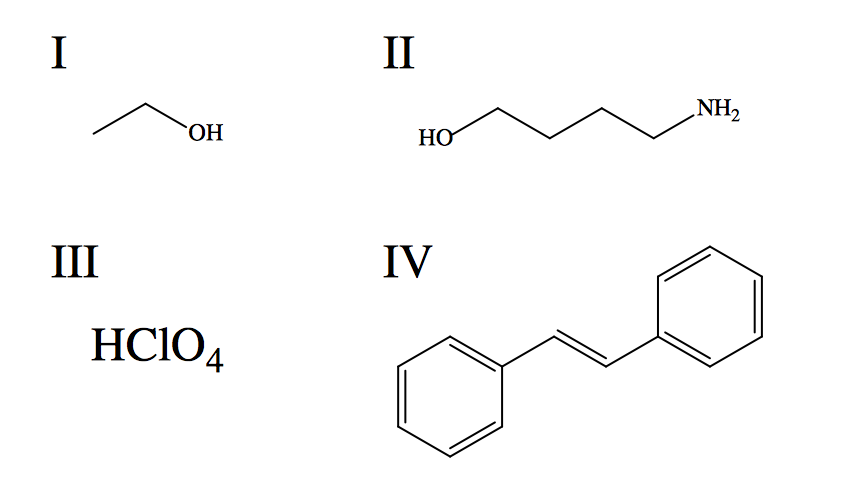
Rank the given species in terms of increasing aqueous solubility.
Rank the given species in terms of increasing aqueous solubility.
Tap to reveal answer
"Like dissolves like" is a good guiding principle to keep in mind in dealing with solubility trends. In other words, polar solvents will more easily dissolve polar solutes than nonpolar; and vice versa. Water is a polar solute that forms strong hydrogen bonds (intramolecular and intermolecular), which are energetically favorable interactions. Solutes that are also capable of hydrogen bonding are readily dissolved in water since they do not significantly disrupt the network of intramolecular hydrogen bonds. In order to predict the solubilities of the given compounds, it is useful to define the primary intermolecular forces each experiences when introduced to water. I: Hydrogen bonding dominates interaction between methanol and water (the two are miscible). II: Hydrogen bonding is present, but solubility is reduced by the presence of a multi-carbon chain, which adds significant nonpolar character to the structure. III: Perchloric acid is a strong acid (stronger than nitric acid and sulfuric acid), meaning it completely dissociates in water, forming verystrong ion-dipole interactions with water. Assessment of the given interactions leads to the correct trend of increasing solubility: IV, II, I, III.
"Like dissolves like" is a good guiding principle to keep in mind in dealing with solubility trends. In other words, polar solvents will more easily dissolve polar solutes than nonpolar; and vice versa. Water is a polar solute that forms strong hydrogen bonds (intramolecular and intermolecular), which are energetically favorable interactions. Solutes that are also capable of hydrogen bonding are readily dissolved in water since they do not significantly disrupt the network of intramolecular hydrogen bonds. In order to predict the solubilities of the given compounds, it is useful to define the primary intermolecular forces each experiences when introduced to water. I: Hydrogen bonding dominates interaction between methanol and water (the two are miscible). II: Hydrogen bonding is present, but solubility is reduced by the presence of a multi-carbon chain, which adds significant nonpolar character to the structure. III: Perchloric acid is a strong acid (stronger than nitric acid and sulfuric acid), meaning it completely dissociates in water, forming verystrong ion-dipole interactions with water. Assessment of the given interactions leads to the correct trend of increasing solubility: IV, II, I, III.
← Didn't Know|Knew It →
Which of the following molecules has the highest boiling point?
Which of the following molecules has the highest boiling point?
Tap to reveal answer
 is an ionic compound. Therefore, it will have the highest boiling point out of any of these molecules. Ionic forces are stronger to covalent forces, which leads to the higher boiling points observed among these compounds.
← Didn't Know|Knew It →
Which of the following will have the highest vapor pressure?
Which of the following will have the highest vapor pressure?
Tap to reveal answer
The compound with the highest vapor pressure will have the weakest intermolecular forces. Octane and pentane have only London dispersion forces; ethanol and acetic acid have hydrogen bonding. Hydrogen bonding is much stronger than London dispersion forces. Because octane is larger than pentane, it will have more London dispersion forces, thus pentane has the weakest intermolecular forces.
The compound with the highest vapor pressure will have the weakest intermolecular forces. Octane and pentane have only London dispersion forces; ethanol and acetic acid have hydrogen bonding. Hydrogen bonding is much stronger than London dispersion forces. Because octane is larger than pentane, it will have more London dispersion forces, thus pentane has the weakest intermolecular forces.
← Didn't Know|Knew It →
Which of the following molecules has the lowest vapor pressure?
Which of the following molecules has the lowest vapor pressure?
Tap to reveal answer
The molecule with the lowest vapor pressure is the molecule with the strongest intermolecular forces. All of these molecules except pentane have the capability to hydrogen bond. However,  can donate two hydrogen bonds (one at each alcohol), and can accept four hydrogen bonds (one at each oxygen). All oxygen, fluorine, and nitrogen atoms are hydrogen bond acceptors, whether or not they are attached to hydrogen. However, a hydrogen bond donor is a hydrogen that must be bound to any of these three atoms.
The molecule with the lowest vapor pressure is the molecule with the strongest intermolecular forces. All of these molecules except pentane have the capability to hydrogen bond. However,
← Didn't Know|Knew It →
Of the following intermolecular forces, which force would typically provide a pure compound with the highest possible boiling point?
Of the following intermolecular forces, which force would typically provide a pure compound with the highest possible boiling point?
Tap to reveal answer
At first glance, we would be eager to jump to ionic bonding as the correct answer, as ionic bonding provides for very high boiling points. The correct answer, however, is a rare type of intermolecular force called network covalent bonding. Network covalent bonding is typically seen in diamond and quartz, and is a stronger intermolecular force than ionic bonding. Hydrogen bonding is the next strongest intermolecular force and also increases the boiling points of pure substances.
At first glance, we would be eager to jump to ionic bonding as the correct answer, as ionic bonding provides for very high boiling points. The correct answer, however, is a rare type of intermolecular force called network covalent bonding. Network covalent bonding is typically seen in diamond and quartz, and is a stronger intermolecular force than ionic bonding. Hydrogen bonding is the next strongest intermolecular force and also increases the boiling points of pure substances.
← Didn't Know|Knew It →