
Help with Molecular Properties - Organic Chemistry
Card 1 of 156
Hexane is an example of an solvent.
Hexane is an example of an solvent.
Tap to reveal answer
Hexane is a hydrocarbon consisting of 6 carbon atoms and 12 hydrogen atoms, making it nonpolar. Because it has no donatable hydrogen ions, it is also considered aprotic.
Hexane is a hydrocarbon consisting of 6 carbon atoms and 12 hydrogen atoms, making it nonpolar. Because it has no donatable hydrogen ions, it is also considered aprotic.
← Didn't Know|Knew It →
How many sigma and pi bonds does a triple bond contain?
How many sigma and pi bonds does a triple bond contain?
Tap to reveal answer
A triple bond contains 2 pi bonds and a single sigma bond.
A triple bond contains 2 pi bonds and a single sigma bond.
← Didn't Know|Knew It →
Which of the following functional groups would stabilize a Grignard reagent?
Which of the following functional groups would stabilize a Grignard reagent?
Tap to reveal answer
A Grignard reagent is equivalent to a carbanion. Electron withdrawing groups help stabilize the negative charge on the carbon while electron donating groups will destabilize it. Therefore,  is the only correct answer.
A Grignard reagent is equivalent to a carbanion. Electron withdrawing groups help stabilize the negative charge on the carbon while electron donating groups will destabilize it. Therefore,
← Didn't Know|Knew It →
Shown below is the molecule known as pyrrole. Pyrrole is an aromatic compound that is quite stable due to resonance.

Which of the following depicts a valid resonance structure for pyrrole?
Shown below is the molecule known as pyrrole. Pyrrole is an aromatic compound that is quite stable due to resonance.
Which of the following depicts a valid resonance structure for pyrrole?
Tap to reveal answer
In this question, we're presented with the structure of pyrrole. We're told that the compound is aromatic and is stabilized by resonance. We're then given a number of resonance structures, and we're asked to decide which is a correct one.
In order to answer this question, we'll need to consider the structure of pyrrole, and see which resonance structures we can obtain. To do this, we'll need to do some electron pushing.
Also, it's critical to recognize that the nitrogen atom in pyrrole has a lone pair of electrons. This lone pair is situated in the nitrogen's p orbitals. This allows the p orbital electrons to participate in pi bonding with the other two carbon-carbon double bonds found in the molecule. Because there is a lone pair of electrons on the nitrogen atom, we can begin our "electron pushing" starting with these electrons first.

After pushing electrons as shown above, we end up with the following possible resonance structure.

Thus, this is the correct answer. All of the other resonance structures shown are not possible. You can do electron pushing to try it out for yourself.
In this question, we're presented with the structure of pyrrole. We're told that the compound is aromatic and is stabilized by resonance. We're then given a number of resonance structures, and we're asked to decide which is a correct one.
In order to answer this question, we'll need to consider the structure of pyrrole, and see which resonance structures we can obtain. To do this, we'll need to do some electron pushing.
Also, it's critical to recognize that the nitrogen atom in pyrrole has a lone pair of electrons. This lone pair is situated in the nitrogen's p orbitals. This allows the p orbital electrons to participate in pi bonding with the other two carbon-carbon double bonds found in the molecule. Because there is a lone pair of electrons on the nitrogen atom, we can begin our "electron pushing" starting with these electrons first.
After pushing electrons as shown above, we end up with the following possible resonance structure.
Thus, this is the correct answer. All of the other resonance structures shown are not possible. You can do electron pushing to try it out for yourself.
← Didn't Know|Knew It →
Which of the following compounds does not have a net dipole moment?
Which of the following compounds does not have a net dipole moment?
Tap to reveal answer
In this question, we're asked to identify a compound that has no dipole moment.
To answer this question, we need to understand what a dipole moment is. Some compounds have an uneven distribution of charge around their molecular structure. This uneven distribution is normally due to differences in electronegativity of the various atoms that make up that molecule. This uneven distribution of electrical charge is what is known as a molecule's dipole moment. However, while electronegativity differences are important, it is also vital to take into consideration the molecular structure of the compound in question because, many times, two dipole moments can cancel each other out and lead to a net dipole moment of zero.
Now, we'll need to look at each answer choice in order to see whether there will be an uneven distribution of electrical charge.
First, let's start with water. We know that water consists of an oxygen atom singly bound to two other hydrogen atoms. Furthermore, the oxygen has two lone pairs of electrons. This causes the water molecule to take on a bent shape. Moreover, the electronegativity of oxygen is much greater than that of hydrogen. Consequently, we can expect there to be a net dipole moment in water.
Next, let's take a look at dichloromethane,  . In an ordinary molecule of methane, we know that the four hydrogen atoms are situated around the central carbon atom in a tetrahedral fashion. Likewise, dichloromethane also has a tetrahedral structure. The difference, however, is that two of the hydrogens are now chlorine atoms. As a result, two of the chlorine atoms will be pointed in the opposite direction to the two hydrogen atoms. Furthermore, chlorine and carbon have a massive difference in electronegativity. As a result, we would expect dichloromethane to have a net dipole moment.
Let's turn our attention to carbon monoxide. This compound consists of a carbon atom triple bonded to an oxygen atom, with a lone pair of electrons on both atoms. Since these are the only two atoms in the compound, the structure is relatively simple as it is just linear. Moreover, there is a substantial difference in the electronegativity of carbon and oxygen and, thus, we would expect carbon monoxide to have a net dipole moment.
Finally, let's look at carbon dioxide. In this compound, we have a central carbon atom which is double bonded to two other oxygen atoms. Just as with carbon monoxide, the structure of carbon dioxide is simply linear. And once again, due to the difference in electronegativity between carbon and oxygen, there is a dipole moment between the central carbon atom and each of the oxygen atoms. However, this doesn't mean that the molecule as a whole has a dipole moment!! Remember, we also need to take the structure of the molecule into account. Because the two oxygen atoms are arranged around the carbon in a linear fashion and are pointing directly away from each other, the two dipole moments between carbon and oxygen will exactly cancel each other out. Thus, carbon dioxide will not have a net dipole moment.
In this question, we're asked to identify a compound that has no dipole moment.
To answer this question, we need to understand what a dipole moment is. Some compounds have an uneven distribution of charge around their molecular structure. This uneven distribution is normally due to differences in electronegativity of the various atoms that make up that molecule. This uneven distribution of electrical charge is what is known as a molecule's dipole moment. However, while electronegativity differences are important, it is also vital to take into consideration the molecular structure of the compound in question because, many times, two dipole moments can cancel each other out and lead to a net dipole moment of zero.
Now, we'll need to look at each answer choice in order to see whether there will be an uneven distribution of electrical charge.
First, let's start with water. We know that water consists of an oxygen atom singly bound to two other hydrogen atoms. Furthermore, the oxygen has two lone pairs of electrons. This causes the water molecule to take on a bent shape. Moreover, the electronegativity of oxygen is much greater than that of hydrogen. Consequently, we can expect there to be a net dipole moment in water.
Next, let's take a look at dichloromethane,
Let's turn our attention to carbon monoxide. This compound consists of a carbon atom triple bonded to an oxygen atom, with a lone pair of electrons on both atoms. Since these are the only two atoms in the compound, the structure is relatively simple as it is just linear. Moreover, there is a substantial difference in the electronegativity of carbon and oxygen and, thus, we would expect carbon monoxide to have a net dipole moment.
Finally, let's look at carbon dioxide. In this compound, we have a central carbon atom which is double bonded to two other oxygen atoms. Just as with carbon monoxide, the structure of carbon dioxide is simply linear. And once again, due to the difference in electronegativity between carbon and oxygen, there is a dipole moment between the central carbon atom and each of the oxygen atoms. However, this doesn't mean that the molecule as a whole has a dipole moment!! Remember, we also need to take the structure of the molecule into account. Because the two oxygen atoms are arranged around the carbon in a linear fashion and are pointing directly away from each other, the two dipole moments between carbon and oxygen will exactly cancel each other out. Thus, carbon dioxide will not have a net dipole moment.
← Didn't Know|Knew It →
Which of the following molecules is the most stable?
Which of the following molecules is the most stable?
Tap to reveal answer
 is the correct answer because it is the most conjugated molecule.
  is conjugated, but it is less conjugated than
  and is therefore less stable. Neither octane nor butene are conjugated.
← Didn't Know|Knew It →
Which of the following is the correct general formula of an alkene?
Which of the following is the correct general formula of an alkene?
Tap to reveal answer
A hydrocarbon is an alkene when it contains at least one carbon-carbon double bond. The double bond takes the place of two hydrogen atoms, and so the formula of an alkene involves two hydrogens less than an alkane.
A hydrocarbon is an alkene when it contains at least one carbon-carbon double bond. The double bond takes the place of two hydrogen atoms, and so the formula of an alkene involves two hydrogens less than an alkane.
← Didn't Know|Knew It →
Of the following choices, which has the most influence in ranking basicity?
Of the following choices, which has the most influence in ranking basicity?
Tap to reveal answer
In most cases, negatively charged compounds are ranked as more basic, while positively charged compounds are deemed as more acidic. If two compounds have the same charge, we begin to look at the sze of the atom, then stabilization provided by resonance, then dipole induction.
In most cases, negatively charged compounds are ranked as more basic, while positively charged compounds are deemed as more acidic. If two compounds have the same charge, we begin to look at the sze of the atom, then stabilization provided by resonance, then dipole induction.
← Didn't Know|Knew It →
Which of the following is the mostsoluble in hexane?
Which of the following is the mostsoluble in hexane?
Tap to reveal answer
When discussing solubility, remember the phrase, "like dissolves like."
Hexane, being made of solely carbons and hydrogens, is extremely nonpolar. Thus, our correct answer must also be nonpolar, as like dissolves like. Although carbon tetrachloride is made up of four polar bonds, the net charge on the molecule is zero, as the polar bonds all pull in equal and opposite directions. All other answer choices are polar, and thus insoluble in hexane.
When discussing solubility, remember the phrase, "like dissolves like."
Hexane, being made of solely carbons and hydrogens, is extremely nonpolar. Thus, our correct answer must also be nonpolar, as like dissolves like. Although carbon tetrachloride is made up of four polar bonds, the net charge on the molecule is zero, as the polar bonds all pull in equal and opposite directions. All other answer choices are polar, and thus insoluble in hexane.
← Didn't Know|Knew It →
Which of the following compounds is a saturated hydrocarbon?
Which of the following compounds is a saturated hydrocarbon?
Tap to reveal answer
By definition, a saturated hydrocarbon is a compound that contains no double or triple bonds-all single bonds. Of these choices, propane (-ane suffix indicates that it is an alkane, which contains only single bonds) is the only saturated hydrocarbon.
By definition, a saturated hydrocarbon is a compound that contains no double or triple bonds-all single bonds. Of these choices, propane (-ane suffix indicates that it is an alkane, which contains only single bonds) is the only saturated hydrocarbon.
← Didn't Know|Knew It →
How many degrees of unsaturation does the given compound have?

How many degrees of unsaturation does the given compound have?
Tap to reveal answer
A fully saturated hydrocarbon will have  hydrogens, where
  is the number of carbons in the compound.
A nitrogen is effectively  hydrogen. Halogens are effectively
  . Oxygens are effectively
  . Seven hydrogens, a nitrogen, and four oxygens come out to a total of six.

This means that the difference between the actual saturation number and the fully saturated number is 12.


To get degrees of saturation, you must divide this number by 2.

There are six degrees of unsaturation.
A fully saturated hydrocarbon will have
A nitrogen is effectively
This means that the difference between the actual saturation number and the fully saturated number is 12.
To get degrees of saturation, you must divide this number by 2.
There are six degrees of unsaturation.
← Didn't Know|Knew It →

How many chiral centers are present in the given molecule?
How many chiral centers are present in the given molecule?
Tap to reveal answer
In general, chiral centers occur at atoms (usually carbon) bound to four unique groups. Switching any two of the bound groups would alter the configuration of the molecule (between R and S configurations) about the chiral center such that the resulting molecule and the original are non-superimposable.
Carbons 2 and 3 (moving right to left across the molecule) are bound to 4 unique groups of atoms, thus they are chiral centers. The remaining 5 carbons are bound to at least two identical substituents and switching any two of the bound groups would not alter the configuration of the molecule.
Oxygen atoms do not bind 4 different substituents and cannot be chiral centers.
In general, chiral centers occur at atoms (usually carbon) bound to four unique groups. Switching any two of the bound groups would alter the configuration of the molecule (between R and S configurations) about the chiral center such that the resulting molecule and the original are non-superimposable.
Carbons 2 and 3 (moving right to left across the molecule) are bound to 4 unique groups of atoms, thus they are chiral centers. The remaining 5 carbons are bound to at least two identical substituents and switching any two of the bound groups would not alter the configuration of the molecule.
Oxygen atoms do not bind 4 different substituents and cannot be chiral centers.
← Didn't Know|Knew It →
What type(s) of hybridized molecular orbitals are present at carbons 2 and 4 in the molecule below? Hint: Carbon chains are ordered such that substituents are present at the lowest numbers possible.

What type(s) of hybridized molecular orbitals are present at carbons 2 and 4 in the molecule below? Hint: Carbon chains are ordered such that substituents are present at the lowest numbers possible.
Tap to reveal answer
For this compound, carbons are ordered from right to left, such that its substituents occur at carbons 1 and 2. Carbon 2 is part of a carbonyl bound to two alkyl groups. The molecular geometry about carbon 2 is trigonal planar and is at the center of three sp2 hybridized orbitals. The bonds of carbon 4 display tetrahedral geometry and contribute four sp3 hybridized orbitals.
For this compound, carbons are ordered from right to left, such that its substituents occur at carbons 1 and 2. Carbon 2 is part of a carbonyl bound to two alkyl groups. The molecular geometry about carbon 2 is trigonal planar and is at the center of three sp2 hybridized orbitals. The bonds of carbon 4 display tetrahedral geometry and contribute four sp3 hybridized orbitals.
← Didn't Know|Knew It →
Which of the following statements best explains why the element carbon can make up the structure of a plethora of compounds?
Which of the following statements best explains why the element carbon can make up the structure of a plethora of compounds?
Tap to reveal answer
Carbon is a tetravalent element, meaning it can form up 4 covalent bonds with other elements, especially other carbon atoms. This allows for the formation of many different carbon-containing elements of differing sizes, shapes, and structures.
Carbon is a tetravalent element, meaning it can form up 4 covalent bonds with other elements, especially other carbon atoms. This allows for the formation of many different carbon-containing elements of differing sizes, shapes, and structures.
← Didn't Know|Knew It →
How many sigma bonds does a double bond contain?
How many sigma bonds does a double bond contain?
Tap to reveal answer
A double bond contains one sigma bond and one pi bond.
A double bond contains one sigma bond and one pi bond.
← Didn't Know|Knew It →
The degree of unsaturation for ephedrine (shown below) is .
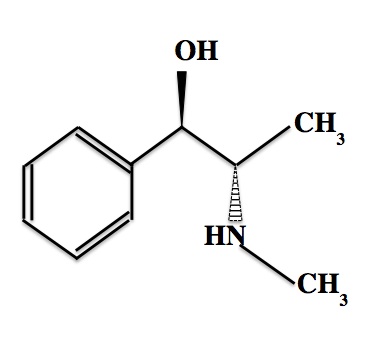
The degree of unsaturation for ephedrine (shown below) is .
Tap to reveal answer
The degree of unsaturation is equal to the number of rings plus the number of pi bonds in a molecule. Ephedrine has one ring and three pi bonds, so its degree of unsaturation is four.
To arrive at this answer, one could also use the formula below, where  is the number of carbon atoms,
  is the number of hydrogen atoms,
  is the number of halogen atoms, and
  is the number of nitrogen atoms.

For ephedrine,  ,
,  ,
,  , and
, and  .
.

The degree of unsaturation is equal to the number of rings plus the number of pi bonds in a molecule. Ephedrine has one ring and three pi bonds, so its degree of unsaturation is four.
To arrive at this answer, one could also use the formula below, where
For ephedrine,
← Didn't Know|Knew It →
Which of the following molecules are aromatic?

Which of the following molecules are aromatic?
Tap to reveal answer
Aromaticity, a special type of energetic stabilization, occurs when the following criteria are met in a molecule:
-
The region in question is cyclic.
-
The region is planar, i.e., sp2 hybridization of all non-hydrogen atoms; molecule must be flat.
-
The total number of pi electrons in the system satisfies Hückel's rule, 4n +2.
Note: Hückel's rule confuses many students as they try to look for an "n" value to plug in. However, "n" simply represents any integer, such that n= 0, 1, 2, or 3 generate a total number of pi electrons of 2, 6, 10, or 14. To help, you could remember that benzene, the quintessential aromatic compound, has 6 pi electrons. Thus, you can add or subtract 4 from 6 to get a valid total number of pi electrons for an aromatic compound.
In the above question, I, indole, is an aromatic molecule as it is totally planar and features 10 total pi electrons. The trick in recognizing this molecule as an aromatic compound is remembering that the nitrogen atom, which would typically be assigned an sp3 hybridization, may rehybridize to sp2. This ensures a planar conformation and shifts its lone pair of electrons into a p orbital to contribute to the total pi electron count. This rehybridization is energetically favorable due to the energy gains associated with aromaticity.
II, furan, is aromatic by the same logic as I. The oxygen rehybridizes to offer up its p lone pair to a total count of 6 pi electrons.
III is not aromatic as it features a sp3 hybridized carbon.
Aromaticity, a special type of energetic stabilization, occurs when the following criteria are met in a molecule:
-
The region in question is cyclic.
-
The region is planar, i.e., sp2 hybridization of all non-hydrogen atoms; molecule must be flat.
-
The total number of pi electrons in the system satisfies Hückel's rule, 4n +2.
Note: Hückel's rule confuses many students as they try to look for an "n" value to plug in. However, "n" simply represents any integer, such that n= 0, 1, 2, or 3 generate a total number of pi electrons of 2, 6, 10, or 14. To help, you could remember that benzene, the quintessential aromatic compound, has 6 pi electrons. Thus, you can add or subtract 4 from 6 to get a valid total number of pi electrons for an aromatic compound.
In the above question, I, indole, is an aromatic molecule as it is totally planar and features 10 total pi electrons. The trick in recognizing this molecule as an aromatic compound is remembering that the nitrogen atom, which would typically be assigned an sp3 hybridization, may rehybridize to sp2. This ensures a planar conformation and shifts its lone pair of electrons into a p orbital to contribute to the total pi electron count. This rehybridization is energetically favorable due to the energy gains associated with aromaticity.
II, furan, is aromatic by the same logic as I. The oxygen rehybridizes to offer up its p lone pair to a total count of 6 pi electrons.
III is not aromatic as it features a sp3 hybridized carbon.
← Didn't Know|Knew It →
How many degrees of unsaturation do all molecules with the molecular formula  have?
have?
How many degrees of unsaturation do all molecules with the molecular formula
Tap to reveal answer
To determine degrees of unsaturation, first draw the carbon skeleton based on the given molecular formula and determine the number of hydrogens necessary to fully saturate the compound:

Then add in hetero atoms anywhere on the chain and account for additional hydrogens:

Finally, subtract the number of hydrogens given in the molecular formula from the number present in the fully saturated compound (including heteroatoms) and divide by two:

A compound with 2 degrees of unsaturation may have any of the following characteristics: a ring and a double bond, two rings, two double bonds, or one triple bond. Relative to the corresponding alkane, rings and double bonds eliminate two hydrogens (1 degree of unsaturation each) and triple bonds remove four hydrogens (2 degrees of unsaturation). One possible structure for the given molecular formula, containing a ring and a double bond, is :

To determine degrees of unsaturation, first draw the carbon skeleton based on the given molecular formula and determine the number of hydrogens necessary to fully saturate the compound:
Then add in hetero atoms anywhere on the chain and account for additional hydrogens:
Finally, subtract the number of hydrogens given in the molecular formula from the number present in the fully saturated compound (including heteroatoms) and divide by two:
A compound with 2 degrees of unsaturation may have any of the following characteristics: a ring and a double bond, two rings, two double bonds, or one triple bond. Relative to the corresponding alkane, rings and double bonds eliminate two hydrogens (1 degree of unsaturation each) and triple bonds remove four hydrogens (2 degrees of unsaturation). One possible structure for the given molecular formula, containing a ring and a double bond, is :
← Didn't Know|Knew It →
What substituent in the X-position would result in the product?

What substituent in the X-position would result in the product?
Tap to reveal answer
The inductive effect of the  group stabilized the carbocation further away from the electron withdrawing group, causing the addition of the
  to occur there.
The inductive effect of the
← Didn't Know|Knew It →
Which of the given compounds has the highest boiling point?
Which of the given compounds has the highest boiling point?
Tap to reveal answer
Boiling point is affected by intermolecular forces, or the attractions between molecules. Molecules with higher intermolecular forces have higher boiling points. The type of intermolecular forces at play here depend largely on surface area of the molecule. Molecules with more surface area have greater attractive forces between them. The branched chain alkanes are more compact than the straight chain ones, so the straight chain alkane has the highest surface area. This means it has the greatest intermolecular forces, and thus the highest boiling point.
Note that increasing the length of the hydrocarbon chain and reducing branching will both raise the boiling point, while shortening the chain or increasing branching will lower the boiling point.
Boiling point is affected by intermolecular forces, or the attractions between molecules. Molecules with higher intermolecular forces have higher boiling points. The type of intermolecular forces at play here depend largely on surface area of the molecule. Molecules with more surface area have greater attractive forces between them. The branched chain alkanes are more compact than the straight chain ones, so the straight chain alkane has the highest surface area. This means it has the greatest intermolecular forces, and thus the highest boiling point.
Note that increasing the length of the hydrocarbon chain and reducing branching will both raise the boiling point, while shortening the chain or increasing branching will lower the boiling point.
← Didn't Know|Knew It →