
Colligative Properties - MCAT Chemical and Physical Foundations of Biological Systems
Card 1 of 252
What is the freezing point of a 3m solution of K2SO4 in water? (kf = 1.9oC/mol)
What is the freezing point of a 3m solution of K2SO4 in water? (kf = 1.9oC/mol)
Tap to reveal answer
Freezing point depression is given by the equation  .
.
i is the Vant Hoff Factor that tells us how many particles (often ions) a solid produces when dissolved in solution. m is the molality of the solution. kf is the freezing point constant.
The question gives us m as 3mol, kf as 1.9, and i is found to be 3 (2K+ and SO42- ). Whe then plug the values into the equation.

Freezing point depression is given by the equation
i is the Vant Hoff Factor that tells us how many particles (often ions) a solid produces when dissolved in solution. m is the molality of the solution. kf is the freezing point constant.
The question gives us m as 3mol, kf as 1.9, and i is found to be 3 (2K+ and SO42- ). Whe then plug the values into the equation.
← Didn't Know|Knew It →
The city of New York is developing a new salt substitute to distribute on the streets during icy weather. Which solution would be the most useful for this purpose?
The city of New York is developing a new salt substitute to distribute on the streets during icy weather. Which solution would be the most useful for this purpose?
Tap to reveal answer
The key to understanding this problem is realizing that it is asking about freezing point depression, or colligative properties. The main factor that concerns freezing point depression is the number of particles in solution, rather than other features, such as size or weight. The more solute dissolved, the greater the freezing point depression will be, meaning that a colder temperature will be needed for a solution to freeze.
In our answer choices we are looking for the solute that is dissociate into the greatest number of ions, or has the highest van't Hoff factor. Magnesium chloride and calcium bromide both generate three moles of ions per mole of solute. The answer choice with magnesium chloride is more concentrated, however, making this the correct option.
The key to understanding this problem is realizing that it is asking about freezing point depression, or colligative properties. The main factor that concerns freezing point depression is the number of particles in solution, rather than other features, such as size or weight. The more solute dissolved, the greater the freezing point depression will be, meaning that a colder temperature will be needed for a solution to freeze.
In our answer choices we are looking for the solute that is dissociate into the greatest number of ions, or has the highest van't Hoff factor. Magnesium chloride and calcium bromide both generate three moles of ions per mole of solute. The answer choice with magnesium chloride is more concentrated, however, making this the correct option.
← Didn't Know|Knew It →
Five solutions are made, each comprised of 1L of water and 1mol of C6H12O6, NaCl, H2SO4, Al(NO3)3, or CaCl2.
Which solution will show the smallest amount of freezing point depression?
Five solutions are made, each comprised of 1L of water and 1mol of C6H12O6, NaCl, H2SO4, Al(NO3)3, or CaCl2.
Which solution will show the smallest amount of freezing point depression?
Tap to reveal answer
Freezing point depression is a colligative property, meaning that it depends on the amount of particles present in solution. The more ions that a solute dissociates into, the larger the magnitude of freezing point depression. Here, we're looking for the smallest amount of depression, so we want to find the solute that dissociates into the fewest particles. The answer is glucose, which is not ionic and does not dissociate at all in solution.
Freezing point depression is a colligative property, meaning that it depends on the amount of particles present in solution. The more ions that a solute dissociates into, the larger the magnitude of freezing point depression. Here, we're looking for the smallest amount of depression, so we want to find the solute that dissociates into the fewest particles. The answer is glucose, which is not ionic and does not dissociate at all in solution.
← Didn't Know|Knew It →
Phase diagrams are used to depict changes in the properties of a solution at different temperatures and pressures. Below is a phase diagram of a polar solution.
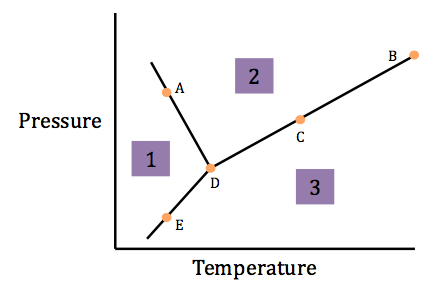
If a polar molecule were added to the solution, how would the slope of segment AD change?
Phase diagrams are used to depict changes in the properties of a solution at different temperatures and pressures. Below is a phase diagram of a polar solution.
If a polar molecule were added to the solution, how would the slope of segment AD change?
Tap to reveal answer
This question asks us to consider what would happen to the freezing point (also known as the melting point) of the solution if a polar molecule were added, for exampl adding NaCl to water. More directly, this question is a freezing point elevation/depression problem. After we determine what would happen to the freezing point of the solution, we can predict the change in the slope of the line.
The formula for freezing point depression is given below.

kf is the cryoscopic constant that says how easily a solution freezes with a given change in temperature, m is the molality of the solution, and i is the Vant Hoff factor. (The Vant Hoff factor is the number of ion particles per individual molecule that has been added; i.e. for NaCl this is 2 because it will separate into exactly two ionic particles when dissociated).
Given that kf and b will be constants for a given solution, we know that adding a molecule will decrease the freezing point because i has some positive value. Now that we know the freezing point is depressed (lowered), how will the slope of the line change?
At the same pressure, a lower temperature will be required for the solution with the added polar molecule to freeze, thus the slope will be less negative (segment AD will look more flat on the graph).
Why does the added molecule have to be polar to have an effect? First, notice that we are told that the phase diagram is of a polar solution. Next, let’s look at the i factor. i only has a value if the added molecules can be dissolved in the original solution. If, for example, we added a nonpolar molecule, it could not be dissolved by the solution and will not contribute to depressing the freezing point. “Like-dissolves-like” also applies here; the freezing point will only change if the solution and molecule added are both polar or both nonpolar.
This question asks us to consider what would happen to the freezing point (also known as the melting point) of the solution if a polar molecule were added, for exampl adding NaCl to water. More directly, this question is a freezing point elevation/depression problem. After we determine what would happen to the freezing point of the solution, we can predict the change in the slope of the line.
The formula for freezing point depression is given below.
kf is the cryoscopic constant that says how easily a solution freezes with a given change in temperature, m is the molality of the solution, and i is the Vant Hoff factor. (The Vant Hoff factor is the number of ion particles per individual molecule that has been added; i.e. for NaCl this is 2 because it will separate into exactly two ionic particles when dissociated).
Given that kf and b will be constants for a given solution, we know that adding a molecule will decrease the freezing point because i has some positive value. Now that we know the freezing point is depressed (lowered), how will the slope of the line change?
At the same pressure, a lower temperature will be required for the solution with the added polar molecule to freeze, thus the slope will be less negative (segment AD will look more flat on the graph).
Why does the added molecule have to be polar to have an effect? First, notice that we are told that the phase diagram is of a polar solution. Next, let’s look at the i factor. i only has a value if the added molecules can be dissolved in the original solution. If, for example, we added a nonpolar molecule, it could not be dissolved by the solution and will not contribute to depressing the freezing point. “Like-dissolves-like” also applies here; the freezing point will only change if the solution and molecule added are both polar or both nonpolar.
← Didn't Know|Knew It →
What is the freezing point of a  aqueous solution of
  ?
?

What is the freezing point of a
Tap to reveal answer
Freezing-point depression is a colligative property and is calculated with the formula:

The van't Hoff factor,  , represents the number of particles a compound will dissociate into when dissolving in a solution.
  is the freezing-point depression constant, which is given in the question.
  is molality.
Using the equation, we can calculate the freezing point depression using the values from the question.


The standard freezing point of water is  . With the freezing point depression, the solution will freeze at
Freezing-point depression is a colligative property and is calculated with the formula:
The van't Hoff factor,
Using the equation, we can calculate the freezing point depression using the values from the question.
The standard freezing point of water is
← Didn't Know|Knew It →
What is the freezing point of a  aqueous solution of
  ?
?

What is the freezing point of a
Tap to reveal answer
Freezing-point depression is a colligative property and is calculated with the formula:

The van't Hoff factor,  , represents the number of particles a compound will dissociate into when dissolving in a solution.
  is the freezing-point depression constant, which is given in the question.
  is molality.
Using the equation, we can calculate the freezing point depression using the values from the question.


The standard freezing point of water is  . With the freezing point depression, the solution will freeze at
  .
.
Freezing-point depression is a colligative property and is calculated with the formula:
The van't Hoff factor,
Using the equation, we can calculate the freezing point depression using the values from the question.
The standard freezing point of water is
← Didn't Know|Knew It →
The values for normal boiling and freezing points, along with  and
and  values are given below for select solvents.

What is the freezing point of a  solution of glucose in benzene?
The values for normal boiling and freezing points, along with
What is the freezing point of a
Tap to reveal answer
First, calculate the freezing point depression with the equation:

The van't Hoff factor for glucose is 1, since it does not dissociate in solution. The freezing point depression constant is given in the table.


Next, subtract this value from the freezing point of pure benzene to find the freezing point of the final solution.

First, calculate the freezing point depression with the equation:
The van't Hoff factor for glucose is 1, since it does not dissociate in solution. The freezing point depression constant is given in the table.
Next, subtract this value from the freezing point of pure benzene to find the freezing point of the final solution.
← Didn't Know|Knew It →
The values for normal boiling and freezing points, along with  and
and  values are given below for select solvents.

Which of the following will result in the least freezing point depression when added to  of water?
The values for normal boiling and freezing points, along with
Which of the following will result in the least freezing point depression when added to
Tap to reveal answer
We are looking for the least amount of freezing point depression. Freezing point depression is calculated using the equation:

Each of these solutions has a different molality, which needs to be calculated. Molality is equal to moles of solute per kilogram solvent. To find this value, convert grams to moles (using molar mass) and divide by the mass of the solvent.


Next, find the van't Hoff factor for each compound.


Finally, use the initial equation to find the smallest freezing point depression (we are looking for the solution with the highest freezing point).


After calculating the change in freezing point for each solution, we find that the barium hydroxide solution has the smallest depression.
We are looking for the least amount of freezing point depression. Freezing point depression is calculated using the equation:
Each of these solutions has a different molality, which needs to be calculated. Molality is equal to moles of solute per kilogram solvent. To find this value, convert grams to moles (using molar mass) and divide by the mass of the solvent.
Next, find the van't Hoff factor for each compound.
Finally, use the initial equation to find the smallest freezing point depression (we are looking for the solution with the highest freezing point).
After calculating the change in freezing point for each solution, we find that the barium hydroxide solution has the smallest depression.
← Didn't Know|Knew It →
A 2-liter aqueous solution of glucose has a freezing point of  .
.


Given the solution's freezing point, how many moles of glucose were added to the water?
A 2-liter aqueous solution of glucose has a freezing point of
Given the solution's freezing point, how many moles of glucose were added to the water?
Tap to reveal answer
Since we know that the freezing point of the water has changed by 3.5 degrees, we can solve for how many moles of glucose were added using the freezing point depression equation:

Since glucose does not ionize in solution, the vant Hoff factor is equal to 1. Keep in mind that we must use molality for the concentration.


Since we know that the freezing point of the water has changed by 3.5 degrees, we can solve for how many moles of glucose were added using the freezing point depression equation:
Since glucose does not ionize in solution, the vant Hoff factor is equal to 1. Keep in mind that we must use molality for the concentration.
← Didn't Know|Knew It →
Colligative properties are properties of compounds that are altered by the amount of substance present. There are four main colligative properties: boiling point, freezing point, vapor pressure, and osmotic pressure. The change in each of these properties can be calculated using the amount of molecules/ions present in solution and the concentration or partial pressure of the compound. The boiling point is defined as the temperature at which the vapor pressure equals the atmospheric pressure. The freezing point is the temperature at which a liquid is converted to a solid. Vapor pressure is the pressure produced by the vapor above a solution. Osmotic pressure is the pressure required to prevent flow of water into a solution (across a membrane).
The freezing point of a solution and the boiling point of the solution after the addition of  .
.
Colligative properties are properties of compounds that are altered by the amount of substance present. There are four main colligative properties: boiling point, freezing point, vapor pressure, and osmotic pressure. The change in each of these properties can be calculated using the amount of molecules/ions present in solution and the concentration or partial pressure of the compound. The boiling point is defined as the temperature at which the vapor pressure equals the atmospheric pressure. The freezing point is the temperature at which a liquid is converted to a solid. Vapor pressure is the pressure produced by the vapor above a solution. Osmotic pressure is the pressure required to prevent flow of water into a solution (across a membrane).
The freezing point of a solution and the boiling point of the solution after the addition of
Tap to reveal answer
Freezing point and boiling point are both colligative properties that are altered by the addition of solutes. Addition of solutes decreases freezing point whereas addition of solutes increases boiling point. These phenomena are called freezing point depression and boiling point elevation, respectively.
The other two colligative properties are vapor pressure and osmotic pressure. Vapor pressure decreases and osmotic pressure increases after addition of solutes.
Freezing point and boiling point are both colligative properties that are altered by the addition of solutes. Addition of solutes decreases freezing point whereas addition of solutes increases boiling point. These phenomena are called freezing point depression and boiling point elevation, respectively.
The other two colligative properties are vapor pressure and osmotic pressure. Vapor pressure decreases and osmotic pressure increases after addition of solutes.
← Didn't Know|Knew It →
Colligative properties are properties of compounds that are altered by the amount of substance present. There are four main colligative properties: boiling point, freezing point, vapor pressure, and osmotic pressure. The change in each of these properties can be calculated using the amount of molecules/ions present in solution and the concentration or partial pressure of the compound. The boiling point is defined as the temperature at which the vapor pressure equals the atmospheric pressure. The freezing point is the temperature at which a liquid is converted to a solid. Vapor pressure is the pressure produced by the vapor above a solution. Osmotic pressure is the pressure required to prevent flow of water into a solution (across a membrane).
Consider the following two solutions:
Solution A: 
Solution B: 
Which of the following is true regarding these two solutions?
Colligative properties are properties of compounds that are altered by the amount of substance present. There are four main colligative properties: boiling point, freezing point, vapor pressure, and osmotic pressure. The change in each of these properties can be calculated using the amount of molecules/ions present in solution and the concentration or partial pressure of the compound. The boiling point is defined as the temperature at which the vapor pressure equals the atmospheric pressure. The freezing point is the temperature at which a liquid is converted to a solid. Vapor pressure is the pressure produced by the vapor above a solution. Osmotic pressure is the pressure required to prevent flow of water into a solution (across a membrane).
Consider the following two solutions:
Solution A:
Solution B:
Which of the following is true regarding these two solutions?
Tap to reveal answer
The freezing point depression can be calculated by the following equation.

where  is change in boiling point,
  is the freezing point depression constant,
  is the number of ions, and
  is the molality. Solution B will produce three ions whereas solution A will produce two ions in solution; therefore, if the concentration were the same, solution B will have a lower freezing point by a factor of 1.5. The concentration, however, is different. The concentration of solution B is twice as much as solution A; therefore, the freezing point of solution B will be lower by a factor of 3 (1.5 from ions and 2 from concentration); therefore, solution A will have 3 times higher freezing point.
The freezing point depression can be calculated by the following equation.
where
← Didn't Know|Knew It →
Two moles of sodium chloride (NaCl) are added to 1kg of a mystery solvent. The addition of the NaCl caused an increase of 6K to the solvent's boiling point.
Based on this information, what is the boiling constant for the solvent?
Two moles of sodium chloride (NaCl) are added to 1kg of a mystery solvent. The addition of the NaCl caused an increase of 6K to the solvent's boiling point.
Based on this information, what is the boiling constant for the solvent?
Tap to reveal answer
In order to solve this problem, we can use the boiling point elevation equation:  .
.
We know the temperature change, we can compute molality from the given information, and we know the van't Hoff factor (expected to be 2 in this scenario due to NaCl becoming 2 ions in solution). We can calculate the boiling point constant for the solvent.


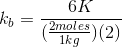

In order to solve this problem, we can use the boiling point elevation equation:
We know the temperature change, we can compute molality from the given information, and we know the van't Hoff factor (expected to be 2 in this scenario due to NaCl becoming 2 ions in solution). We can calculate the boiling point constant for the solvent.
← Didn't Know|Knew It →
Which of the following aqueous solutions will have the highest boiling point?
Which of the following aqueous solutions will have the highest boiling point?
Tap to reveal answer
In order to answer this problem, consider the equation for boiling point elevation:  .
.
 is a specific constant for the boiling substance, so it will not change between the solutions (they are all aqueous). Molality is designated as "m", and a high molality will result in a higher boiling point, however, the value we want to look at for this problem is
  , which is also known as the van't Hoff factor. The van't Hoff factor is the number of particles that a single solute will dissociate into when added to a solution. MgCl2 will dissociate into three particles: 1 Mg2+ cation and 2 Cl- anions. Since 2m of MgCl2 has the highest molality as well as the largest van't Hoff factor out of the options, it will result in the highest boiling point.
In order to answer this problem, consider the equation for boiling point elevation:
← Didn't Know|Knew It →
The equation for boiling point elevation is written as  .
.
The " " value in the equation is referred to as the van't Hoff factor, and is the number of particles that the solute is expected to dissociate into once in solution. In ideal solutions, ions will separate entirely, and the van't Hoff factor will be the expected value; however, nonideal solutions can have ion pairing take place, where ions do not separate entirely. As a result, the observed van't Hoff factor will be slightly less than the expected van't Hoff factor.
If a solution has ion pairing taking place, which statement is true?
The equation for boiling point elevation is written as
The "
If a solution has ion pairing taking place, which statement is true?
Tap to reveal answer
If there is ion pairing taking place in a solution, the van't Hoff factor will be slightly lower than predicted. As a result, the boiling point will not be as elevated as it would be if all of the ions were separated from each other. This conclusion can be draw from the given equation,  . The number of particles in the solution does not affect the molality.
If there is ion pairing taking place in a solution, the van't Hoff factor will be slightly lower than predicted. As a result, the boiling point will not be as elevated as it would be if all of the ions were separated from each other. This conclusion can be draw from the given equation,
← Didn't Know|Knew It →
Suppose two containers each contain the same amount of solvent. 2m NaCl solution is added to the first container, and a mystery solution is added to the second container. Upon heating the flasks, it is determined that the second container has a higher boiling point than the first container. Assume the solutions are ideal.
Based on the above information, which of the following compounds could have been added to container 2?
Suppose two containers each contain the same amount of solvent. 2m NaCl solution is added to the first container, and a mystery solution is added to the second container. Upon heating the flasks, it is determined that the second container has a higher boiling point than the first container. Assume the solutions are ideal.
Based on the above information, which of the following compounds could have been added to container 2?
Tap to reveal answer
Based on the equation  , we see that there are two factors that differ between the containers and can affect the elevation of the boiling point: molality and the van't Hoff factor (
 ).
).
The sodium choride added to container 1 has a molality of 2, as well as a van't Hoff factor of 2. As a result, we are looking for a compound that has a larger combination of these two factors, which would cause a higher boiling point. 2m CaF2 has a molality of 2 and a van't Hoff factor of 3. Since this combination of factors in container 2 would be higher than the combination in container 1, we can conclude that this was the mystery compound added to the container with the higher boiling point.
Note that C6H12O6 is the formula for glucose, and will not ionize in solution.
Based on the equation
The sodium choride added to container 1 has a molality of 2, as well as a van't Hoff factor of 2. As a result, we are looking for a compound that has a larger combination of these two factors, which would cause a higher boiling point. 2m CaF2 has a molality of 2 and a van't Hoff factor of 3. Since this combination of factors in container 2 would be higher than the combination in container 1, we can conclude that this was the mystery compound added to the container with the higher boiling point.
Note that C6H12O6 is the formula for glucose, and will not ionize in solution.
← Didn't Know|Knew It →
Boiling point is the temperature a liquid needs to achieve in order to begin its transformation into a gaseous state. Campers and hikers who prepare food during their trips have to account for differences in atmospheric pressure as they ascend in elevation. During the ascent, the decrease in atmospheric pressure changes the temperature at which water boils.
Further complicating the matter is the observation that addition of a solute to a pure liquid also changes the boiling point. Raoult’s Law can be used to understand the changes in boiling point if a non-volatile solute is present, as expressed here.

In this law,  is the mole fraction of the solvent,
  is the vapor pressure of the pure solvent, and
  is the vapor pressure of the solution. When this vapor pressure is equal to the local atmospheric pressure, the solution boils.
The change in boiling point with addition of a solute is a colligative property of a solution. Which of the following are also examples of colligative properties?
I. Vapor pressure reduction
II. Color emission with dissolution of a solute
III. Osmotic pressure
Boiling point is the temperature a liquid needs to achieve in order to begin its transformation into a gaseous state. Campers and hikers who prepare food during their trips have to account for differences in atmospheric pressure as they ascend in elevation. During the ascent, the decrease in atmospheric pressure changes the temperature at which water boils.
Further complicating the matter is the observation that addition of a solute to a pure liquid also changes the boiling point. Raoult’s Law can be used to understand the changes in boiling point if a non-volatile solute is present, as expressed here.
In this law,
The change in boiling point with addition of a solute is a colligative property of a solution. Which of the following are also examples of colligative properties?
I. Vapor pressure reduction
II. Color emission with dissolution of a solute
III. Osmotic pressure
Tap to reveal answer
Colligative properties are defined as properties that depend entirely upon the ratio of the number of solute particles to the number of solvent particles. Only osmotic pressure and vapor pressure depression are examples of such phenomena. While color emission is a property of a solution, it depends on the chemical species involved, and not the number of particles.
Colligative properties are defined as properties that depend entirely upon the ratio of the number of solute particles to the number of solvent particles. Only osmotic pressure and vapor pressure depression are examples of such phenomena. While color emission is a property of a solution, it depends on the chemical species involved, and not the number of particles.
← Didn't Know|Knew It →
Boiling point is the temperature a liquid needs to achieve in order to begin its transformation into a gaseous state. Campers and hikers who prepare food during their trips have to account for differences in atmospheric pressure as they ascend in elevation. During the ascent, the decrease in atmospheric pressure changes the temperature at which water boils.
Further complicating the matter is the observation that addition of a solute to a pure liquid also changes the boiling point. Raoult’s Law can be used to understand the changes in boiling point if a non-volatile solute is present, as expressed here.

In this law,  is the mole fraction of the solvent,
  is the vapor pressure of the pure solvent, and
  is the vapor pressure of the solution. When this vapor pressure is equal to the local atmospheric pressure, the solution boils.
Two campers are preparing food at an altitude of 13,000 feet on a mountain in Colorado. Which of the following is true as they boil a pot of water?
Boiling point is the temperature a liquid needs to achieve in order to begin its transformation into a gaseous state. Campers and hikers who prepare food during their trips have to account for differences in atmospheric pressure as they ascend in elevation. During the ascent, the decrease in atmospheric pressure changes the temperature at which water boils.
Further complicating the matter is the observation that addition of a solute to a pure liquid also changes the boiling point. Raoult’s Law can be used to understand the changes in boiling point if a non-volatile solute is present, as expressed here.
In this law,
Two campers are preparing food at an altitude of 13,000 feet on a mountain in Colorado. Which of the following is true as they boil a pot of water?
Tap to reveal answer
The local atmospheric pressure at 13,000 feet is less than the pressure at sea level; therefore, it takes less heat to make the vapor pressure meet the local atmospheric pressure. Heat added to the system easily exits again as the water is converted to steam, leaving less heat in the water to cook the food. Food cooks more slowly as a result.
The local atmospheric pressure at 13,000 feet is less than the pressure at sea level; therefore, it takes less heat to make the vapor pressure meet the local atmospheric pressure. Heat added to the system easily exits again as the water is converted to steam, leaving less heat in the water to cook the food. Food cooks more slowly as a result.
← Didn't Know|Knew It →
Which solution will have a higher boiling point?
Solution 1:  in
in  water
water
Solution 2:  in
in  water
water
Which solution will have a higher boiling point?
Solution 1:
Solution 2:
Tap to reveal answer
Adding solute to water will result in boiling point elevation due to the presence of more molecules. Change in temperature is given by the relation  , where
  is a constant for the solvent,
  is the solution molality, and
  is the van't Hoff factor. In this example, the molalities are equal.
Since  dissociates into
  and
and  ,
,  , representing the two ions derived from each molecule. For glucose
  , as the molecule does not dissociate. Solution 1 will have a higher elevation in temperature due to the greater number of ions in solution.
Adding solute to water will result in boiling point elevation due to the presence of more molecules. Change in temperature is given by the relation
Since
← Didn't Know|Knew It →
Each of the following solutions is added to equal amounts of water. Which solution will result in the greatest amount of boiling point elevation?
Each of the following solutions is added to equal amounts of water. Which solution will result in the greatest amount of boiling point elevation?
Tap to reveal answer
Boiling point elevation is a colligative property, meaning that it depends on the relative number of solute particles in solution. The answer choice with the largest number of moles of particles will show the greatest boiling point elevation. The equation for boiling point elevation is:

Molality is equal to moles of solute per kilogram of solvent, meaning that it will be proportional to the moles of solute added. Each solute is added to equal amounts of water, allowing us to keep this value constant. Similarly,  will be constant for all of the solutions. Overall, boiling point elevation will be proportional to the moles of solute multiplied by the van't Hoff factor.

Using this proportion, we can find the solute that will most impact the boiling point of water.





Since sodium chloride results in the greatest moles of ions in solution, it will yield the greatest boiling point elevation.
Boiling point elevation is a colligative property, meaning that it depends on the relative number of solute particles in solution. The answer choice with the largest number of moles of particles will show the greatest boiling point elevation. The equation for boiling point elevation is:
Molality is equal to moles of solute per kilogram of solvent, meaning that it will be proportional to the moles of solute added. Each solute is added to equal amounts of water, allowing us to keep this value constant. Similarly,
Using this proportion, we can find the solute that will most impact the boiling point of water.
Since sodium chloride results in the greatest moles of ions in solution, it will yield the greatest boiling point elevation.
← Didn't Know|Knew It →
Which of the following compounds will create the greatest increase in boiling point when added to an aqueous solution?
Which of the following compounds will create the greatest increase in boiling point when added to an aqueous solution?
Tap to reveal answer
Colligative properties are dependent only on the number of particles in a solution, and not their identity. Some examples of colligative properties are vapor pressure, boiling point, freezing point, and osmotic pressure.
There is a direct relationship between the boiling point elevation and the number of particles present in a solution. The more particles that are present in solution, the higher the boiling point elevation.
We are looking for the compound that will create the greatest number of ions when dissolved in solution.
Sodium chloride and magnesium sulfate will produce two ions per mole. 
Magnesium chloride and barium chloride will produce three ions per mole. 
Calcium hydroxide will also produce three ions per mole, but we are given two moles instead of one. 
Calcium hydroxide will produce the greatest number of ions, thus creating the greatest increase in boiling point elevation.
Colligative properties are dependent only on the number of particles in a solution, and not their identity. Some examples of colligative properties are vapor pressure, boiling point, freezing point, and osmotic pressure.
There is a direct relationship between the boiling point elevation and the number of particles present in a solution. The more particles that are present in solution, the higher the boiling point elevation.
We are looking for the compound that will create the greatest number of ions when dissolved in solution.
Sodium chloride and magnesium sulfate will produce two ions per mole.
Magnesium chloride and barium chloride will produce three ions per mole.
Calcium hydroxide will also produce three ions per mole, but we are given two moles instead of one.
Calcium hydroxide will produce the greatest number of ions, thus creating the greatest increase in boiling point elevation.
← Didn't Know|Knew It →