
Physics - MCAT Chemical and Physical Foundations of Biological Systems
Card 1 of 3927
A pendulum with a mass of 405kg reaches a maximum height of 2.4m. What is its velocity at the bottommost point in its path?
A pendulum with a mass of 405kg reaches a maximum height of 2.4m. What is its velocity at the bottommost point in its path?
Tap to reveal answer
First solve for the potential energy of the pendulum at the height of 2.4m.
PE = mgh
PE = (405kg)(10m/s2)(2.4m) = 9720J
This must be equal to the maximum kinetic energy of the object.
KE = ½mv2
9720J = ½mv2
Plug in the mass of the object (405 kg) and solve for v.
9720J = ½(405kg)v2
v = 6.9m/s
First solve for the potential energy of the pendulum at the height of 2.4m.
PE = mgh
PE = (405kg)(10m/s2)(2.4m) = 9720J
This must be equal to the maximum kinetic energy of the object.
KE = ½mv2
9720J = ½mv2
Plug in the mass of the object (405 kg) and solve for v.
9720J = ½(405kg)v2
v = 6.9m/s
← Didn't Know|Knew It →
An empty mining cart has a mass of  and is traveling down a track that has a slope of
  to the horizontal. The cart is traveling at a rate of
  when an operator notices a disturbance on the track ahead and locks the wheels of the cart. What is the speed of the cart after it has traveled
  with the wheels locked?


An empty mining cart has a mass of
Tap to reveal answer
We need the equation for conservation of energy for this problem:

We can eliminate final potential energy if we set the final height to be zer. We are solving for final velocity, so let's rearrange for final kinetic energy.

Substituting our equations for each variable, we get:

Rearranging for final velocity we get:
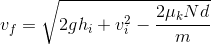
If you derive this formula and are unsure of your work, simply check your units. Each term under the square root has units of  , which will ultimately give us units of
  , which is what we want.
We have values for all variables except two: height and normal force.
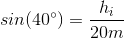
Let's calculate the height. We know that the between the initial and final states, the cart has traveled 20 meters down a slope of 40 degrees. Therefore, we can calculate height with the formula:


Now we just need to find the normal force. The following diagram will help visualize this calculation.
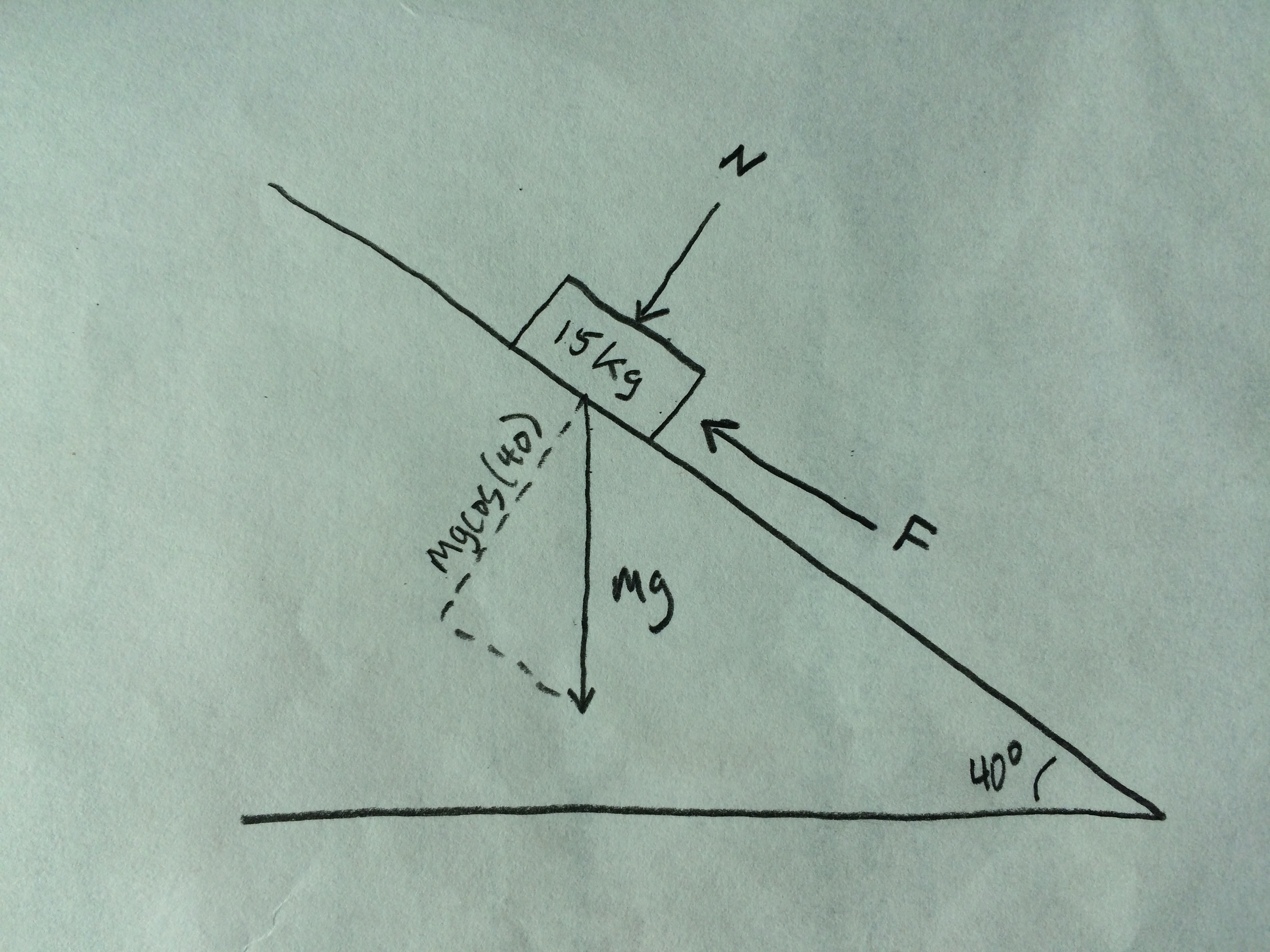
If you are unsure whether to use sine or cosine, think about it practically. As the angle gets less and less, the normal force is going to get larger. This is characteristic of a cosine function.
Therefore, we can say that:

Now that we have all of our variables, it's time to plug and chug:


We need the equation for conservation of energy for this problem:
We can eliminate final potential energy if we set the final height to be zer. We are solving for final velocity, so let's rearrange for final kinetic energy.
Substituting our equations for each variable, we get:
Rearranging for final velocity we get:
If you derive this formula and are unsure of your work, simply check your units. Each term under the square root has units of
We have values for all variables except two: height and normal force.
Let's calculate the height. We know that the between the initial and final states, the cart has traveled 20 meters down a slope of 40 degrees. Therefore, we can calculate height with the formula:
Now we just need to find the normal force. The following diagram will help visualize this calculation.
If you are unsure whether to use sine or cosine, think about it practically. As the angle gets less and less, the normal force is going to get larger. This is characteristic of a cosine function.
Therefore, we can say that:
Now that we have all of our variables, it's time to plug and chug:
← Didn't Know|Knew It →
Two students (student X and student Y) lift a boulder vertically from point A to point B. Student X directly lifts the boulder from point A to point B, whereas student Y uses a pulley to lift the boulder. This allows student Y to apply a force ( ) that is three times smaller than the force applied by student X (
 ). Both students apply force upwards and take the same amount of time to complete this task.
The vertical distance between point A and point B is  .
.
Student Z uses a frictionless inclined plane to lift the boulder and has to apply only a third of  . Which of the following is true regarding the inclined plane and the pulley (used by Student Y)?
Two students (student X and student Y) lift a boulder vertically from point A to point B. Student X directly lifts the boulder from point A to point B, whereas student Y uses a pulley to lift the boulder. This allows student Y to apply a force (
The vertical distance between point A and point B is
Student Z uses a frictionless inclined plane to lift the boulder and has to apply only a third of
Tap to reveal answer
The question states that:

Recall that the passage states that  is also one third of
  .
.

The force exerted by student Y and student Z is the same.

Mechanical advantage is defined as:

The weight of the object is the same for both students because both of them are lifting the same boulder. The force applied is also the same; therefore, mechanical advantage for both machines is the same.
The question states that:
Recall that the passage states that
The force exerted by student Y and student Z is the same.
Mechanical advantage is defined as:
The weight of the object is the same for both students because both of them are lifting the same boulder. The force applied is also the same; therefore, mechanical advantage for both machines is the same.
← Didn't Know|Knew It →
Regarding the following sets of conditions, which answer option gives the correct listing of systemic pressures from greatest to least?




Regarding the following sets of conditions, which answer option gives the correct listing of systemic pressures from greatest to least?
Tap to reveal answer
This question asks for you to look at a set of conditions for gases, and determine relative pressures. The best equation to use for quick calculation and relation is the ideal gas law, given by:

Rearranging this, and removing the constant (since it will not affect relative pressure), we can generate a proportionality of pressure to the other variables.

We can use this proportionality with each option to determine their rankings by pressure.
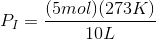



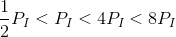

This question asks for you to look at a set of conditions for gases, and determine relative pressures. The best equation to use for quick calculation and relation is the ideal gas law, given by:
Rearranging this, and removing the constant (since it will not affect relative pressure), we can generate a proportionality of pressure to the other variables.
We can use this proportionality with each option to determine their rankings by pressure.
← Didn't Know|Knew It →
A sealed container holds three moles of gas at 1atm and 200K. Its pressure is to 2atm. What will be the resulting temperature in the container?
A sealed container holds three moles of gas at 1atm and 200K. Its pressure is to 2atm. What will be the resulting temperature in the container?
Tap to reveal answer
In the problem, the volume and the number of moles are constant and the temperature and pressure are the only two variables that are changing. Using the ideal gas law we can find that temperature and pressure are directly proportional. When pressure increases by a factor of two, temperature will also increase by a factor of two.
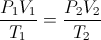
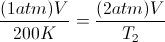

In the problem, the volume and the number of moles are constant and the temperature and pressure are the only two variables that are changing. Using the ideal gas law we can find that temperature and pressure are directly proportional. When pressure increases by a factor of two, temperature will also increase by a factor of two.
← Didn't Know|Knew It →
If one mole of oxygen gas occupies a 5L container at 300K, what is the pressure in the container?
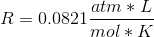
If one mole of oxygen gas occupies a 5L container at 300K, what is the pressure in the container?
Tap to reveal answer
Using the ideal gas law,  , we can solve for pressure.


Using the ideal gas law,
← Didn't Know|Knew It →
Which of the following forces is not conservative?
Which of the following forces is not conservative?
Tap to reveal answer
Conservative forces are forces that do not lose energy to heat, sound, or light. Of these answers, energy is completely conserved and transferred from kinetic energy to potential energy, or vice versa. Gravitational forces, electrostatic forces, and elastic forces all work by providing a potential that will work in the same direction as the motion of an object or particle, allowing kinetic and potential energy to interconvert. Frictional forces lose energy as heat when sliding across a surface, and the more force (the more rough the surface), the more energy that is lost.
Conservative forces are forces that do not lose energy to heat, sound, or light. Of these answers, energy is completely conserved and transferred from kinetic energy to potential energy, or vice versa. Gravitational forces, electrostatic forces, and elastic forces all work by providing a potential that will work in the same direction as the motion of an object or particle, allowing kinetic and potential energy to interconvert. Frictional forces lose energy as heat when sliding across a surface, and the more force (the more rough the surface), the more energy that is lost.
← Didn't Know|Knew It →
Which of the following is not a conservative force?
Which of the following is not a conservative force?
Tap to reveal answer
Friction is a non-conservative force, meaning that the work it does depends on the path taken by the object. For example, moving a brick in a long zig-zag across the table will generate more heat from friction than moving it in a straight line across the table.
Electric and gravitational forces are conservative. This can be tested by knowing a constant equation to calculate the energy associated with these forces; such equations are applicable regardless of path. No such equation exists for frictional energy.
Friction is a non-conservative force, meaning that the work it does depends on the path taken by the object. For example, moving a brick in a long zig-zag across the table will generate more heat from friction than moving it in a straight line across the table.
Electric and gravitational forces are conservative. This can be tested by knowing a constant equation to calculate the energy associated with these forces; such equations are applicable regardless of path. No such equation exists for frictional energy.
← Didn't Know|Knew It →
Two students (student X and student Y) lift a boulder vertically from point A to point B. Student X directly lifts the boulder from point A to point B, whereas student Y uses a pulley to lift the boulder. This allows student Y to apply a force () that is three times smaller than the force applied by student X (). Both students apply force upwards and take the same amount of time to complete this task.
The vertical distance between point A and point B is .
If the pulley has a mechanical advantage of  and
and  , what is the weight of the boulder?
Two students (student X and student Y) lift a boulder vertically from point A to point B. Student X directly lifts the boulder from point A to point B, whereas student Y uses a pulley to lift the boulder. This allows student Y to apply a force (
The vertical distance between point A and point B is
If the pulley has a mechanical advantage of
Tap to reveal answer
The definition of mechanical advantage is:
Rearranging this equation and solving for weight gives:


Mechanical advantage is a unitless quantity. Remember the difference between weight and mass. Weight is a measure of force and has units of Newtons, whereas mass has units of kilograms.
The definition of mechanical advantage is:
Rearranging this equation and solving for weight gives:
Mechanical advantage is a unitless quantity. Remember the difference between weight and mass. Weight is a measure of force and has units of Newtons, whereas mass has units of kilograms.
← Didn't Know|Knew It →
A 2kg lead ball is loaded into a spring cannon and the cannon is set at a 45º angle on a platform. The spring has a spring constant of 100N/m and the ball and spring system is compressed by 1m before launch. While the ball is in flight air resistance can be neglected, and the ball finishes its flight by landing at a cushion placed some distance away from the cannon.
Find the horizontal component of velocity once the ball has left the cannon.
A 2kg lead ball is loaded into a spring cannon and the cannon is set at a 45º angle on a platform. The spring has a spring constant of 100N/m and the ball and spring system is compressed by 1m before launch. While the ball is in flight air resistance can be neglected, and the ball finishes its flight by landing at a cushion placed some distance away from the cannon.
Find the horizontal component of velocity once the ball has left the cannon.
Tap to reveal answer
This asks us to understand the vector components of velocity. Remember that the final velocity is the hypotenuse of a triangle (solved to be 10m/s in the previous problem), and that by knowing the hypotenuse value we can solve for the horizontal component by using cosine.
vx = (10m/s)(cos(45o)) = 7.1m/s
This asks us to understand the vector components of velocity. Remember that the final velocity is the hypotenuse of a triangle (solved to be 10m/s in the previous problem), and that by knowing the hypotenuse value we can solve for the horizontal component by using cosine.
vx = (10m/s)(cos(45o)) = 7.1m/s
← Didn't Know|Knew It →
A 2kg lead ball is loaded into a spring cannon and the cannon is set at a 45º angle on a platform. The spring has a spring constant of 100N/m and the ball and spring system is compressed by 1m before launch. While the ball is in flight air resistance can be neglected, and the ball finishes its flight by landing at a cushion placed some distance away from the cannon.
What is the initial vertical component of velocity of the ball?
A 2kg lead ball is loaded into a spring cannon and the cannon is set at a 45º angle on a platform. The spring has a spring constant of 100N/m and the ball and spring system is compressed by 1m before launch. While the ball is in flight air resistance can be neglected, and the ball finishes its flight by landing at a cushion placed some distance away from the cannon.
What is the initial vertical component of velocity of the ball?
Tap to reveal answer
This question also asks us to understand the vector components of velocity. Remember that the final velocity is the hypotenuse of a triangle, and that by knowing the hypotenuse value (solved as 10m/s in a previous problem) we can solve for the vertical component using sine.
vy = (10m/s)(sin(45o)) = 7.1m/s
This question also asks us to understand the vector components of velocity. Remember that the final velocity is the hypotenuse of a triangle, and that by knowing the hypotenuse value (solved as 10m/s in a previous problem) we can solve for the vertical component using sine.
vy = (10m/s)(sin(45o)) = 7.1m/s
← Didn't Know|Knew It →
A 2kg lead ball is loaded into a spring cannon and the cannon is set at a 45º angle on a platform. The spring has a spring constant of 100N/m and the ball and spring system is compressed by 1m before launch. While the ball is in flight air resistance can be neglected, and the ball finishes its flight by landing at a cushion placed some distance away from the cannon.
What is the horizontal acceleration of the ball during its flight?
A 2kg lead ball is loaded into a spring cannon and the cannon is set at a 45º angle on a platform. The spring has a spring constant of 100N/m and the ball and spring system is compressed by 1m before launch. While the ball is in flight air resistance can be neglected, and the ball finishes its flight by landing at a cushion placed some distance away from the cannon.
What is the horizontal acceleration of the ball during its flight?
Tap to reveal answer
Without an additional force acting in the horizontal direction during flight (we are told we can neglect air resistance), there is no acceleration. Remember that Newton's second law, F = ma, requires that a force act on an object to produce acceleration. Here, we have no additional force and thus no acceleration.
Without an additional force acting in the horizontal direction during flight (we are told we can neglect air resistance), there is no acceleration. Remember that Newton's second law, F = ma, requires that a force act on an object to produce acceleration. Here, we have no additional force and thus no acceleration.
← Didn't Know|Knew It →
A 2kg object falls from a height of 3m onto a spring, which compresses 20cm. What is the spring constant?
A 2kg object falls from a height of 3m onto a spring, which compresses 20cm. What is the spring constant?
Tap to reveal answer
Conservation of energy is the key here. Initial energy is all gravitational potential energy:

Note that the final height change is equal to the height above the spring added to the displacement of the spring.
This is equal to the final energy, which is all spring potential energy:

Set these equations equal and solve for the spring constant.
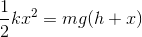
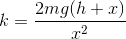


Conservation of energy is the key here. Initial energy is all gravitational potential energy:
Note that the final height change is equal to the height above the spring added to the displacement of the spring.
This is equal to the final energy, which is all spring potential energy:
Set these equations equal and solve for the spring constant.
← Didn't Know|Knew It →
Two objects with masses of M and m, sit r distance apart. What will be the effect on the gravitational force between them if the masses are changed to 2M and 3m?
- It will increase 36-fold.
- It will increase 6-fold.
- It will increase 3-fold.
- It will not change unless r is changed.
- None of the above.
Two objects with masses of M and m, sit r distance apart. What will be the effect on the gravitational force between them if the masses are changed to 2M and 3m?
- It will increase 36-fold.
- It will increase 6-fold.
- It will increase 3-fold.
- It will not change unless r is changed.
- None of the above.
Tap to reveal answer
Choice 2 is correct. The formula for gravitational force, G, is 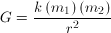 , where k is a constant. The effect of doubling one mass and trebling the other is multiplicative,
  , so the answer is six-fold. The question attempts to confuse the respondent by forcing them to recall that the element of the equation which is squared is distance between objects.
Choice 2 is correct. The formula for gravitational force, G, is
← Didn't Know|Knew It →
An object has a mass of 50kg and a weight of 500N when it is resting on the surface of the Earth. If it is moved to a height equal to three times the Earth’s radius, what is the object’s new weight?
An object has a mass of 50kg and a weight of 500N when it is resting on the surface of the Earth. If it is moved to a height equal to three times the Earth’s radius, what is the object’s new weight?
Tap to reveal answer
You should be familiar with the following equation for the force of gravity.
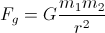
To solve this problem, recognize that weight (Fg) is proportional to the inverse square of the radius. When the object was a distance of r (Earth’s radius) it had a weight of 500N. Now, the object is at a distance of 4r (radius of Earth plus the 3r distance that the object is moved to). With the proportion described above, we can see that the force is decreased by a factor of (4)2.

You should be familiar with the following equation for the force of gravity.
To solve this problem, recognize that weight (Fg) is proportional to the inverse square of the radius. When the object was a distance of r (Earth’s radius) it had a weight of 500N. Now, the object is at a distance of 4r (radius of Earth plus the 3r distance that the object is moved to). With the proportion described above, we can see that the force is decreased by a factor of (4)2.
← Didn't Know|Knew It →
Which factors increase the maximum velocity of a pendulum?
Which factors increase the maximum velocity of a pendulum?
Tap to reveal answer
Both the length of the pendulum's string and the angle of displacement affect the maximum velocity of the pendulum. Increasing the length of the pendulum's string and increasing the angle of displacement both increase the distance the pendulum must travel in a single period, increasing its potential energy at its maximum height, and therefore the maximum velocity at its lowest point.
Both the length of the pendulum's string and the angle of displacement affect the maximum velocity of the pendulum. Increasing the length of the pendulum's string and increasing the angle of displacement both increase the distance the pendulum must travel in a single period, increasing its potential energy at its maximum height, and therefore the maximum velocity at its lowest point.
← Didn't Know|Knew It →
The moon's distance from the center of the Earth was decreased by a multiple of three. How would this affect the gravitational force of the Earth on the moon?
The moon's distance from the center of the Earth was decreased by a multiple of three. How would this affect the gravitational force of the Earth on the moon?
Tap to reveal answer
The law of gravitation is written as  , with G being equal to
 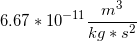 .
.
Since the radius of the two masses acting on each other is squared, and is found in the denominator, a decrease in the radius by a multiple of three will cause a nine-fold increase in the gravitational force.

The law of gravitation is written as
Since the radius of the two masses acting on each other is squared, and is found in the denominator, a decrease in the radius by a multiple of three will cause a nine-fold increase in the gravitational force.
← Didn't Know|Knew It →
Using Newton's Law of Universal Gravitation equation, which of the following expressions is equal to the local gravitational acceleration  on Earth?
Using Newton's Law of Universal Gravitation equation, which of the following expressions is equal to the local gravitational acceleration
Tap to reveal answer
On earth,  .
.
The law of universal gravitation is equal to 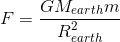 .
.
We can set these equations equal to one another and isolate  by dividing both sides by
  , the mass of an object on Earth.
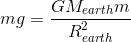

Using the mass of the Earth, the radius of the Earth, and the gravitational constant,  , we get a value of approximately
  if we solve for
  .
.
On earth,
The law of universal gravitation is equal to
We can set these equations equal to one another and isolate
Using the mass of the Earth, the radius of the Earth, and the gravitational constant,
← Didn't Know|Knew It →
Which of the following would not cause a decrease in the pressure of a gas in a sealed container?
Which of the following would not cause a decrease in the pressure of a gas in a sealed container?
Tap to reveal answer
A decrease in pressure means a decrease in gas particle collisions. The only option that would not cause a decrease in collisions is adding moles of a different gas. Even though different molecules are added, there will be greater pressure as particle collisions will be more frequent.
Reducing temperature slows the gas particles, thus decreasing the frequency of collisions. Similarly, increasing the volume of the container and removing particles will cause a decrease in collisions, and subsequent pressure.
A decrease in pressure means a decrease in gas particle collisions. The only option that would not cause a decrease in collisions is adding moles of a different gas. Even though different molecules are added, there will be greater pressure as particle collisions will be more frequent.
Reducing temperature slows the gas particles, thus decreasing the frequency of collisions. Similarly, increasing the volume of the container and removing particles will cause a decrease in collisions, and subsequent pressure.
← Didn't Know|Knew It →
A body with mass  is situated
  meters from a second body with a mass of
  . What will be the effect on gravitational attraction of moving one body so that it is only
  meters from the other body?
A body with mass
Tap to reveal answer
Gravity is essentially a property of mass, and the force of gravitational attraction between two bodies is given by the formula:
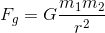
In our scenario, the masses remain the same, and of course  is a constant, so the only thing that changes is the denominator.




Gravity is essentially a property of mass, and the force of gravitational attraction between two bodies is given by the formula:
In our scenario, the masses remain the same, and of course
← Didn't Know|Knew It →