
Work, Energy, and Power - MCAT Chemical and Physical Foundations of Biological Systems
Card 1 of 350
A stone of mass m sits atop a hill of height h. As it rolls downhill, which of the following is true?
- Half way down the hill,

- Half way down the hill,

- Half way down the hill,

- Half way down the hill, PE still equals mgh.
- None of these is true.
A stone of mass m sits atop a hill of height h. As it rolls downhill, which of the following is true?
- Half way down the hill,
- Half way down the hill,
- Half way down the hill,
- Half way down the hill, PE still equals mgh.
- None of these is true.
Tap to reveal answer
4. Choice 1 is correct because initially, all of the mechanical energy in the stone was potential energy and none was kinetic energy: ME = KE + PE. PE is “stored” in the stone-hill system by rolling the stone up hill. It is obvious that it takes half as much energy to roll the stone half way up the hill, compared with rolling it to the top. At the bottom of the hill, all of the PE will have been converted into KE, given by the formula 
Since the PE was ½ mgh when rolling the stone half way up hill, it is the same as it rolls down hill.
4. Choice 1 is correct because initially, all of the mechanical energy in the stone was potential energy and none was kinetic energy: ME = KE + PE. PE is “stored” in the stone-hill system by rolling the stone up hill. It is obvious that it takes half as much energy to roll the stone half way up the hill, compared with rolling it to the top. At the bottom of the hill, all of the PE will have been converted into KE, given by the formula
Since the PE was ½ mgh when rolling the stone half way up hill, it is the same as it rolls down hill.
← Didn't Know|Knew It →
A ball with mass of 2kg is dropped from the top of a building this is 30m high. What is the approximate velocity of the ball when it is 10m above the ground?
A ball with mass of 2kg is dropped from the top of a building this is 30m high. What is the approximate velocity of the ball when it is 10m above the ground?
Tap to reveal answer
Use conservation of energy. The gravitational potential energy lost as the ball drops from 30m to 10m equals the kinetic energy gained.
Change in gravitational potential energy can be found using the difference in mgh. 
So 400 Joules are converted from gravitational potential to kinetic energy, allowing us to solve for the velocity, v.
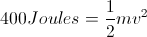


Use conservation of energy. The gravitational potential energy lost as the ball drops from 30m to 10m equals the kinetic energy gained.
Change in gravitational potential energy can be found using the difference in mgh.
So 400 Joules are converted from gravitational potential to kinetic energy, allowing us to solve for the velocity, v.
← Didn't Know|Knew It →
Consider a spring undergoing simple harmonic motion. When the spring is at its maximum velocity .
Consider a spring undergoing simple harmonic motion. When the spring is at its maximum velocity .
Tap to reveal answer
Kinetic energy is highest when the spring is moving the fastest. Conversely, potential energy is highest when the spring is most compressed, and momentarily stationary. When the force resulting from the compression causes the spring to extend, potential energy decreases as velocity increases.
Kinetic energy is highest when the spring is moving the fastest. Conversely, potential energy is highest when the spring is most compressed, and momentarily stationary. When the force resulting from the compression causes the spring to extend, potential energy decreases as velocity increases.
← Didn't Know|Knew It →
A pendulum with a mass of 405kg reaches a maximum height of 2.4m. What is its velocity at the bottommost point in its path?
A pendulum with a mass of 405kg reaches a maximum height of 2.4m. What is its velocity at the bottommost point in its path?
Tap to reveal answer
First solve for the potential energy of the pendulum at the height of 2.4m.
PE = mgh
PE = (405kg)(10m/s2)(2.4m) = 9720J
This must be equal to the maximum kinetic energy of the object.
KE = ½mv2
9720J = ½mv2
Plug in the mass of the object (405 kg) and solve for v.
9720J = ½(405kg)v2
v = 6.9m/s
First solve for the potential energy of the pendulum at the height of 2.4m.
PE = mgh
PE = (405kg)(10m/s2)(2.4m) = 9720J
This must be equal to the maximum kinetic energy of the object.
KE = ½mv2
9720J = ½mv2
Plug in the mass of the object (405 kg) and solve for v.
9720J = ½(405kg)v2
v = 6.9m/s
← Didn't Know|Knew It →
Two children are playing with sleds on a snow-covered hill. Sam weighs 50kg, and his sled weighs 10kg. Sally weighs 40kg, and her sled weighs 12kg. When they arrive, they climb up the hill using boots. Halfway up the 50-meter hill, Sally slips and rolls back down to the bottom. Sam continues climbing, and eventually Sally joins him at the top.
They then decide to sled down the hill, but disagree about who will go first.
Scenario 1:
Sam goes down the hill first, claiming that he will reach a higher velocity. If Sally had gone first, Sam says they could collide.
Scenario 2:
Sally goes down the hill first, claiming that she will experience lower friction and thus reach a higher velocity. If Sam had gone first, Sally says they could collide.
Scenario 3:
Unable to agree, Sam and Sally tether themselves with a rope and go down together.
At the bottom of a neighboring hill, a neighbor watches Sally and Sam come down the hill. Sally is traveling 15m/s and Sam is traveling 10m/s. From the moment the neighbor begins watching, to just after they both come to a stop, who has dissipated more heat in the form of friction? (Assume all friction is lost as heat).
Two children are playing with sleds on a snow-covered hill. Sam weighs 50kg, and his sled weighs 10kg. Sally weighs 40kg, and her sled weighs 12kg. When they arrive, they climb up the hill using boots. Halfway up the 50-meter hill, Sally slips and rolls back down to the bottom. Sam continues climbing, and eventually Sally joins him at the top.
They then decide to sled down the hill, but disagree about who will go first.
Scenario 1:
Sam goes down the hill first, claiming that he will reach a higher velocity. If Sally had gone first, Sam says they could collide.
Scenario 2:
Sally goes down the hill first, claiming that she will experience lower friction and thus reach a higher velocity. If Sam had gone first, Sally says they could collide.
Scenario 3:
Unable to agree, Sam and Sally tether themselves with a rope and go down together.
At the bottom of a neighboring hill, a neighbor watches Sally and Sam come down the hill. Sally is traveling 15m/s and Sam is traveling 10m/s. From the moment the neighbor begins watching, to just after they both come to a stop, who has dissipated more heat in the form of friction? (Assume all friction is lost as heat).
Tap to reveal answer
Sally has greater kinetic energy in this example than does Sam. From the moment when the neighbor begins watching we can calculate the kinetic energy. Once stopped, all of the kinetic energy will have been dissipated.
Sally's KE = 1/2 (52kg) (15m/s)2 = 5850J
Sam's KE = 1/2 (60kg) (10m/s)2 = 3000J
All of this energy will be dissipated as friction before Sam and Sally come to a stop.
Sally has greater kinetic energy in this example than does Sam. From the moment when the neighbor begins watching we can calculate the kinetic energy. Once stopped, all of the kinetic energy will have been dissipated.
Sally's KE = 1/2 (52kg) (15m/s)2 = 5850J
Sam's KE = 1/2 (60kg) (10m/s)2 = 3000J
All of this energy will be dissipated as friction before Sam and Sally come to a stop.
← Didn't Know|Knew It →
A rock is dropped from a given height and allowed to hit the ground. The velocity of the rock is measured upon impact with the ground. Assume there is no air resistance.
In order for the velocity of the rock to be doubled before impact, which of the following is necessary?
A rock is dropped from a given height and allowed to hit the ground. The velocity of the rock is measured upon impact with the ground. Assume there is no air resistance.
In order for the velocity of the rock to be doubled before impact, which of the following is necessary?
Tap to reveal answer
We can compare height and velocity by comparing the equations for potential and kinetic energy. This is possible because the rock initially has no kinetic energy (velocity is zero) and has no potential energy upon impact (height is zero). Using conservation of energy will yield the comparison below.
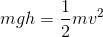
Because velocity is squared in the equation for kinetic energy, it requires a quadrupling of height in order to double the velocity.
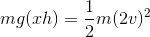
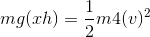

We can compare height and velocity by comparing the equations for potential and kinetic energy. This is possible because the rock initially has no kinetic energy (velocity is zero) and has no potential energy upon impact (height is zero). Using conservation of energy will yield the comparison below.
Because velocity is squared in the equation for kinetic energy, it requires a quadrupling of height in order to double the velocity.
← Didn't Know|Knew It →
A  boulder drops from rest off of a
  cliff. Find its velocity at
  before impact.

A
Tap to reveal answer
Conservation of energy dictates that the initial energy and final energy will be equal.

In this case, the boulder starts with zero kinetic energy and ends with both kinetic and potential energy.


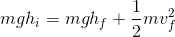
We can cancel the mass from each term and plug in the given values to solve for the velocity at a height of  .
.

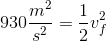
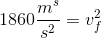

Conservation of energy dictates that the initial energy and final energy will be equal.
In this case, the boulder starts with zero kinetic energy and ends with both kinetic and potential energy.
We can cancel the mass from each term and plug in the given values to solve for the velocity at a height of
← Didn't Know|Knew It →
Ignoring air resistance, which of the following is true regarding the motion of a pendulum?
Ignoring air resistance, which of the following is true regarding the motion of a pendulum?
Tap to reveal answer
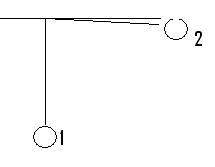
Energy must be conserved through the motion of a pendulum. Let point 1 represent the bottom of the oscillation and point 2 represent the top. At point 1, there is no potential energy, using point 1 as our "ground/reference," thus all of the system energy is kinetic energy. At point 2, the velocity is zero; thus, the kinetic energy is zero and all of the system energy is potential energy. At the highest point in the swing, potential energy is at a maximum, and at the lowest point in the swing, kinetic energy is at a maximum.
Energy must be conserved through the motion of a pendulum. Let point 1 represent the bottom of the oscillation and point 2 represent the top. At point 1, there is no potential energy, using point 1 as our "ground/reference," thus all of the system energy is kinetic energy. At point 2, the velocity is zero; thus, the kinetic energy is zero and all of the system energy is potential energy. At the highest point in the swing, potential energy is at a maximum, and at the lowest point in the swing, kinetic energy is at a maximum.
← Didn't Know|Knew It →
A block of wood is floating in space. A bullet is fired from a gun and hits the block, embedding itself in the wood and generating heat. Which of the following is conserved?
A block of wood is floating in space. A bullet is fired from a gun and hits the block, embedding itself in the wood and generating heat. Which of the following is conserved?
Tap to reveal answer
Momentum is always conserved in a system, when not experiencing external forces.
An inelastic collision can be identified if the two objects stick together after the collision occurs, such as the bullet becoming embedded in the wood. In an inelastic collision, kinetic energy is not conserved. Since mechanical energy is the sum of kinetic and potential energy, mechanical energy is also not conserved. This lack of conservation is due to the conversion of some of the kinetic energy to heat and sound. The kinetic energy decreases as the heat energy increases, resulting in a non-constant temperature.
Momentum is always conserved in a system, when not experiencing external forces.
An inelastic collision can be identified if the two objects stick together after the collision occurs, such as the bullet becoming embedded in the wood. In an inelastic collision, kinetic energy is not conserved. Since mechanical energy is the sum of kinetic and potential energy, mechanical energy is also not conserved. This lack of conservation is due to the conversion of some of the kinetic energy to heat and sound. The kinetic energy decreases as the heat energy increases, resulting in a non-constant temperature.
← Didn't Know|Knew It →
An empty mining cart has a mass of  and is traveling down a track that has a slope of
  to the horizontal. The cart is traveling at a rate of
  when an operator notices a disturbance on the track ahead and locks the wheels of the cart. What is the speed of the cart after it has traveled
  with the wheels locked?


An empty mining cart has a mass of
Tap to reveal answer
We need the equation for conservation of energy for this problem:

We can eliminate final potential energy if we set the final height to be zer. We are solving for final velocity, so let's rearrange for final kinetic energy.

Substituting our equations for each variable, we get:

Rearranging for final velocity we get:
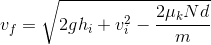
If you derive this formula and are unsure of your work, simply check your units. Each term under the square root has units of  , which will ultimately give us units of
  , which is what we want.
We have values for all variables except two: height and normal force.
Let's calculate the height. We know that the between the initial and final states, the cart has traveled 20 meters down a slope of 40 degrees. Therefore, we can calculate height with the formula:
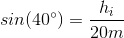


Now we just need to find the normal force. The following diagram will help visualize this calculation.
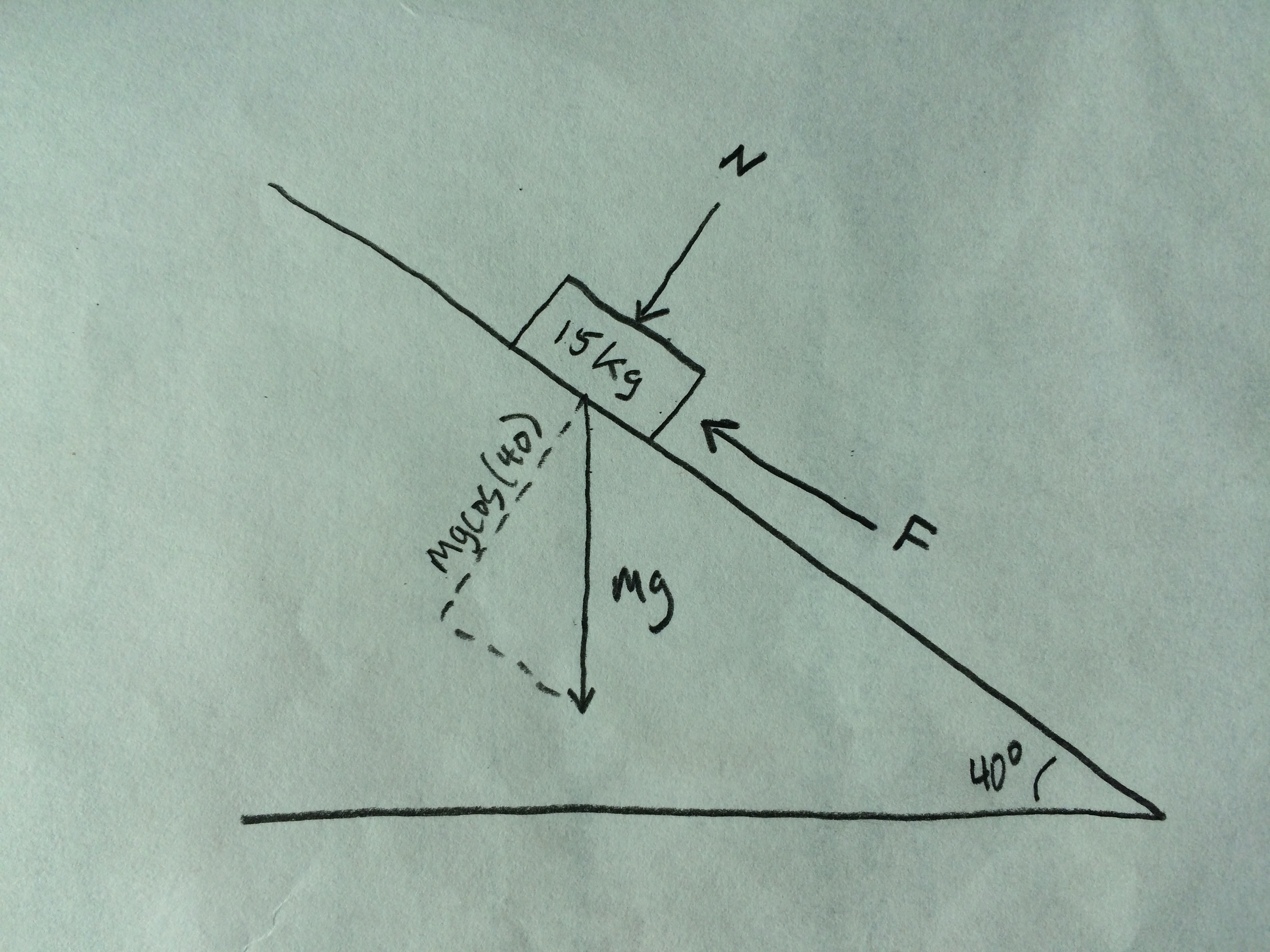
If you are unsure whether to use sine or cosine, think about it practically. As the angle gets less and less, the normal force is going to get larger. This is characteristic of a cosine function.
Therefore, we can say that:

Now that we have all of our variables, it's time to plug and chug:


We need the equation for conservation of energy for this problem:
We can eliminate final potential energy if we set the final height to be zer. We are solving for final velocity, so let's rearrange for final kinetic energy.
Substituting our equations for each variable, we get:
Rearranging for final velocity we get:
If you derive this formula and are unsure of your work, simply check your units. Each term under the square root has units of
We have values for all variables except two: height and normal force.
Let's calculate the height. We know that the between the initial and final states, the cart has traveled 20 meters down a slope of 40 degrees. Therefore, we can calculate height with the formula:
Now we just need to find the normal force. The following diagram will help visualize this calculation.
If you are unsure whether to use sine or cosine, think about it practically. As the angle gets less and less, the normal force is going to get larger. This is characteristic of a cosine function.
Therefore, we can say that:
Now that we have all of our variables, it's time to plug and chug:
← Didn't Know|Knew It →
Two children are playing on an icy lake. Child 1 weighs 50kg, and child 2 weighs 38kg. Child 1 has a backpack that weighs 10kg, and child 2 has a backpack that weighs 5kg.
Over the course of the afternoon, they collide many times. Four collisions are described below.
Collision 1:
Child 1 starts from the top of a ramp, and after going down, reaches the lake surface while going  and subsequently slides into a stationary child 2. They remain linked together after the collision.
Collision 2:
Child 1 and child 2 are sliding in the same direction. Child 2, moving at  , slides into child 1, moving at
  .
.
Collision 3:
The two children collide while traveling in opposite directions at  each.
each.
Collision 4:
The two children push off from one another’s back, and begin moving in exactly opposite directions. Child 2 moves with a velocity of  .
.
Consider that child 1 adds 5kg of books to her backpack. She then prepares to slide down the ramp to the lake surface. If she slides down the ramp but stops herself after she has lost 2m in vertical height, how much work does the force of gravity perform on her to get her to her new position? Ignore assume the ramp is frictionless.
Two children are playing on an icy lake. Child 1 weighs 50kg, and child 2 weighs 38kg. Child 1 has a backpack that weighs 10kg, and child 2 has a backpack that weighs 5kg.
Over the course of the afternoon, they collide many times. Four collisions are described below.
Collision 1:
Child 1 starts from the top of a ramp, and after going down, reaches the lake surface while going
Collision 2:
Child 1 and child 2 are sliding in the same direction. Child 2, moving at
Collision 3:
The two children collide while traveling in opposite directions at
Collision 4:
The two children push off from one another’s back, and begin moving in exactly opposite directions. Child 2 moves with a velocity of
Consider that child 1 adds 5kg of books to her backpack. She then prepares to slide down the ramp to the lake surface. If she slides down the ramp but stops herself after she has lost 2m in vertical height, how much work does the force of gravity perform on her to get her to her new position? Ignore assume the ramp is frictionless.
Tap to reveal answer
The amount of work performed to get child 1 down the ramp is equal to the amount of kinetic energy gained by her from top to bottom, via the work-energy theorem. Unfortunately, we are not given her kinetic energy. We can't use the 5m/s in the passage, because she stops herself before sliding to the lake surface.
We must instead recognize the potential energy lost is equal to kinetic energy gained. The potential energy that she has lost is given by mgh.

The amount of work performed to get child 1 down the ramp is equal to the amount of kinetic energy gained by her from top to bottom, via the work-energy theorem. Unfortunately, we are not given her kinetic energy. We can't use the 5m/s in the passage, because she stops herself before sliding to the lake surface.
We must instead recognize the potential energy lost is equal to kinetic energy gained. The potential energy that she has lost is given by mgh.
← Didn't Know|Knew It →
Two children are playing on an icy lake. Child 1 weighs 50kg, and child 2 weighs 38kg. Child 1 has a backpack that weighs 10kg, and child 2 has a backpack that weighs 5kg.
Over the course of the afternoon, they collide many times. Four collisions are described below.
Collision 1:
Child 1 starts from the top of a ramp, and after going down, reaches the lake surface while going  and subsequently slides into a stationary child 2. They remain linked together after the collision.
Collision 2:
Child 1 and child 2 are sliding in the same direction. Child 2, moving at  , slides into child 1, moving at
  .
.
Collision 3:
The two children collide while traveling in opposite directions at  each.
each.
Collision 4:
The two children push off from one another’s back, and begin moving in exactly opposite directions. Child 2 moves with a velocity of  .
.
Before collision 3 takes place, suppose that child 1 starts at the top of a ramp that is 3m long, and  to the lake surface.
With what speed does child 1 hit the lake surface? Ignore friction and air resistance.
Two children are playing on an icy lake. Child 1 weighs 50kg, and child 2 weighs 38kg. Child 1 has a backpack that weighs 10kg, and child 2 has a backpack that weighs 5kg.
Over the course of the afternoon, they collide many times. Four collisions are described below.
Collision 1:
Child 1 starts from the top of a ramp, and after going down, reaches the lake surface while going
Collision 2:
Child 1 and child 2 are sliding in the same direction. Child 2, moving at
Collision 3:
The two children collide while traveling in opposite directions at
Collision 4:
The two children push off from one another’s back, and begin moving in exactly opposite directions. Child 2 moves with a velocity of
Before collision 3 takes place, suppose that child 1 starts at the top of a ramp that is 3m long, and
With what speed does child 1 hit the lake surface? Ignore friction and air resistance.
Tap to reveal answer
This is an application of the work-energy theorem. The amount of work done by the force of gravity to move child 1 down the ramp is equal to force * distance, as well as equal to the amount of kinetic energy picked up down the ramp.
The force down the ramp is equal to mg*sin(30o) = 600J * 0.5 = 300J



This is an application of the work-energy theorem. The amount of work done by the force of gravity to move child 1 down the ramp is equal to force * distance, as well as equal to the amount of kinetic energy picked up down the ramp.
The force down the ramp is equal to mg*sin(30o) = 600J * 0.5 = 300J
← Didn't Know|Knew It →
What is the work done by gravity if a 50kg block is pushed along a 40m track?
What is the work done by gravity if a 50kg block is pushed along a 40m track?
Tap to reveal answer
The work done by any force that is perpendicular to the displacement is equal to zero. Since the block is moving horizontally, the net force in the vertical direction will be equal to zero; therefore, work done by either gravity or the normal force will be equal to zero.



The work done by any force that is perpendicular to the displacement is equal to zero. Since the block is moving horizontally, the net force in the vertical direction will be equal to zero; therefore, work done by either gravity or the normal force will be equal to zero.
← Didn't Know|Knew It →
An object of mass 100g moves in circular path of radius 0.5m, under the influence of a 15N force directed radially inwards towards the center of the path. How much work is done by this force as the object moves one quarter of the way around the circle?
An object of mass 100g moves in circular path of radius 0.5m, under the influence of a 15N force directed radially inwards towards the center of the path. How much work is done by this force as the object moves one quarter of the way around the circle?
Tap to reveal answer
Work is given by  , the dot product of force and displacement. Since the dot product only sees the components of vectors which are parallel to each other, the dot product of two perpendicular vectors is 0. Force is directed radially inward, while displacement is directed tangent to the circumference. At any point along this object's path, the force is perpendicular to displacement, so
  is simply 0.
Work is given by
← Didn't Know|Knew It →
A 2kg box slides down a ramp a distance of two meters before it reaches the ground. The ramp has an angle of 30o. The coefficient of kinetic friction for the ramp is 0.1.
What is the work done by gravity on the box?
A 2kg box slides down a ramp a distance of two meters before it reaches the ground. The ramp has an angle of 30o. The coefficient of kinetic friction for the ramp is 0.1.
What is the work done by gravity on the box?
Tap to reveal answer
Work is determined using the equation  . Here,
  is the force applied,
  is the displacement of the object, and
  is the angle of the force relative to the movement of the object. Since gravity is acting on the box, we can solve for the force of gravity causing the movement of the box. Note that in this case
  refers to the angle between gravity and the box's path; thus, the angle will be 60o, rather than 30o.


Notice how the work done by gravity is equal to the potential energy of the box at the top of the ramp. This is because mechanical energy is conserved in the system; thus, we can set the two equations equal to each other.

Work is determined using the equation
Notice how the work done by gravity is equal to the potential energy of the box at the top of the ramp. This is because mechanical energy is conserved in the system; thus, we can set the two equations equal to each other.
← Didn't Know|Knew It →
A 2kg box slides down a ramp a distance of two meters before it reaches the ground. The ramp has an angle of 30o. The coefficient of kinetic friction for the ramp is 0.1.
What is the work done by the normal force on the box?
A 2kg box slides down a ramp a distance of two meters before it reaches the ground. The ramp has an angle of 30o. The coefficient of kinetic friction for the ramp is 0.1.
What is the work done by the normal force on the box?
Tap to reveal answer
Remember that the work done by a force on an object is dependent on the angle of the force to the object's displacement. The normal force acts perpendicularly to the ramp, which means it has an angle of 90o with respect to the box's displacement.

Because  , the total work done on the box by the normal force is
  .
.
Remember that the work done by a force on an object is dependent on the angle of the force to the object's displacement. The normal force acts perpendicularly to the ramp, which means it has an angle of 90o with respect to the box's displacement.
Because
← Didn't Know|Knew It →
A 2kg box slides down a ramp a distance of two meters before it reaches the ground. The ramp has an angle of  . The coefficient of kinetic friction for the ramp is 0.1.
What is the work done on the box by friction?
A 2kg box slides down a ramp a distance of two meters before it reaches the ground. The ramp has an angle of
What is the work done on the box by friction?
Tap to reveal answer
Because the force of friction is parallel to the displacement of the box, we can solve for the work done by friction using the following equation.

Now, we need to define the force of friction or  .
.

In this formula,  equals acceleration. In this case, acceleration equals acceleration due to gravity in the x-direction; therefore, use the cosine function.

Insert the value of acceleration due to gravity for  .
.


Now, we can solve for the work done by friction.


Because the force of friction is parallel to the displacement of the box, we can solve for the work done by friction using the following equation.

Now, we need to define the force of friction or 

In this formula, 

Insert the value of acceleration due to gravity for 


Now, we can solve for the work done by friction.


← Didn't Know|Knew It →
A  block slides along a smooth surface at a velocity of
  . The block then encounters a rough surface and continues for six meters before coming to a complete stop. What is the force of friction on the block?
A
Tap to reveal answer
This question can be answered using conservation of energy. Having an understanding of the work-energy theorem allows us the knowledge that changing kinetic energy is a form of work, and that work can be a form of energy. In this particular question, the only force acting on the block to slow it down is the force of friction from the rough surface. As we know, work is equal to force times distance.

Because the block started with a certain amount of kinetic energy, and then is brought to a complete stop, all of that kinetic energy is transferred to work done by the force of friction over a distance of six meters.

Because the  block had a velocity of
  on a smooth surface and ends with a velocity of
  at rest, we can calculate the change in kinetic energy.


The kinetic energy is completely converted to the work done by friction.

We can then use the first equation for work to determine the force of friction.

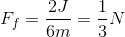
This question can be answered using conservation of energy. Having an understanding of the work-energy theorem allows us the knowledge that changing kinetic energy is a form of work, and that work can be a form of energy. In this particular question, the only force acting on the block to slow it down is the force of friction from the rough surface. As we know, work is equal to force times distance.
Because the block started with a certain amount of kinetic energy, and then is brought to a complete stop, all of that kinetic energy is transferred to work done by the force of friction over a distance of six meters.
Because the
The kinetic energy is completely converted to the work done by friction.
We can then use the first equation for work to determine the force of friction.
← Didn't Know|Knew It →
A student carries a  stack of books
  along a soccer field. She carries the books at a constant height of one meter above the ground and walks with a constant speed. How much work does the student do on the books?
A student carries a
Tap to reveal answer
Since the height of the books is constant, there is no change in potential energy. Similarly, since the speed of the books is constant, there is no change in kinetic energy. By the work-energy theorem, work is equal to the change in mechanical energy (including potential and kinetic). If there is zero change in energy, the work done must also be zero.

We can also look at this problem in terms of forces. There is zero acceleration on the books, since they do not move in the vertical direction and the horizontal velocity is constant. If there is no acceleration, then there is no force. If there is no force, then there is no work, according to Newton's second law.


Since the height of the books is constant, there is no change in potential energy. Similarly, since the speed of the books is constant, there is no change in kinetic energy. By the work-energy theorem, work is equal to the change in mechanical energy (including potential and kinetic). If there is zero change in energy, the work done must also be zero.
We can also look at this problem in terms of forces. There is zero acceleration on the books, since they do not move in the vertical direction and the horizontal velocity is constant. If there is no acceleration, then there is no force. If there is no force, then there is no work, according to Newton's second law.
← Didn't Know|Knew It →
How much work is done to lift a  block to a point
  above its resting location?
How much work is done to lift a
Tap to reveal answer
The work done is equal to the gravitational potential energy of the block after it has been lifted.

The gravitational potential energy is calculated using the following formula:

We are given the mass and the change in height, and we know the acceleration due to gravity. Using these values, we can solve for the change in potential energy by multiplication.


The work done is equal to the gravitational potential energy of the block after it has been lifted.
The gravitational potential energy is calculated using the following formula:
We are given the mass and the change in height, and we know the acceleration due to gravity. Using these values, we can solve for the change in potential energy by multiplication.
← Didn't Know|Knew It →