
Forces - MCAT Chemical and Physical Foundations of Biological Systems
Card 1 of 518
Two objects with masses of M and m, sit r distance apart. What will be the effect on the gravitational force between them if the masses are changed to 2M and 3m?
- It will increase 36-fold.
- It will increase 6-fold.
- It will increase 3-fold.
- It will not change unless r is changed.
- None of the above.
Two objects with masses of M and m, sit r distance apart. What will be the effect on the gravitational force between them if the masses are changed to 2M and 3m?
- It will increase 36-fold.
- It will increase 6-fold.
- It will increase 3-fold.
- It will not change unless r is changed.
- None of the above.
Tap to reveal answer
Choice 2 is correct. The formula for gravitational force, G, is 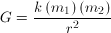 , where k is a constant. The effect of doubling one mass and trebling the other is multiplicative,
  , so the answer is six-fold. The question attempts to confuse the respondent by forcing them to recall that the element of the equation which is squared is distance between objects.
Choice 2 is correct. The formula for gravitational force, G, is
← Didn't Know|Knew It →
An object has a mass of 50kg and a weight of 500N when it is resting on the surface of the Earth. If it is moved to a height equal to three times the Earth’s radius, what is the object’s new weight?
An object has a mass of 50kg and a weight of 500N when it is resting on the surface of the Earth. If it is moved to a height equal to three times the Earth’s radius, what is the object’s new weight?
Tap to reveal answer
You should be familiar with the following equation for the force of gravity.
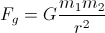
To solve this problem, recognize that weight (Fg) is proportional to the inverse square of the radius. When the object was a distance of r (Earth’s radius) it had a weight of 500N. Now, the object is at a distance of 4r (radius of Earth plus the 3r distance that the object is moved to). With the proportion described above, we can see that the force is decreased by a factor of (4)2.

You should be familiar with the following equation for the force of gravity.
To solve this problem, recognize that weight (Fg) is proportional to the inverse square of the radius. When the object was a distance of r (Earth’s radius) it had a weight of 500N. Now, the object is at a distance of 4r (radius of Earth plus the 3r distance that the object is moved to). With the proportion described above, we can see that the force is decreased by a factor of (4)2.
← Didn't Know|Knew It →
The moon's distance from the center of the Earth was decreased by a multiple of three. How would this affect the gravitational force of the Earth on the moon?
The moon's distance from the center of the Earth was decreased by a multiple of three. How would this affect the gravitational force of the Earth on the moon?
Tap to reveal answer
The law of gravitation is written as  , with G being equal to
 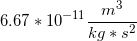 .
.
Since the radius of the two masses acting on each other is squared, and is found in the denominator, a decrease in the radius by a multiple of three will cause a nine-fold increase in the gravitational force.

The law of gravitation is written as
Since the radius of the two masses acting on each other is squared, and is found in the denominator, a decrease in the radius by a multiple of three will cause a nine-fold increase in the gravitational force.
← Didn't Know|Knew It →
Using Newton's Law of Universal Gravitation equation, which of the following expressions is equal to the local gravitational acceleration  on Earth?
Using Newton's Law of Universal Gravitation equation, which of the following expressions is equal to the local gravitational acceleration
Tap to reveal answer
On earth,  .
.
The law of universal gravitation is equal to 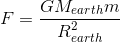 .
.
We can set these equations equal to one another and isolate  by dividing both sides by
  , the mass of an object on Earth.
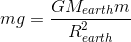

Using the mass of the Earth, the radius of the Earth, and the gravitational constant,  , we get a value of approximately
  if we solve for
  .
.
On earth,
The law of universal gravitation is equal to
We can set these equations equal to one another and isolate
Using the mass of the Earth, the radius of the Earth, and the gravitational constant,
← Didn't Know|Knew It →
A body with mass  is situated
  meters from a second body with a mass of
  . What will be the effect on gravitational attraction of moving one body so that it is only
  meters from the other body?
A body with mass
Tap to reveal answer
Gravity is essentially a property of mass, and the force of gravitational attraction between two bodies is given by the formula:
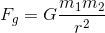
In our scenario, the masses remain the same, and of course  is a constant, so the only thing that changes is the denominator.




Gravity is essentially a property of mass, and the force of gravitational attraction between two bodies is given by the formula:
In our scenario, the masses remain the same, and of course
← Didn't Know|Knew It →
Which of the following changes would increase a satellite's orbital speed?
Which of the following changes would increase a satellite's orbital speed?
Tap to reveal answer
We know  , and the force of gravity is:
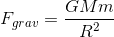
Also, the equation for uniform circular motion, such as a satellite in orbit is:

Set  and substitute the acceleration due to circular motion into the equation. Solve for velocity.

This indicates that the only variables that affect the orbital speed are orbital radius and the mass of the Earth.
We know
Also, the equation for uniform circular motion, such as a satellite in orbit is:
Set
This indicates that the only variables that affect the orbital speed are orbital radius and the mass of the Earth.
← Didn't Know|Knew It →
Which of the following must be true for a  block to be considered weightless?
Which of the following must be true for a
Tap to reveal answer
One way an object can be considered "weightless," is if it is accelerating downward at the same rate that it would be if it were free falling. This is why objects in an elevator whose cable had been cut would be "weightless." Therefore the answer is just for the block to be accelerating in the same magnitude and direction as the acceleration due to gravity, which is 
One way an object can be considered "weightless," is if it is accelerating downward at the same rate that it would be if it were free falling. This is why objects in an elevator whose cable had been cut would be "weightless." Therefore the answer is just for the block to be accelerating in the same magnitude and direction as the acceleration due to gravity, which is
← Didn't Know|Knew It →
When the force applied to a moving object is equal and opposite the force of kinetic friction, what happens to the object?
When the force applied to a moving object is equal and opposite the force of kinetic friction, what happens to the object?
Tap to reveal answer
It is important to understand the difference between static and kinetic friction. When an object is at rest, it takes more force to get it to start moving than to keep it moving. If you match the amount of static friction that can be generated when the object is at rest, it will not move because there is zero net force; the force applied must be greater than the static friction in order to initiate motion. Once the object begins moving, the force required to keep it moving decreases. If you match the force of kinetic friction, the object moves at a constant velocity because there is again no net force. Any more force will cause acceleration, while any less will cause deceleration.
It is important to understand the difference between static and kinetic friction. When an object is at rest, it takes more force to get it to start moving than to keep it moving. If you match the amount of static friction that can be generated when the object is at rest, it will not move because there is zero net force; the force applied must be greater than the static friction in order to initiate motion. Once the object begins moving, the force required to keep it moving decreases. If you match the force of kinetic friction, the object moves at a constant velocity because there is again no net force. Any more force will cause acceleration, while any less will cause deceleration.
← Didn't Know|Knew It →
A  object is originally at rest on an inclined plane, which forms an angle with the ground of
  . If the coefficient of static friction is
  , what is the force of friction that must be overcome for the object to begin moving?
A
Tap to reveal answer
In this situation, we must simply remember how to calculate friction. Once the force of gravity overcomes the force of static friction, the object will slide. Our formula for friction is:

This means the force of friction is equal to the friction coefficient times the normal force. On an incline, the normal force is equal to the force of gravity times the cosine of the angle:


We can combine our formulas to give the force of friction.

Using the given coefficient of friction, mass, and angle, we can calculate the force of friction.


In this situation, we must simply remember how to calculate friction. Once the force of gravity overcomes the force of static friction, the object will slide. Our formula for friction is:
This means the force of friction is equal to the friction coefficient times the normal force. On an incline, the normal force is equal to the force of gravity times the cosine of the angle:
We can combine our formulas to give the force of friction.
Using the given coefficient of friction, mass, and angle, we can calculate the force of friction.
← Didn't Know|Knew It →
Two children are playing with sleds on a snow-covered hill. Sam weighs 50kg, and his sled weighs 10kg. Sally weighs 40kg, and her sled weighs 12kg. When they arrive, they climb up the hill using boots. Halfway up the 50-meter hill, Sally slips and rolls back down to the bottom. Sam continues climbing, and eventually Sally joins him at the top.
They then decide to sled down the hill, but disagree about who will go first.
Scenario 1:
Sam goes down the hill first, claiming that he will reach a higher velocity. If Sally had gone first, Sam says they could collide.
Scenario 2:
Sally goes down the hill first, claiming that she will experience lower friction and thus reach a higher velocity. If Sam had gone first, Sally says they could collide.
Scenario 3:
Unable to agree, Sam and Sally tether themselves with a rope and go down together.
Who would you expect to experience a greater force of friction while traveling down the hill?
Two children are playing with sleds on a snow-covered hill. Sam weighs 50kg, and his sled weighs 10kg. Sally weighs 40kg, and her sled weighs 12kg. When they arrive, they climb up the hill using boots. Halfway up the 50-meter hill, Sally slips and rolls back down to the bottom. Sam continues climbing, and eventually Sally joins him at the top.
They then decide to sled down the hill, but disagree about who will go first.
Scenario 1:
Sam goes down the hill first, claiming that he will reach a higher velocity. If Sally had gone first, Sam says they could collide.
Scenario 2:
Sally goes down the hill first, claiming that she will experience lower friction and thus reach a higher velocity. If Sam had gone first, Sally says they could collide.
Scenario 3:
Unable to agree, Sam and Sally tether themselves with a rope and go down together.
Who would you expect to experience a greater force of friction while traveling down the hill?
Tap to reveal answer
The force of friction can be found from the following equation.
Force of Friction = Normal Force * Coeffecient of Friction
Normal force here is the force that the Earth pushes back on Sam against his mass. Thus, because he is more massive, he will experience a greater normal force and greater frictional force as a result.
The force of friction can be found from the following equation.
Force of Friction = Normal Force * Coeffecient of Friction
Normal force here is the force that the Earth pushes back on Sam against his mass. Thus, because he is more massive, he will experience a greater normal force and greater frictional force as a result.
← Didn't Know|Knew It →
Two children are playing with sleds on a snow-covered hill. Sam weighs 50kg, and his sled weighs 10kg. Sally weighs 40kg, and her sled weighs 12kg. When they arrive, they climb up the hill using boots. Halfway up the 50-meter hill, Sally slips and rolls back down to the bottom. Sam continues climbing, and eventually Sally joins him at the top.
They then decide to sled down the hill, but disagree about who will go first.
Scenario 1:
Sam goes down the hill first, claiming that he will reach a higher velocity. If Sally had gone first, Sam says they could collide.
Scenario 2:
Sally goes down the hill first, claiming that she will experience lower friction and thus reach a higher velocity. If Sam had gone first, Sally says they could collide.
Scenario 3:
Unable to agree, Sam and Sally tether themselves with a rope and go down together.
When the force of friction acts on a moving body, as it would on Sam when moving down the hill, .
Two children are playing with sleds on a snow-covered hill. Sam weighs 50kg, and his sled weighs 10kg. Sally weighs 40kg, and her sled weighs 12kg. When they arrive, they climb up the hill using boots. Halfway up the 50-meter hill, Sally slips and rolls back down to the bottom. Sam continues climbing, and eventually Sally joins him at the top.
They then decide to sled down the hill, but disagree about who will go first.
Scenario 1:
Sam goes down the hill first, claiming that he will reach a higher velocity. If Sally had gone first, Sam says they could collide.
Scenario 2:
Sally goes down the hill first, claiming that she will experience lower friction and thus reach a higher velocity. If Sam had gone first, Sally says they could collide.
Scenario 3:
Unable to agree, Sam and Sally tether themselves with a rope and go down together.
When the force of friction acts on a moving body, as it would on Sam when moving down the hill, .
Tap to reveal answer
This is a tricky question. Entropy of the universe increases because, even though Sam's movement does slow down resulting in a local decline in entropy, the heat generated by friction with the ground results in a net increase in entropy overall.
Another tempting choice would be that friction always acts opposite the direction of motion. Friction always acts opposite to the direction of RELATIVE motion, not necessarily to the direction of motion in which the body itself is traveling.
This is a tricky question. Entropy of the universe increases because, even though Sam's movement does slow down resulting in a local decline in entropy, the heat generated by friction with the ground results in a net increase in entropy overall.
Another tempting choice would be that friction always acts opposite the direction of motion. Friction always acts opposite to the direction of RELATIVE motion, not necessarily to the direction of motion in which the body itself is traveling.
← Didn't Know|Knew It →
Two children are playing with sleds on a snow-covered hill. Sam weighs 50kg, and his sled weighs 10kg. Sally weighs 40kg, and her sled weighs 12kg. When they arrive, they climb up the hill using boots. Halfway up the 50-meter hill, Sally slips and rolls back down to the bottom. Sam continues climbing, and eventually Sally joins him at the top.
They then decide to sled down the hill, but disagree about who will go first.
Scenario 1:
Sam goes down the hill first, claiming that he will reach a higher velocity. If Sally had gone first, Sam says they could collide.
Scenario 2:
Sally goes down the hill first, claiming that she will experience lower friction and thus reach a higher velocity. If Sam had gone first, Sally says they could collide.
Scenario 3:
Unable to agree, Sam and Sally tether themselves with a rope and go down together.
What would you expect is true of Sam before he starts moving?
Two children are playing with sleds on a snow-covered hill. Sam weighs 50kg, and his sled weighs 10kg. Sally weighs 40kg, and her sled weighs 12kg. When they arrive, they climb up the hill using boots. Halfway up the 50-meter hill, Sally slips and rolls back down to the bottom. Sam continues climbing, and eventually Sally joins him at the top.
They then decide to sled down the hill, but disagree about who will go first.
Scenario 1:
Sam goes down the hill first, claiming that he will reach a higher velocity. If Sally had gone first, Sam says they could collide.
Scenario 2:
Sally goes down the hill first, claiming that she will experience lower friction and thus reach a higher velocity. If Sam had gone first, Sally says they could collide.
Scenario 3:
Unable to agree, Sam and Sally tether themselves with a rope and go down together.
What would you expect is true of Sam before he starts moving?
Tap to reveal answer
Static friction exerts a greater effect than does kinetic friction. Think about if you are trying to slide a heavy box across a room. It takes some force to get it going, but once it is moving it takes comparatively less force to keep it moving
Static friction exerts a greater effect than does kinetic friction. Think about if you are trying to slide a heavy box across a room. It takes some force to get it going, but once it is moving it takes comparatively less force to keep it moving
← Didn't Know|Knew It →
Two children are playing on an icy lake. Child 1 weighs 50kg, and child 2 weighs 38kg. Child 1 has a backpack that weighs 10kg, and child 2 has a backpack that weighs 5kg.
Over the course of the afternoon, they collide many times. Four collisions are described below.
Collision 1:
Child 1 starts from the top of a ramp, and after going down, reaches the lake surface while going 5m/s and subsequently slides into a stationary child 2. They remain linked together after the collision.
Collision 2:
Child 1 and child 2 are sliding in the same direction. Child 2, moving at 10m/s, slides into child 1, moving at 2m/s.
Collision 3:
The two children collide while traveling in opposite directions at 10m/s each.
Collision 4:
The two children push off from one another’s back, and begin moving in exactly opposite directions. Child 2 moves with a velocity of +8m/s.
Imagine that the above collisions happened on another planet, where the gravitational constant was exactly half that of Earth. Compared to the force of friction acting on moving bodies on Earth, the force of friction on this new planet would be .
Two children are playing on an icy lake. Child 1 weighs 50kg, and child 2 weighs 38kg. Child 1 has a backpack that weighs 10kg, and child 2 has a backpack that weighs 5kg.
Over the course of the afternoon, they collide many times. Four collisions are described below.
Collision 1:
Child 1 starts from the top of a ramp, and after going down, reaches the lake surface while going 5m/s and subsequently slides into a stationary child 2. They remain linked together after the collision.
Collision 2:
Child 1 and child 2 are sliding in the same direction. Child 2, moving at 10m/s, slides into child 1, moving at 2m/s.
Collision 3:
The two children collide while traveling in opposite directions at 10m/s each.
Collision 4:
The two children push off from one another’s back, and begin moving in exactly opposite directions. Child 2 moves with a velocity of +8m/s.
Imagine that the above collisions happened on another planet, where the gravitational constant was exactly half that of Earth. Compared to the force of friction acting on moving bodies on Earth, the force of friction on this new planet would be .
Tap to reveal answer
While the answer choice specifying the material-dependency of the coefficient of friction is true, and may be tempting, the force of friction is dependent on both the coefficients of friction and the normal force. The normal force is directly proportional to the weight of the body in question.

While the answer choice specifying the material-dependency of the coefficient of friction is true, and may be tempting, the force of friction is dependent on both the coefficients of friction and the normal force. The normal force is directly proportional to the weight of the body in question.
← Didn't Know|Knew It →
A crate of mass M is pushed along a frictionless horizontal floor by a force F acting downward from an angle xo above the horizontal. What is the magnitude of the normal force N between the crate and the floor?
A crate of mass M is pushed along a frictionless horizontal floor by a force F acting downward from an angle xo above the horizontal. What is the magnitude of the normal force N between the crate and the floor?
Tap to reveal answer
Since the crate is not accelerating in the vertical direction, the sum of the vertical forces must be 0. In other words, the sum of the downwards forces must equal the sum of the upwards forces. In this case, the downwards forces on the crate are gravity (Mg) and the vertical component of the pushing force (Fsin(x)). The only force acting upwards is the normal force (N) from the floor. So, Mg + Fsin(x) = N. Note that the problem states the direction of the force to be from above the horizontal, meaning that the vertical component will add to the downward force.
Since the crate is not accelerating in the vertical direction, the sum of the vertical forces must be 0. In other words, the sum of the downwards forces must equal the sum of the upwards forces. In this case, the downwards forces on the crate are gravity (Mg) and the vertical component of the pushing force (Fsin(x)). The only force acting upwards is the normal force (N) from the floor. So, Mg + Fsin(x) = N. Note that the problem states the direction of the force to be from above the horizontal, meaning that the vertical component will add to the downward force.
← Didn't Know|Knew It →
A 50kg block resting on the ground experiences an upward acceleration of 4m/s2. What is the normal force acting on the block?
A 50kg block resting on the ground experiences an upward acceleration of 4m/s2. What is the normal force acting on the block?
Tap to reveal answer
The block experiences the force of gravity, plus the force of the upward acceleration


If the block is resting on the ground, then its total force must be zero, and the normal force must cancel out the net force above. The normal force is 300N.
The block experiences the force of gravity, plus the force of the upward acceleration
If the block is resting on the ground, then its total force must be zero, and the normal force must cancel out the net force above. The normal force is 300N.
← Didn't Know|Knew It →
A 3kg book slides towards the right along a frictionless horizontal surface with initial velocity 5m/s, then suddenly encounters a long rough section with kinetic friction coefficient  . How far does the book travel along the rough surface before coming to rest? (Use
  as needed)
A 3kg book slides towards the right along a frictionless horizontal surface with initial velocity 5m/s, then suddenly encounters a long rough section with kinetic friction coefficient
Tap to reveal answer
We'll need to use the kinematic equation  to solve for d, the distance travelled when the book has stopped (
 ). Before solving for d, we need to calculate the acceleration caused by the frictional force, by using the following steps.
-
Find the normal force on the book,  .
.
-
Plug this normal force into  to solve for frictional force.
-
Find the acceleration caused by this frictional force, with  .
.
Step 1 gives  , so in step 2,
  , giving an acceleration of
  to the left (which we will define to be the negative horizontal direction).
Returning to the original kinematic equation,  .
.
Rearranging to solve for d gives 
We'll need to use the kinematic equation
-
Find the normal force on the book,
-
Plug this normal force into
-
Find the acceleration caused by this frictional force, with
Step 1 gives
Returning to the original kinematic equation,
Rearranging to solve for d gives
← Didn't Know|Knew It →
A 2kg box is at the top of a ramp at an angle of 60o. The top of the ramp is 30m above the ground. The box is sitting still while at the top of the ramp, and is then released.
Imagine that the net force on the box is 16.5N when sliding down the ramp. What is the coefficient of kinetic friction for the box?
A 2kg box is at the top of a ramp at an angle of 60o. The top of the ramp is 30m above the ground. The box is sitting still while at the top of the ramp, and is then released.
Imagine that the net force on the box is 16.5N when sliding down the ramp. What is the coefficient of kinetic friction for the box?
Tap to reveal answer
Since the box is moving when the net force on the box is determined, we can calculate the coefficient of kinetic friction for the box. The first step is determining what the net force on the box would be in the absence of friction. The net force on the box is given by the equation  .
.

The difference between the frictionless net force and the net force with friction is 0.8N. This means that the force of kinetic friction on the box is 0.8N, acting opposite the direction of motion. Knowing this, we can solve for the coefficient of kinetic friction using the equation 



Since the box is moving when the net force on the box is determined, we can calculate the coefficient of kinetic friction for the box. The first step is determining what the net force on the box would be in the absence of friction. The net force on the box is given by the equation
The difference between the frictionless net force and the net force with friction is 0.8N. This means that the force of kinetic friction on the box is 0.8N, acting opposite the direction of motion. Knowing this, we can solve for the coefficient of kinetic friction using the equation
← Didn't Know|Knew It →
What is the coefficient of kinetic friction of a 500g book sliding along a floor if the force of friction on the book is 4N?
What is the coefficient of kinetic friction of a 500g book sliding along a floor if the force of friction on the book is 4N?
Tap to reveal answer
For formula for the force of friction is  . We can rearrange this equation to solve for the coefficient of friction.

Remember that the normal force is equal to the force of gravity. Now we can plug in our given values and solve.

Don't forget to convert 500g to 0.5kg. The units cancel out, leaving the answer without any unit.
For formula for the force of friction is
Remember that the normal force is equal to the force of gravity. Now we can plug in our given values and solve.
Don't forget to convert 500g to 0.5kg. The units cancel out, leaving the answer without any unit.
← Didn't Know|Knew It →
Which of the following could not influence the magnitude of frictional force acting on a book sliding across a horizontal table?
Which of the following could not influence the magnitude of frictional force acting on a book sliding across a horizontal table?
Tap to reveal answer
Frictional force is given by the equation:

The only factors that can change frictional force are the coefficient of friction, which is determined by the materials of the surfaces in contact, and the normal force. Since the normal force must have a magnitude such that the sum of forces perpendicular to the table equals zero, both the mass of the book and any external vertical forces would influence the normal force, and thus also would influence the frictional force.

Frictional force is given by the equation:
The only factors that can change frictional force are the coefficient of friction, which is determined by the materials of the surfaces in contact, and the normal force. Since the normal force must have a magnitude such that the sum of forces perpendicular to the table equals zero, both the mass of the book and any external vertical forces would influence the normal force, and thus also would influence the frictional force.
← Didn't Know|Knew It →
A  block rests on a wooden table. What is the force of the table upon the block?
A
Tap to reveal answer
In this question, the net force on the block is zero. We know from Newton's second law that any non-zero force will produce an acceleration, resulting in movement of some sort. Since the block is at rest, and not moving, we can conclude that the net force is zero.

The forces acting on the block are the force of gravity, pulling the block downward, and the normal force, pushing the block upward. The force of the block on the table will be the force from gravity, while the force of the table on the block will be the normal force. Since these are the only two forces acting on the block, we can add them together to get the net force.

Reorganizing the equation, we can set the two forces equal. This is a reflection of Newton's third law.

Gravitational force is equal to the mass of the object times the acceleration from gravity.

Using these values, given in the question, we can find the normal force, or the force of the table on the block.



The final normal force is positive because it acts in the upward direction, opposite of gravity.
In this question, the net force on the block is zero. We know from Newton's second law that any non-zero force will produce an acceleration, resulting in movement of some sort. Since the block is at rest, and not moving, we can conclude that the net force is zero.
The forces acting on the block are the force of gravity, pulling the block downward, and the normal force, pushing the block upward. The force of the block on the table will be the force from gravity, while the force of the table on the block will be the normal force. Since these are the only two forces acting on the block, we can add them together to get the net force.
Reorganizing the equation, we can set the two forces equal. This is a reflection of Newton's third law.
Gravitational force is equal to the mass of the object times the acceleration from gravity.
Using these values, given in the question, we can find the normal force, or the force of the table on the block.
The final normal force is positive because it acts in the upward direction, opposite of gravity.
← Didn't Know|Knew It →