
General Chemistry - MCAT Chemical and Physical Foundations of Biological Systems
Card 1 of 3171
Carbonic anhydrase is an important enzyme that allows CO2 and H2O to be converted into H2CO3. In addition to allowing CO2 to be dissolved into the blood and transported to the lungs for exhalation, the products of the carbonic anhydrase reaction, H2CO3 and a related compound HCO3-, also serve to control the pH of the blood to prevent acidosis or alkalosis. The carbonic anhydrase reaction and acid-base reaction are presented below.
CO2 + H2O  H2CO3
H2CO3
H2CO3  HCO3- + H+
The addition of H2CO3 would the concentration of HCO3-.
Carbonic anhydrase is an important enzyme that allows CO2 and H2O to be converted into H2CO3. In addition to allowing CO2 to be dissolved into the blood and transported to the lungs for exhalation, the products of the carbonic anhydrase reaction, H2CO3 and a related compound HCO3-, also serve to control the pH of the blood to prevent acidosis or alkalosis. The carbonic anhydrase reaction and acid-base reaction are presented below.
CO2 + H2O
H2CO3
The addition of H2CO3 would the concentration of HCO3-.
Tap to reveal answer
This is a Le Chatlier shift problem. When the equilibrium of a chemical reaction is disturbed, the reaction shifts to the side to minimize the change. Here, increasing H2CO3 would shift the reaction to the right to minimize the addition of the acid. Shifting the reaction to the right would thus increase the concentration of HCO3-.
This is a Le Chatlier shift problem. When the equilibrium of a chemical reaction is disturbed, the reaction shifts to the side to minimize the change. Here, increasing H2CO3 would shift the reaction to the right to minimize the addition of the acid. Shifting the reaction to the right would thus increase the concentration of HCO3-.
← Didn't Know|Knew It →
Carbonic anhydrase is an important enzyme that allows CO2 and H2O to be converted into H2CO3. In addition to allowing CO2 to be dissolved into the blood and transported to the lungs for exhalation, the products of the carbonic anhydrase reaction, H2CO3 and a related compound HCO3-, also serve to control the pH of the blood to prevent acidosis or alkalosis. The carbonic anhydrase reaction and acid-base reaction are presented below.
CO2 + H2O  H2CO3
H2CO3
H2CO3  HCO3- + H+
How would the addition of pure H2O shift the carbonic anhydrase reaction?
Carbonic anhydrase is an important enzyme that allows CO2 and H2O to be converted into H2CO3. In addition to allowing CO2 to be dissolved into the blood and transported to the lungs for exhalation, the products of the carbonic anhydrase reaction, H2CO3 and a related compound HCO3-, also serve to control the pH of the blood to prevent acidosis or alkalosis. The carbonic anhydrase reaction and acid-base reaction are presented below.
CO2 + H2O
H2CO3
How would the addition of pure H2O shift the carbonic anhydrase reaction?
Tap to reveal answer
Remember that Le Chatlier’s principle says that pure liquids and solids do not change the equilibrium of the reaction. Regardless of where in the reaction the pure liquid or solid is present, no equilibrium shift would occur.
Remember that Le Chatlier’s principle says that pure liquids and solids do not change the equilibrium of the reaction. Regardless of where in the reaction the pure liquid or solid is present, no equilibrium shift would occur.
← Didn't Know|Knew It →
All of the following elements have the same number of valence electrons except .
All of the following elements have the same number of valence electrons except .
Tap to reveal answer
Beryllium (Be), magnesium (Mg), calcium (Ca), and strontium (Sr) are all alkaline earth metals with two valence electrons.
Rubidium (Rb) is an alkali metal and has only one valence electron.
Beryllium (Be), magnesium (Mg), calcium (Ca), and strontium (Sr) are all alkaline earth metals with two valence electrons.
Rubidium (Rb) is an alkali metal and has only one valence electron.
← Didn't Know|Knew It →
Carbonic anhydrase is an important enzyme that allows CO2 and H2O to be converted into H2CO3. In addition to allowing CO2 to be dissolved into the blood and transported to the lungs for exhalation, the products of the carbonic anhydrase reaction, H2CO3 and a related compound HCO3-, also serve to control the pH of the blood to prevent acidosis or alkalosis. The carbonic anhydrase reaction and acid-base reaction are presented below.
CO2 + H2O  H2CO3
H2CO3
H2CO3  HCO3- + H+
Assuming that reacting CO2 is in the gas phase, increasing the pressure would shift the carbonic anhydrase reaction to the .
Carbonic anhydrase is an important enzyme that allows CO2 and H2O to be converted into H2CO3. In addition to allowing CO2 to be dissolved into the blood and transported to the lungs for exhalation, the products of the carbonic anhydrase reaction, H2CO3 and a related compound HCO3-, also serve to control the pH of the blood to prevent acidosis or alkalosis. The carbonic anhydrase reaction and acid-base reaction are presented below.
CO2 + H2O
H2CO3
Assuming that reacting CO2 is in the gas phase, increasing the pressure would shift the carbonic anhydrase reaction to the .
Tap to reveal answer
This is a Le Chatlier shift problem. When the equilibrium of a chemical reaction is disturbed, the reaction shifts to the side to minimize the change. With pressure, the reaction is shifted to the side with fewer moles of gas. In the carbonic anhydrase reaction, the only gas present would be CO2, a reactant. Decreasing pressure would thus shift the reaction toward the products (right).
This is a Le Chatlier shift problem. When the equilibrium of a chemical reaction is disturbed, the reaction shifts to the side to minimize the change. With pressure, the reaction is shifted to the side with fewer moles of gas. In the carbonic anhydrase reaction, the only gas present would be CO2, a reactant. Decreasing pressure would thus shift the reaction toward the products (right).
← Didn't Know|Knew It →
Carbonic anhydrase is an important enzyme that allows CO2 and H2O to be converted into H2CO3. In addition to allowing CO2 to be dissolved into the blood and transported to the lungs for exhalation, the products of the carbonic anhydrase reaction, H2CO3 and a related compound HCO3-, also serve to control the pH of the blood to prevent acidosis or alkalosis. The carbonic anhydrase reaction and acid-base reaction are presented below.
CO2 + H2O  H2CO3
H2CO3
H2CO3  HCO3- + H+
While the kidney is able to compensate for many acid/base changes in our bodies, vomiting is a temporary cause of acid/base imbalance. While vomiting may allow our bodies to get rid of toxic substances, it also causes us to lose gastric acid, which influences blood pH. How would the loss of gastric acid change the pH of our blood?
Carbonic anhydrase is an important enzyme that allows CO2 and H2O to be converted into H2CO3. In addition to allowing CO2 to be dissolved into the blood and transported to the lungs for exhalation, the products of the carbonic anhydrase reaction, H2CO3 and a related compound HCO3-, also serve to control the pH of the blood to prevent acidosis or alkalosis. The carbonic anhydrase reaction and acid-base reaction are presented below.
CO2 + H2O
H2CO3
While the kidney is able to compensate for many acid/base changes in our bodies, vomiting is a temporary cause of acid/base imbalance. While vomiting may allow our bodies to get rid of toxic substances, it also causes us to lose gastric acid, which influences blood pH. How would the loss of gastric acid change the pH of our blood?
Tap to reveal answer
This is an undercover Le Chatlier shift problem. The question tells us that vomiting causes us to lose gastric acid. In the equation that we can see above, losing H+ (in HCl) would pull the reaction to the right, increasing the concentration of HCO3-. Increasing the concentration of the base HCO3- increases the pH, leading the blood to become more basic.
This is an undercover Le Chatlier shift problem. The question tells us that vomiting causes us to lose gastric acid. In the equation that we can see above, losing H+ (in HCl) would pull the reaction to the right, increasing the concentration of HCO3-. Increasing the concentration of the base HCO3- increases the pH, leading the blood to become more basic.
← Didn't Know|Knew It →
Carbonic anhydrase is an important enzyme that allows CO2 and H2O to be converted into H2CO3. In addition to allowing CO2 to be dissolved into the blood and transported to the lungs for exhalation, the products of the carbonic anhydrase reaction, H2CO3 and a related compound HCO3-, also serve to control the pH of the blood to prevent acidosis or alkalosis. The carbonic anhydrase reaction and acid-base reaction are presented below.
CO2 + H2O  H2CO3
H2CO3
H2CO3  HCO3- + H+
What happens to the pH of our blood if we hyperventilate?
Carbonic anhydrase is an important enzyme that allows CO2 and H2O to be converted into H2CO3. In addition to allowing CO2 to be dissolved into the blood and transported to the lungs for exhalation, the products of the carbonic anhydrase reaction, H2CO3 and a related compound HCO3-, also serve to control the pH of the blood to prevent acidosis or alkalosis. The carbonic anhydrase reaction and acid-base reaction are presented below.
CO2 + H2O
H2CO3
What happens to the pH of our blood if we hyperventilate?
Tap to reveal answer
This is an undercover Le Chatlier shift problem. If we hyperventilate, we expel more CO2, thus pulling the reaction to the left and decreasing the concentration of H2CO3. As the concentration of the acid decreases, the blood becomes more basic, leading to respiratory alkalosis.
This is an undercover Le Chatlier shift problem. If we hyperventilate, we expel more CO2, thus pulling the reaction to the left and decreasing the concentration of H2CO3. As the concentration of the acid decreases, the blood becomes more basic, leading to respiratory alkalosis.
← Didn't Know|Knew It →
If the reactants and/or products in a chemical reaction are gases, the reaction rate can be determined by measuring the change of pressure as the reaction proceeds. Consider the following reaction and pressure vs. reaction rate data below.

Trial PXY(torr) PZ(torr) Rate (torr/s) 1 100 200 0.16 2 200 200 0.32 3 200 100 0.04 4 200 150 0.14
If the volume of the container were reduced, what would happen to the rate of the reaction?
If the reactants and/or products in a chemical reaction are gases, the reaction rate can be determined by measuring the change of pressure as the reaction proceeds. Consider the following reaction and pressure vs. reaction rate data below.
| Trial | PXY(torr) | PZ(torr) | Rate (torr/s) |
|---|---|---|---|
| 1 | 100 | 200 | 0.16 |
| 2 | 200 | 200 | 0.32 |
| 3 | 200 | 100 | 0.04 |
| 4 | 200 | 150 | 0.14 |
If the volume of the container were reduced, what would happen to the rate of the reaction?
Tap to reveal answer
Reducing the volume of the container increases pressure. This results in a higher frequency of gas particle collisions, thereby increasing the rate of the reaction.
Reducing the volume of the container increases pressure. This results in a higher frequency of gas particle collisions, thereby increasing the rate of the reaction.
← Didn't Know|Knew It →
Consider the following equation for the production of ammonia gas from hydrogen gas and nitrogen gas.

If the volume of the vessel containing hydrogen and nitrogen is decreased, the production of ammonia .
Consider the following equation for the production of ammonia gas from hydrogen gas and nitrogen gas.
If the volume of the vessel containing hydrogen and nitrogen is decreased, the production of ammonia .
Tap to reveal answer
Since decreasing the volume of the container has the effect of increasing pressure, equilibrium is shifted to the right. An increase in pressure has the result of favoring the side of the reaction with fewer moles of gas. (According to the balanced equation, there are 4 moles on the reactant side as opposed to 2 moles on the product side).
Since decreasing the volume of the container has the effect of increasing pressure, equilibrium is shifted to the right. An increase in pressure has the result of favoring the side of the reaction with fewer moles of gas. (According to the balanced equation, there are 4 moles on the reactant side as opposed to 2 moles on the product side).
← Didn't Know|Knew It →
Which of the following is the oxidizing agent in the following equation?

Which of the following is the oxidizing agent in the following equation?
Tap to reveal answer
An oxidizing agent is one that oxidizes another element and, becomes reduced in the process. Oxidizing and reducing agents are found in the reactants of the equation, eliminating Al3+ and Cr(s) as answer choices. Cr3+ gains three electrons to become Cr(s), which has an oxidation number of zero. Cr3+ becomes reduced, while Al(s) is oxidized, therefore, Cr3+ is the oxidizing agent. Remember "OIL RIG": Oxidation Is Loss of electrons and Reduction Is Gain of electrons.
An oxidizing agent is one that oxidizes another element and, becomes reduced in the process. Oxidizing and reducing agents are found in the reactants of the equation, eliminating Al3+ and Cr(s) as answer choices. Cr3+ gains three electrons to become Cr(s), which has an oxidation number of zero. Cr3+ becomes reduced, while Al(s) is oxidized, therefore, Cr3+ is the oxidizing agent. Remember "OIL RIG": Oxidation Is Loss of electrons and Reduction Is Gain of electrons.
← Didn't Know|Knew It →
Which of the following is true about insulators?
Which of the following is true about insulators?
Tap to reveal answer
Good insulators are usually non-metals, in which the electrons are not able to freely move. Insulators, unlike conductors, do not carry current. This is because charges cannot move freely in an insulating material, making this choice the correct answer.
Sound would travel slowest through an insulating material, as there is less ability to compress and propagate the sound wave. Copper is an example of a good conductor, and is a poor insulator.
Good insulators are usually non-metals, in which the electrons are not able to freely move. Insulators, unlike conductors, do not carry current. This is because charges cannot move freely in an insulating material, making this choice the correct answer.
Sound would travel slowest through an insulating material, as there is less ability to compress and propagate the sound wave. Copper is an example of a good conductor, and is a poor insulator.
← Didn't Know|Knew It →
What is a typical characteristic of the halogens?
What is a typical characteristic of the halogens?
Tap to reveal answer
Halogens are in the group next to the noble gasses. They have seven valence electrons, and therefore have a high electronegativity. The addition of only a single electron (production of an anion) generates a full valence octet.
Their diameters vary within the group. The diameter can be very small, like fluorine, or large, like iodine. They do not conduct electricity well, as they are non-metals.
Halogens are in the group next to the noble gasses. They have seven valence electrons, and therefore have a high electronegativity. The addition of only a single electron (production of an anion) generates a full valence octet.
Their diameters vary within the group. The diameter can be very small, like fluorine, or large, like iodine. They do not conduct electricity well, as they are non-metals.
← Didn't Know|Knew It →
Which of the following is likely to have multiple oxidation states?
Which of the following is likely to have multiple oxidation states?
Tap to reveal answer
Transition elements have multiple oxidation states because of the d-orbitals they possess. This allows them to lose or gain electrons in a variety of ways, often leading to the standard characteristics of metals, such as electrical conductivity. Lanthanides and actinides are less commonly tested, but also have the ability to form multiple oxidation states due to their large and variable orbitals. Ytterbium is one of the lanthanides, and has Yb(II) and Yb(III) oxidation states.
Transition elements have multiple oxidation states because of the d-orbitals they possess. This allows them to lose or gain electrons in a variety of ways, often leading to the standard characteristics of metals, such as electrical conductivity. Lanthanides and actinides are less commonly tested, but also have the ability to form multiple oxidation states due to their large and variable orbitals. Ytterbium is one of the lanthanides, and has Yb(II) and Yb(III) oxidation states.
← Didn't Know|Knew It →
An unknown element has been studied in the lab. It has been shown to be malleable, ductile, and a good conductor of heat. Which element best fits this description?
An unknown element has been studied in the lab. It has been shown to be malleable, ductile, and a good conductor of heat. Which element best fits this description?
Tap to reveal answer
The correct answer is cobalt, since it is the only metal among the answer choices. Metals have all the properties described (malleability, ductility, and conductivity). Sulfur, boron, and silicon do not exhibit these properties to the same extent.
The correct answer is cobalt, since it is the only metal among the answer choices. Metals have all the properties described (malleability, ductility, and conductivity). Sulfur, boron, and silicon do not exhibit these properties to the same extent.
← Didn't Know|Knew It →
An element from which of the following groups is most likely to react with a halogen?
An element from which of the following groups is most likely to react with a halogen?
Tap to reveal answer
The halogens are the second to last column in the periodic table, meaning that they have an affinity for a single additional electron. Halogens would be most likely to react with alkali metals, which contain only one loosely bound electron in the valence shell. Alkali metals have very low ionization energy, readily losing an electron, while halogens have very high electronegativity, readily gaining an electron. This interaction allows the alkali metals to form ionic bonds with the halogens.
The halogens are the second to last column in the periodic table, meaning that they have an affinity for a single additional electron. Halogens would be most likely to react with alkali metals, which contain only one loosely bound electron in the valence shell. Alkali metals have very low ionization energy, readily losing an electron, while halogens have very high electronegativity, readily gaining an electron. This interaction allows the alkali metals to form ionic bonds with the halogens.
← Didn't Know|Knew It →
What is the molarity of a 1L solution composed of water and 300g of sodium iodide?
What is the molarity of a 1L solution composed of water and 300g of sodium iodide?
Tap to reveal answer
Sodium iodide is given by the formula NaI, and has a molecular weight of 150g/mol. Molarity is found by dividing the moles of solute by liters of solvent.

We find the moles of sodium iodide by using the mass (300g) and molecular weight.
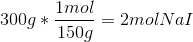
We know our volume is 1L, so now we can solve for the molarity.
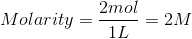
Sodium iodide is given by the formula NaI, and has a molecular weight of 150g/mol. Molarity is found by dividing the moles of solute by liters of solvent.
We find the moles of sodium iodide by using the mass (300g) and molecular weight.
We know our volume is 1L, so now we can solve for the molarity.
← Didn't Know|Knew It →
All of the following are true regarding a solution except .
All of the following are true regarding a solution except .
Tap to reveal answer
Solutions can occur in all three phases of matter. They can also occur between two compounds in a single phase. For example, brass is a solution of two metals: zinc and copper.
Solutions can occur in all three phases of matter. They can also occur between two compounds in a single phase. For example, brass is a solution of two metals: zinc and copper.
← Didn't Know|Knew It →
An unknown element has been shown to be unreactive. It has a low boiling point and an extremely high ionization energy. Which group does the element most likely belong to?
An unknown element has been shown to be unreactive. It has a low boiling point and an extremely high ionization energy. Which group does the element most likely belong to?
Tap to reveal answer
The properties described fit well with the noble gases. Alkali and alkaline earth elements are solid at room temperature, meaning that they have a high boiling point. Halogens can be gaseous at room temperature, but are very reactive. Noble gases have low boiling points and rarely act in spontaneous reactions. Their properties are due to their full valence shell, which is the source of their stability. Changes to their electron configuration (such as removing an electron) require large amounts of energy.
The properties described fit well with the noble gases. Alkali and alkaline earth elements are solid at room temperature, meaning that they have a high boiling point. Halogens can be gaseous at room temperature, but are very reactive. Noble gases have low boiling points and rarely act in spontaneous reactions. Their properties are due to their full valence shell, which is the source of their stability. Changes to their electron configuration (such as removing an electron) require large amounts of energy.
← Didn't Know|Knew It →
Which of the following types of radioactive decay alters the mass number?
Which of the following types of radioactive decay alters the mass number?
Tap to reveal answer
The mass number is the total number of nucleons (protons and neutrons) in an atom's nucleus. An atom that undergoes alpha decay will lose a helium nucleus. This decreases its mass number by four. All other forms of radioactive decay listed alter the atomic number of the atom, but not the mass number.
Beta emission involves the conversion of a neutron to a proton and an electron, but only expels the electron.
Electron capture involves the conversion of a proton and an electron into a neutron.
Positron emission involves the conversion of a proton to a neutron and a "positron," or positively charged electron.
The mass number is the total number of nucleons (protons and neutrons) in an atom's nucleus. An atom that undergoes alpha decay will lose a helium nucleus. This decreases its mass number by four. All other forms of radioactive decay listed alter the atomic number of the atom, but not the mass number.
Beta emission involves the conversion of a neutron to a proton and an electron, but only expels the electron.
Electron capture involves the conversion of a proton and an electron into a neutron.
Positron emission involves the conversion of a proton to a neutron and a "positron," or positively charged electron.
← Didn't Know|Knew It →
Le Chatlier's principle states that when a stressor is introduced to a system, the system will shift its equilibrium state as a way of countering the stress. What are the factors (stressors) that apply to Le Chatlier's principle?
Le Chatlier's principle states that when a stressor is introduced to a system, the system will shift its equilibrium state as a way of countering the stress. What are the factors (stressors) that apply to Le Chatlier's principle?
Tap to reveal answer
Le Chatelier's principle emphasizes three main stressors: changes in temperature, pressure, and concentration of reactants and products. If any of these three stressors are added, the Keq will shift in a way that counters this added stress. Temperature and concentration changes will affect any reaction, while pressure changes will only have a marked effect on reactions involving at least one gaseous compound.
Le Chatelier's principle emphasizes three main stressors: changes in temperature, pressure, and concentration of reactants and products. If any of these three stressors are added, the Keq will shift in a way that counters this added stress. Temperature and concentration changes will affect any reaction, while pressure changes will only have a marked effect on reactions involving at least one gaseous compound.
← Didn't Know|Knew It →
Which of the following is not a property of alkali metals?
Which of the following is not a property of alkali metals?
Tap to reveal answer
Alkali metals are much less dense than other metals due to their large radii, which results from having a single loosely bound valence electron. Some of the alkali metals have such low densities that they can float on water.
Alkali metals are much less dense than other metals due to their large radii, which results from having a single loosely bound valence electron. Some of the alkali metals have such low densities that they can float on water.
← Didn't Know|Knew It →