
Submersion - MCAT Chemical and Physical Foundations of Biological Systems
Card 1 of 203
Solid A has a volume of  and a density of
  . Solid B is cube with sides of
  and has a density of
  .
.
What is the difference in mass between the two solids?
Solid A has a volume of
What is the difference in mass between the two solids?
Tap to reveal answer
The formula for density is:

In the question, we are given the densities of both solids and a means to find their volumes. Using these values, we will be able to determine the mass of each solid.



Now that we know both masses, we can find the difference.

The formula for density is:
In the question, we are given the densities of both solids and a means to find their volumes. Using these values, we will be able to determine the mass of each solid.
Now that we know both masses, we can find the difference.
← Didn't Know|Knew It →
What is the specific gravity of a boat that has a mass of 6000kg and a volume of 10m3?
What is the specific gravity of a boat that has a mass of 6000kg and a volume of 10m3?
Tap to reveal answer
Specific gravity is the density of the substance over the density of water.


Density is given by mass over unit volume.

A boat with a mass of 6000kg and a volume of 10m3 will have a density of 600 kg/m3.
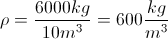
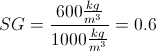
Specific gravity is the density of the substance over the density of water.
Density is given by mass over unit volume.
A boat with a mass of 6000kg and a volume of 10m3 will have a density of 600 kg/m3.
← Didn't Know|Knew It →
A 200-gram object is placed into a bucket of water and floats so that its top edge is just below the surface of the water. Which best describes the density of this object?
Density of water is 1000kg/m3.
A 200-gram object is placed into a bucket of water and floats so that its top edge is just below the surface of the water. Which best describes the density of this object?
Density of water is 1000kg/m3.
Tap to reveal answer
If the object is at rest, the net force on it must equal 0. At any point in the liquid, the total downwards force is described as the difference between the gravitational force and bouyant force:  . When the object is not accelerating, this reduces to
  .
.
Plugging in the equations for these forces respectively yields  .
.
Since mass is the product of density and volume,  .
.
Note that in this case the object's volume equals the volume of liquid displaced, since the object is completely submerged. So, the volumes on either side cancel, as does gravity, leaving just  .
.
If the object is at rest, the net force on it must equal 0. At any point in the liquid, the total downwards force is described as the difference between the gravitational force and bouyant force:
Plugging in the equations for these forces respectively yields
Since mass is the product of density and volume,
Note that in this case the object's volume equals the volume of liquid displaced, since the object is completely submerged. So, the volumes on either side cancel, as does gravity, leaving just
← Didn't Know|Knew It →
An ice cube is placed into a glass containing an unknown liquid. If the ice cube sinks to the bottom, which of the following conclusions could be made?
An ice cube is placed into a glass containing an unknown liquid. If the ice cube sinks to the bottom, which of the following conclusions could be made?
Tap to reveal answer
The density of ice is less than that of water (density of ice = 0.92 g/cm3, density of water = 1 g/cm3). Ice will only sink in liquids that are less dense than 0.92 g/cm3. Since ice will only sink in liquids that are less dense than water, the unknown liquid must have a lower density than that of water.
The density of ice is less than that of water (density of ice = 0.92 g/cm3, density of water = 1 g/cm3). Ice will only sink in liquids that are less dense than 0.92 g/cm3. Since ice will only sink in liquids that are less dense than water, the unknown liquid must have a lower density than that of water.
← Didn't Know|Knew It →
What is the density of a log that is 25cm long, has a cross sectional area of 5cm2, and weighs 100g?
What is the density of a log that is 25cm long, has a cross sectional area of 5cm2, and weighs 100g?
Tap to reveal answer
The density of an object is equal to mass over volume.

Knowing the length and the cross sectional area of the log, we can find its volume.

Plugging in volume and mass into the equation will enable us to find density.
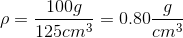
The density of an object is equal to mass over volume.
Knowing the length and the cross sectional area of the log, we can find its volume.
Plugging in volume and mass into the equation will enable us to find density.
← Didn't Know|Knew It →
Phase diagrams are used to depict changes in the properties of a solution at different temperatures and pressures. Below is a phase diagram of a polar solution.
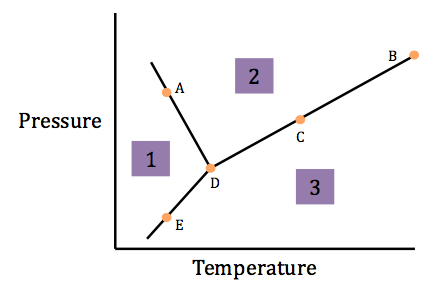
The density of the solution in section 1 is the density of the solution in section 2.
Phase diagrams are used to depict changes in the properties of a solution at different temperatures and pressures. Below is a phase diagram of a polar solution.
The density of the solution in section 1 is the density of the solution in section 2.
Tap to reveal answer
The slope of the solid/liquid phase transition line can predict the comparative density of the solution in each section. A negative slope indicates that the solid phase is less dense than the liquid phase. A positive slope indicates that the solid is more dense. In the above phase diagram, the slope is negative, indicating that the solid is less dense than the liquid.
The slope of the solid/liquid phase transition line can predict the comparative density of the solution in each section. A negative slope indicates that the solid phase is less dense than the liquid phase. A positive slope indicates that the solid is more dense. In the above phase diagram, the slope is negative, indicating that the solid is less dense than the liquid.
← Didn't Know|Knew It →
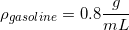
An object is at equilibrium when  of the total volume is submerged in gasoline. Find the density of the object.
An object is at equilibrium when
Tap to reveal answer
To solve, we can equate the volume of the gasoline displaced to the volume of the portion of the object that is submerged.


We know that  of the object is submerged, thus
  of the object's total volume will equal the volume of water displaced.
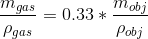
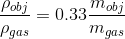
The displaced masses are equal.


To solve, we can equate the volume of the gasoline displaced to the volume of the portion of the object that is submerged.
We know that
The displaced masses are equal.
← Didn't Know|Knew It →
Water has a density of  at a temperature of
  . An certain oil has a specific gravity of
  at this temperature. What is the mass of
  of the oil?
Water has a density of
Tap to reveal answer
The formula for density is:

Specific gravity is the density of a material relative to the density of water.

We are given the specific gravity of the oil and the density of water, allowing us to calculate the density of the oil.


Returning to the equation for density, we can use the density of the oil to find the mass on one liter.


The formula for density is:
Specific gravity is the density of a material relative to the density of water.
We are given the specific gravity of the oil and the density of water, allowing us to calculate the density of the oil.
Returning to the equation for density, we can use the density of the oil to find the mass on one liter.
← Didn't Know|Knew It →
A given iceberg floats such that 90% of its volume is below water. Supposing that the iceberg is composed of pure water, what is the density of the saltwater in which the iceberg floats?

A given iceberg floats such that 90% of its volume is below water. Supposing that the iceberg is composed of pure water, what is the density of the saltwater in which the iceberg floats?
Tap to reveal answer
We can solve this question by using a density ratio, given by the equation:

We know the density of ice, and we can find the ratio of the densities by using buoyancy. If the iceberg were completely submerged, then we could conclude that the density of the ice was equal to the density of the salt water. Since the iceberg is 90% submerged, we can conclude that the density of the ice is 90% of the density of the salt water.

Use this ratio and the density of ice to solve for the density of the salt water.


We can solve this question by using a density ratio, given by the equation:
We know the density of ice, and we can find the ratio of the densities by using buoyancy. If the iceberg were completely submerged, then we could conclude that the density of the ice was equal to the density of the salt water. Since the iceberg is 90% submerged, we can conclude that the density of the ice is 90% of the density of the salt water.
Use this ratio and the density of ice to solve for the density of the salt water.
← Didn't Know|Knew It →
A researcher performs an elemental analysis on a compound. He finds that the compound is made up of only carbon, hydrogen, and oxygen atoms. He isolates a pure sample of the compound and finds that this sample contains  of carbon,
  of hydrogen, and
  of oxygen. The researcher wants to perform further analysis on this compound the next day. Before leaving the lab the researcher creates three stock solutions of varying concentrations of this compound:
  (solution A),
  (solution B), and
  (solution C). He stores these solutions overnight at a temperature of
  .
.
Molecular weight of this compound = 
Which of the following is true regarding the densities of the three stock solutions?
A researcher performs an elemental analysis on a compound. He finds that the compound is made up of only carbon, hydrogen, and oxygen atoms. He isolates a pure sample of the compound and finds that this sample contains
Molecular weight of this compound =
Which of the following is true regarding the densities of the three stock solutions?
Tap to reveal answer
Density is a measure of concentration, defined as mass per unit volume.

Since the stock solutions contain different concentrations, the density of each solution must be different. The solution with the highest concentration will contain the highest density, and the solution with lowest concentration will contain the lowest density. The order of increasing density is solution A, solution B, and solution C. Solution C is the most concentrated and will contain the greatest amount of mass per unit volume, followed by solution B and solution A.

Remember that concentration can be defined in various ways: molarity, molality, mass percent, density, etc. Increasing concentration means you are increasing all of these quantities. Also remember that the density of the compound remains the same in each solution; only the solutions, as a whole, have different densities.
Density is a measure of concentration, defined as mass per unit volume.
Since the stock solutions contain different concentrations, the density of each solution must be different. The solution with the highest concentration will contain the highest density, and the solution with lowest concentration will contain the lowest density. The order of increasing density is solution A, solution B, and solution C. Solution C is the most concentrated and will contain the greatest amount of mass per unit volume, followed by solution B and solution A.
Remember that concentration can be defined in various ways: molarity, molality, mass percent, density, etc. Increasing concentration means you are increasing all of these quantities. Also remember that the density of the compound remains the same in each solution; only the solutions, as a whole, have different densities.
← Didn't Know|Knew It →
A researcher performs an elemental analysis on a compound. He finds that the compound is made up of only carbon, hydrogen, and oxygen atoms. He isolates a pure sample of the compound and finds that this sample contains of carbon, of hydrogen, and of oxygen. The researcher wants to perform further analysis on this compound the next day. Before leaving the lab the researcher creates three stock solutions of varying concentrations of this compound: (solution A), (solution B), and (solution C). He stores these solutions overnight at a temperature of  .
.
Molecular weight of this compound =
A  stock solution, solution X, kept at room temperature (
 ) will have compared to solution A.
A researcher performs an elemental analysis on a compound. He finds that the compound is made up of only carbon, hydrogen, and oxygen atoms. He isolates a pure sample of the compound and finds that this sample contains
Molecular weight of this compound =
A
Tap to reveal answer
Solution A and solution X have the same concentration, therefore, we are only concerned with temperature differences between the two solutions. Density is dependent on temperature: as temperature increases density decreases. Recall the definition of density:

Increasing the temperature will slightly increase the volume of the solution and, subsequently, decrease density. The temperature has no effect on mass. The solution at the higher temperature (solution X) will have a lower density.
Solution A and solution X have the same concentration, therefore, we are only concerned with temperature differences between the two solutions. Density is dependent on temperature: as temperature increases density decreases. Recall the definition of density:
Increasing the temperature will slightly increase the volume of the solution and, subsequently, decrease density. The temperature has no effect on mass. The solution at the higher temperature (solution X) will have a lower density.
← Didn't Know|Knew It →
Various sample sizes of a pure, unknown substance are measured for mass (in grams) and volume (in mL). The results are plotted on a graph with grams of the y-axis and milliliters on the x-axis. Which of the following results most likely indicates experimental error?
Various sample sizes of a pure, unknown substance are measured for mass (in grams) and volume (in mL). The results are plotted on a graph with grams of the y-axis and milliliters on the x-axis. Which of the following results most likely indicates experimental error?
Tap to reveal answer
Plotted in this way, the slope of the line is equal to the density of the substance.
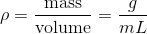
We would expect the line to be linear and positive. A slope close to zero could indicate that the data was not graphed optimally or that the density is extremely small, and a density greater than one is possible (anything that sinks in water has a density greater than one). A negative density would indicate that greater masses of this substance have smaller volumes, which, for a pure substance, does not make sense.
Plotted in this way, the slope of the line is equal to the density of the substance.
We would expect the line to be linear and positive. A slope close to zero could indicate that the data was not graphed optimally or that the density is extremely small, and a density greater than one is possible (anything that sinks in water has a density greater than one). A negative density would indicate that greater masses of this substance have smaller volumes, which, for a pure substance, does not make sense.
← Didn't Know|Knew It →
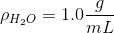
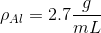
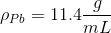

Which of these samples, if any, has a volume greater than three liters?


Which of these samples, if any, has a volume greater than three liters?
Tap to reveal answer
Solving this question requires that we use the given densities to convert mass to volume.



We see that only the aluminum sample has a volume over three liters.
Solving this question requires that we use the given densities to convert mass to volume.
We see that only the aluminum sample has a volume over three liters.
← Didn't Know|Knew It →
Ethanol has a specific gravity of 0.780. If a long barometer tube is placed in a dish of ethanol, with the top end open to the atmosphere, to what height in the tube will the ethanol rise?
Atmospheric pressure = 1.01 * 105 Pa
g = 9.81 m/s2
Density of water = 1000 kg/m3)
Ethanol has a specific gravity of 0.780. If a long barometer tube is placed in a dish of ethanol, with the top end open to the atmosphere, to what height in the tube will the ethanol rise?
Atmospheric pressure = 1.01 * 105 Pa
g = 9.81 m/s2
Density of water = 1000 kg/m3)
Tap to reveal answer
The pressure exerted by the air on the top of the ethanol must equal the fluid pressure in the column of liquid at equilibrium. Fluid pressure is the product of density, gravity, and height of the fluid.

The density of ethanol,  , may be calculated by multiplying specific gravity times the reference density of water, as specific gravity is simply a ratio of a compound's density to that of water.

Using this density in the pressure equation allows us to solve for the height of the ethanol.

After calculating, 
The pressure exerted by the air on the top of the ethanol must equal the fluid pressure in the column of liquid at equilibrium. Fluid pressure is the product of density, gravity, and height of the fluid.
The density of ethanol,
Using this density in the pressure equation allows us to solve for the height of the ethanol.
After calculating,
← Didn't Know|Knew It →
A diver in a lake rises from  deep, where the gauge pressure reads
  , to the surface, where the gauge pressure reads
  . Upon reaching the surface, by what percent has the pressure experienced by the diver changed?
A diver in a lake rises from
Tap to reveal answer
When the diver is submerged, the pressure experienced is the sum of the gauge pressure and the atmospheric pressure above the surface.

At the surface, the gauge pressure will be zero.

The percent change in pressure will be equal to the ratio of the change in pressure to the pressure while submerged.

When the diver is submerged, the pressure experienced is the sum of the gauge pressure and the atmospheric pressure above the surface.
At the surface, the gauge pressure will be zero.
The percent change in pressure will be equal to the ratio of the change in pressure to the pressure while submerged.
← Didn't Know|Knew It →
Two coins lie at the bottom of a pool with an uneven bottom. One is under  of the water, and the second is under
  of water. What is the approximate ratio of total pressure experienced by the first coin to total pressure experienced by the second?
Two coins lie at the bottom of a pool with an uneven bottom. One is under
Tap to reveal answer

Atmospheric pressure always equals  on earth, assuming normal elevation.
Gauge pressure always equals  , where
  is the density of the medium,
  is gravity, and
  is the distance to the surface.



Atmospheric pressure always equals
Gauge pressure always equals
← Didn't Know|Knew It →
A tank is filled to a depth of  with water. Oil with a density of
  is added to the tank until the final depth is
  . What is the reading of the pressure gauge at the bottom of the tank?
Ignore the contribution of atmospheric pressure.
A tank is filled to a depth of
Ignore the contribution of atmospheric pressure.
Tap to reveal answer
The pressure contribution of the liquid can be found using the equation:

The product of the density, gravity, and height of the column of liquid will give the pressure. Start by calculating the pressure of the water.

Then calculate the pressure of the oil.


Sum the pressure of each liquid to find the total pressure at the bottom of the tank.

The pressure contribution of the liquid can be found using the equation:
The product of the density, gravity, and height of the column of liquid will give the pressure. Start by calculating the pressure of the water.
Then calculate the pressure of the oil.
Sum the pressure of each liquid to find the total pressure at the bottom of the tank.
← Didn't Know|Knew It →
Boiling point is the temperature a liquid needs to achieve in order to begin its transformation into a gaseous state. Campers and hikers who prepare food during their trips have to account for differences in atmospheric pressure as they ascend in elevation. During the ascent, the decrease in atmospheric pressure changes the temperature at which water boils.
Further complicating the matter is the observation that addition of a solute to a pure liquid also changes the boiling point. Raoult’s Law can be used to understand the changes in boiling point if a non-volatile solute is present, as expressed here.

In this law,  is the mole fraction of the solvent,
  is the vapor pressure of the pure solvent, and
  is the vapor pressure of the solution. When this vapor pressure is equal to the local atmospheric pressure, the solution boils.
Like boiling point change, osmotic pressure is a property influenced by the addition of solute to solvent. A scientist is studying a solution in a beaker. Osmotic pressure in this solution pulls from solute concentration to solute concentration.
Boiling point is the temperature a liquid needs to achieve in order to begin its transformation into a gaseous state. Campers and hikers who prepare food during their trips have to account for differences in atmospheric pressure as they ascend in elevation. During the ascent, the decrease in atmospheric pressure changes the temperature at which water boils.
Further complicating the matter is the observation that addition of a solute to a pure liquid also changes the boiling point. Raoult’s Law can be used to understand the changes in boiling point if a non-volatile solute is present, as expressed here.
In this law,
Like boiling point change, osmotic pressure is a property influenced by the addition of solute to solvent. A scientist is studying a solution in a beaker. Osmotic pressure in this solution pulls from solute concentration to solute concentration.
Tap to reveal answer
Osmotic pressure pulls water, as a pure solvent, into regions of high solute density to even out the solute concentration between different regions of solution.
Osmotic pressure is related to solute concentration, but does not affect the flow of solute.
Osmotic pressure pulls water, as a pure solvent, into regions of high solute density to even out the solute concentration between different regions of solution.
Osmotic pressure is related to solute concentration, but does not affect the flow of solute.
← Didn't Know|Knew It →
The law of Laplace states what relationship between that the tension in the wall of a bubble and the radius of the bubble?
The law of Laplace states what relationship between that the tension in the wall of a bubble and the radius of the bubble?
Tap to reveal answer
The law of Laplace states that wall tension in a bubble, balloon, pulmonary alveolus, or blood vessel is directly proportional to the radius and the internal pressure.
Law of Laplace: 

In other words, as the size of the bubble increases at constant pressure or as the pressure increases at constant size, the wall tension needed to keep the bubble from increasing in size is increased. In part, this explains why aneurysms on blood vessels burst.
The law of Laplace states that wall tension in a bubble, balloon, pulmonary alveolus, or blood vessel is directly proportional to the radius and the internal pressure.
Law of Laplace:
In other words, as the size of the bubble increases at constant pressure or as the pressure increases at constant size, the wall tension needed to keep the bubble from increasing in size is increased. In part, this explains why aneurysms on blood vessels burst.
← Didn't Know|Knew It →
Which of the following is a possible unit of measurement for surface tension?
Which of the following is a possible unit of measurement for surface tension?
Tap to reveal answer
Surface tension is a phenomenon observed in fluids, and is defined as the resistance of a fluid to outside force (or a resistance to increased surface area). Surface tension is measured in force per unit length.
The SI unit for force is Newtons and the SI unit for length is meters; therefore, the surface tension is usually measured as  .
.
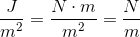
Surface tension can also be measured in energy per unit area. Energy is measured in Joules and area is measured in square meters; therefore, the units for surface tension can also be  .
.
We can see that these units are equivalent by looking at the conversion of Joules and Newtons:

Surface tension is a phenomenon observed in fluids, and is defined as the resistance of a fluid to outside force (or a resistance to increased surface area). Surface tension is measured in force per unit length.
The SI unit for force is Newtons and the SI unit for length is meters; therefore, the surface tension is usually measured as
Surface tension can also be measured in energy per unit area. Energy is measured in Joules and area is measured in square meters; therefore, the units for surface tension can also be
We can see that these units are equivalent by looking at the conversion of Joules and Newtons:
← Didn't Know|Knew It →