
Catalysts, Transition States, and Activation Energy - MCAT Chemical and Physical Foundations of Biological Systems
Card 1 of 161
Which of the following is true about the rate-determining step of a reaction that contains two transition states?
Which of the following is true about the rate-determining step of a reaction that contains two transition states?
Tap to reveal answer
The rate-determining step is the slowest step in the reaction; however, there can be more than one rate-determining step if there are two steps that have high activation energies. Enzymes help lower the activation energy for a particular step, and thus diminish the effect of rate-determining steps to speed up the reaction. The rate-determining step generally precedes the highest energy transition state.
The rate-determining step is the slowest step in the reaction; however, there can be more than one rate-determining step if there are two steps that have high activation energies. Enzymes help lower the activation energy for a particular step, and thus diminish the effect of rate-determining steps to speed up the reaction. The rate-determining step generally precedes the highest energy transition state.
← Didn't Know|Knew It →
Which of the following are true concerning the rate-limiting step of a chemical reaction?
I. It is the slowest step
II. Cannot be altered by a catalyst or enzyme
III. Involves the transition state with the highest activation energy
IV. Is un-affected by a change in reactant concentration or reaction temperature
Which of the following are true concerning the rate-limiting step of a chemical reaction?
I. It is the slowest step
II. Cannot be altered by a catalyst or enzyme
III. Involves the transition state with the highest activation energy
IV. Is un-affected by a change in reactant concentration or reaction temperature
Tap to reveal answer
The rate-limiting step of any reaction will always have the highest activation energy, and thus be the slowest step in a chemical reaction (hence the name). It can be altered with the help of a catalyst, by changing the concentration of reactions, and by altering the reaction temperature. These changes can affect the energy of a transition state or chemical equilibrium, altering the rate-limiting step. Only choices I and III are true.
The rate-limiting step of any reaction will always have the highest activation energy, and thus be the slowest step in a chemical reaction (hence the name). It can be altered with the help of a catalyst, by changing the concentration of reactions, and by altering the reaction temperature. These changes can affect the energy of a transition state or chemical equilibrium, altering the rate-limiting step. Only choices I and III are true.
← Didn't Know|Knew It →
Carbonic anhydrase is an important enzyme that allows CO2 and H2O to be converted into H2CO3. In addition to allowing CO2 to be dissolved into the blood and transported to the lungs for exhalation, the products of the carbonic anhydrase reaction, H2CO3 and a related compound HCO3-, also serve to control the pH of the blood to prevent acidosis or alkalosis. The carbonic anhydrase reaction and acid-base reaction are presented below.
CO2 + H2O  H2CO3
H2CO3
H2CO3  HCO3- + H+
If the reaction series presented above is occurring during alkalosis, H2CO3 may be considered a(n) .
Carbonic anhydrase is an important enzyme that allows CO2 and H2O to be converted into H2CO3. In addition to allowing CO2 to be dissolved into the blood and transported to the lungs for exhalation, the products of the carbonic anhydrase reaction, H2CO3 and a related compound HCO3-, also serve to control the pH of the blood to prevent acidosis or alkalosis. The carbonic anhydrase reaction and acid-base reaction are presented below.
CO2 + H2O
H2CO3
If the reaction series presented above is occurring during alkalosis, H2CO3 may be considered a(n) .
Tap to reveal answer
First, we need to see what the information the question provides us, namely that the reaction is occurring during alkalosis. In alkalosis, we know that the H+ concentration is too low, thus the reaction must be favoring the products in order to reduce the effects of alkalosis (Le Chatlier’s Principle). The H+ is low on the products side, so the reaction shifts to the right. Next, we need to determine where in the reaction H2CO3 is and what is happening to it. We can see that H2CO3 is formed from CO2 and H2O, but then is used up to create HCO3- and H+. In the scenario of alkalosis, H2CO3 will be formed then used (the definition of an intermediate).
First, we need to see what the information the question provides us, namely that the reaction is occurring during alkalosis. In alkalosis, we know that the H+ concentration is too low, thus the reaction must be favoring the products in order to reduce the effects of alkalosis (Le Chatlier’s Principle). The H+ is low on the products side, so the reaction shifts to the right. Next, we need to determine where in the reaction H2CO3 is and what is happening to it. We can see that H2CO3 is formed from CO2 and H2O, but then is used up to create HCO3- and H+. In the scenario of alkalosis, H2CO3 will be formed then used (the definition of an intermediate).
← Didn't Know|Knew It →
Carbonic anhydrase is an important enzyme that allows CO2 and H2O to be converted into H2CO3. In addition to allowing CO2 to be dissolved into the blood and transported to the lungs for exhalation, the products of the carbonic anhydrase reaction, H2CO3 and a related compound HCO3-, also serve to control the pH of the blood to prevent acidosis or alkalosis. The carbonic anhydrase reaction and acid-base reaction are presented below.
CO2 + H2O  H2CO3
H2CO3
H2CO3  HCO3- + H+
Increasing the concentration of the carbonic anhydrase would the rate constant of the forward reaction.
Carbonic anhydrase is an important enzyme that allows CO2 and H2O to be converted into H2CO3. In addition to allowing CO2 to be dissolved into the blood and transported to the lungs for exhalation, the products of the carbonic anhydrase reaction, H2CO3 and a related compound HCO3-, also serve to control the pH of the blood to prevent acidosis or alkalosis. The carbonic anhydrase reaction and acid-base reaction are presented below.
CO2 + H2O
H2CO3
Increasing the concentration of the carbonic anhydrase would the rate constant of the forward reaction.
Tap to reveal answer
The concentration of the enzyme is independent of the rate constant because the enzyme can only catalyze the conversion of reactants to products at a specific rate. Increasing the concentration of the enzyme, however, would increase the absolute number of reactions occurring simultaneously; thus, the rate of reaction (but not the rate constant) would increase.
The concentration of the enzyme is independent of the rate constant because the enzyme can only catalyze the conversion of reactants to products at a specific rate. Increasing the concentration of the enzyme, however, would increase the absolute number of reactions occurring simultaneously; thus, the rate of reaction (but not the rate constant) would increase.
← Didn't Know|Knew It →
Carbonic anhydrase is an important enzyme that allows CO2 and H2O to be converted into H2CO3. In addition to allowing CO2 to be dissolved into the blood and transported to the lungs for exhalation, the products of the carbonic anhydrase reaction, H2CO3 and a related compound HCO3-, also serve to control the pH of the blood to prevent acidosis or alkalosis. The carbonic anhydrase reaction and acid-base reaction are presented below.
CO2 + H2O  H2CO3
H2CO3
H2CO3  HCO3- + H+
Carbonic anhydrase catalyzes the reaction of CO2 (g) + H2O (l)  H2CO3 (l). If the temperature of the reaction were increased, such as in exercise, how would the rate of reaction change?
Carbonic anhydrase is an important enzyme that allows CO2 and H2O to be converted into H2CO3. In addition to allowing CO2 to be dissolved into the blood and transported to the lungs for exhalation, the products of the carbonic anhydrase reaction, H2CO3 and a related compound HCO3-, also serve to control the pH of the blood to prevent acidosis or alkalosis. The carbonic anhydrase reaction and acid-base reaction are presented below.
CO2 + H2O
H2CO3
Carbonic anhydrase catalyzes the reaction of CO2 (g) + H2O (l)
Tap to reveal answer
This question asks us how the rate of the reaction would change if temperature were increased. Increasing the temperature increases the relative velocity of each reactant, increasing the chance that two reactants collide and are able to form a product with the help of carbonic anhydrase. This can also be seen with the following equation.
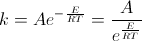
Increasing the temperature decreases the denominator because eE/RT becomes e0 = 1 as the temperature increases. The overall effect is an increasing in reaction rate.
Note however, that the temperature can only increase up to a point. Once the temperature becomes too high, the enzyme would denature and no longer work.
This question asks us how the rate of the reaction would change if temperature were increased. Increasing the temperature increases the relative velocity of each reactant, increasing the chance that two reactants collide and are able to form a product with the help of carbonic anhydrase. This can also be seen with the following equation.
Increasing the temperature decreases the denominator because eE/RT becomes e0 = 1 as the temperature increases. The overall effect is an increasing in reaction rate.
Note however, that the temperature can only increase up to a point. Once the temperature becomes too high, the enzyme would denature and no longer work.
← Didn't Know|Knew It →
Carbonic anhydrase is an important enzyme that allows CO2 and H2O to be converted into H2CO3. In addition to allowing CO2 to be dissolved into the blood and transported to the lungs for exhalation, the products of the carbonic anhydrase reaction, H2CO3 and a related compound HCO3-, also serve to control the pH of the blood to prevent acidosis or alkalosis. The carbonic anhydrase reaction and acid-base reaction are presented below.
CO2 + H2O  H2CO3
H2CO3
H2CO3  HCO3- + H+
If the pH of the blood increases above 8, how would the activity of carbonic anhydrase change?
Carbonic anhydrase is an important enzyme that allows CO2 and H2O to be converted into H2CO3. In addition to allowing CO2 to be dissolved into the blood and transported to the lungs for exhalation, the products of the carbonic anhydrase reaction, H2CO3 and a related compound HCO3-, also serve to control the pH of the blood to prevent acidosis or alkalosis. The carbonic anhydrase reaction and acid-base reaction are presented below.
CO2 + H2O
H2CO3
If the pH of the blood increases above 8, how would the activity of carbonic anhydrase change?
Tap to reveal answer
Extreme temperatures and pH levels decrease the activity of enzymes because they become denatured. In the body, most enzymes work optimally around a pH of 7.4. Increasing the pH too high would denature a protein because amino acids that are normally protonated at physiological pH (i.e. acidic residues) would become deprotonated. Lack of protonation would cause collapse of the tertiary and quaternary structures, leading to a decrease in enzyme function.
Extreme temperatures and pH levels decrease the activity of enzymes because they become denatured. In the body, most enzymes work optimally around a pH of 7.4. Increasing the pH too high would denature a protein because amino acids that are normally protonated at physiological pH (i.e. acidic residues) would become deprotonated. Lack of protonation would cause collapse of the tertiary and quaternary structures, leading to a decrease in enzyme function.
← Didn't Know|Knew It →
Carbonic anhydrase is an important enzyme that allows CO2 and H2O to be converted into H2CO3. In addition to allowing CO2 to be dissolved into the blood and transported to the lungs for exhalation, the products of the carbonic anhydrase reaction, H2CO3 and a related compound HCO3-, also serve to control the pH of the blood to prevent acidosis or alkalosis. The carbonic anhydrase reaction and acid-base reaction are presented below.
CO2 + H2O  H2CO3
H2CO3
H2CO3  HCO3- + H+
If the pH of the blood decreases below 7, how would the concentration of HCO3- change?
Carbonic anhydrase is an important enzyme that allows CO2 and H2O to be converted into H2CO3. In addition to allowing CO2 to be dissolved into the blood and transported to the lungs for exhalation, the products of the carbonic anhydrase reaction, H2CO3 and a related compound HCO3-, also serve to control the pH of the blood to prevent acidosis or alkalosis. The carbonic anhydrase reaction and acid-base reaction are presented below.
CO2 + H2O
H2CO3
If the pH of the blood decreases below 7, how would the concentration of HCO3- change?
Tap to reveal answer
Extreme temperatures and pH levels decrease the activity of enzymes because they become denatured. In the body, most enzymes work optimally around a pH of 7.4. Decreasing the pH too low would denature a protein because amino acids that are normally deprotonated at physiological pH (i.e. basic residues) would become protonated. Protonation would cause changes in tertiary and quaternary structures, leading to a decrease in enzyme function, thus the concentration of the product in the catalyzed reaction would decrease as well.
Extreme temperatures and pH levels decrease the activity of enzymes because they become denatured. In the body, most enzymes work optimally around a pH of 7.4. Decreasing the pH too low would denature a protein because amino acids that are normally deprotonated at physiological pH (i.e. basic residues) would become protonated. Protonation would cause changes in tertiary and quaternary structures, leading to a decrease in enzyme function, thus the concentration of the product in the catalyzed reaction would decrease as well.
← Didn't Know|Knew It →
Reaction: 
Step 1:  (fast)
Step 2:  (slow)
In the reaction above, which step is the rate-determining step and what is the intermediate?
Reaction:
Step 1:
Step 2:
In the reaction above, which step is the rate-determining step and what is the intermediate?
Tap to reveal answer
In this reaction, step 2 is the rate-determining step and BC2 is the intermediate. The rate-determining step is always the slowest step in the reaction; the rate of the entire reaction depends on the speed of this step. BC2 is the intermediate because intermediates are not found in the overall reaction; they are produced and then immediately consumed.
In this reaction, step 2 is the rate-determining step and BC2 is the intermediate. The rate-determining step is always the slowest step in the reaction; the rate of the entire reaction depends on the speed of this step. BC2 is the intermediate because intermediates are not found in the overall reaction; they are produced and then immediately consumed.
← Didn't Know|Knew It →
Which of the following statements is false about catalysts?
Which of the following statements is false about catalysts?
Tap to reveal answer
Catalysts do not shift the equilibrium position of a reaction in favor of the products.
Catalysts speed up chemical reactions by lowering the activation energy (Ea) of reactions, but do not affect the equilibrium position since the change in rate from reactants to products speeds up proportionally to the change in rate from products to reactants (the same Keq will be achieved whether a catalyst is used or not).
Catalysts do not shift the equilibrium position of a reaction in favor of the products.
Catalysts speed up chemical reactions by lowering the activation energy (Ea) of reactions, but do not affect the equilibrium position since the change in rate from reactants to products speeds up proportionally to the change in rate from products to reactants (the same Keq will be achieved whether a catalyst is used or not).
← Didn't Know|Knew It →
If the reactants and/or products in a chemical reaction are gases, the reaction rate can be determined by measuring the change of pressure as the reaction proceeds. Consider the following reaction and pressure vs. reaction rate data below.

Trial PXY(torr) PZ(torr) Rate (torr/s) 1 100 200 0.16 2 200 200 0.32 3 200 100 0.04 4 200 150 0.14
If an inhibitory catalyst were added to the reaction .
If the reactants and/or products in a chemical reaction are gases, the reaction rate can be determined by measuring the change of pressure as the reaction proceeds. Consider the following reaction and pressure vs. reaction rate data below.
| Trial | PXY(torr) | PZ(torr) | Rate (torr/s) |
|---|---|---|---|
| 1 | 100 | 200 | 0.16 |
| 2 | 200 | 200 | 0.32 |
| 3 | 200 | 100 | 0.04 |
| 4 | 200 | 150 | 0.14 |
If an inhibitory catalyst were added to the reaction .
Tap to reveal answer
A catalyst affects activation energy; an inhibitory catalyst increases activation energy. Catalysts do not affect equilibrium concentrations of products or reactants.
A catalyst affects activation energy; an inhibitory catalyst increases activation energy. Catalysts do not affect equilibrium concentrations of products or reactants.
← Didn't Know|Knew It →
For any given chemical reaction, one can draw an energy diagram. Energy diagrams depict the energy levels of the different steps in a reaction, while also indicating the net change in energy and giving clues to relative reaction rate.
Below, a reaction diagram is shown for a reaction that a scientist is studying in a lab. A student began the reaction the evening before, but the scientist is unsure as to the type of the reaction. He cannot find the student’s notes, except for the reaction diagram below.
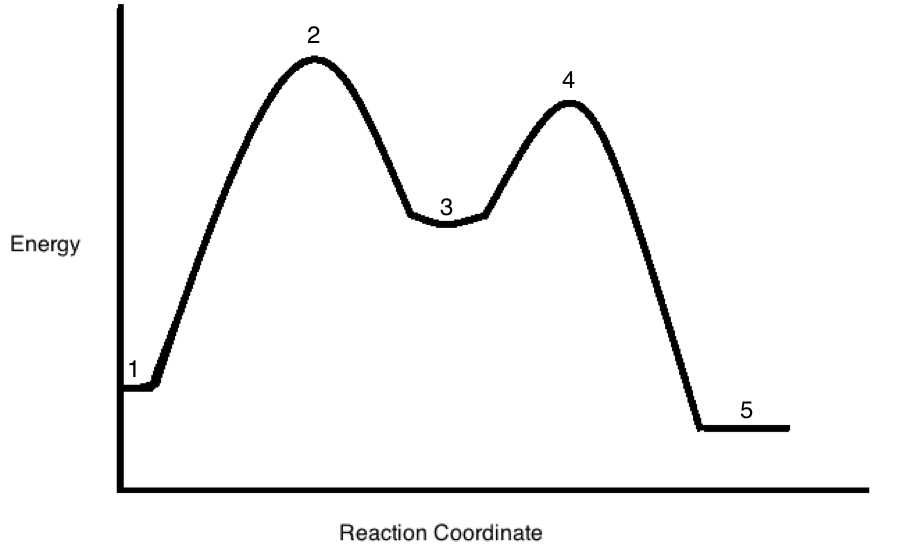
Upon further review, the scientist realizes that the reaction in question involved formation of a carbocation that quickly reacted again to form stable products. At which point would we most likely find this carbocation in the above diagram?
For any given chemical reaction, one can draw an energy diagram. Energy diagrams depict the energy levels of the different steps in a reaction, while also indicating the net change in energy and giving clues to relative reaction rate.
Below, a reaction diagram is shown for a reaction that a scientist is studying in a lab. A student began the reaction the evening before, but the scientist is unsure as to the type of the reaction. He cannot find the student’s notes, except for the reaction diagram below.
Upon further review, the scientist realizes that the reaction in question involved formation of a carbocation that quickly reacted again to form stable products. At which point would we most likely find this carbocation in the above diagram?
Tap to reveal answer
Point 3 is where you would expect to find a relatively stable intermediate. An intermediate is more stable than a transition state, but not as stable as the original reactants and final products. Stability is inversely proportional to energy, thus we are looking for the point that is between the highest and lowest energies in the reaction. By this logic, point 1 is the reactants, 2 and 4 are transition states, 3 is a stable intermediate, and 5 is the products.
Point 3 is where you would expect to find a relatively stable intermediate. An intermediate is more stable than a transition state, but not as stable as the original reactants and final products. Stability is inversely proportional to energy, thus we are looking for the point that is between the highest and lowest energies in the reaction. By this logic, point 1 is the reactants, 2 and 4 are transition states, 3 is a stable intermediate, and 5 is the products.
← Didn't Know|Knew It →
For any given chemical reaction, one can draw an energy diagram. Energy diagrams depict the energy levels of the different steps in a reaction, while also indicating the net change in energy and giving clues to relative reaction rate.
Below, a reaction diagram is shown for a reaction that a scientist is studying in a lab. A student began the reaction the evening before, but the scientist is unsure as to the type of the reaction. He cannot find the student’s notes, except for the reaction diagram below.
In the reaction diagram, which point is most instrumental in determining the rate of the forward reaction?
For any given chemical reaction, one can draw an energy diagram. Energy diagrams depict the energy levels of the different steps in a reaction, while also indicating the net change in energy and giving clues to relative reaction rate.
Below, a reaction diagram is shown for a reaction that a scientist is studying in a lab. A student began the reaction the evening before, but the scientist is unsure as to the type of the reaction. He cannot find the student’s notes, except for the reaction diagram below.
In the reaction diagram, which point is most instrumental in determining the rate of the forward reaction?
Tap to reveal answer
Point 2 is at the highest peak on the chart. The difference between the energy level at this point and the energy level of the reactants is the activation energy. This is the energy that the reactants must overcome to proceed to the lower energy products. Overcoming this point takes energy, and is the primary limiting factor in the speed of any reaction.
Point 2 is at the highest peak on the chart. The difference between the energy level at this point and the energy level of the reactants is the activation energy. This is the energy that the reactants must overcome to proceed to the lower energy products. Overcoming this point takes energy, and is the primary limiting factor in the speed of any reaction.
← Didn't Know|Knew It →
For any given chemical reaction, one can draw an energy diagram. Energy diagrams depict the energy levels of the different steps in a reaction, while also indicating the net change in energy and giving clues to relative reaction rate.
Below, a reaction diagram is shown for a reaction that a scientist is studying in a lab. A student began the reaction the evening before, but the scientist is unsure as to the type of the reaction. He cannot find the student’s notes, except for the reaction diagram below.
At which point(s) on the above graph would you expect to find bonds forming and breaking?
For any given chemical reaction, one can draw an energy diagram. Energy diagrams depict the energy levels of the different steps in a reaction, while also indicating the net change in energy and giving clues to relative reaction rate.
Below, a reaction diagram is shown for a reaction that a scientist is studying in a lab. A student began the reaction the evening before, but the scientist is unsure as to the type of the reaction. He cannot find the student’s notes, except for the reaction diagram below.
At which point(s) on the above graph would you expect to find bonds forming and breaking?
Tap to reveal answer
It may be tempting to include points 2, 3, and 4, but only points 2 and 4 actually have bonds in the process of forming and breaking. This lack of stability is what gives these points the highest relative energy levels on the diagram. Point 3 is a relatively stable intermediate, stabilized by the fact that it does not have bonds in active flux.
It may be tempting to include points 2, 3, and 4, but only points 2 and 4 actually have bonds in the process of forming and breaking. This lack of stability is what gives these points the highest relative energy levels on the diagram. Point 3 is a relatively stable intermediate, stabilized by the fact that it does not have bonds in active flux.
← Didn't Know|Knew It →
For any given chemical reaction, one can draw an energy diagram. Energy diagrams depict the energy levels of the different steps in a reaction, while also indicating the net change in energy and giving clues to relative reaction rate.
Below, a reaction diagram is shown for a reaction that a scientist is studying in a lab. A student began the reaction the evening before, but the scientist is unsure as to the type of the reaction. He cannot find the student’s notes, except for the reaction diagram below.
The scientist in the passage is attempting to modify the reaction as it is ongoing, and adds a catalyst to the vessel. Which points will not move with the addition of a catalyst?
For any given chemical reaction, one can draw an energy diagram. Energy diagrams depict the energy levels of the different steps in a reaction, while also indicating the net change in energy and giving clues to relative reaction rate.
Below, a reaction diagram is shown for a reaction that a scientist is studying in a lab. A student began the reaction the evening before, but the scientist is unsure as to the type of the reaction. He cannot find the student’s notes, except for the reaction diagram below.
The scientist in the passage is attempting to modify the reaction as it is ongoing, and adds a catalyst to the vessel. Which points will not move with the addition of a catalyst?
Tap to reveal answer
Points 1 and 5 are the energy levels of the reactants and products, respectively. These levels do not change with the action of a catalyst, and instead are fixed by the thermodynamic nature of the chemical species involved. A catalyst would lower activation energies by providing an alternate route to reach the products from the reactants, and thus would likely affect points 2, 3, and 4.
Points 1 and 5 are the energy levels of the reactants and products, respectively. These levels do not change with the action of a catalyst, and instead are fixed by the thermodynamic nature of the chemical species involved. A catalyst would lower activation energies by providing an alternate route to reach the products from the reactants, and thus would likely affect points 2, 3, and 4.
← Didn't Know|Knew It →
For any given chemical reaction, one can draw an energy diagram. Energy diagrams depict the energy levels of the different steps in a reaction, while also indicating the net change in energy and giving clues to relative reaction rate.
Below, a reaction diagram is shown for a reaction that a scientist is studying in a lab. A student began the reaction the evening before, but the scientist is unsure as to the type of the reaction. He cannot find the student’s notes, except for the reaction diagram below.
After much thought, the scientist in the passage determines that the reaction depicted in the diagram must be either a radical reaction or a combustion reaction. Which of these options is more likely?
For any given chemical reaction, one can draw an energy diagram. Energy diagrams depict the energy levels of the different steps in a reaction, while also indicating the net change in energy and giving clues to relative reaction rate.
Below, a reaction diagram is shown for a reaction that a scientist is studying in a lab. A student began the reaction the evening before, but the scientist is unsure as to the type of the reaction. He cannot find the student’s notes, except for the reaction diagram below.
After much thought, the scientist in the passage determines that the reaction depicted in the diagram must be either a radical reaction or a combustion reaction. Which of these options is more likely?
Tap to reveal answer
A radical reaction would be a more likely candidate in this case, as step 3 on the diagram would correspond to the stable intermediate. In the radical reaction, this would correspond to a radical intermediate.
Combustion reactions typically don't have a stable intermediate, and are typically exothermic (not endothermic as the answer choice indicates).
A radical reaction would be a more likely candidate in this case, as step 3 on the diagram would correspond to the stable intermediate. In the radical reaction, this would correspond to a radical intermediate.
Combustion reactions typically don't have a stable intermediate, and are typically exothermic (not endothermic as the answer choice indicates).
← Didn't Know|Knew It →
For any given chemical reaction, one can draw an energy diagram. Energy diagrams depict the energy levels of the different steps in a reaction, while also indicating the net change in energy and giving clues to relative reaction rate.
Below, a reaction diagram is shown for a reaction that a scientist is studying in a lab. A student began the reaction the evening before, but the scientist is unsure as to the type of the reaction. He cannot find the student’s notes, except for the reaction diagram below.
The scientist in the passage is able to determine that the reactants in the diagram are hydrophilic compounds. Which of the following is likely to decrease the energy level of the reactants?
For any given chemical reaction, one can draw an energy diagram. Energy diagrams depict the energy levels of the different steps in a reaction, while also indicating the net change in energy and giving clues to relative reaction rate.
Below, a reaction diagram is shown for a reaction that a scientist is studying in a lab. A student began the reaction the evening before, but the scientist is unsure as to the type of the reaction. He cannot find the student’s notes, except for the reaction diagram below.
The scientist in the passage is able to determine that the reactants in the diagram are hydrophilic compounds. Which of the following is likely to decrease the energy level of the reactants?
Tap to reveal answer
Of any of these changes, only the presence of resonance structures will decrease the overall energy level of hydrophilic compounds. The two solution options both reference nonpolar solvents (though carbon tetrachloride has polar bonds, their geometry cancels out any net dipole moment). Additionally, pi bonds are high energy bonds, and d and f orbitals are high energy orbitals.
Resonace allows greater charge distribution and stability, thus reducing energy level.
Of any of these changes, only the presence of resonance structures will decrease the overall energy level of hydrophilic compounds. The two solution options both reference nonpolar solvents (though carbon tetrachloride has polar bonds, their geometry cancels out any net dipole moment). Additionally, pi bonds are high energy bonds, and d and f orbitals are high energy orbitals.
Resonace allows greater charge distribution and stability, thus reducing energy level.
← Didn't Know|Knew It →
Which of the following is false about catalyzed reactions?
Which of the following is false about catalyzed reactions?
Tap to reveal answer
A catalyst is a substance that increases the rate of a reaction without being altered or used up in the reaction. Both the forward and reverse rates of the reaction are accelerated by a catalyst. Slowing the reverse rate, with an increase in forward rate, would result in a shift in equilibrium. Remember that a catalyst will never change the equilibrium constant (Keq) of a reaction.
A catalyst is a substance that increases the rate of a reaction without being altered or used up in the reaction. Both the forward and reverse rates of the reaction are accelerated by a catalyst. Slowing the reverse rate, with an increase in forward rate, would result in a shift in equilibrium. Remember that a catalyst will never change the equilibrium constant (Keq) of a reaction.
← Didn't Know|Knew It →


Suppose a catalyst is added to the equation. How will this affect  ?
?
Suppose a catalyst is added to the equation. How will this affect
Tap to reveal answer
Remember that catalysts affect the kinetics of a reaction, but will not affect the equilibrium. As a result,  will remain the same in the presence of a catalyst, though the reaction rate will accelerate.
Remember that catalysts affect the kinetics of a reaction, but will not affect the equilibrium. As a result,
← Didn't Know|Knew It →
Acids and bases can be described in three principal ways. The Arrhenius definition is the most restrictive. It limits acids and bases to species that donate protons and hydroxide ions in solution, respectively. Examples of such acids include HCl and HBr, while KOH and NaOH are examples of bases. When in aqueous solution, these acids proceed to an equilibrium state through a dissociation reaction.

All of the bases proceed in a similar fashion.

The Brønsted-Lowry definition of an acid is a more inclusive approach. All Arrhenius acids and bases are also Brønsted-Lowry acids and bases, but the converse is not true. Brønsted-Lowry acids still reach equilibrium through the same dissociation reaction as Arrhenius acids, but the acid character is defined by different parameters. The Brønsted-Lowry definition considers bases to be hydroxide donors, like the Arrhenius definition, but also includes conjugate bases such as the A- in the above reaction. In the reverse reaction, A- accepts the proton to regenerate HA. The Brønsted-Lowry definition thus defines bases as proton acceptors, and acids as proton donors.
Acids and bases can be used as catalysts to promote faster reactions of various types. Which of the following will be be true of these catalytic reactions?
I. The acid or base will be regenerated by the reaction
II. The acid or base will increase the activation energy of the reaction
III. The acid or base will increase the amount of energy released by exothermic reactions
Acids and bases can be described in three principal ways. The Arrhenius definition is the most restrictive. It limits acids and bases to species that donate protons and hydroxide ions in solution, respectively. Examples of such acids include HCl and HBr, while KOH and NaOH are examples of bases. When in aqueous solution, these acids proceed to an equilibrium state through a dissociation reaction.
All of the bases proceed in a similar fashion.
The Brønsted-Lowry definition of an acid is a more inclusive approach. All Arrhenius acids and bases are also Brønsted-Lowry acids and bases, but the converse is not true. Brønsted-Lowry acids still reach equilibrium through the same dissociation reaction as Arrhenius acids, but the acid character is defined by different parameters. The Brønsted-Lowry definition considers bases to be hydroxide donors, like the Arrhenius definition, but also includes conjugate bases such as the A- in the above reaction. In the reverse reaction, A- accepts the proton to regenerate HA. The Brønsted-Lowry definition thus defines bases as proton acceptors, and acids as proton donors.
Acids and bases can be used as catalysts to promote faster reactions of various types. Which of the following will be be true of these catalytic reactions?
I. The acid or base will be regenerated by the reaction
II. The acid or base will increase the activation energy of the reaction
III. The acid or base will increase the amount of energy released by exothermic reactions
Tap to reveal answer
A catalyst must be regenerated in its original form for it to be considered as such. A catalyst is never consumed or produced by a reaction. At once, a catalyst cannot change the thermodynamic properties of a reaction, including the energy absorbed or released. Catalysts typically function by lowering the activation energy, not increasing it.
A catalyst must be regenerated in its original form for it to be considered as such. A catalyst is never consumed or produced by a reaction. At once, a catalyst cannot change the thermodynamic properties of a reaction, including the energy absorbed or released. Catalysts typically function by lowering the activation energy, not increasing it.
← Didn't Know|Knew It →
A scientist is studying a reaction, and places the reactants in a beaker at room temperature. The reaction progresses, and she analyzes the products via NMR. Based on the NMR readout, she determines the reaction proceeds as follows:

In an attempt to better understand the reaction process, she varies the concentrations of the reactants and studies how the rate of the reaction changes. The table below shows the reaction concentrations as she makes modifications in three experimental trials.
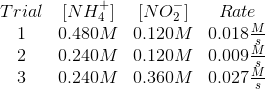
A different scientist runs the same reaction described in the passage. In this trial, however, the scientist adds a catalyst. With the addition of a catalyst, which of the following must be true?
I. The overall order of the reaction increases
II. The rate constant increases
III. The activation energy decreases
A scientist is studying a reaction, and places the reactants in a beaker at room temperature. The reaction progresses, and she analyzes the products via NMR. Based on the NMR readout, she determines the reaction proceeds as follows:
In an attempt to better understand the reaction process, she varies the concentrations of the reactants and studies how the rate of the reaction changes. The table below shows the reaction concentrations as she makes modifications in three experimental trials.
A different scientist runs the same reaction described in the passage. In this trial, however, the scientist adds a catalyst. With the addition of a catalyst, which of the following must be true?
I. The overall order of the reaction increases
II. The rate constant increases
III. The activation energy decreases
Tap to reveal answer
The addition of a catalyst lowers the activation energy of a reaction. This means that the rate constant will increase, as the activation energy is a term used to calculate this value.
The Arrhenius equation shows that  , where
  is the activation energy.
The order of the reaction, however, does not increase.
The addition of a catalyst lowers the activation energy of a reaction. This means that the rate constant will increase, as the activation energy is a term used to calculate this value.
The Arrhenius equation shows that
The order of the reaction, however, does not increase.
← Didn't Know|Knew It →