
Reactions and Titrations - MCAT Chemical and Physical Foundations of Biological Systems
Card 1 of 280
A solution of acetic acid (pKa = 4.75) has a pH of 6.75. The ratio of acid to conjugate base is .
A solution of acetic acid (pKa = 4.75) has a pH of 6.75. The ratio of acid to conjugate base is .
Tap to reveal answer
Use the Henderson-Hasselbalch equation: ![\dpi{100} \small pH=pK_{a}+log\left \frac{\left [ A^{-} \right ]}{\left [ HA \right ]}](https://vt-vtwa-assets.varsitytutors.com/vt-vtwa/uploads/formula_image/image/18757/gif.latex)
![\dpi{100} \small 6.75=4.75+log\left \frac{\left [ A^{-} \right ]}{\left [ HA \right ]}](https://vt-vtwa-assets.varsitytutors.com/vt-vtwa/uploads/formula_image/image/18758/gif.latex)
![\dpi{100} \small 2=log\left \frac{\left [ A^{-} \right ]}{\left [ HA \right ]}](https://vt-vtwa-assets.varsitytutors.com/vt-vtwa/uploads/formula_image/image/18759/gif.latex)
![\dpi{100} \small 10^{2}=\left \frac{\left [ A^{-} \right ]}{\left [ HA \right ]}=100](https://vt-vtwa-assets.varsitytutors.com/vt-vtwa/uploads/formula_image/image/18760/gif.latex)
We want the ratio of acid to conjugate base, which would be the reciprocal, ![\dpi{100} \small 10^{2}=\left \frac{\left [ HA \right ]}{\left [ A^{-} \right ]}=\frac{1}{100}](https://vt-vtwa-assets.varsitytutors.com/vt-vtwa/uploads/formula_image/image/18761/gif.latex)
Use the Henderson-Hasselbalch equation:
We want the ratio of acid to conjugate base, which would be the reciprocal,
← Didn't Know|Knew It →
You need to produce a buffer with pH of  . You have a solution with
  of acetic acid (
 ). How many moles of sodium acetate must you add to achieve the desired pH?
You need to produce a buffer with pH of
Tap to reveal answer
Use the Henderson-Hasselbalch equation: ![\dpi{100} \small pH=pK_{a}+log\left \frac{\left [ A^{-} \right ]}{\left [ HA \right ]}](https://vt-vtwa-assets.varsitytutors.com/vt-vtwa/uploads/formula_image/image/18762/gif.latex)
Assuming that these ions occupy the same volume, ![\dpi{100} \small log=\frac{\left [ A^{-} \right ]}{\left [ HA \right ]}=log\frac{\left ( mol\ of\ A^{-}\right )}{\left ( mol\ of\ HA\right )}](https://vt-vtwa-assets.varsitytutors.com/vt-vtwa/uploads/formula_image/image/18763/gif.latex)
We know we have 30g of acetic acid, which is equal to 0.5mol (you should memorize the formula for acetic acid).
Plugging in our values gives us 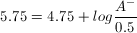
Solving for A– gives us 5mol.
Use the Henderson-Hasselbalch equation:
Assuming that these ions occupy the same volume,
We know we have 30g of acetic acid, which is equal to 0.5mol (you should memorize the formula for acetic acid).
Plugging in our values gives us
Solving for A– gives us 5mol.
← Didn't Know|Knew It →
NaOH is added to a 500mL of 2M acetic acid. If the pKa value of acetic acid is approximately 4.8, what volume of 2M NaOH must be added so that the pH of the solution is 4.8?
NaOH is added to a 500mL of 2M acetic acid. If the pKa value of acetic acid is approximately 4.8, what volume of 2M NaOH must be added so that the pH of the solution is 4.8?
Tap to reveal answer
To solve this question you need to think about the chemical reaction occurring.

We can ignore water and sodium ions for the sake of this question. The reactants exist in a 1:1 ratio, so that for every mol of NaOH we add, we lose one mol of acetic acid and gain one mol of acetate. We can determine the moles of acetic acid by using M = mol/L, which gives us mol = ML = (2M) * (0.5L) = 1mol acetic acid. If we use the Hendersen Hasselbach equation we can see that the pH equals the pKa when the concentration of conjugate base (acetate) equals the concentration of acid.
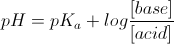
If we have 1mol of acetic acid and add 0.5mol of NaOH, we will lose 0.5mol of acetic acid and gain 0.5mol of acetate. We will then be at a point where acetic acid equals acetate. This is summarized in the ICE table below. Now we know the moles of NaOH (0.5 moles) and the concentration (2M) so we can find the volume by doing M = mol/L.
L = mol/M = (0.5mol)/(2M) = 0.25L
| | Acetic acid | NaOH | Acetate | |
| -------------- | --------- | --------- | -------- |
| I | 1 mol | 0.5 mol | 0 mol |
| C | -0.5 mol | -0.5 mol | +0.5 mol |
| E | 0.5 mol | 0 mol | 0.5 mol |
To solve this question you need to think about the chemical reaction occurring.
We can ignore water and sodium ions for the sake of this question. The reactants exist in a 1:1 ratio, so that for every mol of NaOH we add, we lose one mol of acetic acid and gain one mol of acetate. We can determine the moles of acetic acid by using M = mol/L, which gives us mol = ML = (2M) * (0.5L) = 1mol acetic acid. If we use the Hendersen Hasselbach equation we can see that the pH equals the pKa when the concentration of conjugate base (acetate) equals the concentration of acid.
If we have 1mol of acetic acid and add 0.5mol of NaOH, we will lose 0.5mol of acetic acid and gain 0.5mol of acetate. We will then be at a point where acetic acid equals acetate. This is summarized in the ICE table below. Now we know the moles of NaOH (0.5 moles) and the concentration (2M) so we can find the volume by doing M = mol/L.
L = mol/M = (0.5mol)/(2M) = 0.25L
| | Acetic acid | NaOH | Acetate | | | -------------- | --------- | --------- | -------- | | I | 1 mol | 0.5 mol | 0 mol | | C | -0.5 mol | -0.5 mol | +0.5 mol | | E | 0.5 mol | 0 mol | 0.5 mol |
← Didn't Know|Knew It →
The Ka for HCN is  .
.
If there is a solution of 2M HCN, what concentration of NaCN is needed in order for the pH to be 9.2?
The Ka for HCN is
If there is a solution of 2M HCN, what concentration of NaCN is needed in order for the pH to be 9.2?
Tap to reveal answer
To answer this question, we need to be able to compare the concentrations of acid and conjugate base in the solution with the pH. The Henderson-Hasselbach equation is used to compare these values, and is written as: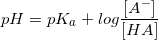 . In this question, this equation can be written with the given values of Ka and pH.

Since we know the Ka of HCN, we can derive the pKa, which turns out to be 9.2.

As a result, we want to see to it that the amount of conjugate base is equal to the concentration of acid, so that  . Because log(1) = 0, we want to see to it that the concentrations of the acid and the conjugate base are equal to one another. We know from the question that \[HCN\] = 2M.



As a result, a concentration of 2M NaCN will allow the pH of the solution to be 9.2.
To answer this question, we need to be able to compare the concentrations of acid and conjugate base in the solution with the pH. The Henderson-Hasselbach equation is used to compare these values, and is written as:
Since we know the Ka of HCN, we can derive the pKa, which turns out to be 9.2.
As a result, we want to see to it that the amount of conjugate base is equal to the concentration of acid, so that
As a result, a concentration of 2M NaCN will allow the pH of the solution to be 9.2.
← Didn't Know|Knew It →
A solution of hydrofluoric acid has a concentration of  .
.
The  for
for  is
is  .
.
If sodium hydroxide is slowly added to this solution, what will the pH be at the half equivalence point?
A solution of hydrofluoric acid has a concentration of
The
If sodium hydroxide is slowly added to this solution, what will the pH be at the half equivalence point?
Tap to reveal answer
If we use the Henderson-Hasselbalch equation, we do not need to worry about using the molar amounts of both the acid and the base. At the half equivalence point, the conjugate base concentration is equal to that of the weak acid. This means that the equation can be simplified.
Henderson-Hasselbalch equation:
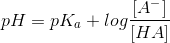
Simplified equation for half equivalence point:

Because we know the acid dissociation constant for hydrofluoric acid, the pH is calculated as:

If we use the Henderson-Hasselbalch equation, we do not need to worry about using the molar amounts of both the acid and the base. At the half equivalence point, the conjugate base concentration is equal to that of the weak acid. This means that the equation can be simplified.
Henderson-Hasselbalch equation:
Simplified equation for half equivalence point:
Because we know the acid dissociation constant for hydrofluoric acid, the pH is calculated as:
← Didn't Know|Knew It →
Calculate the concentration of hydrogen ions in the following acetic acid solution.

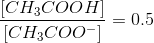
Calculate the concentration of hydrogen ions in the following acetic acid solution.
Tap to reveal answer
To answer this question you need to use the Henderson-Hasselbalch equation:

The ratio given in the question is 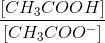 , or
, or 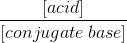 .
.
To use the correct ratio for the Henderson-Hasselbalch equation, we need to convert this ratio to its reciprocal:
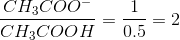
Plugging the given values into the equation gives us:

The question is asking for the concentration of hydrogen ions. To solve for this we have to use the definition of pH.

Solving for the concentration of hydrogen ions gives us:



To answer this question you need to use the Henderson-Hasselbalch equation:
The ratio given in the question is
To use the correct ratio for the Henderson-Hasselbalch equation, we need to convert this ratio to its reciprocal:
Plugging the given values into the equation gives us:
The question is asking for the concentration of hydrogen ions. To solve for this we have to use the definition of pH.
Solving for the concentration of hydrogen ions gives us:
← Didn't Know|Knew It →
Which of the following is true regarding the Henderson-Hasselbalch equation?
I. The pH of the solution is always greater than the pKa of the solution
II. As the ratio of conjugate base to acid increases, the pH increases
III. The hydrogen ion concentration can never equal the acid dissociation constant
Which of the following is true regarding the Henderson-Hasselbalch equation?
I. The pH of the solution is always greater than the pKa of the solution
II. As the ratio of conjugate base to acid increases, the pH increases
III. The hydrogen ion concentration can never equal the acid dissociation constant
Tap to reveal answer
The Henderson-Hasselbalch equation is a tool that allows us to calculate the pH of an acid solution using the pKa of the acid and the relative concentrations of the acid and its conjugate base. It is defined as:
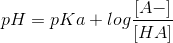
By looking at the equation we can determine that if the ratio inside the logarithm is greater than 1, then the pH of the solution will be greater than the pKa; however, if the ratio is less than 1 (meaning, if the concentration of the acid is greater than the concentration of conjugate base), then the pH will be less than the pKa. Statement I is false.
Increasing the ratio of  to
to  will increase the logarithm, and subsequently the pH of the solution. This makes sense because you will have more conjugate base than acid, thereby making the solution more alkaline and increasing the pH. Statement II is true.
pH and pKa are defined as follows:


If we have the same concentration of hydrogen ions as the acid dissociation constant ( ), then the pH will equal the pKa. According to the Henderson-Hasselbalch equation, the pH equals the pKa if the concentration of the conjugate base equals the concentration of acid; therefore, it is possible for the hydrogen ion concentration to equal the acid dissociation constant. Statement III is false.
The Henderson-Hasselbalch equation is a tool that allows us to calculate the pH of an acid solution using the pKa of the acid and the relative concentrations of the acid and its conjugate base. It is defined as:
By looking at the equation we can determine that if the ratio inside the logarithm is greater than 1, then the pH of the solution will be greater than the pKa; however, if the ratio is less than 1 (meaning, if the concentration of the acid is greater than the concentration of conjugate base), then the pH will be less than the pKa. Statement I is false.
Increasing the ratio of
pH and pKa are defined as follows:
If we have the same concentration of hydrogen ions as the acid dissociation constant (
← Didn't Know|Knew It →
Increasing the volume of an acid solution the pH of the solution and the pKa of the acid.
Increasing the volume of an acid solution the pH of the solution and the pKa of the acid.
Tap to reveal answer
The definition of pH is as follows:

The pH of a solution heavily depends on the concentration of hydrogen ions. Recall that the concentration is in molarity (M), which is defined as:

Increasing the volume of the solution will decrease the concentration (molarity) of the hydrogen ions which will, subsequently, increase the pH; therefore, increasing volume will increase the pH.
Recall that pKa of an acid can never be altered. pKa is a reflection of the strength of the acid, which stays constant under all circumstances.
The definition of pH is as follows:
The pH of a solution heavily depends on the concentration of hydrogen ions. Recall that the concentration is in molarity (M), which is defined as:
Increasing the volume of the solution will decrease the concentration (molarity) of the hydrogen ions which will, subsequently, increase the pH; therefore, increasing volume will increase the pH.
Recall that pKa of an acid can never be altered. pKa is a reflection of the strength of the acid, which stays constant under all circumstances.
← Didn't Know|Knew It →
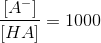
A researcher prepares two solutions. Solution A contains an unknown acid, HA, and solution B contains an unknown acid, HB. The researcher performs several tests and collects the following data.
1. Both solutions contain weak acids
2. 
3. 
4. 
5. 
What can you conclude about these two solutions?
A researcher prepares two solutions. Solution A contains an unknown acid, HA, and solution B contains an unknown acid, HB. The researcher performs several tests and collects the following data.
1. Both solutions contain weak acids
2.
3.
4.
5.
What can you conclude about these two solutions?
Tap to reveal answer
The Henderson-Hasselbalch equation states that:
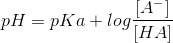
The question gives us information regarding the ratio of conjugate base to acid AND the pH for each acidic solution. Using this information, we can solve for the pKa values of both solutions.
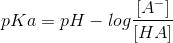


The pKa values of both solutions are the same. This means that both solution contains the same acid; therefore, the identity of HA is the same as the identity of HB.
The hydrogen ion concentration of solution A is lower than that of solution B because the pH of solution A is greater. Acidity, or strength, of an acid is determined by the pKa. Since we have the same pKa for both acids, HA and HB will have the same acidity. Acid dissociation constant, Ka, is defined as:

Acid dissociation constant only depends on the pKa; therefore, the Ka for both acids is the same.
The Henderson-Hasselbalch equation states that:
The question gives us information regarding the ratio of conjugate base to acid AND the pH for each acidic solution. Using this information, we can solve for the pKa values of both solutions.
The pKa values of both solutions are the same. This means that both solution contains the same acid; therefore, the identity of HA is the same as the identity of HB.
The hydrogen ion concentration of solution A is lower than that of solution B because the pH of solution A is greater. Acidity, or strength, of an acid is determined by the pKa. Since we have the same pKa for both acids, HA and HB will have the same acidity. Acid dissociation constant, Ka, is defined as:
Acid dissociation constant only depends on the pKa; therefore, the Ka for both acids is the same.
← Didn't Know|Knew It →
HCN dissociates based on the following reaction.

The Ka for hydrogen cyanide is  .
.
Suppose that a solution with a pH of 4.5 has 2M HCN added. Which of the following values will change?
HCN dissociates based on the following reaction.
The Ka for hydrogen cyanide is
Suppose that a solution with a pH of 4.5 has 2M HCN added. Which of the following values will change?
Tap to reveal answer
Remember that equilibrium constants are not affected by the concentrations of the reactants and products. Since an acid is being added to the solution, the pH of the solution will be affected. This means that the pOH will be affected as well.
Remember that equilibrium constants are not affected by the concentrations of the reactants and products. Since an acid is being added to the solution, the pH of the solution will be affected. This means that the pOH will be affected as well.
← Didn't Know|Knew It →
100mL of an unknown solution of NaOH is titrated with 3M HCl until neutralized. The resulting solution is evaporated, and 3.0g of white crystal are recovered. What was the concentration of the NaOH solution?
100mL of an unknown solution of NaOH is titrated with 3M HCl until neutralized. The resulting solution is evaporated, and 3.0g of white crystal are recovered. What was the concentration of the NaOH solution?
Tap to reveal answer
In the neutralization reaction between NaOH and HCl, NaCl salt is formed. When the solution is evaporated, this salt is left behind.
3.0g of NaCl is equivalent to 0.05mol NaCl. Since the titration is between a strong acid and a strong base, all of the NaOH in the original solution is converted to NaCl in a one-to-one ratio, meaning that mol NaCl = mol NaOH.
We now know that there was 0.05mol NaOH in the 100mL solution, so the concentration must have been 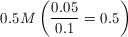 .
.
In the neutralization reaction between NaOH and HCl, NaCl salt is formed. When the solution is evaporated, this salt is left behind.
3.0g of NaCl is equivalent to 0.05mol NaCl. Since the titration is between a strong acid and a strong base, all of the NaOH in the original solution is converted to NaCl in a one-to-one ratio, meaning that mol NaCl = mol NaOH.
We now know that there was 0.05mol NaOH in the 100mL solution, so the concentration must have been
← Didn't Know|Knew It →
How many milliliters of 0.05M HCl are required to neutralize 200mL of 0.025M  ?
?
How many milliliters of 0.05M HCl are required to neutralize 200mL of 0.025M
Tap to reveal answer
First note that there are two moles of  for each mole of
  .
.

Then calculate the number of moles of  in the given volume of solution.

To neutralize, we need  .
.

We can plug in our value of 0.01mol and the given concrentration of 0.05M, and solve for the required volume.


First note that there are two moles of
Then calculate the number of moles of
To neutralize, we need
We can plug in our value of 0.01mol and the given concrentration of 0.05M, and solve for the required volume.
← Didn't Know|Knew It →
What volume of 0.375M H2SO4 is needed to fully neutralize 0.5L of 0.125M NaOH?
What volume of 0.375M H2SO4 is needed to fully neutralize 0.5L of 0.125M NaOH?
Tap to reveal answer
This question requires use of the simple titration equation M1V1 = M2V2. The key is to identify that sulfuric acid has two equivalents of acidic hydrogens while NaOH has only one hydroxide equivalent. All wrong answer choices result from making this mistake or other calculation errors.



This question requires use of the simple titration equation M1V1 = M2V2. The key is to identify that sulfuric acid has two equivalents of acidic hydrogens while NaOH has only one hydroxide equivalent. All wrong answer choices result from making this mistake or other calculation errors.
← Didn't Know|Knew It →
Which of the following is true regarding an acid and its pKa?
I. One can increase the strength of an acid by decreasing its pKa value
II. pKa increases as the acid dissociation constant decreases
III. pKa of an acid cannot be changed by altering the concentration of the acid
Which of the following is true regarding an acid and its pKa?
I. One can increase the strength of an acid by decreasing its pKa value
II. pKa increases as the acid dissociation constant decreases
III. pKa of an acid cannot be changed by altering the concentration of the acid
Tap to reveal answer
Recall that pKa is defined as follows:

Here,  is the acid dissociation constant.
  is a measure of the equilibrium strength of an acid and is unique for each acid. The higher the value of
  , the stronger the acid; however, a particular acid’s
  value, and subsequently its strength, can never be changed. The only way you can change the
  of an acid is by changing the identity of the acid itself. This means that the pKa value of an acid is also always constant; therefore, you cannot decrease an acid’s pKa.
Using the definition of pKa, we can see that the pKa of an acid increases as you decrease the acid dissociation constant ( ). A strong acid will have a high
  and a low pKa.
The pKa of an acid can never be altered; therefore, changing the concentration of the acid will not alter the pKa of the acid. It might change the amount of hydrogen ions produced and alter the pH; however, the pKa of the acid will stay constant.
Recall that pKa is defined as follows:
Here,
Using the definition of pKa, we can see that the pKa of an acid increases as you decrease the acid dissociation constant (
The pKa of an acid can never be altered; therefore, changing the concentration of the acid will not alter the pKa of the acid. It might change the amount of hydrogen ions produced and alter the pH; however, the pKa of the acid will stay constant.
← Didn't Know|Knew It →
Consider two solutions: solution A and solution B. Solution A is a 0.1M hydrogen iodide solution and solution B is a 0.1M hydrochloric acid solution. What can you conclude about these two solutions?
Consider two solutions: solution A and solution B. Solution A is a 0.1M hydrogen iodide solution and solution B is a 0.1M hydrochloric acid solution. What can you conclude about these two solutions?
Tap to reveal answer
To answer this question you need to write out the acid dissociation reaction for hydrogen iodide and hydrochloric acid.
The acid dissociation reaction for hydrogen iodide is:

The acid dissociation reaction for hydrochloric acid is:

Recall that both  and
and  are very strong acids; therefore, they will dissociate completely in solution and produce their respective products. Since the ratio of acid to hydrogen ions is 1:1 for both acids AND the concentration of both acids is the same (0.1M), the amount of hydrogen ions produced will be the same for both solutions.
Recall that pKa decreases as the Ka (acid dissociation) increases. As mentioned, both acids are very strong; therefore, they will have very high Ka values and, subsequently, very low pKa values.
To answer this question you need to write out the acid dissociation reaction for hydrogen iodide and hydrochloric acid.
The acid dissociation reaction for hydrogen iodide is:
The acid dissociation reaction for hydrochloric acid is:
Recall that both
Recall that pKa decreases as the Ka (acid dissociation) increases. As mentioned, both acids are very strong; therefore, they will have very high Ka values and, subsequently, very low pKa values.
← Didn't Know|Knew It →
the pH of an acidic solution will the pKa of the acid.
the pH of an acidic solution will the pKa of the acid.
Tap to reveal answer
The acidity of the solution results from the amount of hydrogen ions present in the solution. We can increase or decrease the pH of the solution by decreasing or increasing the amount of hydrogen ions present, respectively. pKa is a measure of the strength of an acid (meaning how easily it can dissociate into hydrogen ions and its conjugate base). Altering the pH of the solution will have no effect on the strength, and subsequently pKa, of the acid.
The acidity of the solution results from the amount of hydrogen ions present in the solution. We can increase or decrease the pH of the solution by decreasing or increasing the amount of hydrogen ions present, respectively. pKa is a measure of the strength of an acid (meaning how easily it can dissociate into hydrogen ions and its conjugate base). Altering the pH of the solution will have no effect on the strength, and subsequently pKa, of the acid.
← Didn't Know|Knew It →
Consider the following reaction:

Which of the following changes will increase the pH of this solution?
Consider the following reaction:
Which of the following changes will increase the pH of this solution?
Tap to reveal answer
To answer this question you need to use Le Chatelier’s principle. Adding sodium acetate to the solution will cause it to dissociate as follows:

The dissociation reaction will produce more acetate ions. According to Le Chatelier’s principle, the increase in acetate ions will shift the equilibrium of the reaction (given in the question) to the left. This means that  and
and  will be utilized to form
  . This will cause a decrease in the amount of hydronium ions in solution. Recall that pH is increased when the concentration of hydrogen ions (or hydronium ions,
  ) is decreased; therefore, adding sodium acetate will increase the pH of the solution.
Increasing acetic acid concentration will shift the equilibrium to the right and produce more hydronium ions, thereby decreasing the pH. Recall that you can never change the pKa of an acid. The pKa of acetic acid is around 4.75, and it cannot be altered. Le Chatelier’s principle only applies when there is a change in amount of aqueous or gaseous substances; liquid and solid substances will not shift the equilibrium. Changing the volume of liquid water will not change the concentration of hydronium ions.
To answer this question you need to use Le Chatelier’s principle. Adding sodium acetate to the solution will cause it to dissociate as follows:
The dissociation reaction will produce more acetate ions. According to Le Chatelier’s principle, the increase in acetate ions will shift the equilibrium of the reaction (given in the question) to the left. This means that
Increasing acetic acid concentration will shift the equilibrium to the right and produce more hydronium ions, thereby decreasing the pH. Recall that you can never change the pKa of an acid. The pKa of acetic acid is around 4.75, and it cannot be altered. Le Chatelier’s principle only applies when there is a change in amount of aqueous or gaseous substances; liquid and solid substances will not shift the equilibrium. Changing the volume of liquid water will not change the concentration of hydronium ions.
← Didn't Know|Knew It →
250mL of 2N  is added to 100mL of 5N
  . An indicator in the solution is known to be yellow at any pH greater than 8.3 and green at any pH less than 8.3. Which of the following best describes the solution once it reaches equilibrium?
250mL of 2N
Tap to reveal answer
Each of these compounds requires one equivalent of H+ is added to 100mL of 5N NH3 mol, so for HClO4, 2N = 2M, and for NH3, 5N = 5M.
Using the concentrations and volumes, we can find the moles, finding  HClO4 and
  NH3.
NH3.
In this case, equivalents of acid are equal to the equivalents of base, meaning that we are at the equivalence point in a titration. HClO4 is a strong acid, and NH3 is a weak base.
Thus, the acid will fully dissociate, while the base will not, resulting in a greater concentration of H+ than OH– in the solution. This means the resulting solution will be acidic. We know that the indicator changes from yellow to green at 8.3, which is a basic pH. Our initial solution is basic, and we must pass through the pH of 8.3 to reach our final acidic solution, with pH < 8.3, meaning that the indicator must change from yellow to green during the reaction. This gives out final answer that the solution will be acidic and green.
Each of these compounds requires one equivalent of H+ is added to 100mL of 5N NH3 mol, so for HClO4, 2N = 2M, and for NH3, 5N = 5M.
Using the concentrations and volumes, we can find the moles, finding
In this case, equivalents of acid are equal to the equivalents of base, meaning that we are at the equivalence point in a titration. HClO4 is a strong acid, and NH3 is a weak base.
Thus, the acid will fully dissociate, while the base will not, resulting in a greater concentration of H+ than OH– in the solution. This means the resulting solution will be acidic. We know that the indicator changes from yellow to green at 8.3, which is a basic pH. Our initial solution is basic, and we must pass through the pH of 8.3 to reach our final acidic solution, with pH < 8.3, meaning that the indicator must change from yellow to green during the reaction. This gives out final answer that the solution will be acidic and green.
← Didn't Know|Knew It →
100mL of an unknown solution of NaOH is titrated with 3M HCl until neutralized. The resulting solution is evaporated, and 3.0g of white crystal are recovered. What was the concentration of the NaOH solution?
100mL of an unknown solution of NaOH is titrated with 3M HCl until neutralized. The resulting solution is evaporated, and 3.0g of white crystal are recovered. What was the concentration of the NaOH solution?
Tap to reveal answer
In the neutralization reaction between NaOH and HCl, NaCl salt is formed. When the solution is evaporated, this salt is left behind.
3.0g of NaCl is equivalent to 0.05mol NaCl. Since the titration is between a strong acid and a strong base, all of the NaOH in the original solution is converted to NaCl in a one-to-one ratio, meaning that mol NaCl = mol NaOH.
We now know that there was 0.05mol NaOH in the 100mL solution, so the concentration must have been .
In the neutralization reaction between NaOH and HCl, NaCl salt is formed. When the solution is evaporated, this salt is left behind.
3.0g of NaCl is equivalent to 0.05mol NaCl. Since the titration is between a strong acid and a strong base, all of the NaOH in the original solution is converted to NaCl in a one-to-one ratio, meaning that mol NaCl = mol NaOH.
We now know that there was 0.05mol NaOH in the 100mL solution, so the concentration must have been
← Didn't Know|Knew It →
How many milliliters of 0.05M HCl are required to neutralize 200mL of 0.025M ?
How many milliliters of 0.05M HCl are required to neutralize 200mL of 0.025M
Tap to reveal answer
First note that there are two moles of for each mole of .
Then calculate the number of moles of in the given volume of solution.
To neutralize, we need .
We can plug in our value of 0.01mol and the given concrentration of 0.05M, and solve for the required volume.
First note that there are two moles of
Then calculate the number of moles of
To neutralize, we need
We can plug in our value of 0.01mol and the given concrentration of 0.05M, and solve for the required volume.
← Didn't Know|Knew It →