
How to find an angle in an acute / obtuse isosceles triangle
Math · Learn by Concept
Help Questions
Math › How to find an angle in an acute / obtuse isosceles triangle
An isoceles triangle has a base angle that is twice the vertex angle. What is the sum of the base and vertex angles?


Explanation
All triangles have 
Let 

So the equation to solve becomes:


Thus 

The sum of the vertex and one base angle is 
An isoceles triangle has a base angle that is 


Explanation
Every triangle has 180 degrees. An isoceles triangle has one vertex angle and two congruent base angles.
Let 

Then the equation to solve becomes:


Then the vertex angle is 


The base angle of an isosceles triangle is thirteen more than three times the vertex angle. What is the difference between the vertex angle and the base angle?


Explanation
Every triangle has 
Let 

The equation to solve becomes 



Now we can solve for the vertex angle.

The difference between the vertex angle and the base angle is 
An isoceles triangle has a vertex angle that is 


Explanation
Every triangle has 
Let 

So the equation to solve becomes 


Thus the base angles are 

If an isosceles triangle has an angle measuring greater than 100 degrees, and another angle with a measuring 





Explanation
In order for a triangle to be an isosceles triangle, it must contain two equivalent angles and one angle that is different. Given that one angle is greater than 100 degrees: 


Triangle FGH has equal lengths for FG and GH; what is the measure of ∠F, if ∠G measures 40 degrees?
140 degrees
70 degrees
40 degrees
100 degrees
None of the other answers
Explanation
It's good to draw a diagram for this; we know that it's an isosceles triangle; remember that the angles of a triangle total 180 degrees.
Angle G for this triangle is the one angle that doesn't correspond to an equal side of the isosceles triangle (opposite side to the angle), so that means ∠F = ∠H, and that ∠F + ∠H + 40 = 180,
By substitution we find that ∠F * 2 = 140 and angle F = 70 degrees.
An isosceles triangle has a vertex angle that is twenty degrees more than twice the base angle. What is the sum of the vertex and base angles?

40


Explanation
All triangles contain 
Let 

So the equation to solve becomes 
We get 


An isosceles triangle has a base angle that is six more than three times the vertex angle. What is the base angle?


Explanation
Every triangle has 180 degrees. An isosceles triangle has one vertex angle and two congruent base angles.
Let 

Then the equation to solve becomes

or

Solving for 
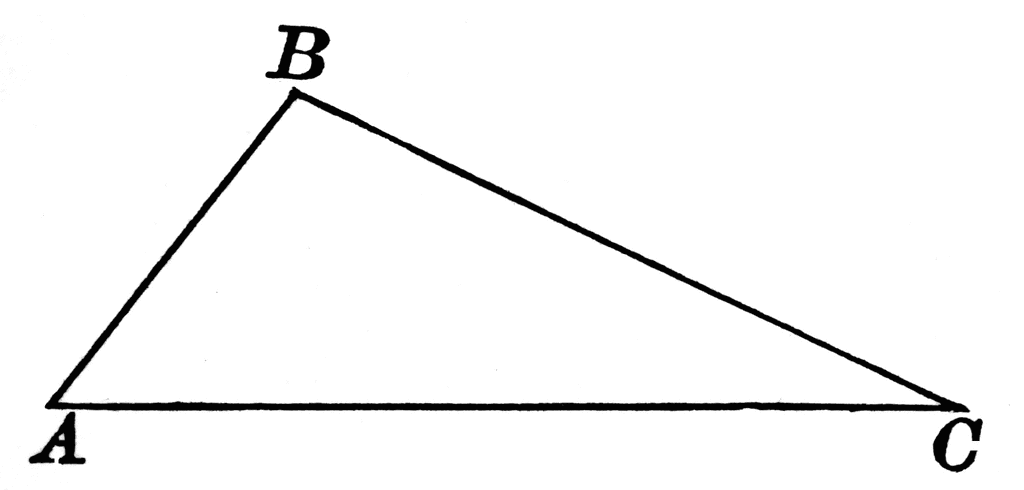
In triangle ABC, Angle A = x degrees, Angle B = 2x degrees, and Angle C = 3x+30 degrees. How many degrees is Angle B?
105°
30°
50°
25°
45°
Explanation
Because the interior angles of a triangle add up to 180°, we can create an equation using the variables given in the problem: x+2x+(3x+30)=180. This simplifies to 6X+30=180. When we subtract 30 from both sides, we get 6x=150. Then, when we divide both sides by 6, we get x=25. Because Angle B=2x degrees, we multiply 25 times 2. Thus, Angle B is equal to 50°. If you got an answer of 25, you may have forgotten to multiply by 2. If you got 105, you may have found Angle C instead of Angle B.
Points A and B lie on a circle centered at Z, where central angle <AZB measures 140°. What is the measure of angle <ZAB?
15°
20°
25°
30°
Cannot be determined from the given information
Explanation
Because line segments ZA and ZB are radii of the circle, they must have the same length. That makes triangle ABZ an isosceles triangle, with <ZAB and <ZBA having the same measure. Because the three angles of a triangle must sum to 180°, you can express this in the equation:
140 + 2x = 180 --> 2x = 40 --> x = 20