
Squares - Math
Card 1 of 136
The area of square R is 12 times the area of square T. If the area of square R is 48, what is the length of one side of square T?
The area of square R is 12 times the area of square T. If the area of square R is 48, what is the length of one side of square T?
Tap to reveal answer
We start by dividing the area of square R (48) by 12, to come up with the area of square T, 4. Then take the square root of the area to get the length of one side, giving us 2.
We start by dividing the area of square R (48) by 12, to come up with the area of square T, 4. Then take the square root of the area to get the length of one side, giving us 2.
← Didn't Know|Knew It →
When the side of a certain square is increased by 2 inches, the area of the resulting square is 64 sq. inches greater than the original square. What is the length of the side of the original square, in inches?
When the side of a certain square is increased by 2 inches, the area of the resulting square is 64 sq. inches greater than the original square. What is the length of the side of the original square, in inches?
Tap to reveal answer
Let x represent the length of the original square in inches. Thus the area of the original square is x2. Two inches are added to x, which is represented by x+2. The area of the resulting square is (x+2)2. We are given that the new square is 64 sq. inches greater than the original. Therefore we can write the algebraic expression:
x2 + 64 = (x+2)2
FOIL the right side of the equation.
x2 + 64 = x2 + 4x + 4
Subtract x2 from both sides and then continue with the alegbra.
64 = 4x + 4
64 = 4(x + 1)
16 = x + 1
15 = x
Therefore, the length of the original square is 15 inches.
If you plug in the answer choices, you would need to add 2 inches to the value of the answer choice and then take the difference of two squares. The choice with 15 would be correct because 172 -152 = 64.
Let x represent the length of the original square in inches. Thus the area of the original square is x2. Two inches are added to x, which is represented by x+2. The area of the resulting square is (x+2)2. We are given that the new square is 64 sq. inches greater than the original. Therefore we can write the algebraic expression:
x2 + 64 = (x+2)2
FOIL the right side of the equation.
x2 + 64 = x2 + 4x + 4
Subtract x2 from both sides and then continue with the alegbra.
64 = 4x + 4
64 = 4(x + 1)
16 = x + 1
15 = x
Therefore, the length of the original square is 15 inches.
If you plug in the answer choices, you would need to add 2 inches to the value of the answer choice and then take the difference of two squares. The choice with 15 would be correct because 172 -152 = 64.
← Didn't Know|Knew It →
If the area of a square is 25 inches squared, what is the perimeter?
If the area of a square is 25 inches squared, what is the perimeter?
Tap to reveal answer
The area of a square is equal to length times width or length squared (since length and width are equal on a square). Therefore, the length of one side is  or
or  The perimeter of a square is the sum of the length of all 4 sides or
The area of a square is equal to length times width or length squared (since length and width are equal on a square). Therefore, the length of one side is
← Didn't Know|Knew It →
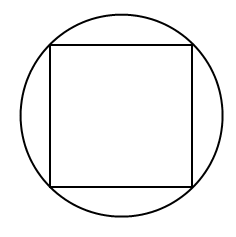
A square is inscribed inside a circle, as illustrated above. The radius of the circle is  units. If all of the square's diagonals pass through the circle's center, what is the area of the square?
A square is inscribed inside a circle, as illustrated above. The radius of the circle is
Tap to reveal answer
Given that the square's diagonals pass through the circle's center, those diagonals must each form a diameter of the circle. The circle's diameter is twice its radius, i.e.  , which is
  . Since this diameter (i.e., the square's diagonal) is the hypotenuse of a right triangle formed by two sides of the square, the length of one of the square's sides can be calculated with the Pythagorean Theorem.
  replace
  and
and  because the sides of the square must be equal in length. Since the objective is to solve for the square's area, solve for
  since one side squared will be the square's area.


 units squared
Given that the square's diagonals pass through the circle's center, those diagonals must each form a diameter of the circle. The circle's diameter is twice its radius, i.e.
← Didn't Know|Knew It →
The perimeter of a square is 48. What is the length of its diagonal?
The perimeter of a square is 48. What is the length of its diagonal?
Tap to reveal answer
Perimeter = side * 4
48 = side * 4
Side = 12
We can break up the square into two equal right triangles. The diagonal of the sqaure is then the hypotenuse of these two triangles.
Therefore, we can use the Pythagorean Theorem to solve for the diagonal:





Perimeter = side * 4
48 = side * 4
Side = 12
We can break up the square into two equal right triangles. The diagonal of the sqaure is then the hypotenuse of these two triangles.
Therefore, we can use the Pythagorean Theorem to solve for the diagonal:
← Didn't Know|Knew It →
What is the length of a diagonal of a square with a side length  ? Round to the nearest tenth.
What is the length of a diagonal of a square with a side length
Tap to reveal answer
A square is comprised of two 45-45-90 right triangles. The hypotenuse of a 45-45-90 right triangle follows the rule below, where  is the length of the sides.

In this instance,  is equal to 6.

A square is comprised of two 45-45-90 right triangles. The hypotenuse of a 45-45-90 right triangle follows the rule below, where
In this instance,
← Didn't Know|Knew It →
What is the length of the diagonal of a 7-by-7 square? (Round to the nearest tenth.)
What is the length of the diagonal of a 7-by-7 square? (Round to the nearest tenth.)
Tap to reveal answer
To find the diagonal of a square we must use the side lengths to create a 90 degree triangle with side lengths of 7 and a hypotenuse which is equal to the diagonal.
We can use the Pythagorean Theorem here to solve for the hypotenuse of a right triangle.
The Pythagorean Theorem states  , where a and b are the sidelengths and c is the hypotenuse.
Plug the side lengths into the equation as  and
and  :
:

Square the numbers:

Add the terms on the left side of the equation together:

Take the square root of both sides:


Therefore the length of the diagonal is 9.9.
To find the diagonal of a square we must use the side lengths to create a 90 degree triangle with side lengths of 7 and a hypotenuse which is equal to the diagonal.
We can use the Pythagorean Theorem here to solve for the hypotenuse of a right triangle.
The Pythagorean Theorem states
Plug the side lengths into the equation as
Square the numbers:
Add the terms on the left side of the equation together:
Take the square root of both sides:
Therefore the length of the diagonal is 9.9.
← Didn't Know|Knew It →
What is the length of the diagonal of a square with a side length of  ?
?
What is the length of the diagonal of a square with a side length of
Tap to reveal answer
To find the diagonal of a square, we must use the side length to create a 90 degree triangle with side lengths of  ,
,  , and a hypotenuse which is equal to the diagonal.
Pythagorean’s Theorem states , where a and b are the legs and c is the hypotenuse.
Take  and
and  and plug them into the equation for
  and
and  :
: 
After squaring the numbers, add them together: 
Once you have the sum, take the square root of both sides: 
Simplify to find the answer:  , or
, or  .
.
To find the diagonal of a square, we must use the side length to create a 90 degree triangle with side lengths of
Pythagorean’s Theorem states
Take
After squaring the numbers, add them together:
Once you have the sum, take the square root of both sides:
Simplify to find the answer:
← Didn't Know|Knew It →
A square has sides of  . What is the length of the diagonal of this square?
A square has sides of
Tap to reveal answer
To find the diagonal of the square, we effectively cut the square into two  triangles.
The pattern for the sides of a  is
is  .
.
Since two sides are equal to  , this triangle will have sides of
  .
.
Therefore, the diagonal (the hypotenuse) will have a length of  .
.
To find the diagonal of the square, we effectively cut the square into two
The pattern for the sides of a
Since two sides are equal to
Therefore, the diagonal (the hypotenuse) will have a length of
← Didn't Know|Knew It →
A square has sides of  . What is the length of the diagonal of this square?
A square has sides of
Tap to reveal answer
To find the diagonal of the square, we effectively cut the square into two  triangles.
The pattern for the sides of a  is
is  .
.
Since two sides are equal to  , this triangle will have sides of
  .
.
Therefore, the diagonal (the hypotenuse) will have a length of  .
.
To find the diagonal of the square, we effectively cut the square into two
The pattern for the sides of a
Since two sides are equal to
Therefore, the diagonal (the hypotenuse) will have a length of
← Didn't Know|Knew It →
The area of square R is 12 times the area of square T. If the area of square R is 48, what is the length of one side of square T?
The area of square R is 12 times the area of square T. If the area of square R is 48, what is the length of one side of square T?
Tap to reveal answer
We start by dividing the area of square R (48) by 12, to come up with the area of square T, 4. Then take the square root of the area to get the length of one side, giving us 2.
We start by dividing the area of square R (48) by 12, to come up with the area of square T, 4. Then take the square root of the area to get the length of one side, giving us 2.
← Didn't Know|Knew It →
When the side of a certain square is increased by 2 inches, the area of the resulting square is 64 sq. inches greater than the original square. What is the length of the side of the original square, in inches?
When the side of a certain square is increased by 2 inches, the area of the resulting square is 64 sq. inches greater than the original square. What is the length of the side of the original square, in inches?
Tap to reveal answer
Let x represent the length of the original square in inches. Thus the area of the original square is x2. Two inches are added to x, which is represented by x+2. The area of the resulting square is (x+2)2. We are given that the new square is 64 sq. inches greater than the original. Therefore we can write the algebraic expression:
x2 + 64 = (x+2)2
FOIL the right side of the equation.
x2 + 64 = x2 + 4x + 4
Subtract x2 from both sides and then continue with the alegbra.
64 = 4x + 4
64 = 4(x + 1)
16 = x + 1
15 = x
Therefore, the length of the original square is 15 inches.
If you plug in the answer choices, you would need to add 2 inches to the value of the answer choice and then take the difference of two squares. The choice with 15 would be correct because 172 -152 = 64.
Let x represent the length of the original square in inches. Thus the area of the original square is x2. Two inches are added to x, which is represented by x+2. The area of the resulting square is (x+2)2. We are given that the new square is 64 sq. inches greater than the original. Therefore we can write the algebraic expression:
x2 + 64 = (x+2)2
FOIL the right side of the equation.
x2 + 64 = x2 + 4x + 4
Subtract x2 from both sides and then continue with the alegbra.
64 = 4x + 4
64 = 4(x + 1)
16 = x + 1
15 = x
Therefore, the length of the original square is 15 inches.
If you plug in the answer choices, you would need to add 2 inches to the value of the answer choice and then take the difference of two squares. The choice with 15 would be correct because 172 -152 = 64.
← Didn't Know|Knew It →
If the area of a square is 25 inches squared, what is the perimeter?
If the area of a square is 25 inches squared, what is the perimeter?
Tap to reveal answer
The area of a square is equal to length times width or length squared (since length and width are equal on a square). Therefore, the length of one side is or The perimeter of a square is the sum of the length of all 4 sides or
The area of a square is equal to length times width or length squared (since length and width are equal on a square). Therefore, the length of one side is
← Didn't Know|Knew It →
A square is inscribed inside a circle, as illustrated above. The radius of the circle is units. If all of the square's diagonals pass through the circle's center, what is the area of the square?
A square is inscribed inside a circle, as illustrated above. The radius of the circle is
Tap to reveal answer
Given that the square's diagonals pass through the circle's center, those diagonals must each form a diameter of the circle. The circle's diameter is twice its radius, i.e. , which is . Since this diameter (i.e., the square's diagonal) is the hypotenuse of a right triangle formed by two sides of the square, the length of one of the square's sides can be calculated with the Pythagorean Theorem. replace and because the sides of the square must be equal in length. Since the objective is to solve for the square's area, solve for since one side squared will be the square's area.
units squared
Given that the square's diagonals pass through the circle's center, those diagonals must each form a diameter of the circle. The circle's diameter is twice its radius, i.e.
← Didn't Know|Knew It →
Freddie is building a square pen for his pig. He plans to buy x feet of fencing to build the pen. This will result in a pen with an area of p square feet. Unfortunately, he only has enough money to buy one third of the planned amount of fencing. Which expression represents the area of the pen he can build with this limited amount of fencing?
Freddie is building a square pen for his pig. He plans to buy x feet of fencing to build the pen. This will result in a pen with an area of p square feet. Unfortunately, he only has enough money to buy one third of the planned amount of fencing. Which expression represents the area of the pen he can build with this limited amount of fencing?
Tap to reveal answer
If Freddie uses x feet of fencing makes a square, each side must be x/4 feet long. The area of this square is (x/4)2 = _x_2/16 = p square feet.
If Freddie uses one third of x feet of fencing makes a square, each side must be x/12 feet long. The area of this square is (x/12)2 = _x_2/144 = 1/9(_x_2/16) = 1/9(p) = p/9 square feet.
Alternate method:
The scale factor between the small perimeter and the larger perimeter = 1 : 3. Since we're comparing area, a two-dimensional measurement, we can square the scale factor and see that the ratio of the areas is 12 : 32 = 1 : 9.
If Freddie uses x feet of fencing makes a square, each side must be x/4 feet long. The area of this square is (x/4)2 = _x_2/16 = p square feet.
If Freddie uses one third of x feet of fencing makes a square, each side must be x/12 feet long. The area of this square is (x/12)2 = _x_2/144 = 1/9(_x_2/16) = 1/9(p) = p/9 square feet.
Alternate method:
The scale factor between the small perimeter and the larger perimeter = 1 : 3. Since we're comparing area, a two-dimensional measurement, we can square the scale factor and see that the ratio of the areas is 12 : 32 = 1 : 9.
← Didn't Know|Knew It →
How much more area does a square with a side of 2r have than a circle with a radius r? Approximate π by using 22/7.
How much more area does a square with a side of 2r have than a circle with a radius r? Approximate π by using 22/7.
Tap to reveal answer
The area of a circle is given by A = πr2 or 22/7r2
The area of a square is given by A = s2 or (2r)2 = 4r2
Then subtract the area of the circle from the area of the square and get 6/7 square units.
The area of a circle is given by A = πr2 or 22/7r2
The area of a square is given by A = s2 or (2r)2 = 4r2
Then subtract the area of the circle from the area of the square and get 6/7 square units.
← Didn't Know|Knew It →
ABCD and EFGH are squares such that the perimeter of ABCD is 3 times that of EFGH. If the area of EFGH is 25, what is the area of ABCD?
ABCD and EFGH are squares such that the perimeter of ABCD is 3 times that of EFGH. If the area of EFGH is 25, what is the area of ABCD?
Tap to reveal answer
Assign variables such that
One side of ABCD = a
and One side of EFGH = e
Note that all sides are the same in a square. Since the perimeter is the sum of all sides, according to the question:
4a = 3 x 4e = 12e or a = 3e
From that area of EFGH is 25,
e x e = 25 so e = 5
Substitute a = 3e so a = 15
We aren’t done. Since we were asked for the area of ABCD, this is a x a = 225.
Assign variables such that
One side of ABCD = a
and One side of EFGH = e
Note that all sides are the same in a square. Since the perimeter is the sum of all sides, according to the question:
4a = 3 x 4e = 12e or a = 3e
From that area of EFGH is 25,
e x e = 25 so e = 5
Substitute a = 3e so a = 15
We aren’t done. Since we were asked for the area of ABCD, this is a x a = 225.
← Didn't Know|Knew It →
A half circle has an area of  . What is the area of a square with sides that measure the same length as the diameter of the half circle?
A half circle has an area of
Tap to reveal answer
If the area of the half circle is  , then the area of a full circle is twice that, or
  .
.
Use the formula for the area of a circle to solve for the radius:
36π = πr2
r = 6
If the radius is 6, then the diameter is 12. We know that the sides of the square are the same length as the diameter, so each side has length 12.
Therefore the area of the square is 12 x 12 = 144.
If the area of the half circle is
Use the formula for the area of a circle to solve for the radius:
36π = πr2
r = 6
If the radius is 6, then the diameter is 12. We know that the sides of the square are the same length as the diameter, so each side has length 12.
Therefore the area of the square is 12 x 12 = 144.
← Didn't Know|Knew It →
If a completely fenced-in square-shaped yard requires 140 feet of fence, what is the area, in square feet, of the lot?
If a completely fenced-in square-shaped yard requires 140 feet of fence, what is the area, in square feet, of the lot?
Tap to reveal answer
Since the yard is square in shape, we can divide the perimeter(140ft) by 4, giving us 35ft for each side. We then square 35 to give us the area, 1225 feet.
Since the yard is square in shape, we can divide the perimeter(140ft) by 4, giving us 35ft for each side. We then square 35 to give us the area, 1225 feet.
← Didn't Know|Knew It →
A square has an area of 36. If all sides are doubled in value, what is the new area?
A square has an area of 36. If all sides are doubled in value, what is the new area?
Tap to reveal answer
Let S be the original side length. S*S would represent the original area. Doubling the side length would give you 2S*2S, simplifying to 4*(S*S), giving a new area of 4x the original, or 144.
Let S be the original side length. S*S would represent the original area. Doubling the side length would give you 2S*2S, simplifying to 4*(S*S), giving a new area of 4x the original, or 144.
← Didn't Know|Knew It →