
Pre-Calculus - Math
Card 1 of 228

Tap to reveal answer
A limit describes what  -value a function approaches as
  approaches a certain value (in this case,
  ). The easiest way to find what
  -value a function approaches is to substitute the
  -value into the equation.

Substituting  for
for  gives us an undefined value (which is NOT the same thing as 0). This means the function is not defined at that point. However, just because a function is undefined at a point doesn't mean it doesn't have a limit. The limit is simply whichever value the function is getting close to.
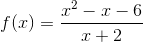
One method of finding the limit is to try and simplify the equation as much as possible:
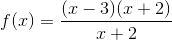
As you can see, there are common factors between the numerator and the denominator that can be canceled out. (Remember, when you cancel out a factor from a rational equation, it means that the function has a hole -- an undefined point -- where that factor equals zero.)
After canceling out the common factors, we're left with:

Even though the domain of the original function is restricted ( cannot equal
  ), we can still substitute into this simplified equation to find the limit at

A limit describes what
Substituting
One method of finding the limit is to try and simplify the equation as much as possible:
As you can see, there are common factors between the numerator and the denominator that can be canceled out. (Remember, when you cancel out a factor from a rational equation, it means that the function has a hole -- an undefined point -- where that factor equals zero.)
After canceling out the common factors, we're left with:
Even though the domain of the original function is restricted (
← Didn't Know|Knew It →
Consider the sequence: 
What is the fifteenth term in the sequence?
Consider the sequence:
What is the fifteenth term in the sequence?
Tap to reveal answer
The sequence can be described by the equation  , where
  is the term in the sequence.
For the 15th term,  .
.



The sequence can be described by the equation
For the 15th term,
← Didn't Know|Knew It →
What is the sixth term when  is expanded?
What is the sixth term when
Tap to reveal answer
We will need to use the Binomial Theorem in order to solve this problem. Consider the expansion of  , where n is an integer. The rth term of this expansion is given by the following formula:
 ,
,
where  is a combination. In general, if x and y are nonnegative integers such that x > y, then the combination of x and y is defined as follows:
  .
.
We are asked to find the sixth term of  , which means that in this case r = 6 and n = 10. Also, we will let
  and
and  . We can now apply the Binomial Theorem to determine the sixth term, which is as follows:


Next, let's find the value of  . According to the definition of a combination,

 .
.
Remember that, if n is a positive integer, then  . This is called a factorial.
Let's go back to simplifying  .
.


The answer is  .
.
We will need to use the Binomial Theorem in order to solve this problem. Consider the expansion of
where
We are asked to find the sixth term of
Next, let's find the value of
Remember that, if n is a positive integer, then
Let's go back to simplifying
The answer is
← Didn't Know|Knew It →
What are the first three terms in the series?

What are the first three terms in the series?
Tap to reveal answer
To find the first three terms, replace  with
with  ,
,  , and
, and  .
.


The first three terms are  ,
,  , and
, and  .
.
To find the first three terms, replace
The first three terms are
← Didn't Know|Knew It →
Find the first three terms in the series.

Find the first three terms in the series.
Tap to reveal answer
To find the first three terms, replace with  ,
,  , and
, and  .
.


The first three terms are  ,
,  , and
, and  .
.
To find the first three terms, replace
The first three terms are
← Didn't Know|Knew It →
Indicate the first three terms of the following series:

Indicate the first three terms of the following series:
Tap to reveal answer
In the arithmetic series, the first terms can be found by plugging  ,
,  , and
, and  into the equation.


In the arithmetic series, the first terms can be found by plugging
← Didn't Know|Knew It →
Indicate the first three terms of the following series:

Indicate the first three terms of the following series:
Tap to reveal answer
In the arithmetic series, the first terms can be found by plugging in  ,
,  , and
, and  for
for  .
.


In the arithmetic series, the first terms can be found by plugging in
← Didn't Know|Knew It →
Indicate the first three terms of the following series:

Indicate the first three terms of the following series:
Tap to reveal answer
The first terms can be found by substituting  ,
,  , and
, and  for
for  into the sum formula.


The first terms can be found by substituting
← Didn't Know|Knew It →
Indicate the first three terms of the following series.

Indicate the first three terms of the following series.
Tap to reveal answer
The first terms can be found by substituting  ,
,  , and
, and  in for
  .
.


The first terms can be found by substituting
← Didn't Know|Knew It →
Evaluate: 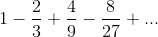
Evaluate:
Tap to reveal answer
This sum can be determined using the formula for the sum of an infinite geometric series, with initial term  and common ratio
  :
:

This sum can be determined using the formula for the sum of an infinite geometric series, with initial term
← Didn't Know|Knew It →
The fourth term in an arithmetic sequence is -20, and the eighth term is -10. What is the hundredth term in the sequence?
The fourth term in an arithmetic sequence is -20, and the eighth term is -10. What is the hundredth term in the sequence?
Tap to reveal answer
An arithmetic sequence is one in which there is a common difference between consecutive terms. For example, the sequence {2, 5, 8, 11} is an arithmetic sequence, because each term can be found by adding three to the term before it.
Let  denote the nth term of the sequence. Then the following formula can be used for arithmetic sequences in general:
 , where d is the common difference between two consecutive terms.
We are given the 4th and 8th terms in the sequence, so we can write the following equations:

 .
.
We now have a system of two equations with two unknowns:


Let us solve this system by subtracting the equation  from the equation
  . The result of this subtraction is
 .
.
This means that d = 2.5.
Using the equation  , we can find the first term of the sequence.


Ultimately, we are asked to find the hundredth term of the sequence.

The answer is 220.
An arithmetic sequence is one in which there is a common difference between consecutive terms. For example, the sequence {2, 5, 8, 11} is an arithmetic sequence, because each term can be found by adding three to the term before it.
Let
We are given the 4th and 8th terms in the sequence, so we can write the following equations:
We now have a system of two equations with two unknowns:
Let us solve this system by subtracting the equation
This means that d = 2.5.
Using the equation
Ultimately, we are asked to find the hundredth term of the sequence.
The answer is 220.
← Didn't Know|Knew It →
Find the sum, if possible:

Find the sum, if possible:
Tap to reveal answer
The formula for the summation of an infinite geometric series is
 ,
,
where  is the first term in the series and
  is the rate of change between succesive terms. The key here is finding the rate, or pattern, between the terms. Because this is a geometric sequence, the rate is the constant by which each new term is multiplied.
Plugging in our values, we get:


The formula for the summation of an infinite geometric series is
where
Plugging in our values, we get:
← Didn't Know|Knew It →
Find the sum, if possible:
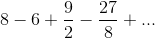
Find the sum, if possible:
Tap to reveal answer
The formula for the summation of an infinite geometric series is
 ,
,
where  is the first term in the series and
  is the rate of change between succesive terms in a series
Because the terms switch sign, we know that the rate must be negative.
Plugging in our values, we get:
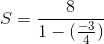


The formula for the summation of an infinite geometric series is
where
Because the terms switch sign, we know that the rate must be negative.
Plugging in our values, we get:
← Didn't Know|Knew It →
Find the sum, if possible:

Find the sum, if possible:
Tap to reveal answer
The formula for the summation of an infinite geometric series is
 ,
,
where  is the first term in the series and
  is the rate of change between succesive terms in a series.
In order for an infinite geometric series to have a sum,  needs to be greater than
  and less than
  , i.e.
  .
.
Since  , there is no solution.
The formula for the summation of an infinite geometric series is
where
In order for an infinite geometric series to have a sum,
Since
← Didn't Know|Knew It →
Factor the polynomial if the expression is equal to zero when  .
.

Factor the polynomial if the expression is equal to zero when
Tap to reveal answer
Knowing the zeroes makes it relatively easy to factor the polynomial.
The expression  fits the description of the zeroes.
Now we need to check the answer.


We are able to get back to the original expression, meaning that the answer is  .
.
Knowing the zeroes makes it relatively easy to factor the polynomial.
The expression
Now we need to check the answer.
We are able to get back to the original expression, meaning that the answer is
← Didn't Know|Knew It →
A polyomial with leading term  has 5 and 7 as roots; 7 is a double root. What is this polynomial?
A polyomial with leading term
Tap to reveal answer
Since 5 is a single root and 7 is a double root, and the degree of the polynomial is 3, the polynomial is  . To put this in expanded form:






Since 5 is a single root and 7 is a double root, and the degree of the polynomial is 3, the polynomial is
← Didn't Know|Knew It →
A polyomial with leading term  has 6 as a triple root. What is this polynomial?
A polyomial with leading term
Tap to reveal answer
Since 6 is a triple root, and the degree of the polynomial is 3, the polynomial is  , which we can expland using the cube of a binomial pattern.


Since 6 is a triple root, and the degree of the polynomial is 3, the polynomial is
← Didn't Know|Knew It →
What are the solutions to  ?
?
What are the solutions to
Tap to reveal answer
When we are looking for the solutions of a quadratic, or the zeroes, we are looking for the values of  such that the output will be zero. Thus, we first factor the equation.

Then, we are looking for the values where each of these factors are equal to zero.
 implies
and  implies
Thus, these are our solutions.
When we are looking for the solutions of a quadratic, or the zeroes, we are looking for the values of
Then, we are looking for the values where each of these factors are equal to zero.
and
Thus, these are our solutions.
← Didn't Know|Knew It →
Simplify the following polynomial function:

Simplify the following polynomial function:
Tap to reveal answer
First, multiply the outside term with each term within the parentheses:


Rearranging the polynomial into fractional form, we get:

First, multiply the outside term with each term within the parentheses:
Rearranging the polynomial into fractional form, we get:
← Didn't Know|Knew It →
Simplify the following polynomial:
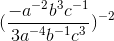
Simplify the following polynomial:
Tap to reveal answer
To simplify the polynomial, begin by combining like terms:
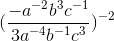

To simplify the polynomial, begin by combining like terms:
← Didn't Know|Knew It →