
Quadrilaterals - Math
Card 1 of 480
The area of square R is 12 times the area of square T. If the area of square R is 48, what is the length of one side of square T?
The area of square R is 12 times the area of square T. If the area of square R is 48, what is the length of one side of square T?
Tap to reveal answer
We start by dividing the area of square R (48) by 12, to come up with the area of square T, 4. Then take the square root of the area to get the length of one side, giving us 2.
We start by dividing the area of square R (48) by 12, to come up with the area of square T, 4. Then take the square root of the area to get the length of one side, giving us 2.
← Didn't Know|Knew It →
When the side of a certain square is increased by 2 inches, the area of the resulting square is 64 sq. inches greater than the original square. What is the length of the side of the original square, in inches?
When the side of a certain square is increased by 2 inches, the area of the resulting square is 64 sq. inches greater than the original square. What is the length of the side of the original square, in inches?
Tap to reveal answer
Let x represent the length of the original square in inches. Thus the area of the original square is x2. Two inches are added to x, which is represented by x+2. The area of the resulting square is (x+2)2. We are given that the new square is 64 sq. inches greater than the original. Therefore we can write the algebraic expression:
x2 + 64 = (x+2)2
FOIL the right side of the equation.
x2 + 64 = x2 + 4x + 4
Subtract x2 from both sides and then continue with the alegbra.
64 = 4x + 4
64 = 4(x + 1)
16 = x + 1
15 = x
Therefore, the length of the original square is 15 inches.
If you plug in the answer choices, you would need to add 2 inches to the value of the answer choice and then take the difference of two squares. The choice with 15 would be correct because 172 -152 = 64.
Let x represent the length of the original square in inches. Thus the area of the original square is x2. Two inches are added to x, which is represented by x+2. The area of the resulting square is (x+2)2. We are given that the new square is 64 sq. inches greater than the original. Therefore we can write the algebraic expression:
x2 + 64 = (x+2)2
FOIL the right side of the equation.
x2 + 64 = x2 + 4x + 4
Subtract x2 from both sides and then continue with the alegbra.
64 = 4x + 4
64 = 4(x + 1)
16 = x + 1
15 = x
Therefore, the length of the original square is 15 inches.
If you plug in the answer choices, you would need to add 2 inches to the value of the answer choice and then take the difference of two squares. The choice with 15 would be correct because 172 -152 = 64.
← Didn't Know|Knew It →
If the area of a square is 25 inches squared, what is the perimeter?
If the area of a square is 25 inches squared, what is the perimeter?
Tap to reveal answer
The area of a square is equal to length times width or length squared (since length and width are equal on a square). Therefore, the length of one side is  or
or  The perimeter of a square is the sum of the length of all 4 sides or
The area of a square is equal to length times width or length squared (since length and width are equal on a square). Therefore, the length of one side is
← Didn't Know|Knew It →
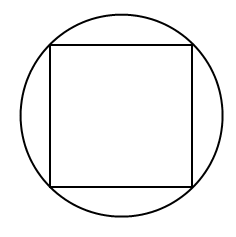
A square is inscribed inside a circle, as illustrated above. The radius of the circle is  units. If all of the square's diagonals pass through the circle's center, what is the area of the square?
A square is inscribed inside a circle, as illustrated above. The radius of the circle is
Tap to reveal answer
Given that the square's diagonals pass through the circle's center, those diagonals must each form a diameter of the circle. The circle's diameter is twice its radius, i.e.  , which is
  . Since this diameter (i.e., the square's diagonal) is the hypotenuse of a right triangle formed by two sides of the square, the length of one of the square's sides can be calculated with the Pythagorean Theorem.
  replace
  and
and  because the sides of the square must be equal in length. Since the objective is to solve for the square's area, solve for
  since one side squared will be the square's area.


 units squared
Given that the square's diagonals pass through the circle's center, those diagonals must each form a diameter of the circle. The circle's diameter is twice its radius, i.e.
← Didn't Know|Knew It →
What is the area of this regular trapezoid?
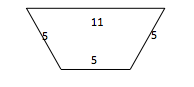
What is the area of this regular trapezoid?
Tap to reveal answer
To solve this question, you must divide the trapezoid into a rectangle and two right triangles. Using the Pythagorean Theorem, you would calculate the height of the triangle which is 4. The dimensions of the rectangle are 5 and 4, hence the area will be 20. The base of the triangle is 3 and the height of the triangle is 4. The area of one triangle is 6. Hence the total area will be 20+6+6=32. If you forget to split the shape into a rectangle and TWO triangles, or if you add the dimensions of the trapezoid, you could arrive at 26 as your answer.
To solve this question, you must divide the trapezoid into a rectangle and two right triangles. Using the Pythagorean Theorem, you would calculate the height of the triangle which is 4. The dimensions of the rectangle are 5 and 4, hence the area will be 20. The base of the triangle is 3 and the height of the triangle is 4. The area of one triangle is 6. Hence the total area will be 20+6+6=32. If you forget to split the shape into a rectangle and TWO triangles, or if you add the dimensions of the trapezoid, you could arrive at 26 as your answer.
← Didn't Know|Knew It →
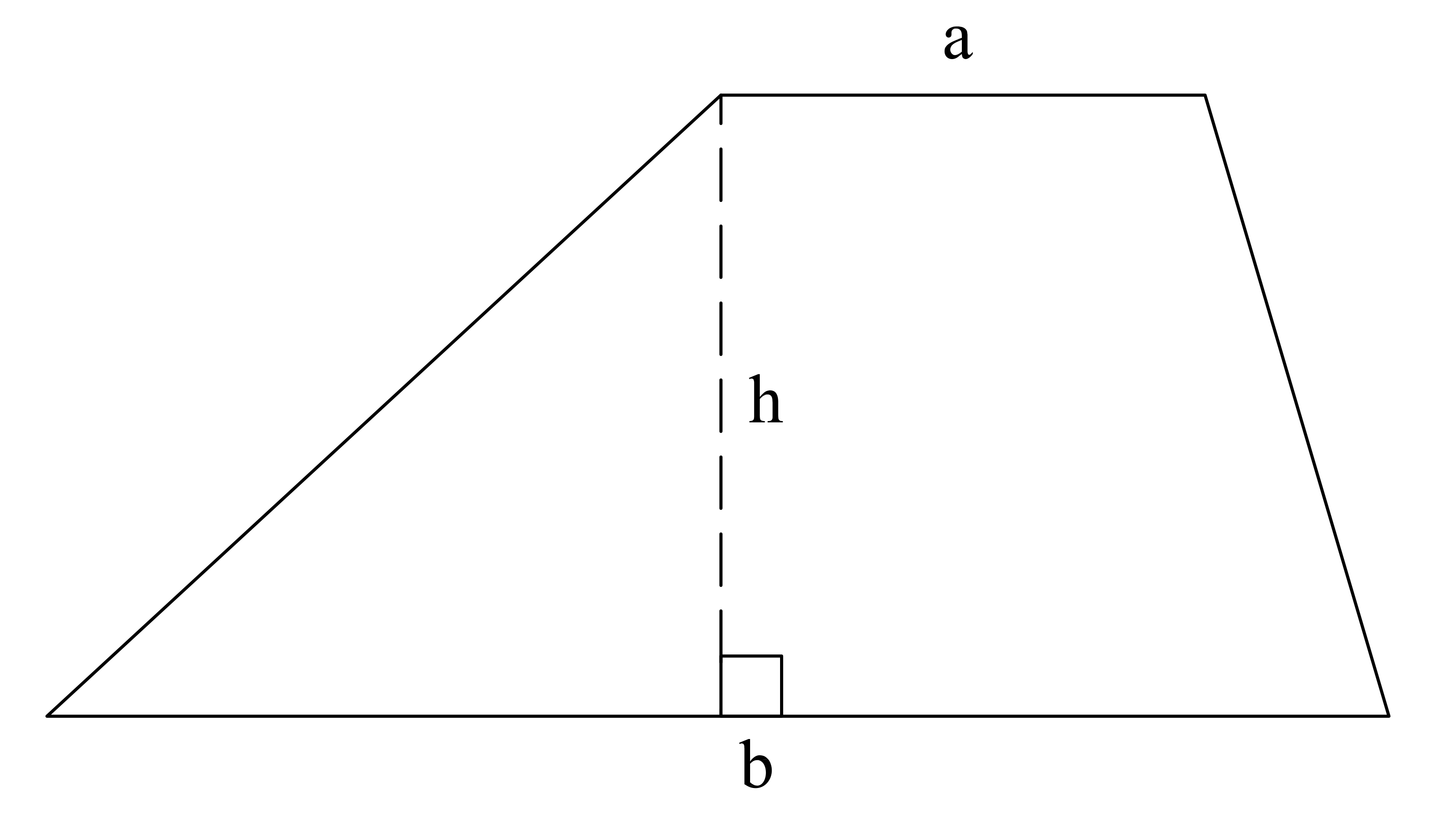
What is the area of the trapezoid above if a = 2, b = 6, and h = 4?
What is the area of the trapezoid above if a = 2, b = 6, and h = 4?
Tap to reveal answer
Area of a Trapezoid = ½(a+b)*h
= ½ (2+6) * 4
= ½ (8) * 4
= 4 * 4 = 16
Area of a Trapezoid = ½(a+b)*h
= ½ (2+6) * 4
= ½ (8) * 4
= 4 * 4 = 16
← Didn't Know|Knew It →
A trapezoid has a base of length 4, another base of length s, and a height of length s. A square has sides of length s. What is the value of s such that the area of the trapezoid and the area of the square are equal?
A trapezoid has a base of length 4, another base of length s, and a height of length s. A square has sides of length s. What is the value of s such that the area of the trapezoid and the area of the square are equal?
Tap to reveal answer
In general, the formula for the area of a trapezoid is (1/2)(a + b)(h), where a and b are the lengths of the bases, and h is the length of the height. Thus, we can write the area for the trapezoid given in the problem as follows:
area of trapezoid = (1/2)(4 + s)(s)
Similarly, the area of a square with sides of length a is given by _a_2. Thus, the area of the square given in the problem is _s_2.
We now can set the area of the trapezoid equal to the area of the square and solve for s.
(1/2)(4 + s)(s) = _s_2
Multiply both sides by 2 to eliminate the 1/2.
(4 + s)(s) = 2_s_2
Distribute the s on the left.
4_s_ + _s_2 = 2_s_2
Subtract _s_2 from both sides.
4_s_ = _s_2
Because s must be a positive number, we can divide both sides by s.
4 = s
This means the value of s must be 4.
The answer is 4.
In general, the formula for the area of a trapezoid is (1/2)(a + b)(h), where a and b are the lengths of the bases, and h is the length of the height. Thus, we can write the area for the trapezoid given in the problem as follows:
area of trapezoid = (1/2)(4 + s)(s)
Similarly, the area of a square with sides of length a is given by _a_2. Thus, the area of the square given in the problem is _s_2.
We now can set the area of the trapezoid equal to the area of the square and solve for s.
(1/2)(4 + s)(s) = _s_2
Multiply both sides by 2 to eliminate the 1/2.
(4 + s)(s) = 2_s_2
Distribute the s on the left.
4_s_ + _s_2 = 2_s_2
Subtract _s_2 from both sides.
4_s_ = _s_2
Because s must be a positive number, we can divide both sides by s.
4 = s
This means the value of s must be 4.
The answer is 4.
← Didn't Know|Knew It →
This figure is an isosceles trapezoid with bases of 6 in and 18 in and a side of 10 in.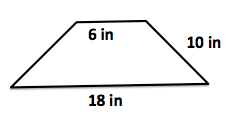
What is the area of the isoceles trapezoid?
This figure is an isosceles trapezoid with bases of 6 in and 18 in and a side of 10 in.
What is the area of the isoceles trapezoid?
Tap to reveal answer
In order to find the area of an isoceles trapezoid, you must average the bases and multiply by the height.
The average of the bases is straight forward:

In order to find the height, you must draw an altitude. This creates a right triangle in which one of the legs is also the height of the trapezoid. You may recognize the Pythagorean triple (6-8-10) and easily identify the height as 8. Otherwise, use  .
.


Multiply the average of the bases (12) by the height (8) to get an area of 96.

In order to find the area of an isoceles trapezoid, you must average the bases and multiply by the height.
The average of the bases is straight forward:
In order to find the height, you must draw an altitude. This creates a right triangle in which one of the legs is also the height of the trapezoid. You may recognize the Pythagorean triple (6-8-10) and easily identify the height as 8. Otherwise, use
Multiply the average of the bases (12) by the height (8) to get an area of 96.
← Didn't Know|Knew It →
Find the area of the following trapezoid:
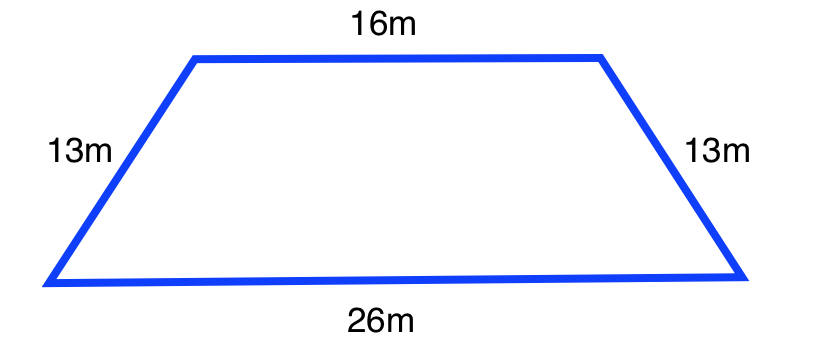
Find the area of the following trapezoid:
Tap to reveal answer
The formula for the area of a trapezoid is:

Where  is the length of one base,
  is the length of the other base, and
  is the height.
To find the height of the trapezoid, use a Pythagorean triple:


Plugging in our values, we get:


The formula for the area of a trapezoid is:
Where
To find the height of the trapezoid, use a Pythagorean triple:
Plugging in our values, we get:
← Didn't Know|Knew It →
Find the area of the following trapezoid:
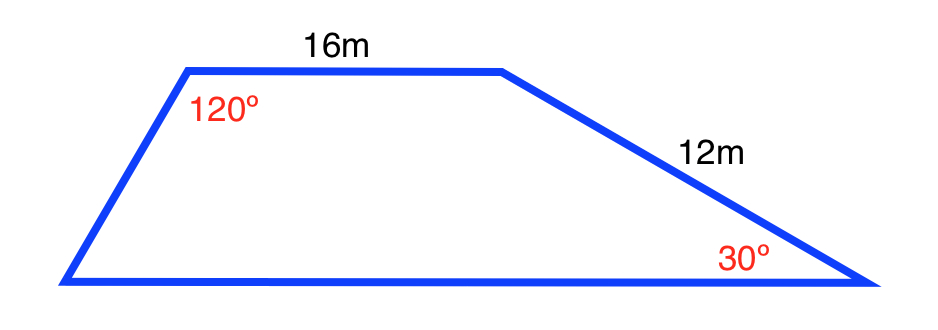
Find the area of the following trapezoid:
Tap to reveal answer
Use the formula for  triangles in order to find the length of the bottom base and the height.
The formula is:

Where  is the length of the side opposite the
  .
.
Beginning with the  side, if we were to create a
  triangle, the length of the base is
  , and the height is
  .
.
Creating another triangle on the left, we find the height is , the length of the base is  , and the side is
  .
.
The formula for the area of a trapezoid is:
Where is the length of one base, is the length of the other base, and is the height.
Plugging in our values, we get:


Use the formula for
The formula is:
Where
Beginning with the
Creating another
The formula for the area of a trapezoid is:
Where
Plugging in our values, we get:
← Didn't Know|Knew It →
Determine the area of the following trapezoid:
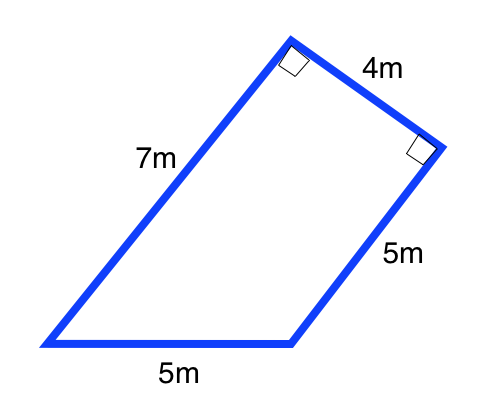
Determine the area of the following trapezoid:
Tap to reveal answer
The formula for the area of a trapezoid is:
 ,
,
where  is the length of one base,
  is the length of another base, and
  is the length of the height.
Plugging in our values, we get:

The formula for the area of a trapezoid is:
where
Plugging in our values, we get:
← Didn't Know|Knew It →
Find the area of the following trapezoid:
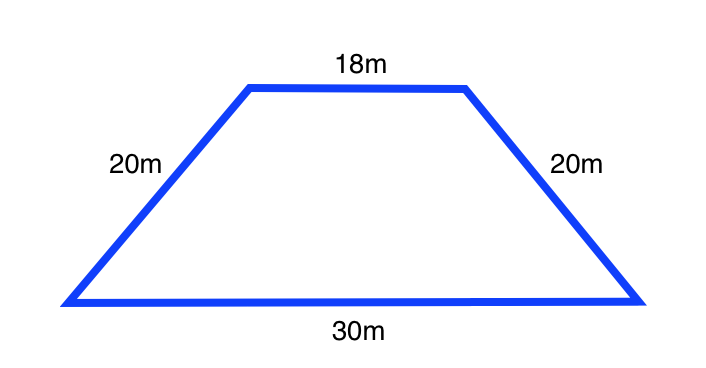
Find the area of the following trapezoid:
Tap to reveal answer
The formula for the area of a trapezoid is:
,
where is the length of one base, is the length of another base, and is the length of the height.
Use the Pythagorean Theorem to find the height of the trapezoid:


Plugging in our values, we get:

The formula for the area of a trapezoid is:
where
Use the Pythagorean Theorem to find the height of the trapezoid:
Plugging in our values, we get:
← Didn't Know|Knew It →
Find the area of the following trapezoid:
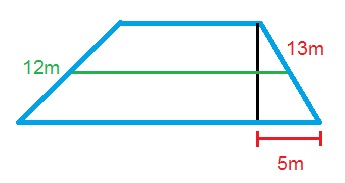
Find the area of the following trapezoid:
Tap to reveal answer
The formula for the area of a trapezoid is
 .
.
Use the Pythagorean Theorem to find the length of the height:


Plugging in our values, we get:


The formula for the area of a trapezoid is
Use the Pythagorean Theorem to find the length of the height:
Plugging in our values, we get:
← Didn't Know|Knew It →
Find the area of the following trapezoid:
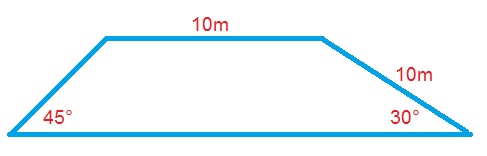
Find the area of the following trapezoid:
Tap to reveal answer
The formula for the area of a trapezoid is
 ,
,
where  is the base of the trapezoid and
  is the height of the trapezoid.
Use the formula for a  triangle to find the length of the base and height:


Use the formula for a  triangle to find the length of the base and height:


Plugging in our values, we get:


The formula for the area of a trapezoid is
where
Use the formula for a
Use the formula for a
Plugging in our values, we get:
← Didn't Know|Knew It →
Quadrilateral ABCD contains four ninety-degree angles. Which of the following must be true?
I. Quadrilateral ABCD is a rectangle.
II. Quadrilateral ABCD is a rhombus.
III. Quadrilateral ABCD is a square.
Quadrilateral ABCD contains four ninety-degree angles. Which of the following must be true?
I. Quadrilateral ABCD is a rectangle.
II. Quadrilateral ABCD is a rhombus.
III. Quadrilateral ABCD is a square.
Tap to reveal answer
Quadrilateral ABCD has four ninety-degree angles, which means that it has four right angles because every right angle measures ninety degrees. If a quadrilateral has four right angles, then it must be a rectangle by the definition of a rectangle. This means statement I is definitely true.
However, just because ABCD has four right angles doesn't mean that it is a rhombus. In order for a quadrilateral to be considered a rhombus, it must have four congruent sides. It's possible to have a rectangle whose sides are not all congruent. For example, if a rectangle has a width of 4 meters and a length of 8 meters, then not all of the sides of the rectangle would be congruent. In fact, in a rectangle, only opposite sides need be congruent. This means that ABCD is not necessarily a rhombus, and statement II does not have to be true.
A square is defined as a rhombus with four right angles. In a square, all of the sides must be congruent. In other words, a square is both a rectangle and a rhombus. However, we already established that ABCD doesn't have to be a rhombus. This means that ABCD need not be a square, because, as we said previously, not all of its sides must be congruent. Therefore, statement III isn't necessarily true either.
The only statement that has to be true is statement I.
The answer is I only.
Quadrilateral ABCD has four ninety-degree angles, which means that it has four right angles because every right angle measures ninety degrees. If a quadrilateral has four right angles, then it must be a rectangle by the definition of a rectangle. This means statement I is definitely true.
However, just because ABCD has four right angles doesn't mean that it is a rhombus. In order for a quadrilateral to be considered a rhombus, it must have four congruent sides. It's possible to have a rectangle whose sides are not all congruent. For example, if a rectangle has a width of 4 meters and a length of 8 meters, then not all of the sides of the rectangle would be congruent. In fact, in a rectangle, only opposite sides need be congruent. This means that ABCD is not necessarily a rhombus, and statement II does not have to be true.
A square is defined as a rhombus with four right angles. In a square, all of the sides must be congruent. In other words, a square is both a rectangle and a rhombus. However, we already established that ABCD doesn't have to be a rhombus. This means that ABCD need not be a square, because, as we said previously, not all of its sides must be congruent. Therefore, statement III isn't necessarily true either.
The only statement that has to be true is statement I.
The answer is I only.
← Didn't Know|Knew It →
A quadrilateral with congruent sides is a .
A quadrilateral with congruent sides is a .
Tap to reveal answer
A rhombus is any quadrilateral with four congruent sides. A square is a quadrilateral with four congruent sides and four right angles. A square is also a rhombus.
Rectangles will have two pairs of congruent sides, but not all four sides will be congruent.
A rhombus is any quadrilateral with four congruent sides. A square is a quadrilateral with four congruent sides and four right angles. A square is also a rhombus.
Rectangles will have two pairs of congruent sides, but not all four sides will be congruent.
← Didn't Know|Knew It →
A quadrilateral ABCD has diagonals that are perpendicular bisectors of one another. Which of the following classifications must apply to quadrilateral ABCD?
I. parallelogram
II. rhombus
III. square
A quadrilateral ABCD has diagonals that are perpendicular bisectors of one another. Which of the following classifications must apply to quadrilateral ABCD?
I. parallelogram
II. rhombus
III. square
Tap to reveal answer
If the diagonals of a quadrilateral are perpendicular bisectors of one another, then the quadrilateral must be a rhombus, but not necessarily a square. Since all rhombi are also parallelograms, quadrilateral ABCD must be both a rhombus and parallelogram.
If the diagonals of a quadrilateral are perpendicular bisectors of one another, then the quadrilateral must be a rhombus, but not necessarily a square. Since all rhombi are also parallelograms, quadrilateral ABCD must be both a rhombus and parallelogram.
← Didn't Know|Knew It →
Mark is making a plan to build a rectangular garden. He has 160 feet of fence to form the outside border of the garden. He wants the dimensions to look like the plan outlined below:
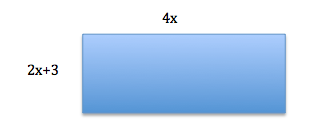
What is the area of the garden, rounded to the nearest square foot?
Mark is making a plan to build a rectangular garden. He has 160 feet of fence to form the outside border of the garden. He wants the dimensions to look like the plan outlined below:
What is the area of the garden, rounded to the nearest square foot?
Tap to reveal answer
Perimeter: Sum of the sides:
4x + 4x + 2x+8 +2x+8 = 160
12x + 6 = 160
12x = 154
x = 
Therefore, the short side of the rectangle is going to be:
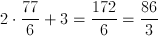
And the long side is going to be:
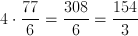
The area of the rectangle is going to be as follows:
Area = lw

Perimeter: Sum of the sides:
4x + 4x + 2x+8 +2x+8 = 160
12x + 6 = 160
12x = 154
x =
Therefore, the short side of the rectangle is going to be:
And the long side is going to be:
The area of the rectangle is going to be as follows:
Area = lw
← Didn't Know|Knew It →
Erin is getting ready to plant her tulip garden. She wants to plant two tulips per square foot of garden. If her rectangular garden is enclosed by 24 feet of fencing, and the length of the fence is twice as long as its width, how many tulips will Erin plant?
Erin is getting ready to plant her tulip garden. She wants to plant two tulips per square foot of garden. If her rectangular garden is enclosed by 24 feet of fencing, and the length of the fence is twice as long as its width, how many tulips will Erin plant?
Tap to reveal answer
We know that the following represents the formula for the perimeter of a rectangle:

In this particular case, we are told that the length of the fence is twice as long as the width. We can write this as the following expression:

Use this information to substitute in a variable for the length that matches the variable for width in our perimeter equation.


We also know that the length is two times the width; therefore, we can write the following:


The area of a rectangle is found by using this formula:


The area of the garden is 32 square feet. Erin will plant two tulips per square foot; thus, she will plant 64 tulips.
We know that the following represents the formula for the perimeter of a rectangle:

In this particular case, we are told that the length of the fence is twice as long as the width. We can write this as the following expression:

Use this information to substitute in a variable for the length that matches the variable for width in our perimeter equation.


We also know that the length is two times the width; therefore, we can write the following:


The area of a rectangle is found by using this formula:


The area of the garden is 32 square feet. Erin will plant two tulips per square foot; thus, she will plant 64 tulips.
← Didn't Know|Knew It →
A contractor is going to re-tile a rectangular section of the kitchen floor. If the floor is 6ft x 3ft, and he is going to use square tiles with a side of 9in. How many tiles will be needed?
A contractor is going to re-tile a rectangular section of the kitchen floor. If the floor is 6ft x 3ft, and he is going to use square tiles with a side of 9in. How many tiles will be needed?
Tap to reveal answer
We have to be careful of our units. The floor is given in feet and the tile in inches. Since the floor is 6ft x 3ft. we can say it is 72in x 36in, because 12 inches equals 1 foot. If the tiles are 9in x 9in we can fit 8 tiles along the length and 4 tiles along the width. To find the total number of tiles we multiply 8 x 4 = 32. Alternately we could find the area of the floor (72 x 36, and divide by the area of the tile 9 x 9)
We have to be careful of our units. The floor is given in feet and the tile in inches. Since the floor is 6ft x 3ft. we can say it is 72in x 36in, because 12 inches equals 1 foot. If the tiles are 9in x 9in we can fit 8 tiles along the length and 4 tiles along the width. To find the total number of tiles we multiply 8 x 4 = 32. Alternately we could find the area of the floor (72 x 36, and divide by the area of the tile 9 x 9)
← Didn't Know|Knew It →