
Exponents - Math
Card 1 of 212

What are the x-intercepts of the equation?
What are the x-intercepts of the equation?
Tap to reveal answer
To find the x-intercepts, set the numerator equal to zero and solve.


We can simplify from here:


Now we need to rationalize. Because we have a square root on the bottom, we need to get rid of it. Since  , we can multiply
  to get rid of the radical in the denominator.


Since we took a square root, remember that our answer can be either positive or negative, as a positive squared is positive and a negative squared is also positive.
To find the x-intercepts, set the numerator equal to zero and solve.
We can simplify from here:
Now we need to rationalize. Because we have a square root on the bottom, we need to get rid of it. Since
Since we took a square root, remember that our answer can be either positive or negative, as a positive squared is positive and a negative squared is also positive.
← Didn't Know|Knew It →

What are the y-intercepts of the equation?
What are the y-intercepts of the equation?
Tap to reveal answer
To find the y-intercepts, set  and solve.


To find the y-intercepts, set
← Didn't Know|Knew It →

What are the y-intercepts of this equation?
What are the y-intercepts of this equation?
Tap to reveal answer
To find the y-intercept, set  and solve.


To find the y-intercept, set
← Didn't Know|Knew It →

What are the x-intercepts of the equation?
What are the x-intercepts of the equation?
Tap to reveal answer
To find the x-intercepts, set the numerator equal to zero.


To find the x-intercepts, set the numerator equal to zero.
← Didn't Know|Knew It →

What are the y-intercepts of this equation?
What are the y-intercepts of this equation?
Tap to reveal answer
To find the y-intercept, set  and solve.


To find the y-intercept, set
← Didn't Know|Knew It →

What are the x-intercepts of this equation?
What are the x-intercepts of this equation?
Tap to reveal answer
To find the x-intercepts, set the numerator equal to zero.


To find the x-intercepts, set the numerator equal to zero.
← Didn't Know|Knew It →
Solve the equation for  .
.

Solve the equation for
Tap to reveal answer
Begin by recognizing that both sides of the equation have a root term of  .
.


Using the power rule, we can set the exponents equal to each other.


Begin by recognizing that both sides of the equation have a root term of
Using the power rule, we can set the exponents equal to each other.
← Didn't Know|Knew It →
Solve the equation for  .
.

Solve the equation for
Tap to reveal answer
Begin by recognizing that both sides of the equation have the same root term,  .
.


We can use the power rule to combine exponents.

Set the exponents equal to each other.


Begin by recognizing that both sides of the equation have the same root term,
We can use the power rule to combine exponents.
Set the exponents equal to each other.
← Didn't Know|Knew It →
Which value for  satisfies the equation
  ?
?
Which value for
Tap to reveal answer
 is the only choice from those given that satisfies the equation. Substition of
  for
for  gives:

← Didn't Know|Knew It →
Solve for  (nearest hundredth):

Solve for
Tap to reveal answer
Take the common logarithm of both sides and solve for  :
:


Take the common logarithm of both sides and solve for
← Didn't Know|Knew It →
Solve for  (nearest hundredth):

Solve for
Tap to reveal answer
 , so
, so  can be rewritten as


← Didn't Know|Knew It →
Solve for  (nearest hundredth):

Solve for
Tap to reveal answer
One method: Take the natural logarithm of both sides and solve for  :
:


One method: Take the natural logarithm of both sides and solve for
← Didn't Know|Knew It →
Solve for  :
:

Solve for
Tap to reveal answer
Since  , we can rewrite this equation by subsituting and applying the power rule:


This statement is identically false, which means that the original equation is identically false. There is no solution.
Since
This statement is identically false, which means that the original equation is identically false. There is no solution.
← Didn't Know|Knew It →
Solve for  :
:

Solve for
Tap to reveal answer
 , so we can rewrite the equation as follows:


← Didn't Know|Knew It →

What are the x-intercepts of the equation?
What are the x-intercepts of the equation?
Tap to reveal answer
To find the x-intercepts, we set the numerator equal to zero and solve.


However, the square root of a number can be both positive and negative.
Therefore the roots will be 
To find the x-intercepts, we set the numerator equal to zero and solve.
However, the square root of a number can be both positive and negative.
Therefore the roots will be
← Didn't Know|Knew It →

What are the y-intercepts of the equation?
What are the y-intercepts of the equation?
Tap to reveal answer
To find the y-intercepts, set  and solve.


To find the y-intercepts, set
← Didn't Know|Knew It →
The population of a certain bacteria increases exponentially according to the following equation:

where P represents the total population and t represents time in minutes.
How many minutes does it take for the bacteria's population to reach 48,000?
The population of a certain bacteria increases exponentially according to the following equation:
where P represents the total population and t represents time in minutes.
How many minutes does it take for the bacteria's population to reach 48,000?
Tap to reveal answer
The question gives us P (48,000) and asks us to find t (time). We can substitute for P and start to solve for t:


Now we have to isolate t by taking the natural log of both sides:


And since  , t can easily be isolated:


Note:  does not equal
  . You have to perform the log operation first before dividing.
The question gives us P (48,000) and asks us to find t (time). We can substitute for P and start to solve for t:
Now we have to isolate t by taking the natural log of both sides:
And since
Note:
← Didn't Know|Knew It →
Solve for  :
:

Solve for
Tap to reveal answer
To solve for  in the equation
Factor  out of the expression on the left of the equation:

Use the "difference of squares" technique to factor the parenthetical term on the left side of the equation.

Any variable that causes any one of the parenthetical terms to become  will be a valid solution for the equation.
  becomes
  when
when  is
is  , and
, and  becomes
  when
when  is
is  , so the solutions are
  and
and  .
.
To solve for
Factor
Use the "difference of squares" technique to factor the parenthetical term on the left side of the equation.
Any variable that causes any one of the parenthetical terms to become
← Didn't Know|Knew It →
Solve for  :
:

Solve for
Tap to reveal answer
Pull an  out of the left side of the equation.

Use the difference of squares technique to factor the expression in parentheses.

Any number that causes one of the terms  ,
,  , or
, or  to equal
  is a solution to the equation. These are
  ,
,  , and
, and  , respectively.
Pull an
Use the difference of squares technique to factor the expression in parentheses.
Any number that causes one of the terms
← Didn't Know|Knew It →
Find the  -intercept(s) of
 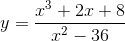 .
.
Find the
Tap to reveal answer
To find the  -intercept, set
  in the equation and solve.
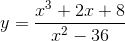
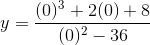
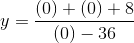


To find the
← Didn't Know|Knew It →